Showing posts with label Charles Dickens. Show all posts

26 August 2026

Decline & Fall


I mentioned in my last column that I’d been reading Gibbon’s famous history of the Roman Empire, Decline and Fall, which I’d never tackled before.  I’ve never read Herodotus, either, on the Peloponnesian War, or Xenophon’s Anabasis, two other celebrated histories.  I know them only by reputation.  There was a time, of course, when both of them were regularly taught, and in the original.  It was the mark of a classically educated scholar to be conversant in Greek and Latin, and construe his Homer and his Cicero.  

I’m reminded that when my dad got older, and retired across the Massachusetts border into New Hampshire, he took up Trollope.  Trollope was enormously popular in his lifetime, a contemporary and rival of Dickens, but Trollope hasn’t worn as well as Dickens.  You suspect this is because Trollope has a narrower focus, the Barchester books (which my dad was particularly fond of), for example, are about the internal politics of the Anglican church, while Dickens had more of a roving eye, so to speak. 

After my dad died, I myself fell into a binge of Sir Walter Scott.  Quite a few of us might have read Ivanhoe in high school, but not much else, and I discovered that Scott – another guy who was a huge celebrity as a writer, while he was alive – wrote some significantly better books, Old Mortality one of my personal favorites.  St. Ronan’s Well is an attempt to cash in with Jane Austen’s public - the novel of manners not Scott’s strength - and Austen has far outdistanced him in readership mileage.  I remember also wondering aloud about this new-found attachment to a neglected 19th-century writer, and my friend Ellen Hawkes telling me it seemed entirely natural, that in the wake of my father’s death, I was falling into the past, being  pulled by historical gravity, and revisiting his history by proxy.  (She knew the story about my dad and Trollope.)

I don’t mean to suggest that I’ve gravitated toward Gibbon in my dotage, but there’s some comfort in reading a book so unselfconsciously old-fashioned.  Gibbon’s mannerisms aren’t assumed, they’re entirely natural to the man, and the age he wrote for.  Decline and Fall was published, in six succeeding volumes, between 1776 and 1789.  As it happens, the years of the American and French revolutions, respectively.  Gibbon isn’t a synthesizer, he isn’t summarizing other histories, really, because he’s not that confident he can trust earlier sources.  A lot of the Latin was written to curry favor with whoever was newly risen to power.  Gibbon is weighing the evidence, and he’s not afraid to voice his opinion.  Much of the experience of reading Gibbon has to do with his cadences.  Once you get familiar with the grammar, and the peculiar punctuation, it swings right along.  He doesn’t sound dated, to my ear.

Writers used to insert themselves into the story.  And now, dear Reader is a common trope that we’ve abandoned, as a too-obvious cliché.  You can hark back to it with the first-person narrative, had I but known, but it’s labored, or clunky.  When you see it in a Regency writer, like Austen, though, or one of the Victorians, you don’t cringe.  You see it, almost, as period detail. 

There are conventions, unavoidably, in Gibbon, that bring you up quite sharply, sometimes.  It is a time capsule, two hundred and fifty years old.  But what seems right, to a modern reader, and which must have entertained his contemporaries, are his asides, and sly bits of business.  Here, the assassination of the emperor Caracalla, a capricious incompetent, murdered by his Praetorians.  “He was attended by a body of cavalry; but having stopped on the road for some necessary occasion, his guards preserved a respectful distance, and Martialis approaching his person under a pretence of duty, stabbed him with a dagger.  The bold assassin was instantly killed by a Scythian archer of the Imperial guard.”  In other words, he got a knife between his ribs while he was taking a leak.  The second point being that Martialis was quickly silenced before he could rat out any of the other plotters.  Gibbon doesn’t underline that.  He leaves it to you to fill in the blanks. 


There’s a whisper, in Decline and Fall, of the unreliable narrator.  Gibbon will tell you, the sources contradict each other - but here’s my best guess, and here’s why.  The other thing, is that he often speaks in a conversational tone, as if we already know the story, and he’s confiding extra detail that was left out before.  This has the effect of treating us as colleagues, and of making his history a dialogue, not a lecture.  He invites us to share his table, and does us the compliment of filling the glasses.

My main takeaway from Gibbon, stylistically, is that you can feel your way into a relaxed and amiable speech pattern that mimics common language, even if it’s not entirely natural, but rehearsed - something you might call demotic by design.  I don’t mean that it rings false, but it’s calculated.  Decline and Fall is going to run to a million and a half words, before he’s done, and he needs to find the rhythm.  Somewhere between the unmediated first-person and an omniscient third, Gibbon settles on a kind of public reveal, cautiously artless, as if presenting us with a display of many shiny distractions, some of which may prove to be treasure.  In a word, the book is fun to read. 

The lesson, if we need one, is that a little charm goes a long way.  A lot depends on voice.  Part of it is probably the 18th- or 19th-century locutions, and what we might say are anachronisms, but I think the appeal is simple.  Gibbon is approachable.  We should be so lucky.

18 June 2023

Write of Way


As you may have noticed earlier this month, I’ve been paying attention to license plates and signs while idling in traffic. While negotiating neighborhood streets in south Orlando, I noticed a street sign labeled Chaucer and shortly thereafter Voltaire, two favorite classic authors.

This came as a surprise because Orlando is better known for family entertainment, not classical arts. Orchestras, opera, and ballet have died from indifference. WMFE, the local Public Broadcasting studio and station, collapsed. Hereabouts, Longfellow is thought to be the tall, floppy-eared pal of Mickey Mouse.

Upon returning home, I looked up this mysterious literary neighborhood and discovered references to nineteen authors, more precisely, sixteen names, two novels, and an epic poem. Two byways puzzled me, Jordan Avenue and Brice Street. I’m unable to think of significant writers matching the names, which indeed may be naught. You may know better.

So before our book-burning Governor DeSantis bans this defiant neighborhood, check out the names. (Click the map to expand it.) A list of authors follows.

Little known Mystery factoid: Voltaire (real name François-Marie Arouet (1694-1778)), arguably was one of the earliest writers of science fiction and detective fiction.
List of Authors
Quintilian Plato Orwell Zola (Nana) Marlowe
Linton Keats Ibsen Hawkes Galsworthy
Forester Dickens Chesterton Longfellow (Evangeline)
Browning Voltaire Chaucer Tennyson Lewis (Arrowsmith)

24 March 2022

Dark Tales for Children


Thanks to Joseph D'Agnese's Reading in Bars blogpost (HERE), I read Zilpha Keattey Snyder's The Egypt Game, and really enjoyed it. I think Snyder captured childhood obsession and fantasy perfectly. You do the damnedest things in childhood, from time-travel to being horses, from reading every single novel by an author and memorizing every freaking character and plot twist (Tolkein, Laura Ingalls Wilder, Andre Norton, Heinlein, T. H. White, Ray Bradbury, Carolyn Keene, Sherlock Holmes, etc.) to knowing you are going to die if you don't get to watch the latest episode of [fill in the blank here].  

And children know that adults have absolutely no understanding or comprehension of who you are, what you want, or what you're going through, and never will. Deep down, every child completely disbelieves that adults were ever children. They are an alien species, set down among us to tell us what to do and train us for some future role. This is, I think, part of the attraction we had for Stranger in a Strange Land, aside from the sex (which for the 60s was pretty damn racy). The Old Ones raising the Nymphs to become something else made perfect sense. 

But I disagree about the darkness of The Egypt Game. Yes, a child is murdered. And a second one, later on. I know, I know, if that isn't dark, what is? Well, so is child molestation, and in my childhood neighborhood we had a guy across the street who was molesting his foster kids, and our college-age next door neighbor tried to molest me when I was six. That's dark - too dark for most children’s book writers to think about touching, and probably rightly so.  

Anyway, despite the murders, there's a distance kept throughout the novel which makes sense:  children really can ignore almost everything if they're obsessed with something else. And 99% of the adults of The Egypt Game are harmless. Most of the time, the children spook themselves, which is also normal. 

MY NOTE:  In The Headless Horseman, my Laskin character, Linda Thompson, reminisces about how she talked herself into an obsession with a man – who does look pretty odd – that makes her absolutely terrified of him. Meanwhile, in case you haven't guessed, there were worse characters roaming Laskin at the time.  

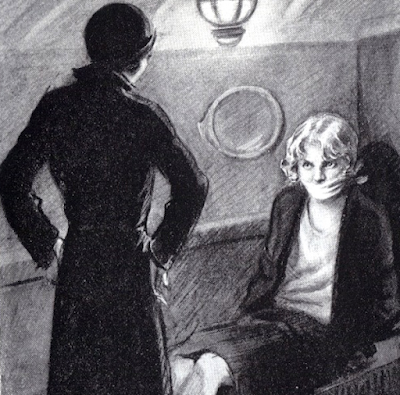
Anyway, as I thought about it, I realized that children's literature has actually gotten tamer in many ways.  Try Nancy Drew - the books we were reading in the 1960s were still, mostly, the editions of earlier years. And thinking back on those books, what I remember is how in almost every story, Nancy was knocked out, kidnapped, bound, gagged, and taunted at least once, if not more than once. 

Nancy Drew in bondage
Image courtesy of The Paris Review

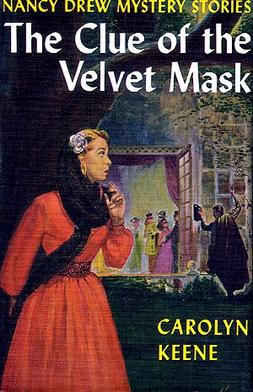
And sometimes it was Nancy and her chums. Repeatedly. In The Clue of the Velvet Mask, George Fayne, one of Nancy's best friends, was not just chloroformed and kidnapped, but shot up with mind-altering drugs, and - when she's finally rescued - is terrified that they are all going to be killed. Now this is important because George is, throughout the series, just as brave as Nancy, and even more of a daredevil. So for her to be frightened? So frightened that she's screaming at Nancy to give up the investigation? Scary. Also, the villain nearly smothers Nancy to death in that one. In fact, the ruthless, dangerous criminals who Nancy's up against repeatedly drug and physically assault Nancy and her friends. (Wikipedia)  Very dark.  

MY NOTE:  The Clue of the Velvet Mask was the last ghostwritten Nancy Drew by Mildred Benson, who has been credited as Nancy's original creator, and apparently the darkest one she ever wrote. If you want to see how dark it can get, you need to find the original - the 1953 edition - currently out of print.  

SECOND NOTE:  We all knew, BTW, that George was gay, even back in the 1960s, but then we were California girls, and learned stuff early. Didn't bother us a lick. When we role-played Nancy Drew novels, none of us minded being George if we couldn't be Nancy - what we hated was being assigned to play Bess Marvin, George's cousin and Nancy's other best friend, who was always depicted as plump, hungry, and scared of her own shadow.

Yes, children's literature has been tamed. Think about Charles Dickens' Oliver Twist. An orphan is almost starved to death in an orphanage, escapes, and is taken in by a young gang of pickpockets and thieves under the tutelage of a career criminal. Among the companions are a young prostitute who is regularly beaten and eventually bludgeoned to death by her brutal criminal lover. Etc. How the hell did this ever get read aloud as a post-supper treat? And yet it was. 

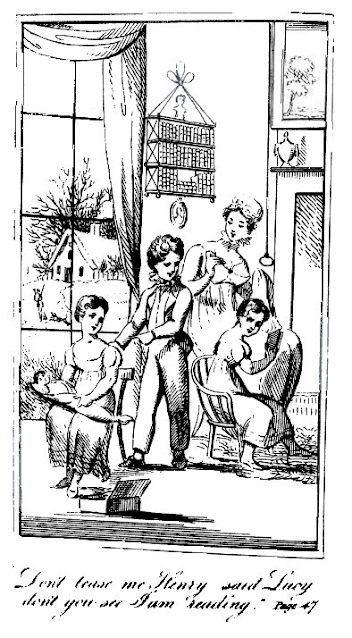
Going back even further in time, there's Martha Sherwood's The History of the Fairchild Family, published in 1818 and remaining in print for over a hundred years, and part of every good Victorian child's library.  Fiercely Calvinist, it's all about the Fairchild parents trying against all odds to save the souls of their little unregenerate children Emily, Lucy, and Henry.  Horrific things happen - Augusta Noble, saucy, pert, and disobedient, plays with candles and burns herself to death, which immediately leads to everyone declaring the obvious truth that she is now burning in hell as well. And, when Emily, Lucy, and Henry fight amongst themselves one day, their father first whips them, then takes them out to see a gibbet, where a rotting corpse is hanging, its chains rattling in the wind, and makes them kneel in the dust and pray underneath it.  Now that's nightmares.

BTW, if you want to read The Fairchild Family in all its horrors, you can read the 1819 text HERE - especially "The Story on the Sixth Commandment."  It explains the early Victorian mindset better than any modern analysis can ever do.

And, finally, Grimm's Fairy Tales. I remember The Robber Bridegroom very well, because for some reason I was fascinated by the fact that the robbers gave the poor victim three glasses of wine:  one white, one red, and one yellow.  Anyway, the miller's daughter goes to see her betrothed in the forest, not knowing he's a robber. At the house both a bird in a cage and an old woman tells her that the people there will kill her and eat her. The old woman hides her behind a cask, and the robber & his gang arrive with a woman whom they proceed to get drunk, and then kill her and chop her up. Luckily the ring finger flies off and lands in the miller's daughter's lap, and she shows it at the pre-wedding banquet. The bad guys are executed, so all is well. Huzzah!

Maybe that's the hallmark of true children's literature - in the end all the bad people are caught, executed, die, are destroyed? And then you grow up, and you find out that the bad guys aren't always caught, executed, die, or destroyed. That's when your heart breaks, and the real nightmares begin.

"Fairy tales do not give the child his first idea of bogey. What fairy tales give the child is his first clear idea of the possible defeat of bogey. The baby has known the dragon intimately ever since he had an imagination. What the fairy tale provides for him is a St. George to kill the dragon."~ G.K. Chesterton, writing the original lines, in Tremendous Trifles, Book XVII: The Red Angel (1909)

10 November 2021

Asking for Tea


Stanley Tucci tells this story:

     An actor complains to his director, “I’m not getting a laugh when I ask for the tea.”

     And the director says, “You’re not asking for the tea, you’re asking for the laugh.”

The audience has a nose for insincerity. You can get away with a lot, but you can’t get away with the pretense of feeling. Readers accept the necessity of researching ballistics, or migratory birds, or the sex habits of the Trobriand Islanders; they won’t accept faking it or phoning it in, not if it’s dishonest, or worse, condescending.

John D. MacDonald said that sentimentality is unearned emotion. I remember breaking down at the end of Old Yeller – the Fred Gipson book was on my summer reading list – and for good reason. You were invested in the story, even more so in the dog. (I was never a fan of the Disney movie. Spike, who played Yeller, was terrific; Tommy Kirk, not so much.) Of course, a few years later I had a similar reaction to the ending of The Spy Who Came In From The Cold. I didn’t burst into tears, mind, I threw the book across the room. Again, a matter of investment. We’ve come to believe in Leamas, and have every confidence in the mission. Who would expect him to climb back down?

Here’s something. You don’t tell people how to feel. You give them a resolution that’s authentic, or persuasive, and allow for a visceral response.

You get the laugh when you ask for tea, whether it’s in character or not, because it develops naturally out of the context. You get the tears for the same reason. You don’t milk them. Oscar Wilde’s remark comes to mind: “A man would have to have a heart of stone not to laugh at the death of Little Nell.” Wilde certainly didn’t mind mocking convention or having fun at someone else’s expense, but he usually pays you the compliment of assuming you’re in on the joke. True, here, of Dickens. He’s reaching for the effect. It’s all too obviously manipulative. You can hear the gears creaking.

In fairness, with all due respect to Wilde, you can find a lot in Dickens that’s genuinely chilling, or funny, or just plain sincere. That’s a tricky adjective, damning with faint praise, the way we might say a piece of art is naïve, the execution rough but its heart in the right place.  My point is that Dickens can work amazing sleights when he imagines himself into a place of his own sympathies, and writes – you guessed it – from the heart. When he tries to fake it, skilled as he is, he can’t spin gold from flax.

You can no more talk somebody into liking something – a movie you’re crazy about, say – than you can talk yourself out of being in love. Some things are simply impervious to reason, or persuasion. By the same token, you can’t make the reader believe a story by wrestling them to the mat with the brute weight of detail, not if you don’t believe in it yourself. The reader’s going to notice. You have to wear the clothes, or it’s just an empty suit.    

The word I’m looking for here is inhabit. You want a lived-in kind of conviction, a sense of the familiar, a confidence that gains your trust. Years ago, Matthew Bruccoli and Richard Layman bought one of my first mystery stories for an anthology, and in their introduction, they quoted Hammett, from “The Gutting of Couffignal.” The Continental Op is settling in for the night with a borrowed book, and he describes it like this.

The book was called The Lord of the Sea, and had to do with a strong, tough and violent fellow… whose modest plan was to hold the world in one hand. There were plots and counterplots, kidnappings, murders, prisonbreakings, forgeries and burglaries, diamonds large as hats and floating forts larger than Couffignal.

It sounds dizzy here, but in the book it was as real as a dime.


Now there’s a nice turn of phrase, as real as a dime.  I’ll leave it at that.  

11 May 2020

The Sidekick Dilemma


The D Case by Carlo Fruttero and Franco Lucentini presents an intriguing bibliophile premise. They bring the great fictional detectives together at a consortium in Rome to re-read, analyze, and eventually solve the unfinished Charles Dickens novel The Mystery of Edwin Drood.

During the course of the action, we see Sherlock Holmes, Hercule Poirot, Arsene Lupin, Father Brown, Inspector Maigret, Pirfory Petrovich from Crime & Punishment, Philip Marlowe, Lew Archer, Nero Wolfe, and a few others. The only major sleuths I don't remember seeing are Ellery Queen and the cops of the 87th Precinct.

I remembered my introduction to many of these characters from my parents' bookshelves and coffee table. My mother loved Agatha Christie, Margery Allingham, and Rex Stout. I read all the existing Hardy Boys books between my tenth and eleventh birthday and receieved The Complete Sherlock Holmes for my twelfth birthday. I still have that book. As you can see, the binding is held together by duct tape.


Even at an early age, my reading ear was well-developed and I had definite likes and dislikes. I never liked Agatha Christie much, and I know now that it was because her dialogue sounded wooden and her characters felt like cardboard. The women were all either 12-year-old virgins or latent doms. I liked the early Holmes stories, but felt they went downhill after he went over the Reichenbach Falls, probably because Conan Doyle himself lost his enthusiasm. I discovered Nero Wolfe when I was 12 or 13, and always liked those books more. Now I know that Rex Stout was also from the Midwest, so our rhythms were similar.

Reading The D Case showed me something else that I'd never thought about. Another reason I never cared much for Poirot or Holmes is that Hastings and Watson always came across as so profoundly dull. They were the stereotypical stolid Englishmen with no imagination or creativity, and they bored the hell out of me. They spent page after page in arias extolling the brilliance of their companions, but did little else for the stories. Well, Watson had his service revolver. But they were so dull they weakened their heroes.

It's pretty much axiomatic that a hero gains his stature from the strength of his antagonist. A great villain demands a great hero. But if the people trying to solve the case can barely dress themselves, the guy solving that crime only needs to be able to tie his shoes.

All the cops in the 87th precinct were good detectives who spoke human dialogue and had real-life problems. Ditto Mrlowe and Archer. Nero Wolfe was an insufferable egomaniac like Poirot, but Archie Goodwin, Saul Panzer, and the other operatives were sharp investigators in their own right, and Archie only  put up with so much of Wolfe's attitude before calling him out on it. I always liked Wolfe more because he really did have to be better than Archie and the Cops. Those cops were a little narrow-minded, but they weren't cretins like Lestrade.

Look at the detectives who had to carry the load themselves without a shuffling minion to look up to them. My current favorites include Lehane's Kenzie and Gennaro (now retired), Don Winslow's Boone Daniels, and Karin Slaughter's Will Trent, who has to cope with his dyslexia. All these characters are solid investigators with capable help and no fanboys in sight.

Call me elitist, but I like them a lot better.

09 April 2020

Passing the Time


I've seen a lot of memes about how Isaac Newton discovered calculus while he (and everyone else) was under quarantine for plague, and how William Shakespeare wrote the poems Venus and Adonis and The Rape of Lucrece.  In other words, get off your butt and do something with all this free time!

To which I answer, what free time?  I'm still writing blogs, writing stories, keeping up with friends, paperwork for Alternatives to Violence Project Sioux Falls, writing (with the permission of prison authorities) to the inmates, keeping up with the latest COVID-19 statistics, a daily walk, and then there's laundry, constant reading, making face masks and other survival kit, and the weekly foray to find food and other necessities.  I suppose I could also clean the house a little bit, but let's not go too far.  It might break into my reading.  And at night - a girl's gotta have some fun - there's Netflix!

Meanwhile, let's talk about our reading habits in time of worldwide pandemic.

Daniel Defoe Kneller Style.jpgSome people are reading Albert Camus' The Plague, and I tried, I really tried, to re-read it, but it was just too damned depressing.  On the other hand, Daniel Defoe's A Journal of the Plague Year, is a real nail-biter, but also has a lot of mordant humor to it.  (Which is only what you would expect from the author of Moll Flanders and Robinson Crusoe.)  The descriptions of "doctors" and treatment alone is enough to make every Monty Python movie look underdone and insipid.
BTW, every day for the last two months I've included the daily COVID-19 statistics in my journal, because (1) I'm an historian and (2) I read Defoe's Journal years ago, and one of the things that always stood out to me were the "daily bills of mortality".  I believe in maintaining the tradition.  In the immortal words of Mr. Defoe, "The bills were simply frightful." 
Meanwhile, if you really want good literature about epidemics, you can't go wrong with the Victorians.  They knew how to write a cracking good yarn, and wallowed in sickbed and deathbed scenes, and all the accompanying pathos and tears, as well as tender moments of love-making on the precipice.  Plus they're long novels.  Like a mini-series, you can binge for quite a while.

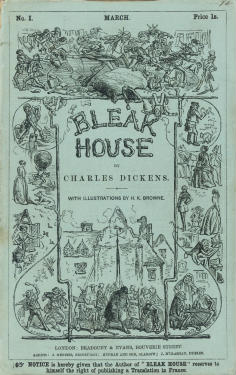
Charles Dickens, Bleak House.  - Smallpox.  Besides being the most bitter satire of the legal system, bureaucracy, and greed that's ever been written, some of the major plot twists depend on a smallpox epidemic.  While I - like many others - find our heroine Esther Summerson almost nauseatingly sweet and self-deprecating (it doesn't help that she narrates much of it), there are enough other characters to make this a great novel.  One of them, Harold Skimpole (supposedly based on the real life poet Leigh Hunt), who is a masterpiece:  free of all the duties and accountabilities of life.
Bleakhouse serial cover.jpg
"I covet nothing," said Mr. Skimpole in the same light way. "Possession is nothing to me. Here is my friend Jarndyce's excellent house. I feel obliged to him for possessing it. I can sketch it and alter it. I can set it to music. When I am here, I have sufficient possession of it and have neither trouble, cost, nor responsibility... It's only you, the generous creatures, whom I envy. I envy you your power of doing what you do. It is what I should revel in myself. I don't feel any vulgar gratitude to you. I almost feel as if YOU ought to be grateful to ME for giving you the opportunity of enjoying the luxury of generosity. I know you like it. For anything I can tell, I may have come into the world expressly for the purpose of increasing your stock of happiness. I may have been born to be a benefactor to you by sometimes giving you an opportunity of assisting me in my little perplexities. Why should I regret my incapacity for details and worldly affairs when it leads to such pleasant consequences? I don't regret it therefore."  
Who among us has not met a Mr. Skimpole?  And what a hard lesson it is when the Mr. Skimpole does to us or someone we love what he does to Richard Carstairs - bleeding him dry of every penny - and to the poor boy Jo, dying of smallpox:  "You had better turn him out." And when Mr. Jarndyce will not turn him out, but nurse him, Skimpole - we find out later - takes a bribe and turns Jo over to the man sent to find and kill the boy.  And no one kills Skimpole!  Bleak House is worth the reading just for the portrait of Skimpole, the ultimate conman.

Charlotte Yonge, The Trial.  - Scarlet fever (an outgrowth of strep throat) combined with typhus (lice) spreads through the village in the opening chapters, killing tons of people.  In the aftermath, one of the local doctors' families has lost the parents, leaving the oldest son (also a physician) in charge of his 4 siblings.  Unfortunately, Henry Ward is of the pompous ass school of Victorian pater familias, and the conflict between him and his younger brother explodes into violence.  Leonard takes off and goes to work for an old reprobate who's a distant relative.  Old reprobate is killed.  Leonard's arrested and tried, and Henry takes his sisters and leaves for America, where they move to a swampy, disease-filled settlement (that should be named Eden after Martin Chuzzlewit).  What could possibly go wrong?  Especially after Henry leaves his sisters in the settlement to go be a doctor in the Civil War?  Who will rescue them?  What will happen to Leonard?  What does Sir Walter Scott's Marmion have to do with anything?  (BTW - this novel is a sequence to her The Daisy Chain, both of them favorites of C. S. Lewis.)
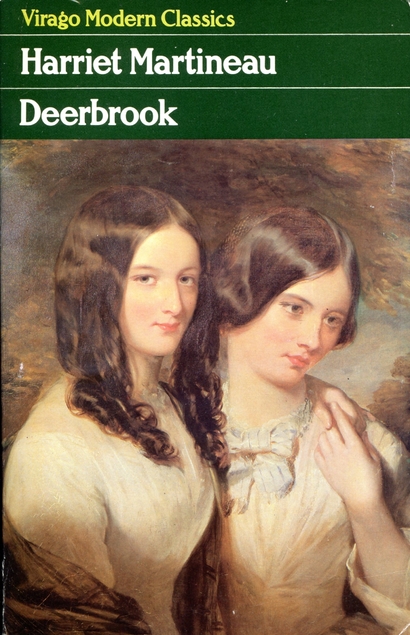

Group read: Deerbrook by Harriet Martineau | Virago Modern ...Harriet Martineau, Deerbrook.  - Among the earliest Victorian novels (1839), the real plot is about Dr. Hope, who marries one sister while being in [unrequited] love with the other, and how that works out.  About mid-way through the novel, either cholera or typhoid ravage through a town, causing mass deaths and change.  This was the only novel Martineau ever wrote - she was famous for her political economic theories, which she put forward in a series of surprisingly well-written Illustrations on Political EconomyDeerbrook doesn't have much on political economy:  but it does have a lot of authorial musings about hopeless love, what women should do with their lives, and poverty.  Plus a truly evil neighbor who will do anything - ANYTHING - to prevent her brother from marrying the object of Dr.  Hope's true love.

Elizabeth Gaskell, Ruth.  - Ruth is a fallen woman, but pure of heart, who redeems herself  by nursing her seducer during a typhus epidemic.


But, if you're tired of morality and uplifting thoughts, or even thoughts about death at all, why not go further back and dig out a copy of Boccaccio's Decameron Tales?  Ten young people (7 women, 3 men) flee plague-stricken Florence and go out in the countryside (yes, they're young; yes, they have money; yes, they have servants; think all the New Yorkers who fled to the Hamptons), where every day they eat and drink and sit out in the garden, each one telling a tale.
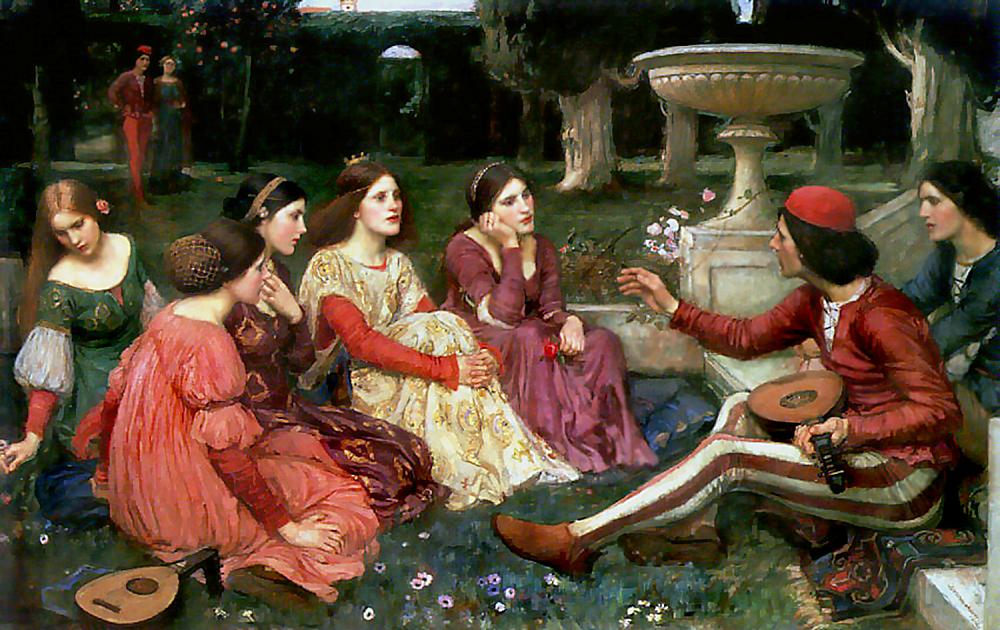


They are almost all tales of love, trade (they're from Florence, and they're all merchants' children) many bawdy, most surprisingly (?) anti-clerical (in a time when there was no alternative to The Church), some tragic, most witty, and very, very, very entertaining.  Most are very old, retold by Boccaccio for his modern audience (everything was modern once upon a time).  And - if you're ever short of a plot, you could do worse than browse through The Decameron.  (Or Marguerite de Navarre's Heptameron, which often skewered her contemporaries...)

And let's not forget Chaucer, who lifted a number of his Canterbury Tales from The Decameron, so why not read that, too?  Read about Chanticleer and Pertelote (The Nun's Priest's Tale), The Wife of Bath's Tale ("Alas that ever love was sin!"), the Cook - too drunk to tell his tale; the Knight's Tale (a classic tale of chivalrous love), and the battling Reeve and Miller (whose tales show a miller and a reeve, respectively, being bamboozled and cuckolded).  And on and on and on:

Thus swyved was the carpenteres wyf,
For al his keping and his Ialousye;
And Absolon hath kist hir nether yë;
And Nicholas is scalded in the toute.
This tale is doon, and god save al the route!
- The Miller's Tale

All of these and more are available for free at Gutenberg! (http://www.gutenberg.org/wiki/Main_Page).

And most are available for darn near free on Kindle and Nook.


19 December 2019

Angelic Voices


by Eve Fisher

'Tis the week before Christmas, and the rituals have begun:

Image result for vintage ceramic christmas treeWe put up our Christmas tree.  (Forty years ago, it was real; twenty years ago, it was artificial; the last five years it's been vintage ceramic!) 

We watch our favorite Christmas movies:  We're No Angels (the original 1955 version); The Man Who Came to Dinner; Reborn; Scrooge (1951, Alistair Sim); The Muppet Christmas Carol (I'm a sentimentalist at heart); The Bishop's Wife (1947, Loretta Young & Cary Grant); National Lampoon's Christmas Vacation; Blackadder's Christmas Carol; and all the Christmas Specials from Last of the Summer Wine.

We go driving around at night and look at Christmas lights.  Falls Park does a great light show; downtown's pretty; and there are all these old houses over by McKennan Park and elsewhere that have wonderful decorations.

Winter Wonderland at Falls Park
Sioux Falls - Falls Park's "Winter Wonderland"

And we go to various musical concerts.  Some years, Handel's Messiah, or Christmas at the Cathedral, or any of a variety of musical Christmas offerings.  This year we went to hear the Singing Boys of Sioux Falls at East Side Lutheran Church.  I hadn't heard of them before, and while I knew that there were men's choirs in Sioux Falls, I hadn't known there was a boys' choir.  So we went, and it was wonderful - beautiful music, beautiful voices, beautiful church.

Now boys' choirs developed in the Middle Ages, when women were barred from participating in any sort of performing arts in mixed company in churches, and they had to get sopranos from somewhere.
NOTE:  Later, of course, women would also be barred from participating in theaters, which leads to the crazy plots in Shakespeare, et al, in which a man playing a woman in disguise as a man courts another man playing a woman, who sometimes pulls a double switcheroo, and basically good luck keeping up with who's playing what when.  It makes our current touchiness about gender roles look pretty strange.
Anyway, it wasn't until the mid-1800s that women were allowed to join church choirs, which is why boys' choirs remained strong well past the Victorian Age. Cathedrals had cathedral schools for young boy singers, where a good voice could get you an education and perhaps even a career where you weren't plowing fields or living on the streets with Fagin.

And there were plenty of boys to choose from. This was because (1) people had a lot more children before birth control and (2) children didn't hit puberty until their mid to late teens because most of them were malnourished. Poverty was a huge factor. Most people were poor. Very poor.

We tend to forget how prevalent poverty was, is, and how it was one of the major subjects of most Christmas stories. Until now. Probably the last Christmas special on TV that centered on the poor - with any sort of accuracy - was the precursor to The Waltons, 1971's The Homecoming:  A Christmas Story.

But almost all Victorian Christmas stories were about the poor.  That or ghost stories (see my blog post https://www.sleuthsayers.org/2015/12/ghoulies-and-ghosties.html) .  Part of the reason why Dickens' A Christmas Carol became such a runaway bestseller is that it combined the two.


Christmas (12 days of it, thank you) with ghosts, and the poor, and sometimes they died! As in Hans Christian Andersen's The Little Match Girl - because no Victorian ever shied away from death, even the death of children. Especially the death of children. Think Little Nell, Tiny Tim (until Scrooge's repentance), Beth March, Smike, as well as a host of lesser known victims of the Victorians' love of a good cry, especially at Christmas. And well past Victorian times. There's O Henry's The Gift of the Magi.  There's Mary Mapes Dodge's Hans Brinker, or the Silver SkatesLittle Women opens with this famous sequence:
"Christmas won't be Christmas without any presents," grumbled Jo, lying on the rug.
"It's so dreadful to be poor!" sighed Meg, looking down at her old dress.
"I don't think it's fair for some girls to have plenty of pretty things, and other girls nothing at all," added little Amy, with an injured sniff.
"We've got father and mother and each other," said Beth contentedly, from her corner.
The four young faces on which the firelight shone brightened at the cheerful words, but darkened again as Jo said sadly,—  "We haven't got father, and shall not have him for a long time." She didn't say "perhaps never," but each silently added it, thinking of father far away, where the fighting was.
Nobody spoke for a minute; then Meg said in an altered tone,—
"You know the reason mother proposed not having any presents this Christmas was because it is going to be a hard winter for every one; and she thinks we ought not to spend money for pleasure, when our men are suffering so in the army. We can't do much, but we can make our little sacrifices, and ought to do it gladly. But I am afraid I don't;" and Meg shook her head, as she thought regretfully of all the pretty things she wanted.
And then Marmee shows up and the girls go off to get the real Christmas spirit by helping the Hummels, German immigrants who are desperately poor, crammed 6 in one room, with a dead father and a very sick mother.

Besides the actual story of the birth of Jesus, i.e., the Incarnation (which most Victorian authors considered too sacred to write directly about), this was what Christmas used to be all about - helping the poor.  But any more it seems that modern Christmas movies are either comedies (increasingly raunchy) or the neverending Hallmark offerings, which specialize in Christmas Princess and other glittery tales of beautiful young women meeting the perfect hunky guy in the perfect snow-covered site - well, I think this video sums it up best:


But back to boys' choirs.  Most of the old 1940s/1950s movies (The Bishop's Wife, Going My Way, and The Bells of St. Mary's) showcased the Mitchell Singing Boys, led by Robert Mitchell from 1934-2000.  (Mr. Mitchell himself lived from 1912-2009!).  The example below is from The Bishop's Wife.


Today, boys' choirs are up against increasing affluence.  Frankly, boys today get a lot more to eat, so the boys go through puberty earlier and earlier.  This means that the general age of boys' choirs have decreased.  And a 10 year old can't be expected to have the same musical ability, understanding, and musical ability as a 15 year old.  The result is that modern boys' choirs have greater turnover, and are often singing much less complicated music than they used to.

Meanwhile, let's listen to the Vienna's Boys' Choir from 1957, with (according to YouTube) boy soloist Michael Paddy Quilligan.  And have a very Merry Christmas, with or without ghosts!


23 October 2019

Reversals


Some of you may know that the Brit writer Mark Billingham started out in comedy, and he once remarked there were a lot of similarities between doing stand-up and writing thrillers. Namely, setting up punchlines. E.g., "The pope, the Dalai Lama, and a stripper walk into a bar." I don't know where it's going, but it catches your attention. Jokes, of course, depend on the reversal of expectations, and setting a trap in writing is much the same. Sometimes the punchline gets left out, all the more effectively. The ending of Pet Sematary. You're not turning around.


The twist ending is a time-honored tradition. I got thinking, on the other hand, about twist openings. I just watched Night Train to Munich again, which is a terrific Carol Reed picture from 1940. The set-up is almost completely self-contained, a story all by itself, and Rex Harrison doesn't even show up until 20 minutes in. Not long after, the movie takes a sharp left-hand turn into the Twilight Zone. It's not what you were expecting.


I realized, watching it this time around, that Night Train to Munich puts me in mind of certain of John LeCarre's novels, The Little Drummer Girl in particular. The beginning, the set-up, "Sooner or later, they say in the trade, a man will sign his name," is itself masterful, and then he seems to wander off the beam, into some other story entirely. You're like, Wait, What, Where Are We? He's actually got absolute control, he's simply gathering the reins. Little Drummer Girl is about a deception operation, and the book is an illustration of method, a metafiction.


Metafictions can be said to call attention to themselves. Sometimes it's sleight of hand, sometimes it's done in plain sight. There's a Dutch Leonard book called The Hunted - some years before La Brava made him a household name - and it starts out with a guy in Witness Protection, who's been relocated to Israel, but the mob tracks him down and puts a hit on him. So far, so good. Then maybe a third of the way in, the story goes off at a right angle and all of a sudden, it's not about that guy at all, it's about this other guy, somebody you thought was a supporting character. Well, okay, it's Elmore Leonard, but hello? 


For my money, The Charm School is still Nelson DeMille's best book, not least because he takes what I think is a false and discredited premise and sells it, utterly. Not just that I suspended my disbelief, but that he had me totally convinced. Whether or not the spell wears off is of no consequence; he owns it, and you sign on. Here's the thing. Nelson pulls the same damn trick Dutch does. He starts off in one direction, and puts the pedal to the floor. We got ignition. Then he takes a curve at speed, and snaps your head around. He's got this guy who's only a walk-on, so you think, and suddenly he's center stage.


I don't think this is all that common a narrative device. At least, I haven't run across it that often. David Copperfield begins, famously, with "Whether I shall turn out to be the hero of my own life, or whether that station will be held by anybody else - " but we don't imagine Dickens is going to give Steerforth the lead. Likewise with Scott, no stranger to conventional theatrics, the hero of Old Mortality is your usual generic ingenue, and Scott quite happily loses control of his story to the two contending heavies, Lord Claverhouse and the Covenanter assassin Burley, who basically walks off with the book, but in the end, convention wins out.

Then there's the thing where you shift gears without even meaning to, or because the story requires it. In the first of the bounty hunter stories, for instance, I started out in one direction and veered off unexpectedly in another. I never intended it to be the beginning of a series, the guy himself seemed accidental, I thought I was channeling The Wild Bunch, and it turned out to be Have Gun, Will Travel. Not that I'm complaining, mind, but it took me by surprise.

I think this is where I'm going with this. That we should anticipate the unexpected. In anybody's narrative, but particularly our own. You follow the scent, you follow the story where it leads you, convention be damned.

Oh, and the punchline? "Mustard, custard, and you, you big shit."

09 February 2019

True Lies


I've been thinking lately about what I do for fun (and a little bit of profit). I like to make stuff up. I routinely write about people and events, conflicts and conundrums, and barely a word of it is true. My stories are mostly cut from the whole cloth of my imagination.

And that said, people read what I write and believe every word.

Bless them. Note: Believe is a fluid term.

I'm no exception. Every writer of FICTION is granted this privilege. And it's a privilege we work with carefully, because if we stretch our fiction too much, too far, or too absurdly, it'll break. The reader will snort with derision and hurl our writing across the room at the wall; or worse, into the publishing house's rejection receptacle.

When people pick up a work of fiction, 99% of them will read and accept it, happily allowing for its inherent falseness; and as long as the writer plays more-or-less by the rules (of whatever field, genre he/she is writing in), everything will be fine.

But, of course, there is that 1% of folk who will pick up a book and actually believe the whole thing is a true story, i.e., not made up.

My percentages are also fiction, but based on a reasonable assumption. People really do send death threats to actors who play nasty villains on TV and in movies. And to pluck an excellent example from history; people really did cry when (PLOT SPOILER!) Little Nell died at the end of of Charles Dickens' The Old Curiosity Shop. In fact, it's been said that readers in New York stormed the docks (in 1841) when the ship arrived bearing the last installment, shouting to the sailors, "Is Little Nell alive?"

Alive?

"Little Nell" perhaps better demonstrates the power of a good story, rather than complete acceptance of a work of fiction in blind faith. But, you know, there really are people out there who totally, utterly, unquestioningly, believe there's a school in Scotland called Hogwarts. Right now, I have at least one friend who's saying, What the hell are you talking about, Stephen?!? You know who you are.

Liking a good story is why we will happily suspend our disbelief. We are consciously aware it's made up, but we allow for that. In fact, the more we like a story, the greater is our ability to suspend our disbelief, regardless of how ludicrous the story might be.

(I am very tempted to segue into politics at this point, but I will not.)

Liking a good story is part of human nature. We've been liking a good story since man could talk and could string enough sentences together to say something interesting. And let's face it, there wasn't much else to do of an evening in prehistoric times, when sitting around the fire, after having swallowed the last mouthful of woolly mammoth. There was nowhere to plug in the TV, to start with, and the wi-fi was lousy.


There is something innate in the human mind that can easily latch onto, like, and believe in a good set of characters and reasonable plot. Were there not, books, plays, movies, and so on, would not be a thing. We'd still be sitting around the fire. Counting the stars.

Speaking as a writer, there's something nice about being able to send made-up ideas into the heads of other people. To make them see things that don't exist. To make them feel. And to keep doing that, possibly forever, or until the stars burn out. Think about it, every time someone picks up one of Dickens' books, the ideas of a man who's been dead for nearly 150 years come through clearly into the reader's head. Natürliche, you need to be someone as good as Dickens to achieve that kind of longevity.

Stephen King, in his book On Writing, talked about this. From memory, I think he referred to it as a form of telepathy—transmitting ideas from the writer's mind into that of the reader's, with, some times, years apart between the writing and the reading.

Nice.

Anyway, back to the next chapter, and making up more stuff.


Thanks to @nubikini for the photo!


www.StephenRoss.net

24 December 2018

The Christmas Spirit


"Brown Eyes Crying in the Rain," my take on the Ghostly Hitchhiker legends, appears in the upcoming issue of Occult Detective Quarterly. It didn't occur to me until a few days ago how appropriate that is. Tomorrow is, of course, Christmas Day.


The British have told ghost stories as part of the holiday celebration for centuries, apparently because the winter solstice is only a few days earlier and the Christians co-opted December 25th to celebrate the birth of Jesus of Nazareth and overshadow the Pagan Saturnalia. Ghosts presumably walk more freely on the longest night of the year, which celebrates the death and re-birth of the sun.

Oliver Cromwell, never the life of the party, didn't want Christmas celebrated as a holiday. He wanted the workers to labor for another long and underpaid shift. During his tenure as ruler of the Commonwealth, he even banned Christmas carols. Barrel of laughs, that Ollie.

But the ghost story is still alive and well (Is that an oxymoron?), and it may have reached its peak of popularity in the Victorian era, when Charles Dickens published short novels for the season, many of them ghostly tales. His most famous is A Christmas Carol. Does anyone even know how many films and theatrical adaptations of that one work exist? My wife and I attended a stage version at the Hartford Stage Company this year, where it has been an annual event for twenty years. It still sells out the thirty performances.

Other British writers have offered ghost stories, too. In Shakespeare's The Winter's Tale (1611), Prince Mamillius says, "A sad tale's best for winter. I have one/ Of sprites and goblins." We never hear the tale because Mamillius dies before intermission. Mary Shelly Wrote Frankenstein when Byron challenged her and others to write a ghost story, and she dated the beginning of the book in mid-December. Wilkie Collins and Elizabeth Gaskell revived the faltering tradition along with Dickens. Algernon Blackwood, Conan Doyle and M. R. James carried it on.

I don't remember Poe setting any of his stories at Christmas (I can't find my copy of "The Devil in the Belfry" on my shelf. Is that set at yuletide?), but Henry James sets the telling of The Turn of the Screw around the fire during a Christmas celebration.

Remember the popular (Well, in my day...) Andy Williams song, "It's the Most Wonderful Time of the Year?" The third verse ends with "...There'll be scary ghost stories/ And tales of the glories..."

I seldom set stories around a holiday, the only exception being "Santa and the Shortstop," which appeared in Sherlock Holmes Mystery Magazine a few years ago.

But who knows? A little more eggnog and maybe I'll be in the spirit to write another ghost story for next year...

In the meantime, Merry Christmas to all, and to all a good fright.

06 December 2018

A Corporate Christmas Carol


It's December, and we've had a lot of news to deal with over the last year, so some things have just gone under the radar.  But it's time to let some of those rats out of the woodwork, and the current scene with nursing homes around the country - including 19 of them here in South Dakota - has enough rats to kill every cat in the country.  That and make Ebenezer Scrooge wonder why he ever listened to the Ghost of Christmas Future when there was money to be made out of starving old folks.

Now I'll admit, I'm fascinated by nursing homes.  My parents lived in a massive retirement center complex in Knoxville, TN, that allowed you to buy a house, then a town home, then an apartment, get assisted living, and then go to their nursing home premises. For ten years, I spent my vacation visiting them and living on-site, and I always found it somewhere between fascinating and scary as hell.  And yes, I've set a few stories in that milieu.  A lot can happen in retirement centers and nursing homes.  In fact, the same things happen there as happen among any other group of people.  Just cause you're old doesn't mean you haven't stopped working on your life, for good or ill.  But it's better when the crazy stuff happens at the instigation of the residents, and not come down from on high.

Back in May, 19 nursing home facilities were going bust in South Dakota, thanks to their (mis)management by Skyline Healthcare of New Jersey. Skyline had gone on a nursing home buying binge between 2015-17:  110 nursing homes in six states at bargain prices, mostly from Golden Living, a large national chain that was sued by the Pennsylvania attorney general in 2015 for providing poor care. Golden Living wanted to lease out a lot of its nursing homes, and Skyline gladly took them over. 

This is the picture you get when you Google
Skyline Healthcare
Now here's one of the problems:  Skyline Healthcare was and isn't a large corporation with the kind of bucks to run 110+ nursing homes. Instead, it's owned by a single family, the Schwartzes (Joseph, Rosie, Michael and Louis), and nursing home industry watchers used to joke about the fact that their office was above a pizza joint in Wood-Ridge, N.J.  

But it wasn't so funny when Skyline quit paying the bills to, among others, nursing home vendor Health Care Services Group in Pennsylvania for housekeeping, laundry and dining and nutrition services. Then they stopped paying in Massachusetts, Florida, Arkansas, Kansas, and most lately, South Dakota. (Kansas City News
According to the complaint argued by Pierre attorney Margo Northrup, Skyline did not pay bills for the facilities, including from vendors and employee salaries. More seriously, “there are hundreds of patients currently residing at the (nursing facilities) who receive varying levels of care and whose health and safety have been put directly at risk by Defendants’ many defaults,” according to the complaint. On April 26, Skyline, the defendants, notified the state health department “that they no longer had sufficient funds to purchase food for the patients.” (Capital Journal)
The former Golden Living Nursing Home in Madison, SD
The result is all the Skyline nursing homes were put in receivership, and most of them are going to close. Where do the residents go? God only knows.

What the hell was the deal? Well, apparently Skyline Healthcare was a classic example of buy, gut, and sell - or outright abandon. And none of the sellers - Golden Living, among them, apparently bothered to check the Better Business Bureau ratings (D+, and God only knows how they got that) or their employee reviews (HERE).   So Skyline Healthcare bought the nursing homes using borrowed money, hosed up all the money in the nursing homes' accounts to repay their debt (and pay themselves, and their investors, of course), and then dumped the nursing homes.  And leaving the residents holding nothing but eviction notes.

And - WARNING, WARNING, WARNING! - this appears to be a (relatively) new trend in elderly care. Witness this article from The Washington Post. Back in 2011, The Carlyle Group bought the ManorCare nursing-home chain - the second-largest nursing-home chain in the United States. The financial deal "extracted $1.3 billion from the [ManorCare] company for investors... Shortly after the maneuver, the company announced hundreds of layoffs. In a little over a year, some nursing homes were not making enough to pay rent. Over the next several years, cost-cutting programs followed, according to financial statements obtained by The Post."

Among those costs were staff, utilities, rent, and patient care:
"The number of health-code violations found at the chain each year rose 26 percent between 2013 and 2017, according to a Post review of 230 of the chain’s retirement homes. Over that period, the yearly number of health-code violations at company nursing homes rose from 1,584 to almost 2,000. The number of citations increased for, among other things, neither preventing nor treating bed sores; medication errors; not providing proper care for people who need special services such as injections, colostomies and prostheses; and not assisting patients with eating and personal hygiene." (The Washington Post


The Carlyle Group is disputing all of these claims.  But the result was bankruptcy and sale, this time to non-profit ProMedica Health.

The Washington Post points out that private-equity firms have been moving - like sharks - into businesses serving some of the nation’s poorest or most vulnerable people, including payday lenders, nursing homes, bail bond providers, low-income homes for rental and prison phone services.

"Ludovic Phalippou, a professor at Oxford who wrote the textbook “Private Equity Laid Bare,” says it is a question of whether private-equity methods are appropriate in all fields. He has praised the ability of private equity to streamline companies but he has also described the firms’ approach as “capitalism on steroids.” (my emphasis)  He said, for example, that while private-equity ownership of nursing homes is accepted in the United States, people in some other countries would be “aghast” at the idea. “People will wonder whether this pure capitalism is appropriate in nursing homes,” Phalippou said. “The health and welfare of the old people who live there depend on them.” (The Washington Post)

But who cares about health and welfare?  That's so oldfashioned!  From The New Yorker:
Ron Shaich, founder of Panera Bread
"Wall Street has embraced the idea that companies exist solely to serve the holders of their stock. Under this way of thinking, managers of companies should focus their actions on driving short-term value for their shareholders, and should pay far less (or no) regard to other constituents who may have a stake in the business, such as employees, customers, or members of the community. [Ron] Shaich... believes that the fixation on short-term profits is jeopardizing the future of American business, and creating social instability that has contributed to our current state of political polarization."

And adding to the fears and worries of a lot of elderly people in nursing homes who literally have nowhere else to go.  Up here in South Dakota, there were 111 nursing homes, so closing 19 of them is taking away 17% of all the nursing homes in this state.  There aren't enough beds left in this state to take all the residents.  Where is Granny going to go for Christmas, this year, anyway?   Does anybody care? 


05 November 2018

Present Tense Tension


by Steve Liskow

One of my beta readers returned a manuscript yesterday and commented that she liked the way present tense carried the story along.

I grew up listening to baseball games on the radio, and the play-by-play was always in present tense. All the announcers were great story-tellers, putting you on the mound, in the batter's box, racing for the fence after that fly ball. You became part of the game. That's why so many of us grew up wanting to be Willie Mays, Yogi Berra or Al Kaline.


But today, many editors loathe present tense. At least one publisher I know says "Absolutely no present tense" on their website guidelines, and I've seen the same warning on a few magazine sites. I've never understood why.

Present tense is nothing new. Charles Dickens used it for portions of Bleak House, one of my favorite novels. Other writers have used it off and on, just as some people experiment with point of view or stream of consciousness or some other technique.

If we're telling a story, we can assume that it's over so past tense is natural and logical. Past tense adds distance if you're discussing a particularly disturbing event because it implies that the narrator survived to tell about it. Everything is over and it's safe again.

But present tense became more common after World War II. Salinger opens The Catcher in the Rye with Holden Caulfield talking to us (his therapist) before he moves into past to tell his story. Kesey's first words in One Flew Over the Cuckoo's Nest are "They're out there." Both Salinger and Kesey trace their literary lineage straight back to Huckleberry Finn, which starts by addressing the reader in present tense: "You don't know me, without you have read a book by the name of The Adventures of Tom Sawyer, but that ain't no matter. That book was made by Mr. Mark Twain..." Twain even manages BSP right out of the gate.

By the 1970s, the style choice was fairly common. Pynchon opens Gravity's Rainbow with "A screaming comes across the sky."

All my early unpublished work was in past tense. Then I read Don Winslow's California Fire and Life, still one of my favorite crime novels--in present tense. Winslow consistently uses present tense, and while you may or may not like his characters or plots, the tense is never a problem. He made me consider that choice seriously for the first time.

My first published novel, Who Wrote the Book of Death? is in present tense. I started writing The Whammer Jammers in past tense and it bogged down after about 50 pages. Then I realized it was sports, like those baseball games when I was a kid. As soon as I changed to present tense, the story took off and I finished a 300-page first draft in five weeks.

Regardless of editorial bias, the present tense has advantages. First, it's more immediate. Not only does the action happen before the reader's eyes, it makes him participate. I generally use what used to be called third person detached POV, and it helps me share the character's reactions and responses, too. It's easy to add sensory detail without calling attention to it, which helps deepen character, too.

Three different readers (all good writers, all female) tell me that the most disturbing scene I've ever written is in The Whammer Jammers. The scene involves Annie Rogers being raped by the abusive boyfriend against whom she has a restraining order, and it got the book rejected by at least one agent (She told me her reader stopped at that scene). The scene had to be horrible to change the trajectory of the plot, and present tense accomplishes that. It means that since the event isn't "over" yet, it could get even worse. I only remember one other scene nearly that bad, and it's in past tense (Shoobie confronting the killer in Dark Gonna Catch Me Here), which seems to soften it a little.

I write the Connecticut novels (Zach Barnes, Trash & Byrne) in present tense because that's how and where I started them. The early drafts of the Detroit books used past tense, and I decided to keep them that way to help me separate them from the Barnes stories. That helped when I was writing or revising two or even three books at once. Now it's not an issue, but I find that I'm used to plotting the Guthrie books in past tense except for Megan Traine's scenes. Meg lives in the moment, so sometimes her scenes work better in present tense.

I'm currently plotting the next Woody Guthrie book, which doesn't even have a title yet. The list of characters grows and shrinks daily, too. I know one pivotal scene that will occur around the middle of the book, though, and it's ugly and brutal. It's also necessary. It will take the book into darker places than I usually go, but it already feels right. The good news is that the Detroit books are in past tense, and that adds a little buffer zone.

Hold that thought…