18 March 2012

Flash Fiction– A Night Out


John Floyd and R.T. Lawton not only routinely cram mysteries into less than 700 words, but John is a master of flash fiction, a subgenre I thought beyond me until I found myself thinking about titles. I suddenly realized a title I had in mind could make a (nearly) complete crime story.

Some might think I'm channeling Elsin Ann (Graffam) Perry's Wide O, a popular single page story published by Ellery Queen, which I highly recommend if you can find it. I title my opus (clearing throat) 'A Night Out'. And now… Wait for it…


A Night Out
by Leigh Lundin

"Darling, doesn't this hankie smell like chlorof…"

17 March 2012

Show Me


by John M. Floyd


No, I'm not from Missouri. The title of this column refers instead to what readers expect from us, as writers, when they pick up a piece of fiction. They expect--and deserve--a story presented in a way that makes them feel they're actually seeing the characters and the setting and the action. In a perfect world, fictional events would be as vivid and compelling as if the readers were witnessing them firsthand.

Show business

All writers know it's better to show than tell. I once read that being "told" is like hearing a friend describe a movie he's seen; being "shown" is like going to see the movie yourself. I've also heard that when you use action and dialogue, you're showing; when you use description and exposition, you're telling. That reminds me of one of Elmore Leonard's "Ten Rules of Writing": Don't start a story with the weather. Good advice, unless maybe someone gets struck by lightning or the only bridge to the mainland gets washed away in the dark and stormy night. Nobody wants to begin a story--especially a mystery/suspense story--with nothing happening, and too much detail or explanatory writing usually means nothing's happening. Whenever possible, both the advancement of the plot and the development of the characters should be accomplished not through description or narrative summary but through the actions of the people in the story.

Example? That night Betty arrived in Chicago would be telling. That night Betty eased her ten-year-old Cadillac into the storm-littered parking lot in south Chicago would be showing.

Don't just TELL me you love me . . .

Is the "showing" version harder to write? Sure it is. According to Renni Browne and Dave King in their book Self-Editing for Fiction Writers, "It's easier to simply say 'Erma was depressed' than to come up with some original bit of action that shows she's depressed. But if you have her take one bite of her favorite cake and push the rest away (or have her polish off the whole cake), you will have given your readers a far better feel for her depression than you could by simply describing it."

In The First Five Pages Noah Lukeman says, "A writer can spend a page telling us that his protagonist is a crook, or he can show it in one sentence by simply describing him taking a twenty-dollar bill from someone's pocket, and letting the reader judge for himself."

How can we spot "telling" in our own story manuscripts? Longtime editor Sol Stein said the best way to recognize whether a writer is showing or telling is to determine if the passage is "visual." Here's one of the examples featured in Stein on Writing.
Telling: Polly loved to dive in her swimming pool.
Showing: With clumsy jubilance, Polly hurtled her body from the rattling board and surfaced grinning through the kelp of her own hair.

Stein also says, "Tell me, and I'll forget. Show me, and you'll involve me."


The scales of injustice

The trouble with any discussion like this is that it almost always leads to a contradiction between show, don't tell and another rule that is at least as important: write tight. It's a balancing act, and a problem that all writers struggle with--especially, I think, writers of suspense fiction. On the one hand, we want to paint a sharp, clear word-picture of what's happening, and on the other hand we want to keep the narrative compact and tight and focused. It is, however, possible to do both. Even the most visual fiction, if it's good, is written "tight." (Cases in point: Larry McMurtry's Lonesome Dove and Stephen King's The Stand. Combined, my hardback copies of those novels run more than two thousand pages--but there are very few wasted words.)

I can't help mentioning the current gaggle of Presidential candidates. I find it interesting that while we writers try to use as few words as possible to say as much as possible, politicians use as many words as possible to say as little as possible. Maybe there is indeed something to be learned from all those endless (and mindless) campaign speeches.

I'll take my inspiration any way I can get it.


16 March 2012

Buddy, can you spare a.....recipe?


As writers, you know all too well how it is when you're writing right along and then you get that phone call, notice in the mail or have that unexpected event happen. Some are little things, short things, like reminders of a dental appointment or notification for jury duty. And then, some are far more reaching. From other posts and comments made on this site, it appears the last few years have been tough on parents.

The way it's been here, my wife and I have been gone a lot, off and on, since Thanksgiving. Then, right after Christmas, we drove 800 miles one way for another trip, so Kiti could help her 87-year old Mom who started chemo and radiation at the end of December. I drove home alone a few days after New Years. There wasn't a lot I could do there, however back home, we have two young grandsons we do daycare for during the school year, something we've done since they were born. Normally, the boys arrive at our house about 7:30 AM, we feed them breakfast, take them to elementary school, pick them up in the afternoon and deliver them to after school activities.


January and into February had a sudden change in the lineup. Yours truly got drafted as the mess hall cook. Prior to then, most of my culinary displays were confined to the grill in the back yard. So, here's how it went. On Day One of batching it, the boys frankly informed me I didn't know how to make oatmeal. Didn't take me long to call Grandma Kiti and find out her oatmeal secrets. On Day Five, when oatmeal came around on the menu again, the boys gave me a Two Thumbs Up. Whew, I was finally getting the hang of this cooking thing.


Then, one morning I overheard the boys talking about how they liked biscuits and gravy. Hey, I could do that. So, come a Wednesday, I opened the refrigerator, popped a tube of flaky style biscuits, arranged them on an ungreased cookie sheet, stuck them in the oven and hustled to the computer. A quick Google for sausage gravy turned up a simple recipe. Racing back to the kitchen, I slid a skillet onto the stove, got out the sausage and commenced to create gravy. It was only after placing everything on the breakfast island that I learned another lesson about cooking for discriminating young-uns. The boys promptly proceeded to tease their biscuits into four flaky layers. The bottom layer got butter, the second layer got grape jelly, the third layer got ONE SPOONFUL of gravy, the fourth piece went on top of the stack and they ate it like a sandwich. Who knew? I had to eat the rest of the biscuits and sausage gravy by myself. I'm sure it was good for my figure.


In an attempt to vary the morning menu, I've also created Grandpa R.T.'s version of a bacon, egg, cheese and biscuit McMuffin. (NOTE: I put those together myself, so we don't end up with more of them multi-layered sandwiches with purple jelly oozing out the sides. Don't think I'll ever have to worry about McDonald's suing me for infringement on their version.) Gotta love the convenience of those pop tube biscuits though. Of course, the boys being the savvy grocery shoppers they are, recently informed me those biscuits do come in smaller cans, so we wouldn't have so many leftover ones ending up in the bread toaster the next morning. Good thing they know what we're doing here.


On a high note, the boys confided in me that they like my fruit smoothies better than Grandma's, but they don't want to hurt her feelings, so I can't tell her. Naturally, I cheat when I make the smoothies, and throw in some vanilla Blue Bell ice cream to get a richer taste. (Those of you residing in states surrounding Texas know what I mean about Blue Bell.) Seems only right that everybody should have ice cream for breakfast.


Anyway, March is here and Grandma Kiti is 800 miles away again for a few weeks. That elevates me once more to the prestigous position of chief cook and dishwasher. Soooo, do any of you out there have any tasty, but simple recipes for a breakfast meal you'd care to share? This is no time to be shy. Just go ahead and put them in the blog's Comments Section. That way, if anybody reading the column sees a mouth watering recipe, it's right there for the trying.
And, to sweeten the pot, I'll try all the recipes out on the boys. Sorry, judges' decisions are final. The breakfast recipe they like the best gets a free personalized copy of the July/August 2012 issue of Alfred Hitchcock Mystery Magazine mailed to them. Hint: It will have the tenth story in my Twin Brothers Bail Bond series and I'll autograph it any way you want. Hurry up now, I've got hungry mouths to feed.

15 March 2012

The Long and the Short


Recently, I was asked to write a four page mystery for a forthcoming anthology. While our Sleuthsayers colleague John Floyd constructs such tidbits for Woman’s World, this is unknown territory for me. However, there’s nothing like a contract in hand and promises of a check to focus the writer’s mind and once I had a plot idea, the story went surprisingly easily. And fast.

This was because I have learned one of the invaluable aspects of the writing game, writing to length and having a sense of how many words take up how much space. Obvious, apparently, but anyone who has worked with beginning writers knows that writing to a set length is one of the difficult things to master. Ask a class for a two page essay, and you will get one and a half skimpy paragraphs with looks of anguish from half the class, and prideful four and a half page torrents from the other half.

Of course, journalists acquire a sense of length with their mother’s milk – or by their editor’s pencil. Well before they earn their first byline the decent journalist can hit his or her word count or, in bygone days, the allotted inches, on the nose.

And how does one acquire this useful skill? By writing over and over again pieces of the same length. I learned by doing two page movie reviews for a West Hartford newspaper. After several months, I not only could hit my page count, I had a new confidence in writing in general, and composition ceased to be a matter of tears and angst.
Now, everything I write (and with twenty books published and more than I’d like in the drawer I’ve written plenty) is just a multiple of those old two page reviews. I’ve acquired a sense of length.

So the little ultra-short story was not quite two reviews length or slightly more than the old Criminal Brief blogs. I figured a half page to set up the situation, a half page for the conclusion and just under three pages for the meat of the story. QED, as we used to say in geometry class.

The matter of length, though, has another aspect. I am convinced that writers all have an optimal length (or lengths). In my case the Anna Peters mysteries consistently came in around 275-290 pages. My contemporary novels are a tad longer, between 300 and 350 pages. My short stories without the incentive of a contract run between 10 and 14 pages, rarely longer – or shorter.

Other writers, I believe, follow the same sort of pattern. Stephen King clearly writes long. The Portuguese Nobelist Jose Saramago wrote short – check Cain, his posthumously published novel about the first murderer.
The great Edwardian humorists, P.G. Wodehouse and Jerome K. Jerome liked short. The classic American novelists were divided. Melville liked long as did Stowe; Hawthorne liked short and was better even shorter. The great UK Victorians and the great Russian novelists needed amplitude, though one of the best of the era, Emily Bronte, brought in Wuthering Heights at a modest length.

Perhaps if penicillin had been available to knock out her TB, Bronte might have evolved into a long writer. More recently, this been the pattern of successful mystery novelists. While Christie, Chandler, and Simenon all stayed with compact books, all too many of our contemporaries have moved from short and tight to brogdingnagian. Dick Francis, he of the thrilling Nerve and Flying Finish, grew rich on doorstop novels of multiple plots – and abundant padding.

P.D. James has grown longer, too, over the decades, if with fewer ill effects, but Elizabeth George’s Believing the Lie suggests that she may have reached the tipping point. Ruth Rendall has resisted the trend; indeed her most recent novel was shorter than usual, but she has had the outlet of the Barbara Vine novels, suggesting she has two ideal lengths.

Surprisingly, given the cost-cutting in the publishing world with lower advances – or no advances at all – cheaper paper, and cheesy construction, there seems to be a preference for the massive. Big novels, big books suggest big ideas or, at least, big sales and big sticker prices. Big suggests important, though many a savvy reader knows it really means inflated. But in this economy, who can blame writers, if like me with a contract in hand, they are tempted to venture beyond their muse’s favorite territory?

1

14 March 2012

Me, Hitch and Hollywood


by Neil Schofield

I was cock-a-hoop last month, well, two weeks ago, when Rob and John and everyone else was celebrating Alfred Hitchcock's Mystery Magazine, because I realised I have an anniversary in February. February 2001 in fact, which was when my very first story appeared in AHMM. Actually it was a dead heat because I also had a story in EQMM that month but that's by the way and neither here nor there. 2001 was a good year for me: I had six stories published including my only ever cover story. I know how Rob feels. I was tickled to bits, and wanted to kiss the postwoman, but I didn't because you never know where that sort of thing is going to lead.

The editor then was Cathleen Jordan, whom I never really got to talk to because she died tragically and too soon. I did get an e-mail from her with a rare rejection of one story. She made it clear that she was onto me, had seen the end coming a mile off, but that she like the 'particularly good title'. I still have that title which is waiting for the particularly good story to come along to fit it. I was in Short Crime Fiction Heaven, happily getting used to the ferlap of a contract coming through the door or the flump of the complimentary copies hitting the deck.

Another anniversary comes along this month. In March 2004, I had a story in AHMM. A little story actually, no more than 4500 words. I had originally sent it to Zoetrope, who returned it with a nice handwritten note saying very enjoyable, but not for them. So, I mucked it around a little, changed the title and sent it to Linda Landrigan for her to have a butcher's. And it duly appeared in the March number in 2004.

A week later - no more - I had a phone call. From a Hollywood producer. It was a Sunday night, and Mimi was out - doing something, I don't quite know what. I never quite know what. When she finally hove up alongside me I told her I had one word to say to her and the word was Hollywood.

Tell you what, though, the paramedics are quick off the mark in France. When Mimi had been pronounced out of danger, I filled her in: a female Hollywood producer wanted to option the story with a view to making it into a feature-length film. You can imagine how the champagne flowed that night. You can imagine it if you like, but the sad truth is we didn't have any in the house and it was too late to buy any.

Anyway, the following week all sorts of negotiations went on, and to my boyish delight I was involved in long-range early morning discussions about option payments and percentages of net receipts. I had conversations with the amiable Scott Lais in Contracts and Permissions at Dell, and from him I learned that there was another production company in the frame, for whom my producer had worked.

"We're in a bitter bidding war," I said to Mimi. I had to translate and explain and that took the shine off a bit.

I spoke to the second production company and they seemed lukewarm, so I decided that all things being equal I would go with the original candidate.

A contract came, and was signed and was sent back. A three-year renewable option with staged payments. I thought I had died and gone to paradise.

The first cheque bounced.

It was then I realised that there is Hollywood and there is Hollywood.

That hiccup was sorted out after a fashion after a while. But the pattern or something like it was repeated: getting the instalments of money out of Ms Producer was like pulling teeth. Still, I stuck grimly to it, telling myself that even hotshot Hollywood producers can have little administrative problems. I invented an Accounts Person called Marsha who was the bane of everyone's life and who hated signing cheques would do anything not to sign a cheque even when she was ordered to and her job, livelihood and two-bedroom apartment depended on it.

We carried on like this, me in my fantasy world, and Ms Producer in hers, into 2005, when Ms Producer up and announced that she would be going down to the Cannes Film Festival to sell her film wares, and wouldn't it be great if, while she was traversing Paris, we could lunch. Her treat. My choice of restaurant.

I was now going through mental contortions such as only the most feeble of minds can produce. Suddenly Ms Producer was back on the A-List, the problems with the cheques had been simple Marsha-based aberrations. I resolved that I would ask - no, demand - a new clause in my contract under which Marsha would be told to hit the highway. I think I was in what psychiatrists call a fugue state. Elizabeth might be able to help me out here.

I had chosen the Closerie des Lilas, on the corner of the Boulevard Montparnasse and just round the corner from where Hemingway lived. In fact the Closerie was one of his favourite watering holes, and today it is very posh. I sat at the bar with before me a small brass plaque which told me I was in the very seat where Hem used to park it on his frequent visits. I could imagine Hemingway nailing the plaque to the bar with his very own hands.

Ms Producer made it on time, and lunch ensued. A superb lunch, needless to say, outside on the terrasse, in the sunshine. Sunshine without and sunshine within. I was being lunched by a Hollywood producer. Ms P talked about her plans, showed me the press pack - the press pack! -for the film, including a mock-up of the poster. Wine was taken, casting was discussed: names were bandied about and I remember that Hugh Jackman was the principal bandyee. I bandied for all I was worth. Ms P told me that the South Koreans were interested in the project.

"What, all of them?" I quipped, up for for anything and eager to promote my sardonic Brit humour.

"No, just the ones that matter." said Ms P tersely.

Apparently, down in Cannes, she had hired a hospitality suite, had wined and dined various film coves. And covesses, I suppose. She presented me with a bottle of her specially-labelled champagne. And, remember, all this for a fourteen page short story turned down by Zoetrope.

Ms P produced plastic, we collected our personal belongings and parted on good terms, me with my press pack and bottle of champagne and the feeling that we were that close, Ms P with her high hopes.

And it finished there; more or less. The tooth-pulling recommenced in the autumn, and as the effects of a Closerie lunch slowly wore off, the option slowly expired. There was some loose talk about renewing it, but I knew by then what anyone else would have known from the start: that I was in the hands of a wannabe who wasn't gonnabe. I knew that we weren't that close, we were that far away.

Ms Producer, when I Google her name today, is flogging wine and dating services on the Net. In a spirit of nostalgia, I Google the name of the story sometimes, and up pops Ms Producer's company site, with embedded somewhere in it the mock-up poster of a film that was not to be.

So what did I get out of all this? Quite a lot, actually.

I got several thousand bucks - however hardly won - about twelve times what I had been paid for the original story.

I got a great lunch.

And for two or three years, I had the warm winds of Hollywood fanning my cheeks and ruffling my hair.

Which is a lot, I say.

And all that because AHMM published a little story of mine. Life is full of surprises, my mother used to say. And in this, as in most things, she was right.

I haven't given the real name of Ms P. A gentleman doesn't. And in any case, one day, who knows? Life is full of surprises.

Vive AHMM. And all who sail in her.

13 March 2012

Blood Relations


If the situation between us were put into a book, it would be damned as utterly incredible

                                                            Frederic Dannay to Manfred B. Lee
                                                            Letter dated May 12, 1949

                                                            Quoted in Blood Relations by Joseph Goodrich

    It is a rare event for Ellery Queen fans to have a new publication to enjoy,  While Queen novels continue to be published around the world – notably in Japan, Italy and Russia –  Ellery’s adventures, and other Queen-related works, can be found in the United States virtually only in used bookstores.  On line you will be searching ABE, not Amazon or Barnes and Noble.


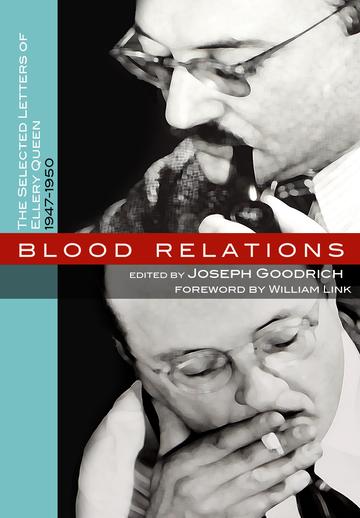
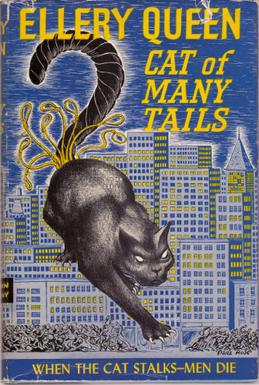
    Swimming against that current, however, Joseph Goodrich has just offered up Blood Relations, the Selected Letters of Ellery Queen, 1947-1950, a slim but thoroughly engaging volume collecting the letters exchanged by Frederic Dannay and Manfred B. Lee during the plotting and writing of three Ellery Queen mysteries – Ten Days Wonder, Cat of Many Tails and The Origin of Evil.

    The book is a great read on at least three levels:  first, it provides a fascinating background on the writing of three of the strongest Ellery Queen mysteries, second it is a great teaching exercise on how mysteries are plotted, including how the suspicions of the reader can be deflected away from the true culprit, and third it is a revealing, and often troubling, insight into the rivalries that festered between two cousins, Dannay and Lee, who collectively were Ellery Queen.

    Throughout their long literary partnership Dannay and Lee were famously at each others' throats.  Lee described the partnership as a “marriage made in hell.”  The friction in the “marriage,” as well as its long-term survival, was borne of necessity -- each cousin depended on Queen for the economic livelihoods of their respective families.  And Ellery's survival could only be assured if the partnership between Dannay and Lee continued.

    As mystery writer, professor and Queen scholar Francis M. Nevins has noted, neither Dannay nor Lee could complete a work of fiction alone.  Rather, each of the Queen novels and short stories followed the same pattern:  Frederic Dannay would supply a detailed outline of a proposed book or story – often running to 75 to 80 pages for a novel that would eventually ring in at around 300 printed pages.  Then it would be left to Manfred Lee to transform the outline into a complete novel, building believable characters and a compelling narrative flow.  According to Nevins, Lee could not plot out a story to save his life, and Dannay was equally incapable of writing a narrative from an outline.  And so, bound at the wrists, and each damned by a resentment fueled by that which only the other could do, the cousins fought their way through over 40 Ellery Queen books.

    Much of this acrimonious writing process was completed through the exchange of letters, particularly in the late 1940s when Lee was on the west coast supervising the production of the Ellery Queen radio show and Dannay was on the east coast editing EQMM.  At a time when long distance telephone calls were unreliable and exorbitant, the cousins plotted (and bickered) in exchanges of very long special delivery letters.  It is these letters that comprise  Blood Relations.

    The book reads as compellingly as good fiction, and offers up a fascinating insight into the minds of Dannay and Lee.  A spoiler alert is warranted, however.  Anyone reading Blood Relations will come away knowing all there is to know about Ten Days Wonder, Cat of Many Tails and The Origin of Evil.

    The bitter and accusatory tone of the letters that comprise Blood Relations is not a complete surprise to Queen fans.  Frederic Dannay’s papers, which contained copies of most correspondence between the cousins, were donated to the Columbia University Butler Library in 2005, the centennial year for Dannay and Lee, and therefore Ellery, as well.  At that time Ellery Queen Mystery Magazine held a centennial Queen symposium at Columbia and Francis Nevins delivered a keynote lecture taken completely from the letters exchanged between the two cousins.  But while the angry exchanges quoted by Nevins during that speech left a lot of the audience wide-eyed in 2005, reading the text of these exchanges in full provides even more of an eye opener. 

Francis M. Nevins at the Centenial
    One of the documents that was on display at the Butler Library in 2005 during the Queen centennial symposium was a legal agreement between Dannay and Lee forbidding either cousin from ever leaving the Queen partnership.  The document seems superficially strange since it is hard to imagine how it could ever be enforced.  But the need for some sort of definitional boundary understanding between Dannay and Lee  becomes evident when the reader has the opportunity to review the cousins’ actual correspondence.  The partnership set forth in the contract between Dannay and Lee is premised on dividing the task of writing Ellery Queen works into two “zones,” each of which was envisioned to be the domain of one, and only one, of the strong-willed cousins.  Under the terms of this arrangement Dannay was to be given complete control over the plot outlines of Queen works, and Lee was to have complete control over the final written work product bringing to life the story set forth in each outline.  Predictably this arrangement was tinder waiting to be ignited.  How could this division of labor work given the fact that plotting and drafting overlap, and that each cousin had very different views as to what any given Ellery Queen project should ultimately should look like?  

    The following exasperated passage from a 1948 letter from Lee illustrates this.  Dannay has asked for a change of one sentence in Ten Days Wonder.  Lee responds as follows:
You say [that the phrase] is “out of key,” “ineffective,” and “tends to spoil the very good stuff that surrounds it.”  I’ve reread the line in context and I don’t agree.  I could take the line out to please you, certainly; but this very minor, unimportant example – by admission on both our parts – raises a major, important question:  Is pleasing you, in the face of my strong affirmative opinion that the  line is in key, effective and helps the stuff that surrounds it, to be my rule-of-thumb?  We divided ourselves into rigid-boundaried “zones” just because our differences of opinion on basic matters of both plot and writing were so strong that we found it impossible to reconcile them either in principle or in practice.  In the face of this, pleasing each other is pointless.  We can only do, in our respective provinces, what pleases ourselves. . . .
    When pages are spent arguing over one sentence in a draft, the reader is left to ponder how the finished products were ever produced.  As Lee notes in a subsequent 1948 letter, “[w]hat began as friendly competition wound up as active and bitter hostility . . . our history as a ‘team’ is a series of explosions.”  The marvel is that even given this the cousins in fact produced over 40 novels, anthologies and critiques.

    On at least one level reading Blood Relations is therefore a bit like watching a rather steamy soap opera.  The reader becomes enthralled, almost against better judgment, by angry tirades that normally would take place only behind closed doors.  In that sense the experience of reading the book is a little akin to the natural tendency to slow down, even when we do not mean to, as we drive past a grisly automobile pile-up.  Dannay and Lee mercilessly pick at each other, neither wanting to give an inch on a point, until the result becomes unbearable to both.  And they do it all before our eyes.  This from Lee, again in 1948 and addressing the drafting of Cat of Many Tails:

I now have the mere job of finishing this story.  What in the good God’s world is the use of anything?  What, I ask you?  Why am I writing to you?  Why do you write to me?  We are two howling maniacs in a single cell, trying to tear each other to pieces.  Each suspects the other of the most horrible crimes.  Each examines each word of the other’s under a lens, looking, looking, looking for the worst possible construction.  We ought never to write a word to each other.  We ought never to speak.  I ought to take what you give me in silence, and you ought to take what I give you in silence, and spit our galls out in the privacy of our cans until someday, mercifully, we both drop dead and end the agony.
    Whew! Time for the reader to take a deep breath.

    The quotes provided here are but the tip of the iceberg that is Blood Relations.  But the book also offers lessons on other planes.  Beyond the vituperations that erupt in many of the letters of Dannay and Lee one finds two headstrong writers, each working to make the final product believable.  Every writer already knows  that despite what we may say, we do not particularly enjoy criticism.  Strong criticism  makes for a better final product, but each of us carries that silent wish that those who read our works will say “Perfect.  Wouldn’t change a thing.”  What Dannay and Lee subjected themselves to was just about the most rigorous barrage of literary criticism imaginable.  Every single thing was subject to debate.  But beyond the pent up hostility they each harbored, their arguments always have the purpose of furthering the written product.  And the differences of approach that were at the core of each man fueled debates during the writing of the Queen novels that are illustrative of the struggles that all good writers go through, although more normally not in dialogue, when a book or story is devised and then executed. 

    The nature and end result of the process that brought about the Queen oeuvre  is summarized by Dannay, also from a 1948 letter.  Dannay's observations offer a denouement  finally concluding the cousins’ blistering special delivery exchanges concerning Cat of Many Tails:

Manfred B. Lee and Frederic Dannay
[A]s I sit in front of the typewriter this morning, I feel extraordinarily calm; and in the calmness I see clearly – [even] without having read your [most recent] letter – that surely the answer is very simple:  I must have misunderstood you, and you must have misunderstood me, and we both keep misunderstanding each other – and probably will keep right on.  And perhaps that really isn’t too bad a thing, wearing as it is on our nerves and lives; it keeps both of us doing the best we possibly can, and while we are eternally suspicious of each other, and eternally hypersensitive to each other, the resultant work – coming out the hard way – is strangely enough, the better for it  . . . [even though] the price is high . . . .
    Blood Relations is available from Amazon and Barnes and Noble.    It is a must read for Ellery Queen fans, and it should also be a must read for writers interested in the meticulous plotting and drafting of mysteries. 

12 March 2012

As the World Turns


Jan GrapeTime continuum. Time Marches On. Time to Go. Time To Live or Time to Die. There's A Time for Everything.

How do you envision time? Sixty seconds, sixty minutes, twenty-four hours. Thirty or Thirty-one days, excepting February with its twenty-eight days. Three hundred sixty-five days in a year, except for 2012 when we had 29 days in February.

As long as I can remember I seem to have somehow envisioned time as a sort of elliptical or oblong shape. Maybe when I learned the earth revolved around the moon, and I didn't want to see time as a circle. And as time passes and we reach each season it does somehow seem to be oblong and not a circle. More of a chance for there to be room for four seasons if time is elliptical.

But how do we define time when we write? Often to denote the passage of time a writer will title each chapter with a week-day name or a month's name. Or if they want to show something that happened in the past they might write, March 12, 1989 as the chapter's heading. What about if you're just wanting to show time passing throughout a day? You could put "Morning or Evening or Midnight."

Often a writer will just end a scene with a small climax and skip a couple of extra spaces, make putting *** ellipses to denote the scene change involves time or place. There are many ways to show time in our writing.

But don't forget there are different aspects of time. There is the chronological passing of time but there is also the emotional passing of time. An emotional clock so to speak. Albert Einstein once said when a guy sits with a beautiful girl for an hour it can seem like only a minute. But let him sit on a hot stove for a minute and it's longer than an hour."

Remember when you were little and waiting for Christmas to come? It took days and weeks and hours. When you had your first child you turn around twice and he or she is starting to school and you have no idea where time went.

What factor comes into play with emotional time having such a huge range for your reader. Tension or fear are the obvious ones. When your character is relaxed time moves almost quicker than you can believe it. When your character is tense, time stands still.

You can and should incorporate the emotional clock in your writing always. I remember one writing teacher who told my class when your character is involved in an action scene you want to write short, action words and sentences. People punch, jab, smack, slap, or explode. You don't want to drag out a fight scene. Unless you've researched some good karate moves and want to add them so it's more realistic.

At the same time, if details are important to the story and you are building up the tension you probably want to give long descriptions that lead to the action. That lets your reader know that something important is going to happen. Something significant.

If you gloss over things then the reader won't attach any importance to that at the moment. And sometimes that's a good place to hide a clue or a red herring.

Just don't ever use words because you LOVE words and want to use a lot of them. Words need to show in a clear and concise way that your character is going to experience fear or tension. You need to show that your character is going to have to choose a course of action. If he or she chooses wrong it might mean death for him/her or someone he/she cares for.

Words need to move the story along not slow you down. However, after some significant tension is met but it's not yet the climax of the story, that's when you need to slow down to allow your character and your reader to relax, to reflect. Maybe discuss the problem and see if a solution can be found.

I hope I've made a case for you to use a emotional clock when you write. The hour and minute and second hands of your clock are spinning and days are getting longer now so make every moment count in your work.