Not quite our main subject, but I think you will see the relevance, and sympathize... - Robert Lopresti
Another fact of nature that plays an important role in crime fiction is that people often don’t tell the truth. Almost never. They lie, hedge, dissemble, prevaricate, and weasel their way through their lives, flooding the environment with oceans of uncertainty.
Not everyone lies all the time, but
everyone is in the habit of telling only part of the truth. This is usually meant to maintain civility
and pleasant relations, though there’s a lot of daylight between complimenting
your mother-in-law’s lousy meatloaf and telling the cops that you were home all
night and have no idea how that BMW ended up in your garage. We do these sorts of things naturally and fluently,
having evaded responsibility for cleaning out the cookie jar or socking little
brothers as soon as we can form sentences.
It’s innate.
Raymod
Chandler described detective fiction as “riding around in cars and interviewing
people.” Maybe he didn’t actually say that,
but it fits with his general view of the genre.
And while driving skills are fairly widespread, a good interviewer is an
artist.
There
was an awful lot I liked about the advertising business, but aside from
creating ads, the thing I liked most was qualitative market research. That is the academic term for what mostly involves
interviewing people, one-on-one, or in groups.
You might believe, like most people, that marketing is a soulless
endeavor, but not if you’ve had a bunch of guys in a room talking about their
cars. Or intercepted a pack of teenagers
in a mall to learn why they’re buying brand new jeans with the knees ripped
out. Or shadowed kitchen-table insurance
agents as they chatted with ordinary people about death, disability and destruction.
After hundreds of these encounters discussing thousands of individual judgement calls, I’ve learned a few things.
Everyone likes to talk about
themselves and what they do for a living, or how they spend their free
time. In other words, their lives. That’s why salesmen, journalists, homicide
detectives and hostage negotiators want to get the conversation on a personal level
as quickly and smoothly as possible. You
cynics out there claim the interviewer’s true feelings can be faked, but they
can’t. You won’t succeed without some
natural empathy and a genuine interest in what people have to say.
Although a research interview isn’t
a test, everyone thinks there’s a right answer.
There’s an urge to please that’s very powerful, but also a desire to
look good in the eyes of the interviewer.
That’s why focus groups (a session where one questioner tries to extract
information on a specific subject from five, or eight, or ten people sitting
around a conference room) can be a harder nut to crack, since few enjoy
standing out from the consensus. You
have to convince each individual that the only right answer is what they
actually believe if you want any meaningful outcome.
You’ve probably noticed that the accuracy of political polling has been falling dramatically. One reason is it’s hard to get people on the phone, and even harder to catch them face-to-face. In my experience, phone interviews themselves are far less effective than in person, for reasons explicated above. I think written questionnaires are close to worthless, and online surveys worse than that. Social research is a bit of a science, but it’s mostly an art. Which is why detectives and savvy researchers always prefer to handle their assignments in the flesh. You can hide those lying eyes, but it’s harder with the questioner staring you right in the face.
Body language is often the most
articulate. This is because gestures and
facial expressions are less voluntary. Things
just sort of leak out that you aren’t intending. Consequently, the first reaction is usually
the most reliable, because it springs from an emotional response. Over the following few seconds, the conscious
mind takes the reigns, and people begin to say what they think they ought to
say, or what their conditioning says is the proper point of view.
People often don’t know why they
want what they want. Or why they did
what they did. Humans aren’t robots, but
we do tend to delegate a lot of our behavior to unconscious impulses. But when gently pressed to apply logic and
reason to emotional decisions, we’re not that bad at figuring it out. It may not be the whole truth and nothing but
the truth, but it’s often good enough for storytellers in any line of
business.
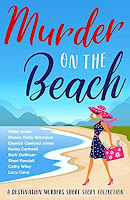
My 17th book, The Merry Widow Murders, came out last year, and my publisher said, "get out there!" And provided me with a bunch of places to go.
I like my publisher. And I like book clubs. It's fun to meet with like-minded people, and discuss our mutual love of mystery books. Usually, you hear good things about your novel, and I've learned to wear protective clothing around my ego for those times when things don't go quite as planned.
Witness the crazy, loopy scene that took place last month, at a particularly large, mixed book club gathering. Bless them all. They gave me a story to tell in perpetuity.
It all started with research.
(What follows is verbatim, I swear. I had it fact-checked by one of the women :)
I explain the exhausting amount of research involved in writing The Merry Widow Murders, which is set in 1928. All about the food and drinks of the time, fashions, music that just came out, fuel used by a 1920s era ocean liner, social mores...
Man of a certain age shoots up his hand and says: "Speaking of research. You wrote that they sat on a bale of hay. I looked it up, and hay balers didn't come out until 1938. So there couldn't have been bales of hay in 1928."
One could call his tone triumphant and be accused of understatement.
Sounds of silence. A woman's voice says, "And here we go..."
Another man: "Didn't they call them bales before?"
Me: "I can tell you that my father worked on a farm before WW11 and he called them bales of hay."
At which point, every man in the room grabs his phone to look stuff up.
Man 2: "Here it is! John, you're wrong. Bales have been used to describe hay since forever."
Man 3: "Hah! The fur traders called them bales of pelts way before 1928. You're wrong, John. WRONG."
Woman: "Can we talk about the book please?"
Me: "Wait a minute. The Merry Widow Murders takes place on an ocean liner. There aren't any bales of hay in that book."
John (grumping): "Well, I read it somewhere."
Me, thinking fast: "You may have read it in The Goddaughter's Revenge, from an old series, maybe ten books ago. It takes place during Halloween in today's time period, not 1928."
Another woman's voice: "Oh for the love of Gawd..."
Man 2: "Speaking of 1928. You realize that you're only talking about a small slice of society in this book. It's all about rich people in first class. The elites." (He barely keeps from spitting.) "Hardly representative of the life of a normal person in 1928. People on farms."
"Baling hay," says another man, snickering.
Woman: "For Heaven's sake, Roy! That's the people we want to read about!"
Man 3, still looking at phone: "About those hay bales-"
"ENOUGH ABOUT THE HAY BALES!" yell several women in unison.
Melodie Campbell promises there are no bales of hay in The Silent Film Star Murders, out next winter.
A few months past, I said on these pages that I would offer a post about writing historical fiction.
In fact, I wish I had read this post before I started writing historicals!
Now, I had been forewarned. Several years ago, my friend, the excellent writer of cozies, Vicki Delany, said to me: "Don't write historical crime. You narrow your market by doing that."
What she meant was this: I've heard that only about 20% of the crime reading market read historicals. Of those potential readers, most have preferences for a certain time period. Some read Victorian, and no other. Some like classical Rome, and no other. Some like between the wars, like me. Very few historical crime readers read all periods.
So you are reducing your market considerably.
I can attest that this is true, and would speak the same words to aspiring writers today. But my emphasis for this post is different.
Here's what I have to offer, while writing the third book in the 1928 Merry Widow Murder series:
The trouble with writing historical novels strikes me as a very similar to that of writing comedic novels: Not only do you have to come up with an original plot, wonderful characters, engaging dialogue, compelling pacing, and believable motivation like every other author, but you have this additional requirement that other authors don't have. You have to make it funny. And you don't get paid any more for doing it.
Historical novels - and I write exclusively mystery/crime novels now - are of the same ilk. You have to include all the traditional elements of a great mystery book, but you also have to do a tremendous amount of research to get the time period right, and I don't just mean setting. Yes, I give great attention to detail of the food and drink of the time (was Chicken a la King served then? How about a Sidecar?) Music of the time (When exactly did Mack the Knife become available in sheet music?) And clothing (the Flapper look wasn't the only look for clothing in the 1920s, and short skirts weren't as short as Halloween costumes now would have you believe.)
Questions like: When did ocean liners move from coal to bunker C fuel? (1917ish - after the Titanic)
What were the mores of the time? The etiquette? Could respectable women travel alone on an ocean liner, in first class? (Yes, with a maid.) Did the maid have her own cabin, or did she stay in yours?
I nearly go mad with the research I have to do! Every single page I write, I'm looking something up. And that brings me to the comparison with comedic writing:
In historical novels, you have to do everything a writer of contemporary fiction has to do, but you also have this extra requirement: you must research, you must get it right, and - you don't get paid any more for doing it.
I can speak to the importance of getting it right. My first series was actually fantasy, the Rowena Through the Wall series, which takes place during the dark ages in Great Britain.
'But even in fantasy, you have to get it right. In book two of that series, Rowena and the Dark Lord, magic occurs. Rowena inadvertently brings forth a Roman Legion fighting Bodicea. Now, I did the usual thing. Researched Celtic warfare, and researched Roman warfare, so I could get the battle styles right. I also researched Roman armor and weapons, vs Celt. It then occurred to me that I needed to dig deeper into what it would mean for a Roman Legion to vanish from battle. Would they be considered deserters? (Yes) Would this affect their families back in Rome (Hell, yes.) So they would do everything possible to get back to the battlefield, even if it mean imminent death. And that created a turning point for my plot.
Believe it or not, and to my great surprise, some Roman scholars read the book, because they like to read everything that has anything to do with ancient Rome. And one professor emailed me to say, "I can see you used Legion number XXX in the book, located at XXX in the month of..." He enthused about the thrill of reading accuracy in fiction. (Good thing I was a college professor at the time...)
Now, I know that if I had not done my research, I would have heard about it. Even though the book is a fantasy! People love to point out when you get things wrong in a book. So I breathed a sigh of relief, that this time, I carried it off.
But it's a heck of a lot of work.
I've been lucky to get a two-book contract for books two and three, and an option for the 4th. In some ways, I'm relieved, because I'm learning this period of time inside out, and it's good to be able to use it for more than one book.
But I have to ask myself: why do it? Why write fiction set in historical times? I ask myself that every day, writing this third book. And I've come to some sort of conclusion.
There's a certain amount of security, in writing and reading a book that takes place in the past. Why? It's a simple as this:
The world is still here. Mankind survived the trials from the time of our book, survived WW1, the depression, WW11. There's comfort in knowing that the world lives on after the book ends.
But in our world today, who knows? The future is a blank.
And that's why I love writing about the past.
Melodie Campbell can't resist a classic mystery crackling with humour, and that's why she wrote one herself. The Merry Widow Murders is her 18th book, and the first of a new series.
I intended to write about a Mexican thriller/mystery series, but after reading Mark Thielman’s column, I considered an article in his shadow, and then Friday Joseph D’Agnese came along with his advice about organizers and notebooks. Okay, okay, so I have the attention span of a squirrel and… something, something.
That’s why James Lincoln Warren dubbed me the ADD Detective. If anyone needs an organizer, I do, and thank God for Rob Lopresti and Janice and secretaries and assistants and adjutants. I’m worse than a squirrel burying his nuts and…
Hey! Eve! Stop giggling! You too, Melodie. Oh Liz! Y’all are a klatch of incorrigible children.
Anyway, before I was so roooodly interrupted… What was I saying? Oh, squirrels. I’d make a terrible squirrel because I don’t remember where I put things.
I’m aware of the problem (I should be by now), so I consciously think: Where should I put this or that so I can find it next time?
I come up with a genius place to store it.
And then I can’t find it.
My chosen tuck-away place was so brilliant, I’ve completely lost it.
Assisted Living
I’m fortunate to live in this age. As a child, I built my first simple ‘computer’ (a gated circuit) and started programming in my teens. I realized computers could help with some my attention deficit problems:
So there I was, a teenager using half-million dollar computers to save my name/address book. Life was good. Until the computer crashed. But still…
Aids, Aides, and Accessories
Computers can't solve everything. I can't yet say, "Hey Google: Where are my glasses?" which is why I keep a half dozen pairs scattered around the house in 'known' locations. Damn squirrels.
But we come ever closer. Apple markets AirTags, which look like half-size key fobs. Attach it to my key ring and, if I happen to misplace my keys, I can say, "Hey Siri: Where are my keys?"
(You might think I often lose my keys or wallet, but I don't. I have one place for each and I'm well-trained to put them in place.)
They're also useful for items that might be potentially stolen– purses, briefcases, luggage, someone’s wandering child. ("Mrs Lundin, dis is Benny de Snatcher. We got your boy. How much we gotta pay if we return him?")
Aids, Aides, and Assistants
Amid all this verbal perambulating, I offer my methods of using computers to help organize and write. Sure, we know the obvious: proper formatting (real tabs, double space, etc.), spell checking and sometimes grammar. That’s handy, but computers shine at research.
Sure, we have Google, Bing, Yahoo, Duck-Duck-Go, and DogPile, but I need to collect notes. I want to copy articles in case they go away. What to do? Excel and text processors are 'okay', but I wanted more than a digital filing cabinet. Cross-platform could be a great goal too: Mac, Windows, Android, iPad.
I snapped awake one night (all right, one afternoon) and realized I could apply my programming background to create sort of Post-It notes on web pages. Before I began, I swept the web to find out if anyone else had hit upon the same idea, and it’s happened indeed. Some very smart person not only had created web page Post-Its, but also provided marker-style high-lighting! Better yet, they introduced a free version.
What if I wanted to organize and store articles? I tried Pocket. My phone and tablets had limited space back then and Pocket was large, comparable to OneNote. That might not be a concern today, but back then when I needed the space, I deleted it.
Like OneNote and similar to Diigo, Pocket plants a Pocket icon in the menu bar. To bookmark or copy an article, click on the Pocket icon.
I can never remember the name of the EverNote app, only its logo, an elephant, which presumably never forgets. They're light on free storage, but it is popular with students. Check it for yourself.
Microsoft sells OneNote and way back, they should have been ashamed. Using it brought back those caustic jokes that Microsoft uses their customers to stress-test their programs, and Microsoft doesn’t recognize a bug until every single user on the planet has reported it. Oh Lord, OneNote was horribly buggy. Ofttimes the Android version wouldn’t save articles. On other platforms it lost data, but when following up, I found a remedy of sorts: Sync the data each time the program opens. This prevents the Android version trampling on the iOS data and crushing the laptop versions.
Microsoft spent years to get a handle on OneNote problems. These days it’s fairly clean, although I continue to hit the Sync All command whenever I open it. Reading between the corporate lines, Microsoft would love to sell the product but it had been so troublesome, they permit customers to use it for free. OneNote fits in nicely with the paid Mac version of MS Office, so I’ve settled upon it.
Its interface is idiosyncratic but no longer erratic. Unlike other offerings that copy articles and not much more, users can create notebooks, sections within each notebook, and pages within each section. Pages can contain pretty much anything: rich text, pictures, audio recordings and videos, snippets of conversation, and sketches you might make. Clicking the OneNote icon in the menu bar or the Share button on mobile devices offers a number of choices for saving articles. It stores data in Microsoft’s OneDrive cloud, which allows the user to access it multiple ways.
I create notebooks for each project I’m working on, a notebook named SleuthSayers that contains sections on news (with a subsection for Florida news), writing, fraud, and miscellaneous notes, and a personal notebook with multiple sections. The interface is quirky, but you may find it suits you.
But wait, there’s more!
One product that didn’t pass my research test I keep around… In fact, it’s called Keep introduced by Google a few years ago. When they proposed discontinuing it, a public outcry kept it alive.
Compared to the other programs above, it’s not especially suitable for writerly research, but it is perfect for personal use in several ways. Its interface resembles those Post-Its we spoke of above. Double-clicking on a note expands it for better readability and editing. Notes can use any color with or without to-do-type checkboxes. Checkbox items can have sublists.
I keep (see what they did there?) a couple of general reminders, technical notes I picked up whilst wandering, security alarm codes for friends (without personal identifying information), field notes, a couple of items to ask my doctor on the next visit, library book list, and shopping lists… multiple checkbox shopping lists for groceries, hardware, Costco, Walmart, and so on. Moreover, many of them are linked to friends, so whoever arrives at a given store can pick up items for me or vice versa. If one of us thinks of an add-on item, we enter it on our device and it appears automatically on theirs.
Note: The above link is the general Google Keep page where you can download mobile apps. To visit the web page for notes from your computer, you’ll use:
Bad News / Good News
Common to all these programs, if you lose your phone or drop your tablet off a Pacific Coast cliff, your data is still available. And it all can fit in your pocket.
Have you tried these? What do you think?
I used to outline my novels but not my short stories. For them, I'd jot down the basic idea and let it ferment for a few days until the main points worked themselves out. Then I started writing. I usually had a fairly clear idea of the solution if it was a mystery, but I always struggled with how the sleuth would figure it out. That's still one of my biggest problems, and may explain why I write more "crime" stories than true mysteries with a solution.
Recently, an idea tapped on my shoulder, and the more we got acquainted, the more she felt like a novella, which meant I needed a subplot to flesh out her figure. One plot is tough, and subplots, variations on the major theme, are exponentially tougher. In my Zach Barnes series, Barnes's girlfriend Beth Shepard is a writer in her own life, but she also makes book appearances as "Taliesyn Holroyd," who writes over-the-top bodice-ripper romance novels. The real writer is male, but his publisher pays Beth to dress to thrill at signings and pose for pictures on the website because everyone "knows" romance writers are women. The pen name is an in-joke, too: Taliesyn was the legendary bard of King Arther, and even though the name sounds feminine, the guy, if he really existed, was a man.
You see where this is going, right?
Well, I overthought the new idea so much that I painted myself into an intellectual corner. A short story or a novella is short enough so I can go back and tweak detals later to make everything fit instead of micro-planning. The novella is neither fish nor fowl, or maybe both fish and foul play, so it falls between.
When that idea appeared to me several weeks ago, I knew it required some research, and the sources of the info I needed were close at hand. Unfortunately, I fell down the rabbit hole and got so interested in the research that it got in the way of my half-formed plot. It crowded out the mystery and I couldn't find a way to connect them. It got so bad I even developed a chronological list of scenes (My version of an outline), which I've never done for a short story or novella. The 8000 words in eight or nine scenes kept bouncing off one wall and into another like a racquetball on steroids. I finally put all my ideas and scenes and fragments into a separate file and stuck it in a dark corner so I could go on about my other copious and crucial business.
Two weeks later, that same idea started nagging again, like the six-year-old in the back seat demanding, "Are we there yet?"
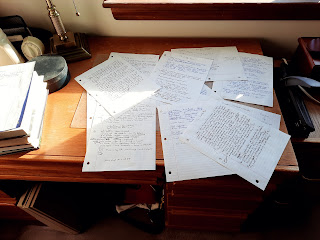
Last week, I decided to attack the story from the opposite direction and introduce the research idea later, which turned it into a subplot without further effort. I spread all those old notes and jottings across my desk and went to work with my favorite fountain pen (A Parker Sonnet, if you care).
I started writing again with more energy than I've felt in months, no outline, beginning in a completely different place, and using some different people, except for Zach Barnes. I quit every night knowing what the next scene would be.
Last night, as I lay in bed listening to the wind whipping our foot of new snow, the idea crawled under the covers and spoke to me again. A soft voice whispered, "He didn't do it." That hasn't happened since Megan Traine told me her huge sad secret when I was struggling with Woody Guthrie over a decade ago. The best thing was that I wouldn't have to change any of the new stuff to find the right culprit; adding four or five sentences to a couple of early scenes would fix everything.
When the story starts telling you where you're wrong, you know you're REALLY on the right track. I don't know when I'll finish this first draft. It's not aimed at any deadline, so I don't even care. But it feels like it might actually happen.
Jimi Hendrix once said, "I play a whole concert, some nights I'm just trying to find that one pretty note."
Well, I found that one neat twist.
I've been away a long time.
How do YOU know when it's really working?
by Steve Liskow
Last week, Barb Goffman discussed details that make or break your work, and many people chimed in with stories or authors that had lost them by making a careless--and avoidable--mistake.
With the Internet, billions of bits of information are only a click away. That's both good and bad, especially for someone like me. I'm a trivia junkie and even as my memory fades, I can bring up details no healthy person would know, usually about music. I often use music in my stories because I already have enough context so I can write a story and know exacty what I still need to check or verify. Usually.
Several years ago, I wrote "Hot Sugar Blues" about a folk and blues singer who became popular when he turned to rock and roll. I based him on Bob Dylan, John Sebastian, The Blues Project, and several other real artists, and I had him mention the Cafe Au Go-Go in Greenwich Village. The anthology editor, whose job was to verify such details, said the venue didn't feature live bands until later that year.
Oops. My knowledge fell short. Fortunately, the date wasn't crucial for the story, so we became less specific.
I can do research, but I prefer not to for a short story because it feels like more effort than it's worth for a few thousand words. Old school research--books and magazines--wasn't a problem because wandering off on a tangent took more effort.
Novels, of course, are different because they demand more information.
Lately, though, I've found myself writing stories for specific times or places that fall outside my usual turf. That's good because it's expanding my repertoire, but it means yes, I do need to do research. Sometimes, it's amazing what you already have at hand that you didn't think about.
This spring, one of my stories will appear in Groovy Gumshoes, a collection of PI stories set in the Sixties, edited by Michael Bracken. The guidelines recommended using an historical event from that period, and I happened to take summer classes at Oakland University in 1967. The college is thirty miles north of Detroit, and two of my dorm mates watched their homes burn in the television coverage of the West Side Riot. My roommate at the time is now a Motor City attorney, and I asked him to email me a few photographs. I also have a street map of Detroit, and a lot of music from that era: The Stooges, the MC5, the SRC, Motown...
I'm doing research for two other stories, too, and I already know enough so I can recognize the specific gaps in my background. My parents loved to dance, and they loved the music of the 20s through the 50s. My mother had dozens of remastered compact discs of that music, and I've used them in plays I directed and now I know the major hits of the years in question. They give me a context for a story set during Prohibition.
The other story may not happen, but I think it will involve a Mark Twain artifact somehow. My wife conducts tours at the Mark Twain House in Hartford and everyone there is a trivia junkie and Twain nerd. I'm creating a list of questions, and the answers will determine how--or maybe if--that story develops.
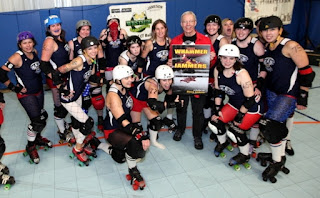
The only novel that took as much research was The Whammer Jammers, my first roller derby book. I only knew what I remembered from television back in my deformative years, nothing about the modern sport. Fortunately, my daughter was Hazel Smut Crunch # Bake 350, captain of the Queen City Cherry Bombs, and she helped me create a questionaire I sent to skaters, coaches, referees, and promotors. Everyone knew "Haze" because she also wrote the grant for the non-profit league. And one of my former theater buds knew two local skaters, so I got comped into events in New Haven and set up a few interviews.
Having friends in high places makes the job a lot easier.
The hardest part of research isn't getting the answers. It figuring out the right questions.
by Steve Liskow
I've started using open submission calls as writing prompts and it seems to work; I've finished more short stories in the last six months than in any other year since I started writing seriously. I've noticed many of the calls want historical fiction, which I usually avoid.
Why?
I can do research, but I try to avoid it because I'm a trivia junkie. If I see an interesting factoid, or, even worse, a link, I'll follow it to another link...and another. Three hours later, I might have 25 open links on the monitor, all of them fascinating, and none with any connection to my original quest. I'm the walking embodiment of research as the best way to avoid actually writing.
Besides the trivia distractions, I find that too much historical fiction uses exposition ("Lessons?") instead of story-telling. A few years ago, I heard of a book by another local author, and the premise intrigued me, so I downloaded a sample. The "dialogue" was "As you know, Bob," information dumps that sounded like a seventh-grade history text. Description of the setting and characters was even worse, and even more plentiful. The first 25 pages, the whole sample, had almost no story, but constant scene-setting in turgid prose. The writer was so proud of her research that she gave us all of it.
Another danger stems from involving a major historical event. If you write about Columbus, Gettysburg, or Prohibition, you'd better get every detail correct or you'll smother in the messages from readers who spotted your mistake.
There are exceptions, of course. Sheri Holman's The Dress Lodger is a terrific novel about an English prostitute in the cholera epidemic of 1831. The setting and exposition stay in the background like good harmony singers and keep the plot and characters in the spotlight. If all historical fiction were this good, I read a lot more of it.
I've written a little--very little--historical fiction myself. Those works sprang from personal experience so the only research was confirming dates and checking the spelling.
Run Straight Down isn't really historical; my experience as a teacher inspired it. While I taught at the largest public school in the State of Connecticut during the 1990s, I lost students three consecutive years in gang shootings. A lawyer suggested I change all the details to protect myself from potential lawsuits, so I changed the town, all the names, and the geography. That meant I didn't have to do much research, but I still saw those boys' faces every time I sat down at the keyboard.
In 1967, I attended summer sessions at Oakland University in Rochester, Michigan, 30 miles north of Detroit. In late July, we crowded around the TV set in the lounge of Fitzgerald House and watched Army tanks rumble down Woodward Avenue.
My other exception is Postcards of the Hanging, which I published in 2014. A judge for a contest praised my research and use of details to establish the mood and setting without being forced or obvious. Neat, huh? Now for full disclosure...
The story takes place during the 1964-65 school year, and it wasn't historical at the time. I began the first draft in 1972, and it was inspired by a sex scandal involving a high school teacher during my senior year. I changed all the names and details, but if I needed to check on music or dress styles, I looked at my high school yearbook.
I remembered the Beatles and Ed Sullivan, Lawrence Welk, the football and baseball games (We had a terrific football team and our weakest basketball team in years), struggling to talk to girls, slang, adolescent angst, local bands and everything else, only seven years earlier. I taught myself to write by producing three distinctly different versions of the book, and the third one became my sixth-year project in 1980. Those three manuscripts gained my first 40 rejections.
When I decided to self-publish the book, I kept all those topical references because they helped me remember that world AND they defined my characters. I actually named minor characters after the streets in my neighborhood. I changed the sequence and used flashbacks to build more tension, but I was amazed how little rewriting I had to do. Someone suggested adding a prologue and epilogue to show the book wasn't really a YA novel, and those two sections, about 25 pages, contain most of the new writing. I added transitions to move in and out of flashbacks, but I think I only did major revisions to one or two existing scenes.
I don't know if I'll ever try another historical novel or story.
Maybe if I lived a more adventurous life...
"In order to write about life
you must first live it.
— Ernest Hemingway
![]() |
| My listening station for The Eagles |
![]() |
| An echo-cardiogram (posed by model) |