19 February 2012

In Black & White


Boris Karloff and Bela Lugosi

Not long ago I watched a pair of late 1930s films featuring iconic names, Boris Karloff and Bela Lugosi. I know what you're thinking, but you're wrong although one of the movies is monstrously awful. Both turned out to be locked room mysteries.

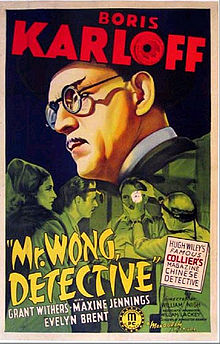
Mr. Wong Mr. Wong, Detective (1938)

This Karloff film is clever if you forgive a kind of police stereotype and the fact Karloff isn't Chinese, but it tied in with America's on-going fascination with the Orient.

I found myself smiling at a particular 'trope' (for lack of a better word), but discovered the plot hinges upon it. Given that wrinkle, the story turns out to be surprisingly satisfying. If you haven't seen it, it's worth watching.

As much as I like and recommend this film, I'll talk about another with a major failing.

Murder by Television (1935)

Murder by Television In contrast, the Lugosi flick was surprising awful. Bela himself seems resigned to struggling through the movie trying not to tatter his reputation.

What's not to like? It contains everything: corporate intrigue, high tech toys, a musical number, comic moments, and an imbecilic dénouement. Er, but wait, there's more: A half-hearted romantic flame flickers, sputters, and almost dies. Did they forget anything?

Movies in Black & White

The best part of Murder by Television was the cook, Hattie McDaniel, who stole the show with her gentle humor. I heard she sang in this film, though how and why remains a mystery– often films slipped in musical numbers on the flimsiest of excuses.

When I saw no singing, I shrugged it off until I came across a note in IMdb that suggested this particular print may have been intended for America's Deep South and deliberately omitted the scene.
Murder by Television
What a shame. I can't imagine that Miss Hattie singing would have offended Southern sensibilities, so I'm still mystified if she sang in the film and if it was subsequently deleted. If you know details, share them in the comments. Meanwhile, back in the studio…

Television in 1935

A character in the film makes this prediction: "Television is the greatest step forward we have yet made in the preservation of humanity. It will make … a paradise we have always envisioned but never seen."

Presumably they were thinking of Dancing with the Stars and not Jerry Springer or 'rasslin' (which can be synonymous).

In the early years, television was a hot topic in radio enthusiast magazines. Numerous technical contributions from around the world– Russia, France, Mexico, Hungary, Scotland, the UK and US– led to an explosion of television invention in the mid-1920s.

By 1928, General Electric began experimental transmission from two stations in Schenectady and New York City, the figure of Felix the Cat rotating on a turntable. The Great Depression may have devastated the working man, but technical development continued.

Murder by Television was released in 1935 at a moment when the exciting possibilities of TV appeared poised on the threshold. The following year, Germany would broadcast the Olympic games from Berlin and Leipzig and by November, the BBC tele-vising group would begin the world's first public regular 'high definition' transmission from the Alexandra Palace in London.

In that context, the underpinnings of Murder by Television weren't out of place. The value of the props– actual experimental television on loan– was $75,000 for a film budgeted at $35,000. For those familiar with competing technologies, a close look reveals the mechanical rotating aperture that was one thrust of development at the time.

Reel Problem (spoiler)

Professional Tip
First clue when writing a tech thriller: look up interstellar in the dictionary. Hey, I told you the plot was bad!
Most mystery writers go to a great deal of trouble to make the means of crimes realistic. We don't like deus ex machina or too much contrivance and this is where Murder by Television fails.

I won't reveal the howdunit of Mr. Wong, but I'll spare you the drudgery of Murder by Television, not the who, but the how. (Trust me: The movie will gel your mind and you'll forget I told you.) The inventor was murdered by– are you ready– "the interstellar frequency death ray". Verily, I say unto you.

A Noir Treat

From my CB files, I tender this little noir film from the Bristol band Portishead, which perfectly captures the tone and mood of a late 60s spy film. Like many noir films, To Kill a Dead Man is more ambience than logic, but it's satisfying. Fortunately Beth Gibbons doesn't sing until the closing credits, leaving the viewer with a mellow Ipcress File melancholy. Granted she's not so bad here or in Catch the Tear as on other tracks that cause one to wonder why so many bands have their Yoko Ono.

18 February 2012

Night Work


Some quick background info: For the past eleven years, I've taught six night courses every year in the Continuing Education department at Millsaps College here in Jackson, Mississippi. Each course is seven weeks long, and the subject is "Writing and Selling Short Stories." (Actually, there are two different courses. One's intro-level and the other's advanced. The second of my courses has the brilliant and original title "Writing and Selling Short Stories, Part 2.")

Class distinctions


Lest I misrepresent myself, I should explain that I have no formal training that would qualify me to be an instructor on these topics. I was, in earlier episodes of my life story, an Air Force captain and an IBM systems engineer. I am not an English major, I don't have an MFA, and my only journalism experience is that I drew cartoons for my high-school newspaper. What then, you might well ask, steered me to teach courses in writing and selling short stories? The answer is two things: (1) I simply love to talk to other writers about writing, and (2) I've sold a lot of short stories. An added bonus--one I never thought of before agreeing to this "job," long ago--is that it's brought me in contact with some of the most fascinating people I've ever met. At this point I'm three weeks away from finishing up the classes in our winter session, and--as usual--I've been blessed with a number of talented and interesting students.

How interesting? Well, I got to thinking the other day about the several hundred folks who have endured my courses, and what I came up with gives proof to the "from all walks of life" cliche. My students' ages have ranged from fifteen to eighty-six, and their regional and ethnic backgrounds are almost as varied. So are their occupations.


Odd Jobs?

On the remote chance that any of you are interested in this kind of thing, here are some of the day jobs of the writers who have subjected themselves to my instruction in the art (?) of creating and marketing short fiction:

Lawyers -- At least one per class, it seems.
Schoolteachers
Bankers
Physicians -- Two dozen or so.
Pastors
Accountants and engineers -- A LOT of these folks. I have no idea why.
Salesmen
A head chef
A nun
A limo driver
A cartoonist
TV newcasters -- Three of them, so far.
Firemen
Artists and musicians
Full-time students -- Two in high school, several in college.
Veterinarians
Stay-at-home mothers
Journalists
Police officers -- Plenty of grist for the story mill, in that job.
Farmers
English professors -- Enough of them to thoroughly intimidate me.
Computer programmers/analysts
Nurses
Published novelists -- Maybe half a dozen.
Mechanics
Government employees -- Many, many of these. Why? Another mystery.
psychologists
stockbrokers

NOTE: I've never had a career politician as a student, which seems strange since fiction writers are liars by trade. (Not that I'm complaining.)

Things I didn't expect


One fact that's always surprised me is that of the 68 groups of students I've had so far, 66 of them included more women than men, and a few classes were made up entirely of women. Does that mean that there are more female writers, these days? Again, I have no idea. There are almost certainly more female readers.

I was also surprised to discover that the classes are usually equally divided in the following categories: (1) outliners vs. non-outliners and (2) literary writers vs. genre writers. The lit/genre proportions are a little puzzling because, as a nation, we obviously have more readers of genre fiction out there, than (so-called) literary fiction. Of those who are genre writers, though, I've noticed that many are fans of mystery/suspense, which is my first love as well.


Things I expected


Something that doesn't puzzle me is that these adult-education "enrichment" classes are so much fun for the instructor. I think there are two reasons for that. First, the subject taught is usually one that the teacher truly enjoys; second, adult-ed students actually want to be there. Attendance is voluntary, not mandatory. They're even paying to be there. Sometimes that makes a big difference.

I recognize that occasional seminars and workshops and conference sessions are fun to teach as well. But a regular, ongoing, classroom-environment course is especially good--at least for me--in that it always keeps me current and in-touch and busy with the kinds of things I like to do anyhow. It also makes me feel a certain responsibility to try to keep publishing regularly. Students in pilot training need the reassurance that their instructors still remember how to safely and effectively fly the planes, and I think that applies to other kinds of students as well. (Failure on my part, of course, only means rejection letters, not crash landings--but it's still failure.)


Another thing I sort of expected: Nonfiction writers don't seem to find it difficult to make the switch to short stories. Any writing experience helps, whether it's technical journals, legal briefs, self-help columns, or what--and writers who have previously done only nonfiction seem thrilled at the sudden freedom offered by fiction, in both content and style. Their imaginations can run wild. And even the English profs tend to welcome, rather than resist, the chance to occasionally splice commas, fragment sentences, and split infinitives.

Get out of there, Billy--your class is over HERE

The only drawback to this teaching gig is that my classroom happens to be down the hall from a class on belly dancing and another on French wines. Students who have to walk past those open doors (especially when the gyrating and tasting are in process--I'll leave it to you to figure out which group is doing which) are probably often tempted to stop in there rather than continue on to a place where we'll be talking about manuscript formatting and simultaneous submissions and kill fees and dangling modifiers. But continue they do, and I think many of them wind up enjoying this writing stuff as much as I do.

Question: Do any of you teach, or have any of you taught, these kinds of courses? Have you ever enrolled in them? Any insights you might want to offer?

By the way, it just occurred to me that terms like "added bonus" and "continue on" might be redundant. Maybe I should learn to practice what I preach . . .

17 February 2012

Kansas City Shootout


Six Months out of the academy and starting to put into practice what the Wise Men had taught us. Had my .38 caliber, snub nose, Smith & Wesson six shot revolver, standard issue in those early days for Basic Agent Trainees. Most of us quickly learned to wrap large rubber bands around the slender handle in order to give the thing some friction so it wouldn't slide down inside the back of your pants leg and out on the floor. After all, you couldn't really wear a holster if you did undercover work, and you were better off keeping your weapon in the same place all the time so your subconscious knew where to find it when you needed it in a hurry. They say you react in stressful situations according to the habits you've learned.

On this particular Thursday morning, two agents, "Bigun" and "Preacher," had a meet set in a grocery store parking lot on the Kansas side of the river. They'd already bought twice from two burglars (let's call them Lefty and Louie), hard core street guys who sold amphetamine for a second income. This was to be a third buy, followed up with a grand jury warrant for their arrest at a later time. No problems expected.

Being a new guy, I got assigned to surveillance from inside the store while other back up agents sat in cars on side streets and watched for the bad guys to drive in. I had to wear a suit that day, so tried to look inconspicuous. Picking a spot inside the east doorway near the shopping carts, I could look out the huge plate glass windows and see most of the parking lot.

Bigun and Preacher showed on time and parked in the middle of the lot. They'd borrowed their Group Supervisor's brand new government Charger for their undercover deal. Good choice as it didn't have a radio installed yet, so if the bad guys got in the car and looked around there would be nothing suspicious for them to see. Now it was merely a case of waiting for the show to begin.

After 15 minutes of me standing by the shopping carts, the store manager got a little curious.
"Can I help you," he inquired.
To deflect suspicion, I appealed to his male chauvinist side.
"Nah, I'm just waiting for my wife so we can buy groceries. She's running late as usual."
He sympathized and departed to go about his store duties.

Several minutes later, here came Lefty and Louie in their vehicle. Parking on the far east side of the lot, they got out of their vehicle and walked toward the undercover Charger. Our two agents got out and met them halfway.

Murphy's Laws of Combat: Law #29 - The enemy invariably attacks on only two occasions ... when you're ready for them and when you're not.
What we didn't know at the time, was Lefty and Louie didn't have any drugs to sell this go around, but they still wanted the money. Also, what none of us could see except for the two undercover guys, was that Lefty and Louie had drawn automatic pistols on our two agents, with intent to rob or worse.
I watch Louie and Preacher start walking towards the bad guy's car, while Bigun and Lefty start walking toward the Charger. To surveillance, nothing looked out of place.

Rules to a Gun Fight: Rule #19 - Decide to be aggressive ENOUGH, quickly ENOUGH.
Bigun opens the driver's door and gets in. Lefty tells him to slide over because he'll be the one driving. Bigun slides over. As soon as Lefty sits down in the driver's seat, Bigun draws his .38 and at point blank range blows a hole through Lefty's right arm and into the lung.
Lefty leaps out of the Charger, slams the door and blows two holes through the driver's window. Fortunately for Bigun, he leaned forward to go out the driver's side after Lefty, so both rounds passed over his back. Lefty starts running northwest through the parking lot with Bigun chasing him.

Gun Fight Rule #3 - Only hits count.
Now they have my full attention. I draw my trusty .38, step on the electric door pad, get outside and pop one at Lefty as he crosses my front from left to right. Damn, I didn't lead him enough. All that amphetamine in Lefty's system means he is really picking 'em up and putting 'em down, still he manages to cap a round into the store window on my right.

Murphy's Law #6 - Incoming fire has the right of way.
The rest of surveillance storms the parking lot on foot, guns popping here and there. For a moment, it looked like my senior partner and Lefty were going to run into each other, but Lefty ducks behind a car parked right in front of the store, while my partner ducks behind the other side. They then take turns bobbing up like a couple of out of synch Jack-in-the-Boxes and blast away at each other through the car's side windows.

Murphy's Law #24 - The only thing more accurate than incoming enemy fire is friendly incoming fire.
Gun Fight Rule #14 - Use cover or concealment as much as possible.

Having quickly realized that any shots missing Lefty are then coming my way, I duck behind the car nearest to the store doorway. At that time, it appeared to me that the boys had Lefty trapped behind the shot up car, so I look to my left to see what happened to Preacher.

Murphy's Law #3 - Automatic weapons ... aren't.
Turns out, when all the shooting started, Preacher drew his hideout gun, a small caliber automatic pistol. His captor, Louie, with a .25 caliber automatic stolen from the same sporting goods store as Lefty's pistol was, aims at Preacher and pulls the trigger. Nothing. Gun jammed. At the same time, Preacher pulls the trigger on his automatic. Nothing. Gun jammed.
Louie lights out for the tall timber, or in this case, the waist high brick wall at the south end of the parking lot. He finds a thirty foot drop to a sidewalk on the other side, so he slumps down with his back to the wall. By now, I'm using a different car for a shield, pointing my .38 at Louie and commanding him to drop his weapon. He keeps pulling the trigger on his automatic like it will somehow magically work one of these times. His brain has obviously gone into shock. I'm not sure he's really cut out for the business he's in. Finally, I give up, walk over and take it away from him.

So now, You're wondering about Lefty.

Murphy's Law #22 - A sucking chest wound is nature's way of telling you to slow down.
When Lefty ran out of ammo, he bolted from behind the car, gun in hand, ran along the front of the store and went in the same door I'd come out. Damn, thought the boys had him cornered. As it was, Bigun tackled Lefty in the shopping cart area and arrested him.
In the sudden silence that followed, everybody looked around to see if there was a flag on the play. Final situation: bad guys dealt with and no civilians or agents down. Final shooting score: four cars, two store windows, a can of tomatoes and Lefty.

Murphy's Law #15 - Never draw fire, it irritates everyone around you.
I can't say I was requested to never come back to that store again, but the manager did start off our next conversation with, "I thought you said you were here to go shopping." We never did become friends.

Moral:
Gun Fight Rule #24 - Never attend a gun fight with a hand gun, the caliber of which does not start with a "4".
Having witnessed the poor knockdown power of a .38, I soon copied the example of our Marines who fought drug crazed Moros in the Philippines during the 1900's; I got myself a .45.

Just goes to show it helps to know the Laws and Rules if you want to stay ahead of the game.

16 February 2012

Beginnings


In writing, as in so much in life, a good start is vital. Unless it’s the dreaded assigned reading, a novel or story with a flat opening is doomed to remain unread and unsold, one reason why so many contemporary mysteries and thrillers start with the page one discovery of a corpse, preferably young, female and formerly beautiful. While a few writers, like Barbara Vine (Ruth Rendell) in A Fatal Inversion and Eric Ambler in Journey into Fear, are content to build up a suspenseful atmosphere and trust to their literary skill, most prefer to start with more visceral excitements.
But the modern preference for a scene of unbridled carnage is not the only option. Since February 2012 marks the 200th anniversary of Charles Dickens birth, we can profitably look at a writer who was supremely confident about his beginnings – and his audience.

He is famous for opening lines like, “It was the best of times, it was the worst of times” that begins A Tale of Two Cities, and he was no stranger to exciting openings. In the first pages of Great Expectations, Pip is frightened by the escaped convict, Magwitch, and early on in Our Mutual Friend, a body, yes, indeed, is pulled from the river. There’s also murder and all sorts of brutality in Oliver Twist, and, besides Our Mutual Friend, another genuine mystery in the unfinished novel, The Mystery of Edwin Drood.

The beginnings of any one of these – or of other Dickens’ works – repay examination, but I will stick with the one I know best, having taught it to many classes of Gen Ed students, most of whom were not enthralled by literature of any type. A Christmas Carol was a happy exception for them, although it lacks the explosions, car chases, and bizarre deaths of the pop fiction and video games they enjoyed.

True, A Christmas Carol does begin with a death or, at least, the fact that Marley, Scrooge’s old partner, is dead. But Dickens doesn’t plunge immediately into the whys and wherefores of Jacob Marley’s demise. He takes time to speculate on whether “dead as a doornail” is really the most appropriate simile, before declaring that it embodies the “wisdom of the ancestors.” He also allows himself an amusing digression on the ghost of Hamlet’s father before he finally turns to the matter at hand, which becomes the immortal description of Ebenezer Scrooge.

Right away, we see two things that appeal to readers. First, an intimate, amusing, and confident voice. Who can resist Dickens’ conviction that we will stay with him through his little jokes and asides? And who wants to resist those energetic sentences with their reckless piling up of nouns and adjectives, all due to be undercut for comic effect. Referring to Marley’s death, he tells us that “Scrooge was his sole executor, his sole administrator, his sole assign, his sole residuary legatee, his sole friend and sole mourner. And even Scrooge was not so dreadfully cut up by the sad event...”

And then, there are the characters. When its time to describe Scrooge himself, Dickens really cuts loose, beginning with “Oh! but he was a tight-fisted hand at the grindstone, Scrooge! a squeezing, wrenching, grasping, scraping, clutching, covetous old sinner!” Most writers would be exhausted right there, but Dickens is just warming up. He has a lot to say about his protagonist, much of it funny, all of it sharp, with no wishy washy adjectives, no cliches.

Every character gets similar treatment. There is no such thing as a faceless man or woman in Dickens. The most minor character is sharply delineated and even the holiday display of fruit and vegetables in Carol get the star treatment. This is writing with energy, and I think even reluctant readers respond to the writer’s irresistible enthusiasm.

Of course the passport of genius crosses many borders, but it is not a bad thing to remember energy in writing as well as pyrotechnics in plot. Especially in mysteries and thrillers, there is a tendency to rush to the exciting scenes or to what, in more innocent times, was called the naughty bits. Action writers tend to remember Elmore Leonard’s famous dictum to leave out the parts readers skip, but anyone who has sampled his dialogue knows that if his sentences are short, his high octane prose has been painstakingly distilled.

So can Dickens two hundred years on give us some tips for beginnings? Yes, he can. Write with confidence in your audience. Build up the energy in the prose as well as in the plot, and remember there is really no such thing as a minor character in the hands of a genius.


15 February 2012

Popularity Contest


by  Robert Lopresti

A couple of weeks ago one hundred-plus million people watched a football game broadcast from Indianapolis.  I was not among them.  Instead I was one of about fifty watching Dick Hensold do his stuff in person.  He's the dude on the left in the video below.


The contrast between the audience for these two events got me thinking about popularity.  It seems like a good time for it, since a bunch of politicians are currently spending mult-millions to try to win one of the biggest popularity contests in the world.  On a slightly smaller scale, I also belong to the Short Mystery Fiction Society whose volunteer judges are currently trying to decide on nominees for the best stories of 2011.  Then I and the other members will get to pick the winners.  It seems like everyone wants to be popular.

Of couse we all know that fan-base is not a perfect measure of quality.  Some very bad books have sold like crazy and some very good books vanished without making a ripple.  But I suppose it is the closest thing to an objective measurement we have: people voting with their dollars, their time, their attention. 
I sometimes wonder if there is another measure besides width of the fan-base.  Depth, perhaps?  After all, there are lots of writers I like, but I'm  not equally crazy about them.  Everyone on the best seller list has tons of fans, but are they equal if you ask the desert island question (If you could only bring five books…)  But maybe that would only identify the obsessive fans, the scary folk Elizabeth wrote so well about last week..
After all, if you want attention, you can’t get much more intense than a stalker.  But I suppose most of us would prefer the same amount of attention spread out over a few hundred book-buyers.  Although it might be fun if some big corporation offered to pay a million dollars to put an ad on SleuthSayers....

14 February 2012

Valentine's Day -- Love Among the Clues


    Every once in a while my schedule of alternating Tuesdays coincides with a special day on the calendar.  Such is the case today:  Valentine’s Day.  A day of romance, a day that, while falling in the midst of winter, conjures spring.

    Trying to stay on topic here I decided to offer up my best recommendation for a Valentine’s Day mystery:  a story that will tug at your mind while also tugging at your heart.  Finding a candidate that fits that description is not, however, an easy task.  The Golden Age of detective fiction (my favorite hunting ground) is not exactly riddled with romantic mysteries.  This can be illustrated best by examining some favorite classical mystery authors whose works simply do not fit the bill.
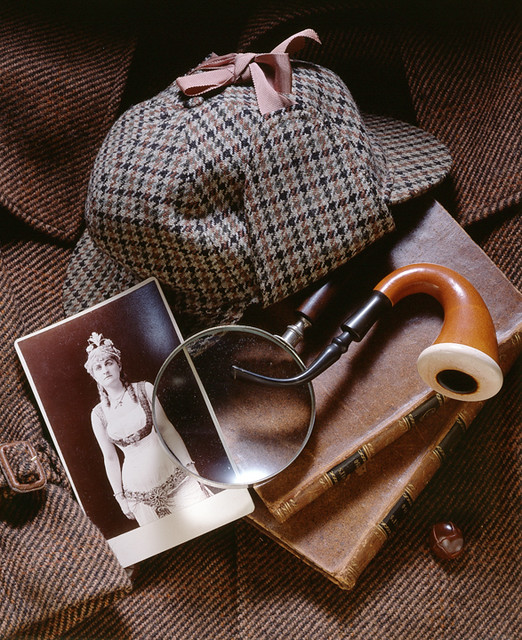
   None of the Sherlock Holmes stories are potential Valentine’s Day nominees.  The closest we get to a romantic involvement for Mr. Holmes is Irene Adler, who actually appears in only one Holmes story, A Scandal in Bohemia..  Irene Adler has no romantic scenes with Holmes in any Arthur Conan Doyle story, and in fact A Scandal in Bohemia ends with her marriage to someone else.  Nonetheless she is frequently linked with Holmes, but in various pastiches, not in the original Arthur Conan Doyle canon.

    The source for these romantic conjectures involving Sherlock and Irene probably stems from a passage in  A Scandal in Bohemia where Watson sets the stage as follows:


To Sherlock Holmes she is always the woman. I have seldom heard him mention her under any other name. In his eyes she eclipses and predominates the whole of her sex. It was not that he felt any emotion akin to love for Irene Adler. All emotions, and that one particularly, were abhorrent to his cold, precise but admirably balanced mind.
    This, plus the fact that Irene Adler is referred to, albeit fleetingly, in four other Holmes stories, A Case of Identity, The Adventure of the Blue Carbuncle, the Five Orange Pips and His Last Bow, inspired other writers, notably Nicholas Meyer and J.S. Baring-Gould, to speculate as to a romantic involvement between the two.  But none of their stories, and certainly none of Arthur Conan Doyle’s, meets our Valentine’s Day requirements of a mystery that is also a romance.

    My favorite Golden Age detective, Ellery Queen, fares no better.  While Ellery engaged in some flirtations over the years, in The Finishing Stroke for example, no actual romantic involvement ever took place during the course of the Queen novels and short stories.  Two recurring female characters appear as quasi-romantic possibilities, but, again, neither suffices for our purposes.

    The first of these is Nikki Porter who for a time was Ellery’s secretary.  Nikki first appeared in the Ellery Queen radio series and movies and was later a character in two Queen novels, There Was an Old Woman and The Scarlet Letters .  Nikki also appears in several short stories, but she and Ellery were never portrayed as a couple.  (Just as Irene Adler inspired other writers to hypothesize romantic involvement with Holmes, so, too, Nikki inspired a similar hypothesis concerning her involvement with Ellery in The Book Case, a conjecture for which I am largely responsible!)

   The only other possible femme fatale in the Queen canon is Paula Paris, a reclusive Hollywood columnist who sparks Ellery’s interest in The Four of Hearts and who also appears in several Queen short stories set in Hollywood.  (Paula also makes a brief appearance in my Queen pastiche The Mad Hatter’s Riddle.)  But, again, whatever spark there might have been between Paula and Ellery ultimately fails to ignite.

David Suchet as Poirot
    What of Agatha Christie?  Well, slim pickings there too.  As far as I can determine there was never any reference to a love interest for Miss Marple, and no love story involving her ever played a part in the Miss Marple novels and short stories.  We get a little closer with Hercule Poirot.  Poirot was apparently smitten at least once --  by Vera Rossakoff , a Russian countess who appears in The Double Clue and then re-appears in The Big Four and The Labours of Hercules.  However, while there is infatuation that is evident on Poirot’s part, at least in the course of Christie’s written word any attraction between the two remains unrequited.  So no Valentine story there.

    With Rex Stout’s Nero Wolfe we fare, if anything, even worse.  While there is the occasional female character who earns the grudging respect of Wolfe, by and large the detective is portrayed by Rex Stout as a misogynist.  Archie Goodwin describes Nero Wolfe’s views on women as follows in The Silent Speaker:


 The basic fact about a woman that seemed to irritate him was that she was a woman; the long record showed not a single exception; but from there on the documentation was cockeyed. If woman as woman grated on him you would suppose that the most womanly details would be the worst for him, but time and again I have known him to have a chair placed for a female so that his desk would not obstruct his view of her legs, and the answer can’t be that his interest is professional and he reads character from legs, because the older and dumpier she is the less he cares where she sits. It is a very complex question and some day I’m going to take a whole chapter for it.

    Well, interesting, all in all.  But not the stuff of which Valentines are made.

    As an aside, I should at least mention here the famous "e-o/o-e" theory propounded by John D. Clark, Nicholas Meyer, Frederic Dannay and Manfred B. Lee, writing as Ellery Queen, and W.S. Baring-Gould that the combination and order of the vowels in "Sherlock Holmes" and "Nero Wolfe" are a clue that Nero Wolfe is in fact the son of Sherlock Holmes and Irene Adler.  But, again, while there are Valentine possibilities here, the theory is derivative and appears only in homages and analytic works.

     We get much closer to the mark, however, with The Thin Man by Dashiell Hammett.  While it is sort of hard to believe, given all of the movie and television sequels that this book spawned, Hammett only wrote one book starring Nick and Nora Charles.  In fact, it was the last book he ever wrote.  And, even more strange is the fact that the Nick and Nora did not even appear in the original version of the 1934 novel, which was first published in a shorter version in installments in Redbook.  In any event, the romantic and flirtatious interchanges between Nick and Nora push this novel much closer to a Valentine’s Day nominee.  Indeed it was Hammett’s novel that set the stage for later spins on the “romantic couple” as detectives, notably television’s MacMillan and Wife, starring Rock Hudson and Susan St. James, and even Richard Stevenson's characters Donald Strachey and his partner Timothy Callahan, who have been referred to as the gay Nick and Nora.

    Having said all of this, however, The Thin Man is no better than a near miss, as far as I am concerned, for today’s purpose.  While the detectives are a couple, the mystery itself doesn’t tie back to or otherwise derive from their romantic involvement.

    Well, as you have probably guessed, I do have a personal favorite to nominate for best Valentine's Day mystery story.   It is Random Harvest by James Hilton. 
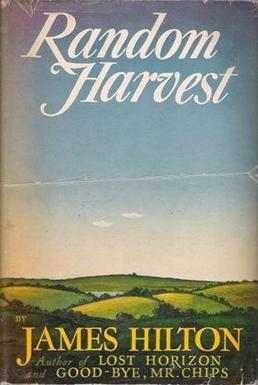
    I know, I know, Random Harvest isn’t a classic Golden Age “whodunit” mystery.  But it is a classic.  And it is also, most certainly, a mystery.  Written in 1941, Random Harvest tells the story of Charles Rainier, a wealthy businessman and politician, who battles his way out of amnesia to search for his long-lost love.  The story is a wonderful and nostalgic depiction of life in England from the First World War to the brink of the second, but it is also one of the finest classic mysteries I can remember reading.

    There is a tendency to say too much when discussing Random Harvest, and this I refuse to do.  As I have said before, “no spoilers here.”  I will offer up a snippet from the New York Times review published back in 1941:  “a strange tale . . . harrowing and romantic and tender.”   The Chicago Tribune, in the same year, called the book “Mr. Hilton’s best novel to date.”  That is saying something since Random Harvest was preceded by Lost Horizon  and Goodbye Mr. ChipsRandom Harvest is, in any event, my Valentine’s Day nominee since, to my mind, it is one of the best blends of mystery and romance ever written.

    So if there are any readers out there who have somehow gotten to 2012 without reading Random Harvest, or watching the 1942 film version starring Ronald Coleman  and Greer Garson, this book is for you.  My advice, however, is that you should look no further for information concerning the book: don't watch the movie, don't search out reviews, don't read about it on Wikipedia.  Just get the book and then read it as James Hilton intended, from start to finish without the “help” of others.

    Happily, unlike many volumes from the 1940s Random Harvest is still readily available from Amazon and Barnes and Noble.  There is even a Nook edition for $3.99.  (Sorry, apparently it has yet to be “Kindled”!)

    Enjoy. 

    And Happy Valentine’s Day.


13 February 2012

Flim-Flam or Con Artist


Jan Grapeby Jan Grape

For some strange reason I seem to like con artists. Not the ones who set up older people and cheat them out of money.  I mean the guys like Robert Redford and Paul Newman in The Sting. The con to set up bad guys who've wronged people and need to be taken.

The brilliance of a good con is intriguing.  I watched an old Law and Order TV show the other day. It was probably was filmed in the early 2000s. The con was amazing, however, the con artist were not nice people and the people they were cheating were nice people.  And unsuspecting. The story involved two people who had a lot of money.  They were both married, but not to each other.  They were both married to flim-flam artists.  The rich lady had been raped and almost killed.  In fact, she was paralyzed on one side.  Her husband was not suspected at the time and he was very supportive and solitious of her. He was the con man.

As the detectives investigated they discovered another lady living nearby who also had been attacked. Her husband was out of town and he was not a suspect.  She was the con artist.  The two cons set up a lock-smith guy to take the fall. The locksmith had installed new locks on the doors of each residence. When all that failed and the investigation led to the discovery that the con man and woman had been convicted of fraud on Canada and they had different names, the police were charging that the marriages of the two con artist to the rich man and woman were invalid because the cons used fake names.  The DA wanted the rich man and woman to testify against the con artist.  The cons lawyer said they couldn't testify against their spouses. The cons lawyer then gave the DA copies of the both con artists having legally changed their names to the phony ones they were using prior to all this.

The con artist each confessed to their spouse all their previous misdeeds and confessed also to their current misdeeds and the rich man and the rich woman each forgave the con person they were married to and that settled it. Both rich people were in love with their spouses and couldn't believe any of this was just to obtain their money.

Now I won't tell you how the DA and the investigators managed to right this horrible wrong because that would be a spoiler and you might have a chance to see the old episode and you don't want the answer revealed, do you?  (Ok, if you're dying to know, you can e-mail me at Jangrape@aol.com .)

My first thought was whoever wrote this screen play was really an excellent writer.  I don't know who it was because like most of us I don't pay a lot of attention to who the writer is.  Well, maybe I pay more attention than most people because I am a writer and I do have some interest. But I don't remember who the author was and if it had been someone I had heard of or knew about, I might remember.

My next thought was the fact that the story was very entertaining and intriguing.  There were so many twists and turns that everytime the DA thought he had the con artist "dead to rights," they had an answer. Their lawyer was able to produce conflicting evidence and keep his clients out of jail.

As mystery writers we can learn a lot from such programs.  Unfortunately, so many TV shows and movie plots are so full of plot holes that you almost run from the room screaming.  All of us, writers and readers alike really enjoy a good plot.  We like to try to figure out the "mystery," to solve the case along with the detective. I think we can all agree that if we can paint our protagonist into a corner which seems to have no way out, then we have a good story going. The reader had to keep pealing back the layers until they get to the end.

I'll admit that I'm not always the best at plotting.  I think my strongest point is characters.  I enjoy developing good, well-rounded believable characters and hope that my readers like them enough to keep reading even if they figure out "whodunit" by mid-book.  I wish I could plot better and I'm hoping that I can learn more as I continue this journey into the writing game.

But I'll just have to confess that a good flim-flam artist story is one of my favorite reads and I also admit that a good con man is fascinating.  Or maybe it's just Redford and Newman that intrigues me.