01 April 2012

Florida's Right to Kill Law


by Leigh Lundin

Three weeks ago, we brought you the story about Trayvon Martin's death when it was an early local issue. Since then the story has made national, even international headlines. The Reverend Jesse Jackson flew in and Friday the Reverend Al Sharpton called for 'action' and a boycott.

Our local NAACP has declined Sharpton's 'action' and boycott, thank you very much. We have a new prosecutor, the 11-month police chief stepped aside, and a majority of folks– including white folks– believe Trayvon Martin was terribly wronged.

Here's what most people don't know: Someone other than George Zimmerman is ultimately responsible.

Trayvon Martin

Shoot from the Lip

To be sure, radio wing-nuts assert we don't know how frightened and brave Ward Captain Zimmerman was to face an unarmed kid, and a gun group is advertising a George Zimmerman defense fund. Zimmerman's father claims we don't know all the facts and Zimmerman's brother made wild accusations that Martin grabbed the pistol and screamed "Tonight you die," which doesn't seem to fit known facts. We learned Zimmerman's magistrate father may have intervened on the side of his son in earlier arrests.

Worse, far-right sites such as StormFront have taken to defaming the teenager, falsifying photos and a police record. Yes, Trayvon was tattooed– with praying hands and a tribute to his grandmother.

In contrast, Trayvon's brother appeared level-headed and honest to a fault, saying he couldn't be certain if the screams heard on recordings are Trayvon or not. For the record, the Orlando Sentinel hired experts who, using two different technologies, demonstrated the screams weren't Zimmerman's.

Trayvon wasn't perfect, but we know that night the teen was innocent. That evening, he did nothing more wrong than buy tea and candy then walk home chatting with his 16-year-old girlfriend on his cell phone. The two had spent 400 minutes (6 hours 40 minutes!) chatting that day before the phone was knocked aside. Minutes later, he was killed mere meters from his house. [Note: We now know Rachel Jeantel was 19 and didn't consider herself a girlfriend.]

Culpability

I'm not here to demonize the shooter, much as I believe he caused a tragic death. Although Sanford's police department has had problems, I'm not sure we can focus blame on police. Why? If prosecutors refuse to prosecute, how can police jail the accused? And according to detectives, police wanted to arrest George Zimmerman but prosecutors refused.

Certainly investigators made mistakes, beginning with not dispatching a homicide detective to the scene and accepting the word of George Zimmerman without question. They did not test Zimmerman for drugs or alcohol, violating standard procedure. They uncritically accepted recorded screams were the killer's, not the victim's. They stated neighbors' stories conflicted with 'known' evidence. They refused to release the 911 calls until forced to by attorneys.

But in the end, their hands were tied. Why? You're about to find out. I'm going out on a limb and say another man is more responsible for not only Trayvon Martin's death, but the murder of dozens of other Floridians.

Legislated to Kill

This man's name is Durell Peaden of Crestview, Florida, a former state senator, the genius behind 776.013§3 that gives Floridians the right to kill with virtual impunity, a law that tripled the number of 'justifiable homicide' killers set free, jumping from an average of thirty-four a year to more than a hundred. The lobbyist behind the law was NRA's Marion Hammer who argued Floridians needed more than a right to carry a weapon, they need the right to use it pretty much at will.

In 2005, our Sunshine State pioneered a law called 'Stand Your Ground', also called 'Never Retreat', 'Shoot First', 'License to Kill' and, according to Tallahassee State Attorney Willie Meggs, 'that stinking law'. This testosterone-powered statute supplanted the common (and sensible) 'castle doctrine', which gave people the right to defend their homes. Sneering at what they called 'the Brady bunch', the NRA claimed the new statute was needed to prevent authorities from harassing law-abiding citizens with petty arrests.

It's not a 'pro-gun' law nor are the law's opponents anti-gun, although politicos on both sides may argue otherwise. The new statute legalized an aggressive never-back-down philosophy. It says you don't have to walk away from a confrontation. It says you have the right to solve problems with a gun or a baseball bat or a knife or an ice pick.

Applied Murphy's Law

With impunity, it allowed a man to kill another in a playground argument over a skateboard– literally. It allowed a homeowner to legally shoot an inebriated man who knocked on the wrong door and asked for a light. Alcisviades Polanco walked after fatally stabbing another in the head with an ice pick. Numerous avoidable bar fights have needlessly ended in death… and without penalty.

Six months ago, Judge Richard Oftedahl of the 15th Judicial Circuit dismissed all charges against Michael Monahan, charged in a double homicide and facing the death penalty. Monahan walked after shooting two unarmed men from a distance of twenty feet, men who never laid a hand on him.

No Bad Deed Goes Uncopied

This bill was strongly opposed by law enforcement, prosecutors, liberals and conservatives alike, although it appealed to excitable wing-nut elements. Since its inception, as many as twenty-four states copied it.

Its first five years saw nearly a hundred claims of use with more than two-thirds resulting in death. The vast majority of these homicides were excused by prosecutors or, in cases where prosecution actually occurred, given a pass by the courts.

Those favoring the law declare it a great success with fewer people clogging the courts. Victims like Trayvon Martin might argue otherwise. Many of the cases have only two witnesses… one who winds up dead.

Law of Unintended Consequences

Police and prosecutors tried to warn legislators about the predictable effects of the law, but lawmakers blew off their concerns, seduced by NRA donations and that exciting chance to kill a human being. Sadly, they're not the ones paying the price.

For the record, if you think I'm letting George Zimmerman off the hook or if you think I'm opposed to gun ownership, then you've misread the article. What I'm for is common sense which is sadly missing in Florida.

Maybe it's legislative sunstroke.

One more small thing bothers me. In researching this article, I came across two cases in which Florida courts disallowed the Stand Your Ground defense. In both of those cases, the shooter happened to be… black.

31 March 2012

A Familiar Face


I think it's safe to say that most people enjoy the films of Alfred Hitchcock. Even my mother, who doesn't watch many movies at all, watches Hitchcock movies. It's not that suprising, really. He was successful for the same reason that writers like Stephen King are successful: their first priority is to entertain. Hitch knew how to hook viewers right away and keep them interested throughout the story.

Holding us Spellbound


For those of us who love his work rather than merely like it, there's a little bonus we get with every film. For some reason--probably egotistic--the Master Director himself appears on screen, for just a moment, in almost every one. In some of his movies you never know where the cameos might pop up; in the later ones, though, he decided to restrict most of those surprise appearances to the first few minutes of the film. Why? Because moviegoers had learned to watch for them. Hitchcock--always the professional--didn't want anyone to be distracted from the story, and if the cameo happened early, alert viewers could get it out of the way and direct their undivided attention to the plot.

I heard or read someplace that one Hitchcock documentary (a DVD bonus feature) mentioned plans for a cameo where Hitch and a deaf woman are walking down the street, and he says something to her using sign language and she slaps him in the face. I've watched most of those "special feature" documentaries on Hitch and his movies, and so far I haven't seen the one that talks about this--but I love the idea.

To Spot a Director

Anyhow, here's a recap of the fifteen most recent Hitchcock cameos. I started with 1954 for a couple of reasons: (1) I don't want to go all the way back to the late twenties, and (2) '54 was the year that two of my favorite Hitchcock films were released (I couldn't ignore those).

See how many of these Hitch "pop-ups" you remember . . .

Rear Window (1954) -- He's winding a clock in the songwriter's apartment, seen of course from Jimmy Stewart's window. The songwriter, who's playing the piano at the time, is real-life composer Ross Bagdasarian, Jr.

Dial M for Murder (1954) -- My favorite of all his cameos. He appears in a framed photo of Ray Milland's class reunion, sitting in a tuxedo at a table with Milland, Anthony Dawson, and others.


To Catch a Thief (1955) -- He's sitting beside and to the left of Cary Grant on the rear seat of a bus. Grant gives him a curious look, but Hitch stares straight ahead and neither of them says a word. On the seat to Grant's right is an old woman and a cage that contains two fluttering birds.

The Trouble With Harry (1955) -- One of the hardest cameos to spot. He's seen through a window, walking in a tan overcoat down a rural lane past a parked limousine. The old man who owns the limo is studying an outdoor exhibition of artwork while his driver waits beside the car.

The Wrong Man (1956) -- He is seen only in silhouette, while narrating the film's prologue. This probably shouldn't be counted as a cameo; according to a biography by Donald Spoto, Hitch chose to make an actual appearance rather than a cameo because this movie, unlike his others, was a true story.

The Man Who Knew Too Much (1956) -- He walks up and joins a crowd watching acrobats in a Moroccan marketplace. He's facing away from the audience and standing several feet away from Doris Day and The Man Who Would Soon Know Too Much.

Vertigo (1958) -- He's walking down a city sidewalk wearing a dark suit and carrying a black trumpet case.

North by Northwest (1959) -- During the opening title sequence, he rushes to a catch a bus but just misses it--it closes its door and leaves him standing at the curb.

Psycho (1960) -- He's seen standing on a Phoenix sidewalk outside Janet Leigh's office window as she opens the door and walks in. He's wearing what looks like a cowboy hat.


The Birds (1963) -- He's leaving a San Francisco pet shop with two white dogs on a leash as Tippi Hedren enters it. Moments later she meets Rod Taylor there in the shop, and the plot is afoot.

Marnie (1964) -- He steps into a hotel hallway after Tippi Hedren and a bellboy walk past. He looks at them a moment, then turns and stares straight into the camera.

Torn Curtain (1966) -- He's sitting in a hotel lobby balancing a baby boy on his right knee, and after several seconds picks the boy up and shifts him over to his left knee.

Topaz (1969) -- My second-favorite cameo. He's in an airport being pushed in a wheelchair by a lady in a nurse's uniform, and suddenly he stands up from the chair, shakes hands with a man in a dark suit, and walks away.


Frenzy (1972) -- He's in the middle of a crowd, wearing a black hat and listening to a speech, and is the only person not applauding. A minute or so later, he's shown in a crowd again, standing next to a man with a gray beard.

Family Plot (1976) -- He's seen in silhouette on the other side of a door, talking with--and gesturing to--another man.

And remember, that was less than half of them. In all, I'm told Hitchcock made 36 cameo appearances--37 if you count the opening of The Wrong Man--in his fifty years of directing.

Dial T for Trivia

For anyone who's interested, here are some useless facts involving Hitchcock cameos:

In many of them--at least ten--he was just walking through the scene, and in several (Spellbound, The Paradine Case, Strangers on a Train, and Vertigo) he was carrying cases for musical instruments.


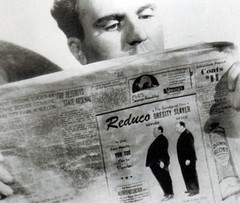
At least three cameos (Rope, Lifeboat, and Dial M for Murder) are especially interesting because most of the filming for each was limited to a single location, which also limited the opportunity for Hitch to "appear." I've already mentioned Dial M; the cameo in Rope was a through-the-window glimpse of him strolling in the street below and the one in Lifeboat was a newspaper ad showing "before and after" photos for a product called Reduco Obesity Slayer.

He had two cameos each in five of his movies: Suspicion, Rope, The Lodger, Frenzy, and Under Capricorn.

Don't forget TV: In an episode of Alfred Hitchcock Presents--"A Dip in the Pool"--Hitchcock is shown on the cover of a magazine being read by Philip Bourneuf.

Back from the dead: In Psycho II (1983), when Tony Perkins and Meg Tilly enter "Mother's" bedroom, Hitch's silhouette can be seen in shadow on the wall just before they turn on the lights. (He passed away in 1980.)

The Trouble With Copycats


I think it's fun anytime I see directors appear in cameos in their own movies--Rob Reiner, M. Night Shyamalan, Ron Howard, John Carpenter, Sir Richard Attenborough, Oliver Stone, etc.--but I never see them without thinking of Hitchcock. And I usually enjoy the cameos more when they're very brief. If they're too long, they start calling too much attention to themselves.

One of my favorites is Roman Polanski as a thug with a switchblade in Chinatown--he's the one who causes Jack Nicholson to walk around for half the movie with a bandage on his nose. The cameo isn't short (although Polanski is), but I enjoyed it anyway. It's certainly memorable.

Even so . . . he's no Alfred Hitchcock.


30 March 2012

the Sixth Sense


by R.T. Lawton

Those who have lived on the edge and survived can probably tell you about times when their brain tingled or they had that "certain feeling." All of us are aware of the first five senses we use on a daily basis for everyday living, but what about that sixth sense, the one that tells us something is about to happen? Have you felt it? Was it correct? How did it affect your next actions?

My Mother often had premonitions. Naturally, the ones I heard the most about dealt with me getting into some kind of future trouble. In later years, I came to think the warnings she got from her premonitions had more to do with her neighborhood intelligence system of other mothers who kept track of the local kids, especially those boys most likely to indulge in some type of frowned upon behavior, plus whether or not the "good" kids were mixing with the "others." So no, in that case I don't really believe my Mother was fey, she merely had a good data base from which to project good possibilities. Now her full blood Prussian mother on the other hand was someone not to trifle with when it came to superstitions and premonitions.

But perhaps we should differentiate between "getting a feeling" those times when the brain has other information to input from your surroundings as opposed to the circumstances of "getting that feeling" out of the clear blue nothingness. To use an analogy from modern sci-fi movie culture, let's define the latter as a "disturbance in the Force." I choose this analogy not to trivialize the subject, but rather as the simplest concept for explanation.


Llet's say you are in a squad of armed men patrolling in the mountain jungle several klicks from base camp. Your point man, the troop most experienced in booby traps and the ways of your enemy, leads your squad down into a valley with tall bamboo growth on both sides of the trail. The path is faint with no recent tracks from boots or other footwear, but it is known that other people have used this trail in the past. There are no obvious signs of mismatched dirt where the earth may have been dug up and a mine planted, and there are no patches of fallen vegetation which might conceal a punji pit or other booby trap. No wires found to trip a claymore mine, nor to slide a grenade, with its pin already pulled, out of the open end of a tin can tied to the base of a tree along the trail. Nothing at all to indicate that the enemy is waiting ahead to ambush you in the valley. Yet, your point man suddenly raises one fist and freezes like a statue.

Why? More than likely, his brain has been fed other information. Those living on the edge get spurts of adrenaline that make them super aware of their surroundings. They have also acquired habits of noticing the things that matter to their survival. Their ears become attuned to certain sounds, or the lack thereof. Their eyes tend to recognize patterns that aren't quite the way they should be. Sometimes, their sense of smell becomes more acute. And, their brains compute faster.

It could be that your point man has noted the sudden lack of animal or bird sounds in the landscape ahead. Maybe he smelled the enemy. There were those in Nam who said they could sometimes detect the aroma of rank fish sauce emenating from the enemy's sweat. Of course that can work both ways. In the Cav, we were told which soaps to use so as not to leave a distinctive odor on ourselves for the enemy to smell.

Whatever it was that tingled the brain of your point man, he feels that something is not right in this valley. He backs your squad away. Is this a matter of his sixth sense kicking in? I think so, but I also believe this is one of those situations where the man's super awareness of his surroundings may have fed other barely noticeable, minute information to his brain, and his brain alerted him to a danger ahead. He may not consciously know what that warning information consisted of or where it came from. And then again, he may have sensed a "disturbance."

As for the "disturbance in the Force" type of sixth sense, I don't know that I can explain why it happens. It's like a thought or strong emotion has been pushed through the air and the person on the other end feels a presence is there. Can just anyone pick up on this disturbance if the thought or emotion is directed at him or her? Maybe, if they are in the right state of mind and their brain is not distracted by something else. I do believe that those with their brains amped up from living on the edge are more attuned to detecting these disturbances, or whatever you want to call them. Several times in my working days, I had the distinct feeling of being stared at, turned suddenly and found a person from one of my cases, or a person who had developed an interest in me. Most occured at close range, such as inside a bar or restaurant, or across the street. At least once from a block away. It's an eerie feeling, but better to have it than to walk blindly into something.

In suspense, thriller and horror novels, you sometimes read about hair standing up on the back of the neck of one of the story characters when he feels he is being watched, or he feels something dangerous is about to happen. To me, that can be a real situation, but it has never been the hair standing up, it has always been the slight tingle in my brain.

What about you? Have you experienced the Sixth Sense? Or are you a skeptic? Me? I'm a partial skeptic because of all the frauds out there who use tricks of one kind or another in order to claim they have "special powers." I only believe in the parts I've experienced myself. That's all anecdotal evidence, but if you want a more scientific explanation, then see what modern psychology researchers have discovered recently in controlled tests : http://www.psychologytoday.com/articles/200007/is-there-sixth-sense

29 March 2012

Your South Dakota Correspondent


by Eve Fisher

Hello, all SleuthSayers!  

I'm Eve Fisher, new contributor and correspondent from South Dakota.  Not that I'm from around here.  Actually,  I've never been from "around here," wherever "here" was - I was adopted at three from Athens, Greece, and I have moved a lot since then.
I've lived on both coasts, spent almost two decades in the South (Kentucky, Georgia, Tennessee and North Carolina), and I currently live in small town South Dakota, along with my husband, my cat, and (at last count) five thousand books.  (So many books, so little time...)  And, along the way, I've been to almost every state in America, including every national/state park, monument, giant ball of string and iguana farm west of the Mississippi.  I even stayed (as a child) in the teepee motel on Route 66!

I've had a lot of variety in my working life, too, ranging from an early job as a part-time clerk in a seedy corner market in Atlanta (where I was the only woman to work there who wasn't robbed or shot - more on that another time), to teaching history at the university level in Brookings, SD.   I've worked for ballet companies, lawyers, CPAs, pizza places (I make a great pizza dough), judges, fabric stores, and for quite a while I was the circuit administrator for one of the South Dakota judicial circuits, which enlarged my acquaintance considerably on both sides of the law (more on that another time, too).  

I primarily write mysteries, some fantasy/sci-fi, and primarily short stories.  I’ve been fortunate enough to have had many publications in Alfred Hitchcock Mystery Magazine - I'm in the May issue along with Rob Lopresti, R. T. Lawton, and many others.  Honored as always, both to be published and to be in great company!  You can find all of my published stories (or links thereto) at my website at http://evefishermysteries.wikispaces.com/ 

So, having said all of that...  
 
Almost all of my writing -  no, I'd say all of my writing starts with either a character or a place that takes over my mind.  
For example, I was sitting in a local restaurant, where a (locally) well known and well-respected couple who shall be nameless walked in as the restaurant phone rang.  The man turned to his wife and said, "I'll bet that's for you.  I wish I had my gun, I'd shoot it."  Well, that sparked "The Lagoon".

My story "At the End of the Path", a strange mix of mystery and fantasy, is set in a half a mile long path between ordered rows of pine trees at our local state park, a path set high up on a ridge, planted a very long time ago, by persons unknown, a path somewhere between a refuge and a haunting, and the light draws you on and on until the very end.  
Then there's "Not the Type", which is based - only partly! - on a real incident, decades ago, where a girlfriend and I ran into an old boyfriend of mine and his new wife.  She took one look at me and decided that my girlfriend was the one he'd dated, and acted accordingly.  Not necessarily a good idea. 
And "Drifts", one of my personal favorites, which...  well the cover says it all:  "Winter is a season, a menace, a playground, and a weapon."

Anyway, it's great to be part of SleuthSayers.  Next time I'll share some scenes behind the scenes, or whatever curious incidents come up.  Speaking of incidents, did I mention that a couple of months ago we had a premeditated murder in our nice small town?  All because of an incident in the locker room in high school almost fifty years back:  Resentments really can kill you.  
More later,
Eve

28 March 2012

Department of Lost Stories


by Robert Lopresti
 
Tin Foil Hat Area by sictransitdiesoccident
illustration by sictransitdiesoccident

I am writing this piece for purely selfish reasons but, who knows?  Maybe we can perform a public service here if we get enough participation going.

Have you ever remembered a favorite short story, one you were crazy about, but you realize you can't pull up the author or title?  That drives me nuts.  So this is your chance to help me regain my sanity.  I will describe four stories (no spoilers).  If any of them sound familiar, let me know.  And if YOU are missing any great stories put that in the comments as well (again, no spoilers, please)

If Blogger rejects your comments please send them to me at lopresti AT nas DOT com

Here we go.  The titles below are just place holders; I don't know what the real titles were.

1. Tin Foil Hat.   A paranoid gentleman prepares for his day, wrapping his torso in plastic wrap to avoid germs, putting fresh tinfoil in his hat, etc.  He goes for a stroll and gets into an argument with a security guard in front of an office building, with tragic results.  Then we see the events from the viewpoint of the people in the building, which gives us a different perspective.

I thought this story was by  Lawrence Block.  It certainly feels like his kind of piece. But I recently wrote to him and he agreed that it was a good idea, but it was someone else's.

"My Life Is A Soap Opera" by ddpool
illustration by ddpool

2.  Soap Opera.  An actress is about to be written out of a soap opera.  She saves her job by committing -- well, I don't know a name for the crime she commits.  It is that unique.

I think this was in Ellery Queen in the 1980s.

6-20-07 bird shell in nest by nawtydawg 
illustration by nawtydawg
3.  Bird reincarnation.  A man wakes up and realizes he has been reincarnated as a bird and is literally coming out of his shell.  Yes, it's a crime story.

I think I read this in Alfred Hitchcock around 1970.

Carlsad Inn Beach Resort Pool by ResorTime.comillustration by ResorTime.com
4.  Resort love triangle.  I have to be really vague to keep from giving spoilers.  It is a love triangle that ends in murder.  In the last paragraph you find out what sort of institution the people are living in and that changes your perspective.

Again, Hitchcock around 1970.

Any clues?  Any vague bells tinkling?  Any stories of your own to add?


27 March 2012

Gone South III -- Play Ball!


Space Coast Stadium, Viera Florida -- Spring Training home of the Washington Nationals

     Several weeks back I mentioned the geographic challenge of uploading timely articles every second Tuesday during the winter months.  Pat and I decided years ago that once we retired we were going to spend as much time as possible each winter away from our home in Washington, D.C.  This year that meant that for three weeks in January we were in the Caribbean – two weeks of which were on a sailboat with the spottiest internet imaginable.  We came back from that trip to spend two weeks at home, making certain that our adult sons had not completely trashed the house, and then took off again to Gulf Shores, Alabama for two and a half weeks in February.  We lucked out there with great internet available in the condo we rented.  Then after another two weeks of checking on the house we are off on the last of our winter trips – a week and a half in Florida devoted to watching the Washington Nationals’ Spring training.  I’ll have some internet access there, but to be on the safe side this article will be scheduled before we leave. 
"Smartie" getting off of the Autotrain.  Everyone laughed.

    While we drove to and from Gulf Shores, our Spring Training tradition sends us south on the Autotrain.  This allows us to leave our bigger "road trip" car in D.C. and travel instead with our convertible Smart car, which would never otherwise see Florida.  (I can’t imagine 900 miles of I-95 in Smartie).


    The train is always a blast. --  dining cars, where, as a couple, we invariably sit across from people we have never met, and lounge cars where strangers sip cocktails together while watching the scenery pass.  No wonder  trains  have always been fodder for mysteries.  I can’t ride an overnight train without thinking of The Lady Vanishes,  Hitchcock’s second-to-last British film.  The 1938 movie (based on the largely forgotten book The Wheel Spins by Ethel Lina White), together with Hitchcock’s 1959 American film North by Northwest and Agatha Christie’s Murder on the Orient Express all capture the microcosm that is train travel – a self-contained slice of life, detached from the rest of the world by movement.  No wonder that trains afford a perfect setting for classic golden age mysteries – how better to contain your story and all of your suspects?  While ocean liners are a close second, nothing beats the tightly cabined setting of a train.

    So to and from Spring Training I have little trouble conjuring up SleuthSayer thoughts.  But what about baseball itself? 

    For whatever reason the nation’s pastime hasn’t provided much of a setting for mystery stories.  Perhaps readers will offer up other examples, but the only ones that spring readily to my mind are the Ed Gorgon stories by the great Jon L. Breen.  Jon started the series way back in 1970 and has written that his original inspiration for Ed Gorgon, the baseball umpire who repeatedly is called upon to solve mysteries between calling balls and strikes, was that Frederic Dannay, then editor-in-chief at Ellery Queen Mystery Magazine, liked nothing better than baseball and dying messages.  So Jon served up both in Diamond Dick, the first Ed Gorgon story..  That story, and the further installments in the series, spanning thirty years, are collected in Kill the Umpire: The Calls of Ed Gorgon published by Crippen and Landru in 2003. Jon's collection is a fun read and is available at Amazon, Barnes and Nobel, or direct from Crippen and Landru.   (Tell Doug Greene that Dale sent you!)

Shoeless Joe and Ty Cobb, 1913
    If one casts a wider net other non-mystery baseball stories can be reeled in.  Much of the literature that has derived from baseball seems to have its roots in the Black Sox scandal, in which various members of the Chicago White Sox were charged with conspiring to throw the 1919 World Series.  Even though they were acquitted by a Chicago jury, eight players were eventually suspended from baseball for life, including (famously) Shoeless Joe Jackson, who got his name from once running the bases without his shoes on, and who may have been the greatest baseball slugger of all time.  Ring Lardner was a young reporter covering the scandal, and his impressions of Shoeless Joe were said to be the inspiration for his baseball short stories that were later collected in You Know Me Al, a series of letters authored by a vernacularly-challenged ball player.  Lardner uniformly portrays the White Sox players in You Know Me Al as semi-literate and hopelessly avaricious. 

    A real life episode that has repeatedly found its way into baseball lore followed Shoeless Joe Jackson's appearance before a grand jury empaneled to investigate the conspiracy allegations.  On September 29, 1920, The Minneapolis Daily Star, during the course of reporting on the scandal, published the following account:
When Jackson left criminal court building in custody of a sheriff after telling his story to the grand jury, he found several hundred youngsters, aged from 6 to 16, awaiting for a glimpse of their idol. One urchin stepped up to the outfielder, and, grabbing his coat sleeve, said:

"It ain't true, is it, Joe?"

"Yes, kid, I'm afraid it is," Jackson replied. The boys opened a path for the ball player and stood in silence until he passed out of sight.

"Well, I'd never have thought it," sighed the lad
    The line, and the saga of Shoeless Joe, who may or may not have been guilty as charged, reverberated through baseball literature.  In Bernard Malamud’s The Natural the central character, Roy Hobbs, is offered a bribe to throw a game and is then confronted by a child who says “Say it isn’t true, Roy.”  (The line is only in the book, so don’t look for it in the 1984 Robert Redford film!)   The story of Shoeless Joe is also at the heart of the Kevin Costner film Field of Dreams, based on Shoeless Joe by W.P. Kinsella.  And, finally, anyone who has seen the movie or stage production of Damn Yankees (a story close to the heart of any Washington, D.C. baseball fan) will remember the refrain “Shoeless Joe from Hannibal Mo.”  (Hannibal Mo. had nothing to do with Shoeless Joe, but, hey, a song’s gotta rhyme, right?)

    Well I should stop here and start packing.  We are off on one last winter trip to the south.   Hopefully when we head back to Washington D.C. it will be spring, because if winter persists it will be me who you will hear lamenting “it ain’t true, is it, Joe?”

26 March 2012

Lovely Spring Day


Jan Grape
by Jan Grape

Today is a lovely spring day in Central TX. We've finally had a bit of rain and lots of sunshine and the wild flowers are blooming and the Texas Bluebonnets are awesome. They are all over the place and even a few plants in my front and side yard are blooming. I've always wanted bluebonnets in my yard but this is the first time. I didn't plant them, the wind and birds must have seeded my whole neighborhood. Makes me happy to see them. So happy that I even decided to cook this evening. Now that is a rare treat because I don't usually cook a meal. I eat out at least 2 nights a week, going to my favorite restaurant and listening to local singer/songwriters and visiting with the other regular Tuesday and Wednesday night music lovers. Then at least one night a week, if my grandson, Cason, is home, we order pizza from our local pizza place. They use only fresh ingredients and make your pizza to order. The other nights if Cason isn't home, I sorta eat whatever I have on hand. Maybe only a sandwich or a bowl of soup. But today I made meatloaf and mashed potatoes and green peas. I also had the makings for a salad but forgot to do it. (Never said I was a gourmet...lol.) But it was all good and I had a nice glass of wine. Cason seemed to enjoy it all except the peas which he said he really didn't care for too much.

This week-end I've been doing some copy-editing on the anthology that I'm co-editing. R Barri Flowers and I have co-edited our second American Crime Writers League (otherwise known as ACWL) anthology. This one, MURDER HERE, MURDER THERE is due out around May 25th from Twilight Times Books. Our first ACWL anthology was MURDER PAST MURDER PRESENT. All of the stories are by members of ACWL and include such names as Jay Brandon, Kris Neri, Dakota Banks, John Lutz, Taffy Canon, Ed Gorman, Robert Randisi, Bill Crider, Candace Robb. We have as many members who are multiple winners and nominees for all the mystery awards than any organization around. This new book features some of the same authors as in the first anthology, but also Marlys Millhiser, Noreen Ayres, Valerie Malmont, Edward Marston Claire Carmichael, Jim Ingraham & Lauren Haney. Some of the finest short stories I have ever read are soon to be available to everyone.

I love good short stories and although there's not a big demand for them right now, I think they are perfect when you just have a few minutes and want to read a little mystery but don't have the time to devote to a full-length novel. My daughter, Karla, mentioned several years that because she was a busy, working mother that she really didn't have time to read a novel but she could sit down for a few minutes or an hour and really enjoy the suspense and pleasure in a short story. It's also a good way for writers to stretch their writing and play with some new characters rather than always writing about their series characters. However, sometimes a writer will use series characters in short stories but place them in a different time or place and just have a lot of fun with a shorter length.

My writing career actually began with short stories. I published around twenty-five short stories before I ever sold a novel. For this anthology, I wrote a story with my female private-eye characters, Jenny Gordon and C.J. Gunn. The story is titled, "The Confession." I haven't written anything with Jenny and C.J. in several years and enjoyed visiting their lives once again. I never had a novel published with them but wrote around a dozen short stories with the owners of G & G Investigations. In fact, one story with Jenny and C.J., won the Anthony Award at the Bouchercon in Philadelphia in 1998. The story, "A Front-Row Seat," was published in the VENGEANCE IS HERS anthology from Signet.

If you have time, read a short story and enjoy spring, where ever you happen to be today.

IN MEMORY:

A young soldier, PFC Payton Jones, from Marble Falls, TX, age 19, was killed in Afghanistan a few weeks ago and his body was brought home for services and burial. As usual with many small towns there was an out-pouring of respect for the young soldier and his family. Several hundred people, myself included, lined the street as the procession came into town from a nearby airport. The final leg of the soldier's 7,000 mile journey home.The Kiwanis Club always has flags for patriotic days and for something like this showing support and respect. The Patriot Guard of motorcycle riders, all veterans, came first, followed by Firetrucks, EMS vehicles, police and sheriff vehicles all from surrounding communities, then the white hearse carrying our hometown hero, his family and friends to the funeral home. It was a sad moment but also heart-felt as we all stood at attention along both sides of the street, hands over hearts, most of us holding a large flag on a metal pole or waving a little flag. Only a small gesture, but in some small way letting his family know, we were heartbroken with them. RIP Private Jones.