11 March 2012

Florida News (Pathos and Bathos)


by Leigh Lundin

Florida postcardAsinine Mule

Stuart, Florida.  How desperate is your cocaine habit? Martin County police arrested Roman Blair on drug charges and found crack in his, er, crack. What an ass.

Streaking Justice

Melbourne, Florida.  While one dude had crack problems, another had streaks. Melbourne fugitive Matthew Ibarria was caught napping naked in Georgia. The (alleged) fool decided to outrun police and smartly turned onto a street that dead-ends at a river, where he bailed. Vans don't float and neither did Ibarria's excuses.

Elvis has Left the Asylum

Miami, Florida.  In 1990, Michael Conley was convicted of murdering a Canadian tourist at a Fort Lauderdale motel, but beat that rap due to prosecutorial error. Last month he was back in a motel threatening police SWAT, bomb squad, and FBI with ricin and C-4. He later blamed the threats on 'diabetic disorientation'. Conley is known for another crime: He's an Elvis impersonator who sang outside the courtroom during his murder trial.
Elvis

Elvis has Gone Bananas

Naples, Florida.  It gets worse: A man monkeying around with a gun claimed to be Elvis' brother, a friend of George Bush, and director of the CIA, also told police he's part orangutan related through 'monkey blood'.

Government Gone Bananas

Miami, Florida. 
2600 high school kids helped shape government response when adults miserably failed.

A top Miami senior honors student and valedictorian who's studying to become a heart surgeon and is courted by Ivy League schools, is caught up in the politics of the day. Even though Daniela Pelaez has lived in this country since the age of four and her father and brother (who serves in the US Army in Iraq and Afghanistan) long ago had been given legal residency, a federal judge last week set an example and denied her and her younger sister a green card and ordered the siblings deported to Columbia.

Shocked at this miscarriage, her fellow students made Miami proud, making posters and planning a protest, joined by Superintendant of Schools Alberto Carvalho. Congresswoman Ileana Ros-Lehtinen wrote ICE asking them to exercise restraint.

Even the White House made its concerns known. Vice President Joe Biden called the decision 'mindless'. He went on to say "Why in God's name would you want to take a kid with this talent and this capacity and deport her? It's against our national interest."

And ICE 'sort of' listened. They postponed Daniela's deportation for two years. It's not a perfect decision, but it's a start.

On a Sad Note
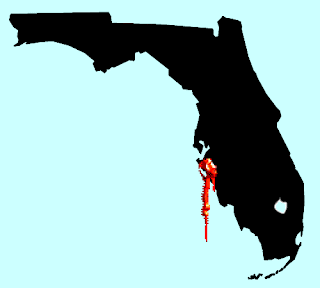
Floorida bleeding

Sanford, Florida. 
At one time, I had an Orlando neighbor who was in his mid-to-latter twenties. He obviously worked out heavily and he cultivated an intimidating stance in which he leaned forward, looming large toward those he was talking to.

Within the first few minutes of meeting someone and often after that, he'd inform people he was a former cop. "Why 'former' cop?" another neighbor mused. "At his age, that would be an awfully short career. I wonder if he was dismissed?"

Two weeks ago in the town of Sanford directly north of Orlando, a teenage boy was strolling down quiet, gated community streets of The Retreat at Twin Lakes, having bought an Arizona Iced Tea and Skittles for his little brother. Minutes after his purchase, Trayvon Martin was shot dead.

To date, there has been no arrest or even hint of an arrest.

There is no doubt who shot him; in fact, the killer readily admitted he killed the boy. The shooter used a licensed 9mm automatic. The killer also happens to be the 28-year-old captain of his Neighborhood Watch who, according to friends, is studying to be a cop.

And… the boy is black and the shooter is white.

Which brings up the question circulating here in Florida– why hasn't the shooter been arrested?

The man, George Zimmerman, violated several rules. First, Neighborhood Watch wardens are not permitted to carry firearms. Secondly, they are supposed to travel in pairs and aren't allowed to confront suspects. Thirdly, the police 911 operator apparently instructed Zimmerman not to follow the 'suspect' and not to leave his car. I say 'apparently' because authorities haven't released the 911 recording.

Zimmerman disobeyed all those instructions and a boy is dead.

His defense is… self defense. He claims he was within his legal rights both in confronting the victim and 'shooting in self-defense' with his legally permitted weapon. This against a teen armed with tea and Skittles.

Debate on the web has polarized: one side questions if Zimmerman was a gung-ho cop wanna-be who started a fight and was possibly getting his ass kicked, or if the boy was a troublemaker recently disciplined in school. Some have absurdly questioned why a teen boy was out strolling at seven on a Sunday evening!

Three things appear obvious to me. One is that Zimmerman can't claim a castle defense. The boy didn't attempt to enter anyone's home or car. His sin may have been WWB, walking while black.

Another is that few of us expect to lose a son on a quiet Sunday evening's stroll. The Martins certainly deserve to see the case in court.

And finally, a family's lost a child and a man his reputation. No matter what happens in the future, he has a death on his hands. There are no winners here.

10 March 2012

Down on the Bowery


by Elizabeth Zelvin

In my new mystery, Death Will Extend Your Vacation, my recovering alcoholic protagonist, Bruce Kohler, and his friends have shares in a clean and sober group house in the Hamptons. But the first book in the series, Death Will Get You Sober, started with Bruce waking up in detox on the Bowery on Christmas Day.

The Bowery in lower Manhattan, along with Seattle’s Skid Row and its namesakes in Los Angeles and other cities, had long been synonymous with down-and-out chronic alcoholism. The area was famous for its bars and flophouses as well as the “Bowery bums” who came from all over the country to drink cheap Thunderbird and sleep it off in the gutter.
Some of my SleuthSayers blog brothers have been dazzling us with action-packed accounts of their experiences in law enforcement and the military. I’ve never fired a gun or made an undercover drug buy. But these are my war stories.

I first went down to the Bowery in 1983. I was not yet a clinical social worker with a master’s degree, and no one dreamed the Bowery would ever become the gentrified, trendy neighborhood it is today.
For a seminar connected with getting my alcoholism counseling credential, I had a choice of places to intern. My professor urged me to pass up the expensive private clinic and go down to the Bowery. “You’ll love it,” he said, and he was right. I caught the very end of the era before the homeless spread out all over the city. There were only a few bars and two or three genuine flophouses left. But walking down the Bowery from Astor Place, you entered another world when you crossed Fifth Street.

The program was housed in the notorious men’s shelter on Third Street, still a scary place at that time. To reach the elevator, you had to breast your way through crowds of not too sweet-smelling men who stood around in a fog of cigarette smoke. The elevator had no buzzer. To get to the program on the fourth floor, you had to pound on the scarred elevator door with your fist, and eventually Wisdom the elevator man would bring it creaking down to get you. (His name was Winston, but no one called him that.) You took your life in your hands if you used the stairs.

My first day as an intern, the last of the cops who’d formed the first “rescue team” in 1967 to bring “Bowery bums” to detox instead of just throwing them in jail took me out with him. It was Check Day, when all the guys on any kind of public assistance or veteran’s benefits got their monthly check. So nobody was lying in the gutter. The cop said we’d find them in the bars. It was 10:30 in the morning. I remember the sun slanting down across the bar, the dust, the bartender polishing a glass, and the row of heads that turned toward us in unison.
They all knew the cop. They knew why we were there. The bartender sounded like an elevator man in Bloomingdale’s. He said, “Fourth floor! fourth floor! who wants to go?” They knew exactly what he meant. They’d all spent many nights in the shelter. Some of them had been in detox 60 times.

One elderly gentleman slid off his stool and announced, “I’ll go!” He was small and grizzled, and I remember his baggy black and white checked pants. Chatty in the police car as we drove the short distance back to Third Street, he told me he’d once been a social worker himself. Not likely, the cop told me.

I kind of telescoped the gentrification of the Bowery in the book. But the shelter was cleaned up by the time I went back in 1993 as program director of an outpatient alcohol program. The building also housed a drug therapeutic community. I once walked up the formerly dangerous stairs in a Santa Claus hat and a red feather boa to help sing Christmas carols in the detox. During the later 90s, chi-chi restaurants and fern bars started moving onto the Bowery. A block east, blue recycling garbage cans stood neatly in front of the Hell’s Angels clubhouse. Their stretch of Third Street curb was painted yellow. The city had put up a sign: “Parking reserved for Hell’s Angels motorcycles only.”

Today, the building has been thoroughly renovated, though it still houses social service programs.
There’s a chic restaurant on the corner and a boutique hotel beyond it, with an outdoor patio bar looking onto the 18th century graveyard hidden behind the facades of the buildings that form the square between Third and Second Streets and the Bowery and Second Avenue.
When I left in 1999, it was still a secret wilderness of spiky grasses, wildflowers, and a gnarled old tree or two, its silence broken only by birdsong and the occasional yowls of mating cats. Now it looks like a park.
Tourists can visit the New Museum, the Bowery Poetry Club, and the Bowery Ballroom. I just took a quick look at the latter’s website and had to smile at some of the “Rules and FAQs” for the music venue:
No flyers, stickers, handbills.
No outside food, beverages, markers, spray paint, weapons (includes pocket knives).
Handicapped seating is available.
You must show proof of age by government-issued photo ID to be served at the bar.
You will be ejected for throwing ANYTHING.

My, how the Bowery has changed.

09 March 2012

Explosives 101: RE Factor


I’ve been busy lately: writing a synopsis for my current novel so I can shop it to agents, working on three short stories that won’t let me alone (drives me crazy in the middle of the night!), writing and assembling a “Parents Packet” for the folks at my church who want to send their kids to summer camp (that took 4 solid days!), and watching my kids (which also means driving them all over creation) this week because they’re home on Spring Break.

This is by way of apology for not having time to post comments on very many SS articles over the past couple of weeks. They’ve all been great; I’ve truly enjoyed reading every single one—but when it comes to posting comments, I’m really sorry. Too often, time management problems have reached out to snag me by the throat!

I wrote this post on Thursday morning in Scottsdale, Arizona. SS posts go up at midnight eastern time, which is 10:00 pm local time, and I’m scheduled at the cigar store from 4:00 pm to 9:30 pm. Which means: I need to put something together that folks will find worth reading, and that I’ll find quick to write. My solution?

A quick rundown on Explosives & How to Use Them.

I got the idea from what Deborah wrote yesterday, in her wonderful article examining the double-edge sword we all call Technology, about needing information concerning “how a weapon would work under certain situations.”

Now, I’ve fired all sorts of weapons — M-16’s, M-14’s, M-21 system (sniper rifle), M-60 Machine Gun (7.62 mm, I can dance with one of these pretty well), M1911 (commonly called a .45 automatic), M-9 (Army issue Barretta 9mm semi-auto sidearm), Ma-Deuce (M2, .50 cal. machine gun – not too good with this one, operator headspace & timing problems lol), M-79 “Blooper” (40 mm grenade launcher), M-203 (M-16 w/ 40 mm grenade launcher attached beneath upper receiver), AK 47 & other AK series, H&K MP5 & MP5SD (an automatic rifle—SD version is suppressed [has what Hollywood calls a “silencer”), suppressed Ruger .22 semi-auto target pistol, Light Anti-Tank Weapons (similar to a collapsible Bazooka – but NOT re-loadable, no matter what you saw in that Dirty Harry movie where they use them at Alcatraz), SAW’s, Glocks and other stuff — and, I’ve used them in the desert, the jungle, the African bush, while riding Zodiac rubber assault boats over the ocean, on the beach (while the weapon’s still wrapped in plastic) after swimming in as a member of a Scout Swim Team, in rain, snow and ice storms, and probably in more places than I care to remember! So, Deborah, feel free to call 24/7; I’m happy to answer any such questions I can. But, she also got me thinking about explosives . . .

Too often in fiction (print, television, films, on-line) I find myself turned off by writing that would have been a joy to read . . . except that the author didn’t know his/her “4th Point of Contact” (That’s paratrooper talk for: rear end) from a hole in the ground! So, I thought I’d post some pointers here that might help. Unfortunately, there’s a lot to explosives (I spent nearly 6 months studying them in the SF qualification course), so I’m going to post it in parts.

On the other hand, I’ve decided to label all the parts. And, if I remember, I’ll add the flags that will help you find the info you want when you need it (like in the dead of night, for instance).

Today’s Subject: RE Factor

Explosives are rated, and charge calculations are based on, what is called the “Relative Effectiveness Factor” (R.E. Factor, or just RE [“are-eee”] for short). I’m sure you’re familiar with the standard number line you learned in grade school, which has “0” (zero) as the baseline. An easy way to envision explosives that are listed by RE is to imagine them hanging from a spot on the number line.

On this number line, however, our base is TNT (Tri-Nitro Toluene C7H5N3O6) instead of zero. And, because charge calculations require multiplication, we’re going to assign TNT an RE Factor of “1” (one) instead of zero, because 1 is the multiplicative identity factor (don’t worry, there’s no test, and I’m not going to make you do math – I just want you to understand what RE is).

Explosive charge size is calculated based on the number of pounds of TNT required to do the job, then you multiply by the RE Factor of whatever explosive you plan to use, in order to convert “pounds of TNT” into the number of “pounds of the explosive you have on hand”.

For example: if we want to cut through a solid steel rod (maybe that rod is part of the support structure for a suspension bridge, for instance), we might use the formula P=3/8A. This means “Pounds of TNT needed to do the job” equals three-eighths of the “Area of the cross-section of the steel rod we plan to cut.” If it’s a rod with an area of one square inch, then we’d need 3/8 of a pound of TNT to cut the rod.

If we are using C-4 (plastic explosive) to cut the rod, then we’d divide our answer in the paragraph above by 1.34, because C-4’s RE is 1.34 (I know I said we were multiplying, but division is just inverted multiplication – it’s the same thing – Trust me!). In other words, C-4 is considered to have 1.34 times the relative effectiveness factor that TNT is calculated to have. And that’s why it’s called a Relative
Effectiveness Factor, because C-4 has an explosive factor of 1.34 Relative to TNT’s explosive factor of 1.0.

Thus: if TNT sits at the baseline of 1 on our number line, C-4 sits at a spot that is labeled 1.34. Dynamite would be sitting just below TNT, at 0.98 and ANFO (Ammonium Nitrate and Fuel Oil – the explosive used by Timothy McVeigh to destroy the Murrah Federal Building in Oklahoma City) is farther down, because it has an RE of only 0.47 (if I recall correctly; I don’t have any of my FM’s at hand, so I’m just working off memory here; it might be 0.42 or 43, but I think it’s 0.47).

A few things to note:

(1) TNT has an RE of 1 in the military explosive charge calculation system. HOWEVER: I’ve worked with civilian blasters who calculated their charges based on an RE system that used Dynamite as the baseline (i.e. in some civilian blasters’ calculation systems, charges are formulated calculating against Dynamite with an RE of 1). This would mean that TNT would have an RE of something around 1. 02 in this system. I thought you might need to know this, incase you write a story about a civilian blaster who’s planted a bomb, or something. His calculations might be a little different than mine, because he’d be using Dynamite as his baseline, instead of TNT.


(2) Don’t be fooled into thinking that a low RE factor means an explosive isn’t potent. Remember what a low RE explosive like ANFO did to the Murrah Building!


3) A good way to think of RE is to compare it to gears on a vehicle. When you need the heavy push of a low gear — to get a heavy load moving — go with a low RE such as ANFO or something. So, use low RE to move dirt, blow out bridge abutments, or push-in the side of a building. BUT: If you wanted to drive your car through a wall, you wouldn’t do it by inching your car up to the wall and then trying to slowly nose through. Instead, you’d get going as fast as you could — in a high gear! — and slam through that wall. So, for breaching a wall or obstacle (or cutting through steel girders, maybe), you want an explosive with a high RE factor, such C-4. High RE explosives go off with a sharp, higher-pitched CRACK! than lower RE explosives that tend to explode with a WHUMP! that you can feel, and which makes the ground jump under your feet (or chest and legs, if you’re lying prone hugging mother earth for dear life as hot lead shreds the air overhead, while you’re counting down and praying your charge goes off on “Zero!” LOL).

(4) For you guys in law enforcement who are sitting there saying, “What’s he talking about? That’s not breaching!” don’t sweat it. The specialized breaching charges you guys use, such as WB, detcord wraps, FLS, etc. are just that — Specialized breaching charges, designed to lower the amount of spalling that occurs. Spalling is the breaking off of fractured concrete, steel or wood from whatever you were breaching; this stuff shoots out from the explosion area in the form of shrapnel and hurts or kills people on the other side of the door or wall you’re going through. The breaching charges you’re familiar with for CQB are designed to reduce that hazard, and are therefore much different than what I’ve described above. (Though Det Cord is filled with PETN, which has a very high RE).

(5) The fireball explosions Hollywood loves, such as the explosion on the ground floor in DieHard is created using gasoline or dust. If you don’t think airborne dust can create a tremendous explosion, talk to somebody who owns a grain elevator; s/he’ll tell you stories that will scare your pants off!

OH! And, one more thing about machine guns . . .

I recently read a story in which a character fired a “60-caliber machine gun” from a helicopter. I’ve never heard of a .60 Cal. I think the author heard of an M-60 machine gun, which fires 7.62 mm rounds (about .30 cal.) and thought the “60” in M-60 referred to the caliber of the round. Please don’t make the same mistake.

I think that about covers it for a “Quick Down & Dirty” about RE Factors. And, your eyes are probably glazing over in boredom about now. So, I’ll call a halt to proceedings. Next time, I’ll cover Blasting Caps and how to Prime A Block of Explosives. And, I promise: Absolutely NO MATH. Lol

Until then . . . Take it easy, and Have a BLAST! (Sorry, couldn’t help it.)
--Dixon

08 March 2012

What If?


A writer spends a lot of time considering the What If's for stories. I sometimes wonder about the What If's of my own life, too.
What if I'd been born in another time and place?

Right smack in the middle of a technological explosion, todays's writers are considerably blessed to have computers with the formatting, spell check and grammatical help so readily available at the touch of a keyboard. Imagine what minds like Dashiell Hammet, Raymond Chandler or Rod Serling could have done if they'd had such conveniences and didn't have to pound out their stories on a manual typewriter? I'm thinking of all the writers who dipped a quill into an inkwell with awe. Today's writers are quite fortunate to have technology on their side.

Thinking about the faster access to research questions is amazing, too. Even turnaround time between most publishers is quicker via e-mail than traditional snail mail submissions. Speedy acceptances keep a writer's soul happy. You notice I didn't mention that rejections also reach us sooner, too. But because we've spent less time waiting for an answer, the pain of a refusal isn't even as dreadful as in the old days where a writer haunted our mailbox and practically attacked our mail carriers for news about a submission.

Ask almost any college-age or younger person how to do something (especially on a computer) and following the inevitable eye roll, will be the answer, "Just Google it!"

While it's easy to find out to do almost anything via the Google search engine, sometimes I miss the one-on-one when another person shares information instead of leading me to directions on a computer screen to dicipher.

However, I admit I appreciate the fact that Google never balks at telling me what it knows. That and being available 24/7 not only is terrific, but soothes my ego by not reminding me I am lame for not already knowing the answer myself. I'm often writing into the wee hours of the morning (or night depending on your half-empty or half-full theory). Most of my friends do not wish to be disturbed when I have a question at that time of the day about whether a law in effect in my state would be the same in another or how a weapon would work under certain situations. Google loves to answer day or night without qualms and is never too tired and rarely uncertain about the information.

I'm sure somewhere in time, some people groused about the telegraph wires messing up the landscape as much as people do about everyone having to have a cell phone (or tablet or computer) at their side, practically attached to their hip. Fearful they will miss "something important" if they aren't plugged in, these people are becoming more and more the majority.

Yes, the telegraph lines did take away some majesty from the scenery, but look what they brought to society; communication capabilities changed the world.

Yes, I get annoyed when people are texting from the bathroom stall, plop their cell on the table while we're lunching and keep more an eye on the device than they do our conversation. (You know who you are! LOL)

But, I do understand the awful sinking pit in the stomach feeling when I realize I forgot my cell and realize I am on my own if something goes wrong with my vehicle or need to get in touch with someone immediately (Have you noticed how few public phones are available these days?)

Technology is like a frenemy. We can't escape them and desperately need to keep a close eye on them.

What if I didn't find inspiration as a writer? Or acceptance for my work? What if no one wanted to read my stories?

Without any chance of publishing, I'd still write. Without any other person beside myself reading my work, I'd still write. It gives me joy to do so ... and because I don't know how to stop. If I were to never find any new inspiration, I'd resort to strictly writing the facts. Nonfiction is also good for the soul.

What if instead of writing about crimes, I lived a life of crime? First, that's impossible for several reasons: 1. I'm too chicken to attempt many of the things I write about. I couldn't personally live with the immoral choices of breaking the law. I have toomuch respect for law enforcement to ever want to be sitting in the back of a patrol car. And 2. I wouldn't do well in jail because I am sure I could not handle those uniforms (the same kind every day???) and especially the shoes they make you wear is enough to make a girl cry.

What if I'd gone into law enforcement or became a lawyer or a judge? Hmm, I'm not certain I'd want to chase a perp down a dark alley or have to represent the bad guys in court (and the prosecutors don't get paid enough to work that hard.) I'd probably enjoy being a judge, but they expect you to work your way up to that, so I guess that's out.

No, it's best I stay where I am and stick to writing. The only What If's I need to employ are the ones that concern my characters. I think that's the best answer for me and I didn't even have to Google it.

07 March 2012

Cover Boy


by Robert Lopresti

Well, who says history doesn't repeat itself?  For the second time since the universe was created  one of my stories has shown up on the cover of a magazine, specifically the May issue of Alfred Hitchcock's Mystery Magazine.  I am okay with that, if "okay" means thrilled to tiny bits.

So, let's talk a bit about "Shanks Commences."  It is the seventh published adventure of Leopold Longshanks, a mystery writer who finds himself reluctantly involved in true crime.  In this case, he is invited to his alma mater to give a commencement speech and gets involved in a murder in the campus library.

And speaking of true crime, there is a little bit more of reality in this story than in most of mine.  Not, thank heaven, that I have ever encountered death in the library, but...   You see, I am occasionally asked if I base my stuff on real people/things/events and I usually reply, no, it's easier to make stuff up.  Which is true, but in this case I did borrow a few details from the real world.
For instance, the Great Hall of the library in my story bears a certain resemblance to the Main Reading Room at the library where I work.   Some of the students call it the Harry Potter Room, seeing a resemblace to the Great Hall at Hogwarts School of Wizardry. 

The Special Collections Room where my crime takes place is not entirely unlike the Rare Book Room at the university where I used to work.  And the library director in my story, Calvin Floyd, shares some elements with the director of the library where I went to college, a heck of a nice guy who was both my boss and adviser.  I'm happy he got through the story without being killed or arrested.

You may have noticed that name: Floyd.   That's another way reality muddled with my story.  When I wrote it I was still blogging at Criminal Brief.  I had to think of a whole lot of names for characters and I thought, what the hell.  So most of them are named for my fellow CB bloggers.  I hope they don't mind making a guest appearance.

And as for you, I hope you enjoy the story.

06 March 2012

Family Plot


THE PATH PAVED WITH…

Perhaps as a result of the aging process, or as a vain attempt at better understanding myself and my family, I began to do an ancestry search some years ago.  It progressed slowly as we were a humble family seldom noted in history.  Additionally, we were poor, and until my own generation (myself excluded) not generally educated beyond high school...if that.  In other words, we didn't write down much stuff other than grocery lists.  That's not to say we couldn't be interesting, as in the case of Jimmy Don of whom I wrote of a short while ago, but by and large we were not a well documented tribe.  I set out to change this, and therein lies the tale--a tale of stunning twists and turns and crackerjack sleuthing by yours truly.  No crime was committed in the writing of this blog, but you may find it instructive if you ever want to tackle the writing of a mystery tale that hinges on DNA and family history.

Enlisting the aid of my favorite cousin who represented the 'Bama branch of the family, we began to hunt down what clues and tidbits that we could.  Fortuitously, she also discovered a great aunt who had kept a fairly detailed family history since she was young and this turned out to be quite a treasure trove of information; much of which could be borne out through various county records.  Voila!  Just like that, we had ourselves some good ol' family history going back to 'round 1780!  Booyah!  Naturally, having had a little bite of the forbidden apple, I decided I'd take another nibble or two.  And since we couldn't seem to get any further back I hit upon another avenue of exploration---DNA! 

We had already started to use DNA technology within my police department at that point, so it just made sense to me to examine its other uses.  So, through the wonders of the Internet (copyright Al Gore) I made contact with a reputable firm in Texas who specialized in this sort of thing; paid my money; provided saliva samples, and sat down to wait.  It didn't take long.

PUZZLING RESULTS

The results showed that my DNA didn't match any other person by the name of Dean who had submitted their own DNA results.  There were a lot of Deans scattered across a lot of places; many of whom discovered connections to one another through common, and sometime distant-in-time ancestors...but, not me...not even close.  Additionally, my Haplogroup (J2...more on this later) was unique to the entire army of people bearing the same name as myself!  What ho?  I liked the idea of being special, but this was making me uncomfortable.  What could it all mean?

There's a lot to learn about DNA as it applies to family research, and I'm probably not the guy to be teaching it, but for the sake of this blog I'm gonna try.  Firstly, you already know that every individual carries his own unique strands of DNA molecules that make him or her...well, him or her.  DNA science has become exacting to the nth degree, which is great for forensics.  That part is easy--you're you and no one else.  The tougher question, at least in my case, is from whom do you descend?

In the short term the answer is usually easy; especially if you know your parents, grandparents, etc...you will share not only physically observable traits, but also repeating strands of DNA that can only have been inherited through the male line.  This is Y-DNA.  Things get a little more difficult the further back you go, because it is unlikely Great-Grandpa Absalom left behind any usable DNA samples and you have to take it on faith that he was who you thought he was.  Sometimes there can be surprises.

There is also a little thing called Haplogroups that I mentioned earlier.  Haplogroups are genetic divisions within the greater family of man that help to determine the geographic origins and time lines of their bearers.  They result from genetic mutations that occur naturally over time within a male line and result in a different group, or sub-clade as they are called, being created.  For instance, my Haplogroup, J2, derived from the broader J group, and is believed to have originated along the Fertile Crescent that lies between the Nile and Tigris-Euphrates rivers.  You read that right.  I don't look much like someone from that region, but it's been awhile...25,000 years, or so.  You change.

Almost all of the Deans that had registered our surname bore Haplogroups more commonly associated with European ethnic groups.  Mine, clearly, did not.  Yet, our family history, such as it was, indicated pretty strongly that we had arrived in North America during the 1700's from somewhere in Britain.  After I got up off the floor, I resumed searching.

WAIT...I MAY BE RELATED TO WHO?

Going back to the site provided by my DNA research lab, I looked for Y-DNA matches under any name.  Surprise!  Surprise!  There was one match and several close matches.  The name Forrester of South Carolina was the exact match--a name with which I was unacquainted.  Yet, our family history had us coming to Georgia shortly before the Civil War from...South Carolina.  Me and this fellow, whose first name I will refrain from revealing for privacy reasons, shared a common male ancestor within, at least, twenty generations, possibly much less.  So how'd we get different names?  And why?

I can leave to your imagination one possibility...but there are others.  Firstly, surnames didn't come into common usage until the 1200's and when they did, the same family, for many reasons, might choose different surnames.  For, instance, many Scots changed their names when their clan, or sept, became outlawed by the crown.  Two brothers living on opposite sides of the mountain might choose different surnames just because they weren't on speaking terms...so forth and so on.  As it turned out, a search of surnames through various sites revealed that a plurality of Deans, and Forresters, lived along the English/Scottish border at least as far back as the 1600's; the Dean name being concentrated in Lancashire and York counties in England and Larnarkshire county in Scotland--an overall and contiguous area less the size of New Jersey.

Yes, this panned out with our family history alright, but I had no way of proving we were in any way related to the Deans, or Forresters, of that region.  Besides...we were J2's, remember...the Fertile Crescent?  More research needed.

FROM WHERE...?

As I mentioned earlier, Haplogroups continue to subdivide down through the ages into various subclades.  Hence, my sample was further tested for more specificity revealing that I was a J2a4b.  How's that help, you may ask?  Well, it brings my timeline up a few years to about 2,000 years ago, give or take, a thousand, and pinpoints the geographic origin just a little better.  It appears that the mutating progenitor in this case lived in, or around, the Caucasus region comprising Georgia (the country), southern Russia, Azerbaijan, and northern Turkey.  That cleared everything right up.


Firstly, I thought it was kind of amusing that my people might have come from Georgia to Georgia.  Secondly, I thought, how in the hell did we get from Central Asia to North America?  And if the family history is true, why did we stop off in Britain  for a few hundred years...or did we?

The sad truth is that I will probably never know.  There is almost no way to ascertain the facts that would be needed to retrace that ancient migration.  But, there is history from which plausible theories can be postulated. 

As most of you probably already know, the Caucasus served as a gateway for mass migrations of peoples from Central Asia into Europe, and these were being recorded by historians hundreds of years BCE.  One of these vast tribes, the Sarmatians, inhabited the Pontic-Caspian Steppe (which extends into the Caucasus region) for a few hundred years prior to pushing westward into Eastern Europe.  It appears this move was not popular with the Romans who forthwith set out to prevent them from crossing that great barrier against the barbarians called the Danube, and after a number of wars, the Romans, under Emperor Marcus Aurelius (of 'Gladiator' fame), inflicted a final and devastating defeat on the Sarmatians in 174 AD.  Under the terms  of surrender he demanded the submission of 8,000 cavalrymen to act as auxiliary troops to his legions already manning Hadrian's Wall in Northern Britain.  Not surprisingly, the Sarmatians agreed.  The ruins of the fort to which they were assigned still exist today in Ribchester, Lancashire County, England--smack dab in Dean/Forrester territory.  Are the Deans descended from one of these horsemen?...God only knows.  I do know that I've never gotten on very well with horses.

Sarmatians as depicted on Trajan's column
CASE OPEN PENDING FURTHER INFORMATION

So, as you can see, my investigation into my family history created more questions than answers.  The Hadrian theory is only one of many possibilities--a Sarmatian tribe known as the Alans also made their way into Central and Western Europe during the course of the early dark ages and settled in France.  Some of their descendants even made their way to England with William the Conqueror; so that's another.  I'm sure there are many, many other possible explanations.  Hell, I'm still trying to wrap my mind around the Dean/Forrester relationship.  It could be as simple as some wandering J2a4b caught a boat to South Carolina and took the name Dean after arrival.  Like I said...who the hell knows? 

So I may have exaggerated when I remarked on my crackerjack sleuthing, as I didn't exactly crack the case of the Dean mystery, but I did stumble upon a yet greater Mystery; hinting at a greater truth--I went from being sure of my place in the world as one certain thing, to arrive at a wholly different understanding of my humanity.  Though DNA demonstrates rather conclusively how wonderfully unique each individual is; it also serves to remind us of our commonality, our shared journey.  Just think how astounding each of our stories are, stretching back into the mists of time, an unbroken string of ancestors leading back to the genetic Adam and Eve from which we all descend--a million unwritten stories.          


05 March 2012

Hidden Gems or Buried Treasure


Jan GrapeI often wonder how other writers research. Whether you write fiction or non-fiction somewhere along the line you surely must look up information about something in your work.

One of my good friends is Suzy Spencer who has written four true crime books. One of them, Wasted made the NY Times Best-Selling List. It was written several years ago but has enjoyed some recent revival due to new television coverage. On I Discovery channel they have a new program called Deadly Sins. Suzy's book was the second story line the program followed. This story features a rich lesbian, Regina, who was only looking for love. A beautiful young girl looking for money and ultimately drugs and a drug-dealer, Justin who killed Regina in a drug-fueled rage. The story takes place in Austin. The deadly sin of both stories featured is gluttony. Nothing to do with food in either case, rather the gluttony of sex, drugs and obsession with those.

The other book I read and thought was a most intriguing read is Breaking Point. The story of the Houston suburban housewife, Andrea Yates who killed her five children. This was such a sad and horrifying story that I can only imagine the mental breakdown this woman suffered. There is still much to learn about post-partum depression and the psychosis that it can lead to.

Suzy has been asked many times how does she research her stories. She says more or less what you might expect to hear...scouring courtroom records, interviewing cops and prosecutors, interviewing friends and families of the victim, friends and families of the killer, attending trials and yet somehow she takes the essence of these interviews and notes and gets into the minds of the people in her stories.

She finds the little gems of reality: the scents, the grittiness, the steamy side, the horror of it all. I think she's a master of putting you in the scene as you read.

As a writer, this is what we have to do to make our stories ring true. If you're writing fiction, you must make as much of your story true as possible. NOW that doesn't mean you have to go out and kill someone...especially one of your in laws...grin. But if you put enough truth in your work then your reader will follow you when you talk of murder and mayhem.

Sometimes the smallest fact will be your hidden treasure of your story. Like detailing a rusty streak on the motel wall or a broken piece of concrete along the entryway to a door. A tiny fact that your research uncovered that becomes a major clue or leads your reader to believe what you've written.
But remember all your research does not belong in your story. It's hard sometimes because you've discovered the most exciting things about Metropolis and it's history for the past 200 years but you don't want to write forty pages about it. Your reader doesn't care. All they care about is getting into your character's head and finding out who the perpetrator really might be.

So if you interview police officers or sales people or attorneys or doctors make sure you find the gem in what they say and that will indeed be your hidden treasure. And as a reader I'll be delighted to read your story.