03 August 2024

Okay, You've Been Warned


About ten years ago I wrote a post here at SleuthSayers about the technique of foreshadowing in fiction. My intention today was to provide a link to that column, but it turns out some of the illustrations in that post have disappeared, so I've updated and expanded the whole thing here. (Partial plagiarism of my ownself.)

First, a definition. Merriam-Webster says foreshadowing is "a suggestion of something that has not yet happened." In the literary world, it's a little more complicated. Among other things, it means the early inclusion of information that makes later action believable. Because of this, and because our fictional plots must always be (or appear to be) logical, this writing technique is one of the most useful items in our toolbox.

I love foreshadowing. I like to read short stories and novels that use it, and--probably because of that--I like to use it in writing my own stories. An example of that is my story in the current (July/Aug) issue of Alfred Hitchcock's Mystery Magazine, called "Moonshine and Roses." I mentioned it in an SS post a few weeks ago, but I didn't talk about the foreshadowing part of it. I won't spell it out in case you haven't yet read the story, but if you have, I hope my early planting of vital information made the plot more interesting--or at least the conclusion more satisfying.

Give 'em hell, Larry

Mystery author Lawrence Block once told a joke about the use of foreshadowing. I'm paraphrasing here:

Officer: Okay, soldier. Suppose an enemy submarine surfaced and ran aground on that beach over there, and suppose it offloaded fifty enemy troops. What would you do?

Soldier: Sir, I'd blow 'em off the sand with concentrated mortar fire, sir!

Officer: What? Where would you get the mortars?

Soldier: Same place you got the submarine.

Foreshadowing, according to Block, is the technique of making both the submarine and the mortars acceptable to the reader.


It's a mystery to me

Mystery stories probably lend themselves to foreshadowing more than any other genre, because the clues in the narrative of a traditional mystery usually lead to the solution to the case--and if the reader pays attention, he is ideally given enough facts to come up with the answer himself. This is true of most crime/suspense stories, not just whodunits; the foreshadowing in thrillers and other non-traditional mysteries is sometimes used to telegraph to the reader the means by which the protagonist will get out of whatever fix the writer puts him in. Maybe there's an hidden gun in the kitchen drawer or a sudden curve in the highway up ahead that the carjacker doesn't know about, or maybe the killer's henchman is actually an undercover cop or the radio button on the dashboard is really the trigger for the ejection seat, or . . . you get the picture. 


And foreshadowing isn't always used just to "explain" later events. It can also be a way to generate suspense and anticipation, sort of a "ticking bomb" effect. If you read a story or novel or see a movie that mentions, during its first half, a particularly scary place or an especially fearsome enemy, then you as the reader/viewer will dread any situation that might put your hero in that dangerous location or put him in contact with that terrible person or entity you've been told about. Consider this: A group of hikers sees a razor-wire fence, or maybe a skull-and-crossbones sign or a row of scarecrows, on a ridge as they pass through the valley below, and one of them points and asks their guide what that means. The guide looks up and frowns and says, "Oh, that? That's the border of the Forbidden Zone. Don't worry--we won't be going there." That vague warning is a kind of foreshadowing, and the Forbidden Zone is of course exactly where the poor hikers will wind up, before the story's done.

What does foreshadowing really look like, in some of the movies and novels and stories that we see or read? (NOTE: the following examples contain spoilers . . .)


Hiding in plain sight 

The Usual Suspects -- As Verbal is questioned by the police, he sees a number of photos and newspaper clippings posted on their bulletin board. Those "clues" later add up to a great surprise ending. 

Psycho -- Norman Bates tells his motel guest, early on, that his mother is "as harmless as one of these stuffed birds." Which turns out to be true, since she turns out to be as dead as they are. It's her son who isn't harmless. 

Wait Until Dark -- The blind lady remarks to a visitor in her apartment that her old refrigerator growls and gurgles when its door is open because it needs to be defrosted. Later, after the lady has escaped from a killer in her apartment and has frantically knocked out all the lights in every room so he'll be in the dark as well, the killer quietly opens her fridge's door so the light will come on and he can see. She, of course, doesn't know he's done this--but then the refrigerator growls. She now knows the door's open, and knows that he can see her but she can't see him. (I saw this movie while in college, and I'll never forget that scene.)

The Empire Strikes Back -- "Much anger in him," Yoda says to Obi-wan, "like his father." He's talking about Luke Skywalker, who turns out to be the son of Darth Vader. 

Jaws -- Hooper warns Chief Brody about the potentially explosive nature of the compressed-air tanks, and Quint says something like "What good is all this equipment? Maybe the shark'll eat it." Later the shark winds up with one of the tanks in its mouth (its jaws?) and Brody shoots the tank, thus blowing Great Whitey to bits.


Reservoir Dogs -- An orange balloon is seen floating along in the street behind a car. As the story progresses, the man code-named Mr. Orange turns out to the impostor who's infiltrated the gang. 

The James Bond novels and films -- Before most of 007's missions, the armorer demonstrates the newest lethal gadgets developed by Q Branch. Later Bond uses them to save his skin (and the world).

Fatal Attraction -- When Dan Gallagher says he has to go walk his dog, the lady to whom he is fatally attracted replies, "Just bring the dog over--I'm great with animals and I love to cook." She later cooks Gallagher's daughter's pet bunny. 

Once Upon a Time in the West -- Several brief flashbacks show a mysterious blurred figure approaching the protagonist, in the desert. At the end of the movie, that image clears to reveal the villain, and the reason the protagonist has been searching for him for all these years.


The Edge -- An Alaskan guide explains to a group of tourists what a bear pit is, and points one out, saying, "Be careful--don't fall in." Afterward, when the two main characters are alone in the wilderness, and one is about to shoot the other, the gunman falls into a bear pit. The viewer accepts this sudden and convenient turn of events only because of that earlier explanation. 

The Shawshank Redemption -- During the search of an inmate's cell, the prison's warden picks up a Bible and says, "Salvation lies within." It's later revealed that the rock hammer used for the breakout is concealed inside the hollowed-out pages of that Bible. 

Goodfellas -- "Tommy's not a bad kid," Paulie Cicero admits. "What am I supposed to do, shoot him?" Which is exactly what later happens.

Citizen Kane -- The word rosebud is spoken at the first, and its meaning is revealed only at the end. 

Indiana Jones and the Last Crusade -- At one point, a wealthy collector notes that they're only one step away from locating the Holy Grail. Indy replies, "That's usually where the ground falls out from underneath your feet." When at the end of the story they find the Grail, a huge earthquake splits the earth and swallows some of the party.


"The Lottery" -- The pile of stones at the very beginning of this short story later takes on a whole new meaning.

Cool Hand Luke, Ghost, Love Story, Casablanca -- Bits of early dialogue are repeated at or near the end, for closure: "What we got here is a failure to communicate," "Ditto," "Love means never having to say you're sorry," "Here's looking at you, kid." 

L. A. Confidential -- Captain Smith asks Ed Exley whether he would be willing to plant evidence, beat a confession out of a suspect, or shoot a criminal in the back. Exley says no. By the end of the movie, though, he has done all three. 

Back to the Future -- In the opening credits the camera pans across dozens of clocks, one of which shows a man hanging from its hands, as Harold Lloyd famously did in the silent movie Safety Last. Later, as Marty McFly tries Doc Brown's experiment to go back to the future, Doc winds up hanging from the hands of the giant clock in the tower on the town square.

Aliens -- Lt. Ellen Ripley, who during training demonstrated her proficiency with a powerloader, later uses a powerloader to battle and defeat the alien queen. (This is, by the way, a fantastic movie.)

Signs of things to come

Two of my all-time favorite examples of foreshadowing:

The Sixth Sense -- There are a number of clues throughout the movie that I never suspected would point directly to what the audience eventually saw. I think this was the only time the Best Picture Oscar was ever awarded to a movie that was totally dependent on a surprise ending.

Signs -- There are at least half a dozen facts (signs?) presented during the course of the story that seem to make very little sense at the time, and later serve to make the unbelievable ending believable. I think of this film every time I see a really clever use of foreshadowing.


Questions for the class

Can you think of other stories, novels, or movies that demonstrate the effective use of foreshadowing? As a writer, do you incorporate foreshadowing in your own plotting? Have you, like me, ever used it to "rescue" a hard-to-believe plot and thus make your ending more logical? Which of your stories have featured it?

I have a few short stories coming out soon that rely heavily on planted clues that (I hope) make the endings better, and I'll probably report on those here, when they're published.

How's that for foreshadowing?


02 August 2024

Does It Have to Be Murder?


Ocean's 11
Warner Bros.

I've been chatting with a podcaster about the upcoming season for her and her husband's show, where they read mysteries live. The husband, who handles the music, tries to solve the mystery by the end of the show. She can't because she reads every story before it's even accepted.

This year, they're doing something different. Anything but murder. Which got me thinking (and about more than my proposed story.) Does every crime fiction story need a body count?

This summer, I'm editing anthologies. A lot of anthologies. Plus, I read an ARC for the upcoming Bouchercon anthology. Virtually all the stories in that and two of the anthologies I've copy edited involve murder. My next anthology short story? Murder. The last three crime fiction novels I've read? Murder. Hell, one was the basis for Season 1 of Bosch.

While I've never agreed with Donald Maas's philosophy of increasing the body count with each book in a series – Let's call that what it is: a cheap ploy eventually leading to bad writing – I do concede murder is the highest of stakes. You're taking a life. If you ask most people how many of the Ten Commandments they've broken, the more honest will likely say, "I ain't killed anyone. Yet." Everyone lies at one point or another. Most people have taken something that wasn't theirs, broken with their parents, and that most underrated of the Big Ten, envied. I'm reading Cormac McCarthy right now, and boy, does he give a writer a case of envy. Leaving out the "God commandments," we continually break the Sabbath. Hell, I'm writing this on a Sunday morning. And while most people get through life without cheating on a lover or a spouse, more do than will admit it. But murder?

Murder is the big one. The taking of life. Most people quote that commandment as "Thou shalt not kill," but really, the original word translates as "murder," the deliberate taking of life. Killing in war or self-defense doesn't count because that other person is trying to kill you, or at least, inflict grievous harm. Accidents? You might get sued, but you won't go to prison unless you did something really stupid, like drive drunk or neglected some obvious bit of safety. But the deliberate taking of life? Either in a fit of rage or through (allegedly) careful planning?

I don't care what religious creed you follow, even if you're an atheist -- or maybe especially if you are one – that's the big kahuna. Taking life deliberately and without any mitigating reason is a huge crime against humanity.

But is it possible to write about crime and not murder? Does it really need a body count?

It takes a bit of skill, and quite often, it goes toward comedic. Oceans 11 is a prime example. It's the heist. It's George Clooney and Brad Pitt being smartasses. The source material is an excuse from Frank Sinatra, Dean Martin, and Sammy Davis, Jr. to play cops-and-robbers.

Catch Me if You Can, the Tom Hanks-Leonardo DiCaprio vehicle based on real life, focuses on Leo's cat-and-mouse game with Hanks's FBI agent and their later collaboration. Murder is not a primary plot device.

Cannonball Run movie poster
Cannonball Run

And if you want to get to the heart of it, the two Cannonball Run movies are really light-hearted (and admittedly light-headed) crime movies. The crime just happens to be an illegal road race that turns into a bunch of comedy sketches sewn together.

But notice the tongues firmly planted in cheeks for these movies. There are relatively few bodies in these films. And when there are, it's often an accident or natural causes, sometimes the inciting event.

Yet if you go all the way back to one of the first modern detective stories, Edgar Allen Poe's "The Purloined Letter," the plot does not center on a body but a missing letter. Our intrepid detective, Dupin, foreshadows Sherlock Holmes in his talent for looking beyond the obvious. The letter is soiled and wrinkled, looking like an old, well-worn paper and not a recently written missive that could bring down the French government. Doyle would revisit this time and again. The stories are not comedic, but neither do they depend on a body.

So, does it have to be murder? For the same reason we all rubberneck at a traffic pile-up or a train wreck, murder grabs our attention faster. Someone's life ended because someone else deliberately ended it. But there are plenty of ways to spin up other crimes: Theft, fraud, adultery (not a crime, but a dirty deed.) It's all in how you handle it. Instead of bleeding, someone simply needs to ask, "Are you in or out?"

Now, if you'll excuse me, I have to sketch out a story of the adventures of Florida Man!

01 August 2024

Biden Cincinnatus: the Egalitarian Virtue of Restraint


"You have often heard [Washington] compared to Cincinnatus. The comparison is doubtless just. The celebrated General is nothing more at present than a good farmer, constantly occupied in the care of his farm and the improvement of cultivation."

                – French traveller Jacques-Pierre Brissot de Warville after visiting Mount Vernon in 1788

Washington and Lafayette at Mount Vernon, circa 1784

“Tis a Conduct so novel, so inconceivable to People, who, far from giving up powers they possess, are willing to convulse the Empire to acquire more.”

– American painter and former Washington military aide-de-camp John Trumbull, on Washington's resignation of his command, 1784

General Washington resigning his commission before Congress in December, 1783, by John Trumbull

"There are decades where nothing happens; and there are weeks where decades happen." 

                                                                                                                     –Vladimir Ilyich Lenin (attr.)

Good Morning Fellow Sleuthsayers, and Happy August!

And I say this with a July for the Ages just barely in the record books. You hear this sort of thing all the time: "One for the record books." "This is unprecedented," etc., especially in this era of big media covering something as consequential as the election of the most powerful person on the planet as if were the fifth race at the dog track. Usually it's hyperbole.

Not this time, my friends.

Now, no matter your political persuasion, this ought to interest you, especially if you're any of the following:

  1. A human being.
  2. A lover of history.
  3. Concerned about the world you might be leaving for your kids/grandkids, etc.
  4. Just love a good story.

So with the assistance of Axios and NBC News, let's timeline this past month and a bit:

June 27, 2024

Debate between President Biden and former president Trump. Biden does poorly.

July 2, 2024

Rep. Lloyd Doggett of Texas becomes the first Democratic congressman to publicly call for President Biden to withdraw from the presidential race.

July 3, 2024

Big Democratic donors including Reed Hastings call on Biden to step aside.

July 5, 2024

George Stephanopoulos interviews President Biden.

July 10, 2024

Senator Peter Welch of Vermont becomes the first Democratic senator to publicly call for President Biden's withdrawl from the presidential race.

July 11, 2024

President Biden accidentally calls Ukrainian President Zelensky "President Putin" and Vice President Harris "Vice President Trump" ahead of a NATO presser.

July 13, 2024

Assassination attempt on former president Trump's life at Pennsylvania rally.

July 15, 2024

Former president Trump announces Senator JD Vance of Ohio as his vice presidential running mate.

July 17, 2024

President Biden tests positive for COVID. Rep. Adam Schiff of California publicly calls for President Biden to withdraw from the presidential race.

July 18, 2024

Rambling, and at times barely coherent, former president Trump formally accepts the Republican nomination for president, with a record length 90-plus minute speech. 

July 19, 2024

President Biden reiterates that he will stay in the race as at least 25 additional lawmakers call for him to step aside. NBC News breaks the story that members of President Biden's family have discussed what an exit from his campaign might look like.

July 20, 2024

Former speaker of the House of Representative Nancy Pelosi meets privately with President Biden, and informs him that in her opinion and based on available polling data, he cannot defeat former president Trump in the coming election, and and risks killing the Democrats' chances of holding the Senate and re-taking the House. Biden is defiant in response.

July 21, 2024

President Biden announces he will leave the presidential race and immediately endorses Vice President Harris to be the party's nominee. All but a few of his closest aides have no idea he will leave the race until mere minutes before he posts a press release on Twitter announcing his withdrawal.

*    *    *

Twenty-four days? Feels like twenty-four years! Which is why I included the Lenin quote (something he may or may not have actually said. Historians differ on this point.). And I'll skip the following ten days, with the rise of Kamala Harris as the party's nominee, the excitement it has generated, the party and many previously disaffected supporters energized and heartened by the quick coalescing of support around Vice President Harris, and the concomitant floundering of former president Trump's candidacy.

That story has yet to play out, and nothing is certain. So I'll write about that at some point after a certain Tuesday in the coming November.

After all, it's really beside the point of this post.

That point? The "Cincinnatus" factor.

Yes, that's right, not "Cincinnati." "Cincinnatus." Don't get me wrong. Cincinnati's a great city. It's the home of so many terrific things: the Reds, its own namesake variant on traditional chili, goetta, Graeter's Ice CreamPlay-Doh, Preparation-HAspercreme, the first truly German-descended beers brewed in America, and of course, long-time friend and fellow Sleuthsayer, Jim Winter (Hi Jim!).

But for the purposes of this conversation, "Cincinnati" will refer to a fellowship aligning itself with tradition of a "Cincinnatus," rather than to the city named in honor of one such worthy.

So what is this "factor" I have dubbed the "Cincinnatus" factor?

Simple: it's the notion that one of the highest of all civic virtues is such respect for great power as to be willing to surrender it, thereby placing the best interests of one's country above one's own selfish desires.

The word comes from the name of an ancient Roman politician and soldier named Lucius Quinctius Cincinnatus (fl. 5th century B.C.). As the story comes down to us from the Roman historian Livy, Cincinnatus earned the respect of his colleagues as both a politician and as a general. Eventually, after a long career serving Rome, he retired from public life to farm a few acres (Livy says it was four acres) he owned outside the city.

Not too far into Cincinnatus' retirement, Rome found itself threatened by a powerful invasion force, with its army surrounded and all but beaten. The current consuls (officials charged with running the city and executing the laws passed by the Roman Senate) were apparently not up the task of saving either the city or its army, and so they followed Roman law which dictated (no pun intended, see next) that in time of emergency the Senate could vote to suspend the Roman constitution and place all power in the hands of a "dictator" for a term of six months.

The Senate voted and the official they chose to serve as dictator was none other than the now-retired Cincinnatus. When the members of that worthy body caught up with the man they had voted absolute power to, he was in the middle of plowing his field. Once the situation had been explained to him, Cincinnatus left his plow standing in the midst of said field, said goodbye to his wife and set off to save Rome and its army.

He was successful in both endeavors.

And it took him just over two weeks (sixteen days) to do it.

And what did he do next? Did he serve out his term and enjoy the perks of absolute power for the next five and a half months?

Nope. Once the danger had passed, Cincinnatus resigned his position and returned to his plow. 

A rare move, rare among Roman dictators (see Lucius Cornelius Sulla Felix and Gaius Julius Caesar, just to name a couple who, for their own reasons, did not follow Cincinnatus' shining example), rarer still among rulers throughout the ages since the fall of Rome. 

You KNOW that rod is not just for show

One need look no further than 17th century English history and the "Protectorate" government of Oliver Cromwell, which while officially a "commonwealth," was in fact nothing short of a military dictatorship. Having fought on the side of the Parliamentary forces against the king's supporters in England's recent civil war, placed at the head of Parliament's military forces, Cromwell took to being an unaccountable autocrat just as quickly as Charles I, the "divine right" king Cromwell helped defeat, depose and eventually see executed. If anything Cromwell was worse than Charles. He was a competent administrator and a shrewd judge of people, where the foppish dullard Charles Stuart was neither of these things.

And that is just one example. History is replete with stories of princes, pashas, caliphs, kings and all other sorts of rulers who, once attaining power, clung to it like grim death.

And our own modern history has its own Pinochets, its Stalins, its Hitlers (I know, too easy, but hey, if the swastika armband fits...), its Castros, its Chavezes, Its Perons, its Duvaliers, its Somozas, its Putins, its Ceaușescus, and so many more.

Which makes the example of America's own "Father of his Country" all the more remarkable.

Yes, none other than George Washington is known in many quarters as the "American Cincinnatus," and the Society of the Cincinnati is named in his honor. Why? Simple. When given the opportunity to seize and hold absolute power at the end of the American Revolution, Washington resigned his commission mere months after the ratification of the Treaty of Paris in 1783.

And then he went home to his farm.

Of course the story doesn't end there. Of course Washington was so highly regarded that he was summoned back into his country's service, first to preside over the constitutional convention intended to codify itself existence as a democratic republic, and then as the first president of that same democratic republic.

And then he did it again. 

After two terms served as president, Washington willingly gave up power again, retiring from public life and refusing to serve a third term.

Instead he went home to Virginia to farm.

Is it any wonder that some of the more poetic among us refer to Washington as "the American Cincinnatus"?

It is just this example that our own current chief executive, haltingly, some would say tardily,  certainly imperfectly, has so recently followed.

Joseph Robinette Biden Jr., easily already the most consequential president of my lifetime (I was born in 1965), when faced with a race he was sure he could win, combined with the failing faith of his erstwhile supporters, did a surprising thing. When his own people told him they thought it best for the nation that he serve out his single term, but step down as his party's nominee for the presidential election this year, he caviled, he argued, I'm sure he stewed and fumed and perhaps even privately raged.

And then he listened to them. And once again, Joe Biden answered his country's call.

I'm not here today to talk about the existential threat this country faces, or how President Biden's action may well have helped rescue it from said threat. I'm not here to talk politics. I'll leave it for others to do that.

I'm just here to point out that without the occasional selfless action of a Cincinnatus, any republic, any democracy, is doomed.

The Cincinnati. May our country continue to produce them.

See you in two weeks!

31 July 2024

Dodge & Burn


Ellen Crosby came through Santa Fe a little while back, to promote her new novel, Dodge and Burn.  I’d met her some years previous, at the Edgars, and I wanted to show my support, so I went to her very lively chat and signing, and came home clutching a brand-new copy of the book. 

I’d read a couple of her Lucie Montgomery wine country mysteries – there are twelve, set in and around Virginia and DC, and wine-making is the underlying theme, the mysteries character-driven and on the edgy side of cozy; they steer away from graphic violence, but the consequences of that violence are full frontal. 

This is true as well of Dodge and Burn, the fourth in the Sophie Medina series.  Sophie’s a photographer, who’s spent time scouting war zones and natural disasters, and the fractures of domestic collapse.  Her husband Nick was a CIA covert officer, murdered in the line of duty.  Dodge and Burn, in fact, is more thriller than mystery, strictly speaking.  There’s a killer unmasked at the end, but the story’s really about Sophie’s moral doubts, and a climate of shifting loyalties.  There are moments when she’s in physical danger, yes, but the real danger is inward. Betrayal is corrosive; Sophie wants badly to trust, and her trust is too often treated carelessly.

Our tale begins with a dead guy out at Dulles airport, and his unclaimed baggage turns out to be a load of looted Ukrainian artifacts from behind Russian lines, ready for sale on the black market.  Then there’s the noted collector and philanthropist with an icon of the Virgin of Vladimir in his basement safe, who invites Sophie to take some head shots, later found dead on the floor with Sophie’s camera tripod the murder weapon, and the icon gone, putting Sophie very much in the frame.  And the half-brother Sophie never knew she had, a by-blow of her absent and long-dead dad, the brother a modern-day Robin Hood who steals back – wait for it – stolen black market artifacts, and he’s hot on the trail of the Virgin of Vladimir. 

I’m giving you the hook, and a little extra.  It’s worked out, more or less, but there’s a cloud of ambiguity at the end.  Good is served, but at what price?  Sophie’s left, to my mind, with an unsatisfactory resolution.  It isn’t tied together neatly.  Sophie questions herself, and she doesn’t come up with easy answers.  At least she knows to ask.


I was struck by the notion of how a different writer might write a completely different story, in fact a completely different kind of story.  We know the rule that you can only write your book, that it’s a book only you can write, so I’m in a sense comparing apples and oranges.  But if you take the initial plot element of Dodge and Burn, not its theme, or execution, you may see it develop in other directions.  If it were me, for instance, I’m pretty sure I would have leaned into the Ukraine end, and the war as enterprise, probably Wagner Group, and former KGB behind the looting.  Off the top of my head.  If it were a Don Westlake, it could be a comic caper, the Dortmunder crew, figuring out how to boost the stolen icon; or if it were a Westlake, but one of the Richard Stark books, it would be dark and nasty, and the gang would turn on each other, in a murderous circle.  This is what’s the most interesting to me, the way Ellen Crosby chose to write her book.  The conflict isn’t with Sophie Medina trying to foil the bad guys; the conflict is Sophie trying to figure out where she herself falls, on the moral spectrum.  Would she do the wrong thing for the right reasons?  And which reasons are those?  Sophie doesn’t have to choose, as it turns out, but she’s led to the edge, and she has to look over. 

30 July 2024

More about Voice? Really?


Three weeks ago, I wrote about voice, saying in part that voice is the way you make your characters sound real, how you enable them to come alive instead of lying flat on the page. It is the way you differentiate your characters through what and how they think and talk. Not just their word choices but their cadence, whether they speak in full sentences most of the time, whether they trail off often or interrupt others a lot. Whether they use slang or curse words. Whether they use a lot of long or short sentences or if they have a nice mix. Whether, to boil it down, they have attitude. Whether, to bring us back to the beginning of this paragraph, they feel real.

In response, commenter Bruce W. Most made the following excellent point:

“When we speak of voice, there are really two types of voice: individual characters and the voice of the author/story. Raymond Chandler's voice in his stories is very different than say the voice of Michael Connelly or James Lee Burke. Creating a unique author voice is as critical as character voice--and often harder in my view.”

A fellow writer sent me an email addressing the same issue, asking:

“I thought voice related to the writer. That is, you have a different voice than John Floyd or Josh Pachter or Michael Bracken. Voice is why a reader can pick up something at random and know it was written by Westlake or Wodehouse or Louis L'Amour. […] Are there two kinds of voice? One belongs to the character and the other to the writer? And if there are two, how does or can a writer develop his voice?”

To answer the questions in the email, are there two kinds of voice, one belonging to the characters and one to the author? Yes. How can a writer develop his author voice? I wish I had a good and simple answer. It isn't easy--as the commenter mentioned above said.

My immediate thoughts regarding developing your author voice is to tell you to write the way you talk and think. If you aren't sure if you're doing that, read your work aloud. Does it sound like you? Voice aside, I recommend always reading your work aloud so you can see if your characters sound different from each other, as well as if anything sounds awkward or if you have overused any words, etc. You often can hear a problem even if you cannot see it, and this is especially true with your own voice. Reading aloud enables you to hear if what you wrote sounds like you.

I discussed this question with my friend Donna Andrews, who writes novels and short stories. She suggested authors trying to develop their own voice should immerse themselves in the writers they think they write like or want to write like--and she isn't talking about wanting to write like every good author out there. She is talking about writing like the authors who feel like who you are when you're talking with someone you feel comfortable with.

Hemingway, for instance, sounds and feels very different than Faulkner does. You might think both are great writers, but it is highly unlikely the way you talk is similar to both of them. The way you talk also might not be similar to either of them. The point is, when you are reading the authors you love, keep your ear open for which ones sound like you and then immerse yourselves in them. Don't do this with the goal of copying their voices but with the hope that they may flavor the way you come alive on the page when you set your fingers on the keyboard.

For more on this worthy topic, I refer you to a recent blog on the Wicked Authors blog by author Barbara Ross. After you read her insightful thoughts about voice, be sure to read the comments too.

You also might check out the thread on Reddit on this topic.

And to all you authors out there, I welcome your thoughts on how to develop an author's voice.

Before I go, I'm happy to mention that my multi-award-winning short story “Dear Emily Etiquette” has been republished in the anthology Twisted Voices, an anthology of stories previously published in Ellery Queen's Mystery Magazine. You can buy a digital copy on Amazon and you can buy a paper copy through bookshop.org. You also can find a print version on Amazon.

29 July 2024

To thine own self, get some perspective.


I think the most difficult thing about being a writer, or any other type of creative person, is the work itself.  Everything else pales in comparison.  The second most difficult is knowing if what you are creating is any good.  This is an affliction that has ruined more creative careers than any other.  It is the plague felt most broadly by the young, or the novice at any age, though it can cripple the experienced, accomplished artist as well. 

I’m not exactly addressing self-confidence, though there’s an element of that.  It’s more a problem of perspective.  It’s impossible to know yourself the way others see you.  Remember the shock of hearing your recorded voice for the first time?  Seeing yourself in a video?  These experiences for most are appalling, not only if you see or hear something much less appealing than you imagined, it’s just the utterly other-worldly sensation of observing yourself.

I imagine film actors get over this, though more than one has reported never watching their own movies and TV shows.  They all probably have different reasons, though to me it boils down to the jarring cognitive dissonance of witnessing a self presented to the world that you don’t exactly recognize. 

This is a big reason we have editors.  Nobody needs a lousy one, yet a good one is priceless.  Unfortunately, the spread between a good editor and a crummy editor is very wide.  And they can make or break your life’s work, not to instill any more dread than you already feel trying to be successful at the trade. 

Even good editors can be wrong, and poor editors can have good ideas.  So you have to learn how to be a capable arbiter of your own work.  There’s no getting around that.  In the creative world, you often hear the words, “It’s all subjective.”  Well, that’s true, sort of.  But we have recorded evidence of Laurence Olivier playing Hamlet and Bo Derek as Tarzan’s girlfriend, Jane Porter, and no one would dispute which performance was the better effort.  All of us are muddling around in between these extremes, and hoping to settle toward the Olivier end of the spectrum.  You can maybe do that all on your own, but usually it takes a little help.

I learned one important lesson from my years in advertising, much of which was consumed by qualitative market research.  This is the branch of study where you go deep into questioning a small sample of respondents.  Exemplars include focus groups and one-on-one interviews.  An important factor was whether the respondents were aided or unaided.  Unaided means they were told nothing about the product or service except the most essential.  Say you were hired by Subaru to learn more about their Outback model.  It would start like this:  “Do you drive a car?”  “Yes, I do.”  “So, let me ask you a few questions about cars.”

If you have a manuscript you want to learn more about, I think it’s best to find someone who doesn’t know you, and make it a completely blind study.  Meaning, they don’t know whether you’re a man, woman or giraffe.  They don’t know your publishing history, or anything else.  Nothing, nada, zip.  The only thing they have to consider is the work on the page.  These people aren’t that easy to find, but usually writers know other writers or literary types who would know someone whose opinion they would trust.  It’s not perfect, but I think the best approach.

You’ll hear these helpful people called beta readers.  My beta readers, with any luck, are residents of far planets. 

I’ve learned there’s no one worse for this task than friends or family.  They’ll either be too gentle or too harsh.  Because they know you, they will screen everything they read through that familiarity.  Doesn’t work.  I do have a very small number of people who read and offer ideas about my stuff who know me well.  But I trust them to be honest, and I like their advice.  But this is only after many years of give and take.

I’m not entirely sure that professional editors are all that good at being beta readers.  They come with a lot of experience, which usually carries some accretion of bias and preference that can get in the way.  I’ve had some wonderful professional advice, though also some that could have been damaging had I not had the wherewithal to stand athwart those judgements and say, nah. 

Even as it’s impossible to truly know thyself, it’s not that much easier to judge the quality of the advice you’re getting, but that’s the deal.  It will always be your ship to captain, and you alone will determine whether or not you make it to port. 


28 July 2024

The Shelf Dilemma


I once read a profile of a famous author (it may have been Stephen King, but my memory for things like this doesn't so much fail me as sit in a corner of my brain and mock me mercilessly) who, when the house next door to theirs went on the market, purchased it and had every room filled with shelves, converting the entire structure into a personal library.  I seem to remember they also had a tunnel built between the two houses, permitting access to the library at all times and in all weather, but I might have imagined that part.

In any case, this arrangement immediately became a life goal of mine.  Unfortunately, none of my neighbors have shown an inclination to move lately.  Still more unfortunately, my writing income doesn't quite measure up to King's, so unless this hypothetical neighbor sets an asking price with the decimal point accidentally moved several spaces to the left, practical obstacles abound.

A small part of my Rex Stout shelf


I bring this up because this particular column isn't giving advice or examining the writing process.  Instead, it's asking a question that has haunted my entire life: what do I do with all these books?

What do you do with yours?

I've always had something of an accumulative, pack rat mentality.  I find it very, very difficult to get rid of any object that has any kind of personal association for me.  I have tourist maps from pretty much every trip I've ever taken in my life.  I have a box filled with notes passed in high school classes, many now completely illegible and none having any specific significance I can recall.  I have a closet shelf stuffed full of free tote bags from a variety of conventions and promotional events.  I will never, under any conceivable circumstance, need to tote that much stuff, but what am I supposed to do?  Just get rid of fifty cents worth of canvas bearing the logo of an organization I no longer belong to or a comic book company that hasn't existed in decades?

When I think about getting rid of stuff like this, a corner of my brain starts poking me with either "but you spent money on that" or "you might want it someday" or, on many occasions, both.

The real problem, as you've probably guessed, is books.  There have been a few times, in the last half century, when I've had more shelf space than books to fill them.  Those times can usually be measured in weeks, if not days.  It's the eternal conundrum: no matter how many shelves I add, the books outrun them.

This has been going on, essentially, for my entire life.  As a kid, my allowance money was almost always spent at Waldenbooks or B. Dalton (look it up, youngsters).  Once I started working as a teenager, I haunted the used book stores in my town, always thrilled to find a Rex Stout or John D. MacDonald I didn't already have.  And yes, I also patronized the library, and I love and honor libraries and librarians to this day.  I just never liked the part where you have to give the books back.

This much of the story probably sounds familiar to most writers.  Most of us, after all, start out as avid readers.  But somehow, most other folks don't seem to have my issues with letting things go, or at least not to this degree.  Adding shelves to try to keep up with myself has been a constant theme of my life.  My father built several sets for me in the basement, when I lived at home.  In graduate school I found myself often going to WalMart to pick up yet another set of cheap particle-board shelves to cram into some corner of my tiny apartment.  

In the house where I live now, there's a small room in the basement designated, on the original blueprints, as a wine cellar.  I lined it floor-to-ceiling with shelves.  That worked for a little while, but it's now overflowing again, with books on the floor and lying on their sides in front of the shelved volumes.  There are books stacked on nightstands and coffee tables, books in drawers, books filling an odd space under a desk, cardboard boxes of books in the storage room.

Just between you and me, I'm starting to think I might have a problem.  Not only does the overflow become unsightly, but it's very difficult to put my hands on any specific book, even if I can remember what room it's (supposed to be) in.

It's really a twofold dilemma.  First, there's that "you might want it someday" part of my brain, which becomes particularly energetic on the subject of books.  The emotional toll involved in parting with any book means that even if I can bring myself to do it, the process takes a considerable amount of time.  I wish I could just zip down each shelf, quickly sorting everything into "keep" and "don't keep" piles, but I apparently have to hold each book, read the jacket, and stare into space moodily for a while before making a call--which, all too often, is "keep."

The second part of the problem is that it's not as easy to get rid of books as it used to be.  When I moved to the the town where I live, it had at least five good used book stores.  Now there's one, which is clinging to life, but which understandably is very, very choosy about acquiring new stock.  Selling things one at a time on ebay is too demanding of time and labor.  I can donate books to the local library or Goodwill, but even they tend to get a little grouchy when you show up with too many at once.  Granted, this isn't as big a problem as when I was trying to find someone to take a few hundred old VHS tapes, but it's an issue.

Yes, I have a copy of this

What I really need is a system that would allow me to make quick decisions about each book.  I need a certain, limited set of categories of books I'm allowed to keep, which would turn the books from an undifferentiated mass into a curated collection.  Some categories are obvious.  I have a pretty sizable collection of Harlan Ellison books, many signed and/or small press limited editions that are not easy to come by.  Keep.  Anthologies I have stories in?  Keep.  I want to hold onto most short story collections, because they often have smaller publication runs and go out of print faster than novels.  I want to keep the battered old book club editions of the writers who got me into this genre--Ed McBain, Sue Grafton, Lawrence Block, maybe a dozen favorites all told.

But there are so many marginal cases.  I did my dissertation on novels by Paul Auster and Don DeLillo.  My reading tastes have shifted such that I rarely pick them up, but do I really want to cull so many books with my annotations in the margins?  How about this battered paperback copy of the George Burns autobiography The Third Time Around, which I probably read a dozen times as a kid (I was a weird kid)?  It's long out of print, and there are no audio or Kindle editions.  Why, I wouldn't be able to replace it!  What about this stack of true crime books?  What if I want to write a story inspired by one of them someday?

So: am I alone in having this problem?  And for those of you who are avid readers but who don't have this problem, how do you do it?  What's your secret?  Where do your books go?

Next month I'll be back to writing issues, I promise.  Right now--I need help! 


27 July 2024

When Book Clubs become Fight Clubs
(A bit of humour for a tough month...)


My 17th book, The Merry Widow Murders, came out last year, and my publisher said, "get out there!"  And provided me with a bunch of places to go.

I like my publisher.  And I like book clubs.  It's fun to meet with like-minded people, and discuss our mutual love of mystery books.  Usually, you hear good things about your novel, and I've learned to wear protective clothing around my ego for those times when things don't go quite as planned.

Witness the crazy, loopy scene that took place last month, at a particularly large, mixed book club gathering.  Bless them all.  They gave me a story to tell in perpetuity.

It all started with research. 

(What follows is verbatim, I swear.  I had it fact-checked by one of the women :)

I explain the exhausting amount of research involved in writing The Merry Widow Murders, which is set in 1928.  All about the food and drinks of the time, fashions, music that just came out, fuel used by a 1920s era ocean liner, social mores...

Man of a certain age shoots up his hand and says:  "Speaking of research.  You wrote that they sat on a bale of hay.  I looked it up, and hay balers didn't come out until 1938.  So there couldn't have been bales of hay in 1928."

One could call his tone triumphant and be  accused of understatement.

Sounds of silence.  A woman's voice says, "And here we go..."

Another man:  "Didn't they call them bales before?"

Me:  "I can tell you that my father worked on a farm before WW11 and he called them bales of hay."

At which point, every man in the room grabs his phone to look stuff up.

Man 2:  "Here it is!  John, you're wrong.  Bales have been used to describe hay since forever."

Man 3:  "Hah! The fur traders called them bales of pelts way before 1928. You're wrong, John. WRONG."

Woman:  "Can we talk about the book please?"

Me:  "Wait a minute.  The Merry Widow Murders takes place on an ocean liner.  There aren't any bales of hay in that book."

John (grumping):  "Well,  I read it somewhere."

Me, thinking fast:  "You may have read it in The Goddaughter's Revenge, from an old series, maybe ten books ago.  It takes place during Halloween in today's time period, not 1928."

Another woman's voice:  "Oh for the love of Gawd..."

Man 2:  "Speaking of 1928.  You realize that you're only talking about a small slice of society in this book.  It's all about rich people in first class.  The elites."  (He barely keeps from spitting.)  "Hardly representative of the life of a normal person in 1928.  People on farms."

"Baling hay," says another man, snickering.

Woman:  "For Heaven's sake, Roy!  That's the people we want to read about!"

Man 3, still looking at phone:  "About those hay bales-"

"ENOUGH ABOUT THE HAY BALES!" yell several women in unison.


Melodie Campbell promises there are no bales of hay in The Silent Film Star Murders, out next winter.

26 July 2024

The Story is Writing Itself


I got a story on my computer writing itself. It started as a title, an idea forming into a sketchy plot. Once the characters arrived, they jokeyed for screen time and we off and running and I tagged along to report what they did.

Couple of characters woke me up this morning at three o'clock and I realized I'd better get this down before I  forgot the scene they were playing out. The cats came into my home office to see what the hell I was doing at that time of the morning and I had to stop and give each treats or they'll lie across my keyboard.


The older I get the more I learn about writing. All of us write differently. My style has changed, evolved, and it doesn't always flow but when it does, I hustle to keep up. The characters often take the story in another direction, ducking into dark alleys on occasion, doing nice things I wouldn't do because I'm not that nice before they stop and the story's over.

Obviously, the bulk of the work involves getting from the opening to the ending. What steps are necessary?


As for inspirations, I have photos of my main characters on my computer. I get them from websites (almost all are face shots) and looking at those faces inspires me when I write.

Since we work together here at Big Kiss Productions, I come up with the cover of most of our books and layout the cover of my books before I start writing the novel like my newest novel GOLDEN DANDELIONS. I've come up with the cover of the next Lucien Caye private eye novel (second draft finished) and the next novel in line, a LaStanza crime novel. Looking at the cover inspires me while I work on the book.

The strange things we do in the creative process.

That's all for now,

www.oneildenoux.com 

25 July 2024

Shelley Duvall in Three Women: An Homage to Ambiguity


Shelley Duvall died in her sleep (apparently from complications of diabetes) on July 11, at age 75. She was quirky, different, hard to peg down, and an incredible actress, producer, director, and writer. And she made it seem effortless.

Think The Shining. Kubrick made everyone do endless takes in almost all his movies, and he was especially hard on Shelley, in order to "break her." Jack Nicholson told Empire magazine later he thought Duvall was fantastic and called her work in the film, "the toughest job that any actor that I've seen had." She later said that "For the last nine months of shooting, the role required her to cry 12 hours a day, five or six days a week, and it was so difficult being hysterical for that length of time".

She could also do a performance simple as a folded napkin: see her journalist in Woody Allen's Annie Hall. Or Dixie in Roxane.

I think the director who understood her best (other than herself in Faery Tale Theatre) was Robert Altman. He cast her in seven movies: Brewster McCloud, McCabe & Mrs. Miller, Thieves Like Us, Nashville, Buffalo Bill & the Indians, or Sitting Bull's History Lesson, 3 Women and Popeye.

Pinky Rose: I wonder what it's like to be twins.
Millie Lammoreaux: Huh?
Pinky Rose: Twins. Bet it'd be weird. Do you think they know which ones they are?

3 Women is my favorite Altman movie. I love the cast, the weirdness and the dreaminess coexisting with the banal reality of so much of the dialog, and so much of working-class life. Harassing and nit-picking bosses, indifferent and cliquish coworkers, and a full-time job that pays so little you still need a roommate to pay the bills and keep food on the table in a one-bedroom apartment. Whatever car you're driving, you'll be driving it until it finally gives up the ghost, and then no one knows how you'll replace it. That, my friends, is real life.

Duvall's Millie Lammoreaux wants more. She reads all the magazines on how to dress, how to decorate, how to act, how to be more attractive to men, and tries to make all of that real. She has no idea that she's trying too hard, is more desperate than she knows, and is a shallow bore. Her coworkers at the health spa (and yes, there are twins there) and the doctors she "lunches with" in an attempt to find a boyfriend ignore her; her fellow apartment dwellers make fun of her (especially when she slinks down the stairs to hang out at the pool in a long, hooded cover up…). Only she and Pinkie Rose think she's wonderful.

Pinky Rose: You're the most perfect person I've met.
Millie Lammoreaux: Gee. Thanks.

Sissy Spacek's Pinkie is an awkward, naive, Southern girl, who latches on to Millie like a limpet, if a limpet could flatter, adore, and imitate. Until the accident, when Pinkie nearly drowns, and when she finally returns, her personality has changed completely.

And then there's Willie. To me, Janice Rule's Willie is the real mystery of the movie: so heavily pregnant, so thoroughly clothed, almost entirely mute (but what she does with her eyes!), painting endless murals of alien-looking naked humanoids with massive penises and / or assaulting, screaming, murdering and dying on all the pools in the area – including her own. As for why she's still with Edgar, that drinking, swaggering, target shooting, womanizing has-been Western stunt double… Well, sadly, that isn't that weird. We've all seen Willie and Edgar in real life.

"Do you think they know which ones they are?"

I don't know. Do any of us really know who we are? Deep down? Remember when you were young, and you ran with a pack (or were kept or rejected from running with the pack) – and the pack really looked, talked, acted all alike so that the adults often couldn't tell one from the other. Could the pack individuate, or was that the point of keeping the pack pure? To drown in the collective?

NOTE: Speaking of drowning, there's a lot of water in 3 Women, and you can interpret it any way you like. Millie and Pinkie work a spa where they spend most of their time providing water exercise and baths. Everywhere has a pool. Dreams begin and end with water. Jung's collective unconscious? Life in the womb? Ursula LeGuin's "The Social Dreaming of the Frin"? You pick.

Some people have said they find the movie misogynistic. I don't see it that way. Each woman in 3 Women has their own character, and the actresses themselves were allowed to develop them. Altman let Spacek and especially Duvall improv a lot of their dialog. Duvall wrote Millie's diary and planned her recipes:

"I got this whole book of recipes that I'm keepin'. And I list 'em by how long they take to make. You know, if you only have 20 minutes, you just look under 20 minutes... and it tells ya all the kind of things that you can make in that amount of time."

I have heard versions of that conversation in real life.

And Millie's dress, always caught in the car door. It started off as a mistake, but Altman didn't reshoot the scene, and kept as a signature through the whole movie.

"Do you think they know which ones they are?"

I don't know, any more than I know what happened to Edgar, or how / why / when the three women end up the way they do. That's half the fun of watching 3 Women more than once. It's a mystery, like dreams...

And I like dreams. And ambiguity. Knowing your version of the ending, but also knowing it could be something else. Also from the "your guess is as good as mine, but I'll probably stick with mine" list:

  • 2001 A Space Odyssey – We've only been arguing about what the hell it means for 56 years and counting...
  • Solaris – (the 1972 version by Tarkovsky, PLEASE)
  • High Plains Drifter - 1973, is he real or is he a ghost?
  • Picnic at Hanging Rock - 1975, One of my top ten ever since the first time I ever saw it. Been watching Peter Weir films ever since.
  • The Navigator: A Medieval Odyssey - Australian, 1988 - another one of my top tens.

What's on your list?

24 July 2024

Many Happy Birthdays


I wish to celebrate an important birthday today.  This piece has little to do with crime or writing, except for the odd fact of some things not being crimes, and the interesting differences between real life and storytelling.  What I mean by that, is that this true tale will take some turns very different than they would in, say, a movie about the events.

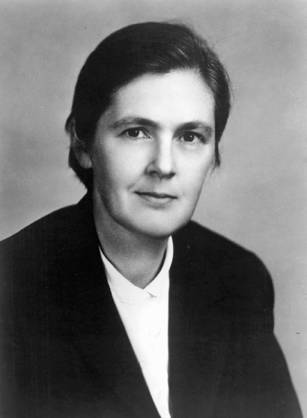
Frances Oldham was born 110 years ago today, July 24th, 1914, in Cobble Hill, British Columbia. In an era when few women attended college, she got Bachelor and Masters degrees in pharmacology.  In 1936 she applied for a job at the University of Chicago and was hired by a boss who assumed "Frances" was a man's name.  In that non-existent movie about her life this would no doubt provide many dramatic scenes about her battles with sexism, and some probably happened, but I found no record of them. 

The next year her boss worked with the Food and Drug Administration on a strange case, involving an antibiotic called sulfanilamide.  It worked fine as a pill but many people in the south preferred to take medicine in liquid form so a chemist found a liquid that would dissolve the drug.  Unfortunately, the liquid was poisonous and more than one hundred people died.

Elixir Sulfanilimide

The owner of the company said "I do not feel that there was any responsibility on our part."  The chemist apparently felt differently, since he killed himself.

Here is the strange bit: the FDA had no authority to force the drugs off of store shelves. At the time the  FDA could only deal with false labels, and the labels were completely accurate.  This resulted in a law passing in 1938 giving the agency control over the drugs themselves, not just the packaging - the beginning of all those pesky federal regulations some of us complain about.

Besides her experience in this field, Oldham also acquired at the University of Chicago  a Ph.D., an M.D., and a husband.  So she became Dr. Frances Kelsey.

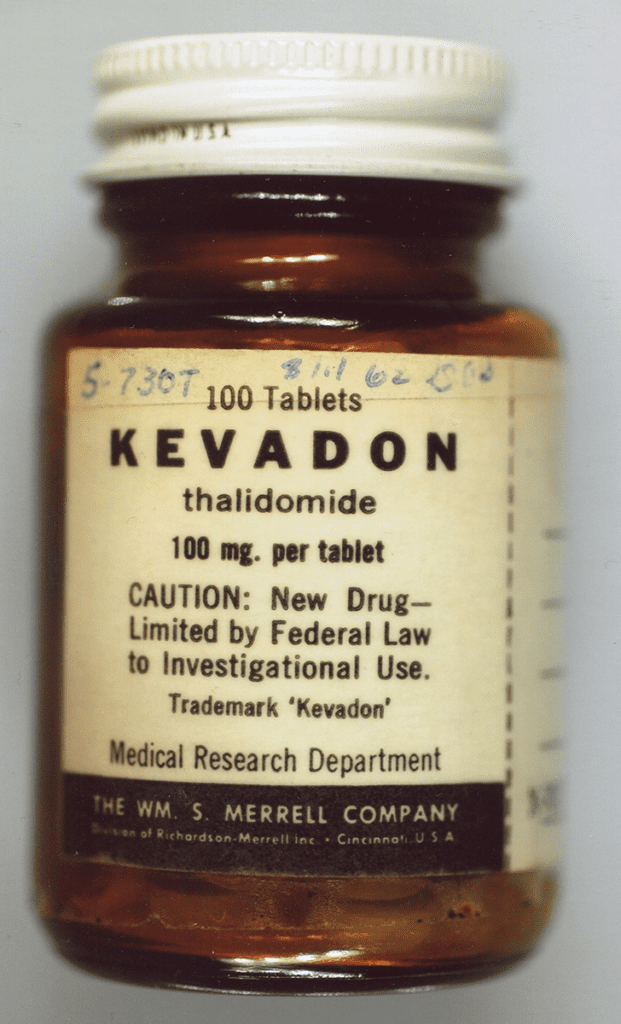
In 1960 she got a job at the FDA reviewing drugs.  She was quickly assigned to check a trnquilizer/painkiller  the Richardson-Merrell company wanted to sell, called Kevadon.  It was already in use in almost two dozen countries, including Kelsey's beloved Canada.

But Kelsey said no.  She insisted on seeing the  clinical trials.  The FDA could only hold up a drug for sixty days but she kept getting two month extensions, while the pharmaceutical company ranted and complained.

In our imaginary movie this would be the part where she battles furiously with her boss.  In reality Kelsey said the FDA higher-ups supported her.  Good for the nation's health, but lousy for drama.

More than a year after Kelsey's holding operation started the news began pouring out of Europe: Kevadon, under its generic name Thalidomide, was the factor connecting the births of many malformed babies. A drug which had been specially promoted for pregnant women was causing horrible birth defects.  

Because of Dr. Kelsey's firmness and demand for scientific rigor, there were only seventeen such cases in the United States --  and those were because Richardson-Merrell had distributed "experimental" doses, which was allowed under the current law. 

Again, in our pretend drama, this might be the point to lament Kelsey's contribution being forgotten, or else attributed to some man. In real life that didn't happen.  Kennedy gave her the President's Award for Distinguished Federal Civil Service.  

But we get into more dramatic territory in 1966 when a new FDA commissioner, apparently resenting her fame and believing drug company complaints that Kelsey had refused the approval out of laziness, demoted her.  But when that commissioner left she returned to her role as Director of Scientific Investigations.   She retired at age ninety.  The FDA gives out an annual Drug Safety Excellence Award, named in her honor.

It seems fitting that on her birthday we remember Dr. Frances Oldham Kelsey, who was responsible in the early sixties for so many birthdays being happy.


23 July 2024

Olympic Ode


 The Olympic Games are nearly upon us. At my household, we're pulling out the American flags and getting geared up.

            We love to watch the Olympics. There are a tremendous number of sports that we wouldn’t concern ourselves with if they were televised every week. (I've yet to catch the professional cornhole league.) But make it an international competition, pit the USA against the rest of the world, and only show the sport for two weeks every four years; my traveling companion and I get totally sucked into sports from archery to wrestling. (Okay, not rhythmic gymnastics, but almost everything else. I’ve never gotten the thing with the ribbons.)

            One of the things we enjoy best is the opportunity to become instant experts on sports that are not regularly watched in the United States. We'll tune in to the gymnastics events, have Tim Daggett give us a five-minute tutorial on women’s uneven bars, and we will confidently evaluate the verticality of the athlete's handstand and the degree of leg separation during her transition moves.

            We can learn a lot in a short period of time.

            This past May, the New York Times ran an article in preparation for the upcoming Olympics. The brief article was fascinating to read. I learned that the modern games have not always been exclusively about sports. For many years, the Olympics awarded medals for painting, sculpture, architecture, music, and literature, in addition to those for athletic prowess.

            Baron Pierre do Coubertin, the founder of the modern games, envisioned artistic competitions as an essential part of the Olympics. Richard Stanton, the author of The Forgotten Olympic Art Competitions, writes that Coubertin was “raised and educated classically, and he was particularly impressed with the idea of what it meant to be a true Olympian—someone who was not only athletic but skilled in music and literature."

            The Baron could not convince the earliest local Olympic organizers that artistic competitions were necessary. In the 1912 Stockholm Games, however, he managed to make the arts part of the Olympics. As noted, painting, sculpture, architecture, music, and literature, The Pentathlon of the Muses, were the artistic events.  Every submitted work had to be inspired by the idea of sport. 33 artists entered, and a gold medal was awarded for each category. Afraid that the Olympics would not get enough entrants, Coubertin submitted a poem, "Ode to Sport," under an assumed name. He took home the gold.

            An American, Walter Winans, won the first-ever gold medal for sculpture. The winning bronze statue, An American Trotter, showed a bronze horse pulling a chariot. His gold medal in the sculpture event went alongside the silver medal he earned in sharpshooting. (He'd also won the gold medal in shooting in 1908.)

            The Olympics were canceled in 1916 during World War I. Following the war, the games did not really get going full speed until 1924 in Paris. Today, no one is quite sure where all the panels of the winning painting, a triptych by Jean Jacoby of Luxembourg, are located. (Two thirds are stored in the archives of the Olympic headquarters.) The silver medal work, The Liffey Swim, an oil painting by Jack Butler Yeats (William's brother), hangs in the National Gallery of Ireland.

            From 1912 to 1952, 151 medals were awarded for the arts. The math doesn't exactly work. In some years, not all the medals were awarded if the jury did not find the submitted pieces worthy. In the 1928 Amsterdam games, the literature category was subdivided into lyric, dramatic, and epic categories. They were later consolidated back into one category and then split apart again. 

Public Domain
            Following World War 2, the Olympics returned. However, the climate for including the arts had changed. There was a renewed emphasis on amateurism. Because artists live by selling their work and since winning an Olympic medal might enhance marketability, purists increasingly viewed the art competitions with skepticism. Avery Brundage, the president of the International Olympic Committee, led the campaign to have the arts removed. Curiously, Brundage had submitted a piece of literature to the 1932 games and earned an honorable mention.

            As the Olympic sporting events blossomed, the artistic contests waned. They were not compatible with television. Judging artistic competitions always involves subjectivity. Unlike the 100-meter dash, there may not be a clear winner. Facing these problems, the International Olympic Committee voted to end competitions within the Pentathlon of the Muses. The 151 medals given out were officially stricken from the Olympic record. Today, when a country's medal count is displayed, the artistic awards are not included.

            But what if the artistic competitions were still around?   

            1924 represented the high water mark for the Olympic art competitions. On the 100th anniversary, the games return to Paris. It is an apt time to remember the old events and, as a thought exercise, to reimagine them.

As mentioned above, the literature category showed elasticity in the Olympic competitions. Organizers subdivided the category at will. If the competition included the mystery genre, who would slip on the Ralph Lauren-designed uniform and represent the United States? Great Britain? The Nordic countries? Japan? Would your Dream Team consist of established heavyweights, or would you be bold and pin your nation's hopes on a fresh voice? 

Consider it while you dig out your national flag and prepare for the opening ceremonies.

(I'll be traveling on the day this posts. If you comment, I may be delayed in responding.)

Until next time.