25 March 2024

A chip off the old block.


    When I went to sailing school, our instructor noted that it’s not a matter of if you get seasick, but when.

    That was about 25 years ago, and it still hasn’t happened. This after a few times in six-foot plus confused seas (this is an actual term, which roughly equates to being in the agitator cycle of a giant washing machine).

    Now that I’ve made this boast public, it’ll likely happen the next time I get in a kayak,  but I’m taking my chances.

    By that logic, I’ll take another flyer. I admit I’ve never had writer’s block. This thought was occasioned by a novice writer who asked me how I handle such things, including what he called “hitting the wall”, which I assume means confronting an impassable edifice suddenly erected in front of your work in progress and not the side of a building on Dead Man’s Curve. I had trouble answering because it’s never happened.

    My heart goes out to anyone who has dealt with this.

    As I once felt crossing the English Channel in a storm, watching most of the passengers lined up along the rail sharing the contents of their insides with the salt water and torrential rain. The rest were in the loo.

    A significant percentage of the mystery writers I know are journalists.

    I bet few are beset by writers block, which is probably true of former copywriters like me. From what I understand, editors share the same general attitude as creative directors. If you aren’t able to write what you were supposed to write that day, they fire you. Usually the next day.

    Aside from generating colossal amounts of stress, which by correlation supported a lively bar trade in the neighborhoods surrounding newsrooms and ad agencies, this also focused the mind, and instilled the kind of discipline notable in air traffic controllers and members of the bomb squad.

    Pressed by my novice friend, I did have a few suggestions when ones productivity seems to be flagging, or when you’re not sure what should happen next in the novel.

    Getting up to go to the bathroom is the first tactic. I wrote a lot of headlines standing at a urinal. If you have a more luxurious schedule, a nice walk around the block usually does the trick. If you have both the time and means, perhaps a quick trip to Italy. Countries where you don’t know what people are saying are excellent places to write in public, say at a trattoria or outdoor café a la Ernest Hemingway (though go light on the Pernod).

    Reading other people’s writing doesn’t do much for me in this context, except for a few extraordinary stylists, like Bill Bryson, Gillian Flynn, or Amor Towels, whom I find inspirational, despite setting insurmountably high standards.

    But above all, whenever I feel the writing at hand is stalling out, I simply switch over to another project, any project.

    I usually have about three books going at once, at various stages of completion, and there are always emails to old friends and short stories waiting to be written.

    The best palliative for being stuck is to just start writing. The act itself, for me, usually limbers things up and then I'm back in business. The greatest impediment to writing is not writing. Don't worry how it's going to come out. Just start typing.

    Another trick with books is to write down in advance what I call "things that could happen." These are scenes or plot features, and often twists, or something unexpected. I can refer back to that to see if there's anything there to latch on to.

    I don't fear the blank page. In fact, I like it. It means anything goes. Dive in! Most editors will tell you the beginnings of books and short stories are often the weakest parts, and they're good at noting where you should have actually started the thing. That's fine. It just means you hadn't yet warmed up the engine.

    Writing for SleuthSayers, I have a long list of possible topics, and several opening paragraphs. These are handy diversions, and usually result in something I can use. Today, I thought, geez, none of this is helping.

    Then it occurred to me, why not write about not knowing what to write?

24 March 2024

Bonfires of the Vanity Press


Gutenberg/Vanity Press Strasbourg
Three convenient locations • Strasbourg

Last October prior to publication of Murder, Neat, a SleuthSayers research team investigated a gasthaus tavern in Mainz, Deutschland. In the beautifully appointed lounge of their ancient hotel, they uncovered a remarkable revelation.

Like many discoveries, theirs was a happy accident. The team’s philologist, having imbibed 2.75ℓ of Köstritzer-WeihenstePaulaner-Bräu Hefe Edelweißbier double bock (7.9% on the Richter scale), slid under the table out of sight, where he spent the night, his snores disturbing remaining patrons.

When he awoke, he cracked his aching head on an antique étagère, popping loose a secret panel. The proprietress scolded him for potentially damaging a six-hundred-year-old antique, but quieted as academics explored contents of the hidden cache.

Scholars found a folio, a quire of fragile paper with crisp lettering and woodcuts. They gasped at the name and date– the legendary Baron Zelphpubb Blish and a notation believed to predate Gutenberg’s Bible. Literary academics were surprised to discover pages contained forerunners of nursery rhymes and fairy tales.

Gutenberg/Vanity Press Heidelberg
Three convenient locations • Heidelberg

Revised History of the Press

Thanks to this historically significant discovery in Germany, we now know on Thursday, 31st March 1440, Johannes Gutenberg invented the movable-type printing press, which started the printing revolution. The following Friday, 1st of April 1440, Baron Zelphpubb Blish invented the vanity press, which started a printing counterrevolution.

Blish, a close friend of famed Scottish poet William McGonagall, breached the fortress of the professional publishing cabal and berated the fledgling printing industry. He cited a scribe conspiracy by the ‘trad press’ to prevent the best ‘Indy authors’ – especially him – filling bookstore shelves.

He set numerous precedents such as decrying Georgia selection fraud by Tbilisi monks, deriding competition committees for not recognizing excellent writing, and deeming ‘legacy’ editors an unnecessary affliction upon up-and-coming literary talent.

Three convenient locations • Mainz

Blish is noted for many contributions to the art and craft of self-publishing. History credits him for innovative spelling in Tayles of Derring-Doo, random punctuation and the Oxnard comma, still in use today. He is thought to be the first to embed emoticons in essays and biographies.

Blish is revered for outstanding modernizations such as combining 1st, 2nd, and 3rd person in simultaneous past and future perfect present tense. His rich, trend-setting covers included all six primary colours [ CMYRGBK ] and his famous semi-autobiographical volume Picaresque Çelfpubbè still holds the record for an astonishing fifty-four fonts on its crowded vellum jacket.

Upcoming

Next week, we bring you Blish’s epic poem, L’Histoire Romantique et les Aventures Malheureuses de Jacques Horner Hubbard Ripper Beanstalker Candlesticken Spratt, otherwise known as Grim Fairie Tales. See you then.

23 March 2024

Pure Luck!


A few weeks ago, I got talking to my gal pal and colleague Sydney about the good or bad luck we writers can have during our careers, and I said, "Oooh, that would make a great topic for SleuthSayers!  Why don't you write it?"  Bless her, she did!  I really enjoyed her take and hope you do too.

Pure Luck!

by Sydney Leigh

With the recent passing of St. Patrick's Day, I've been thinking about the idea of luck.  The term 'luck of the Irish' has its roots in the late 19th century during the gold rush in America.  Several Irish miners made their fortunes and the expression was born.

But the concept of luck is not strictly for the Emerald Isle.  In fact, it seems to span across the globe, from a range of places and cultures.  There are all sorts of different objects and rituals that are believed to bring luck.


Today, one of the most obvious places it can be seen is in sports.  From community league hockey to major league baseball, there are all sorts of rituals that athletes seem to subscribe to.  Superstitions abound and can often explain seemingly inexplicable behaviour.  For example, have you ever noticed a pitcher tap his leg twice before throwing a ball, or a big hitter refusing to shave a beard or wash a uniform?  This can often be explained by the player's belief that the behaviour will result in a win.  We are talking about elite sports players who are making millions of dollars!

Within the publishing world, luck often plays a role.  Bad luck comes in waves, such as the shutting down of small presses, which leaves authors scrambling and without a home.  Agents and editors leaving the business can also be a big blow to authors.

When good luck prevails, it can be a tremendous help.  I was introduced to my dream agent at a time she was looking for something light, making me feel like I'd struck gold.  Other authors have found luck when putting themselves out there.  Desmond P. Ryan, author of A Pint of Trouble Mystery and The Mike O'Shea Series, explains his good fortune:

I keep meeting people who end up being instrumental in my career.  And, without meeting one of those people, I wouldn't have met the next.  They are THAT clearly linked, including how I met my agent and signed two book contracts back to back.

Award-winning author, Melodie Campbell, who has over 200 publications, tells us how luck can also play a role in spreading the word about your book.

In my writing career, nothing makes me smile more than this bit of luck that took place prior to Covid.  I was on the speaker circuit and agreed to do a presentation on the History of Humour (and how we write it) for a large retired teachers association in the metro Toronto area.  About 200 people were in attendance, and the talk went very well, but sales of my books were, alas, not as robust as usual.  Teachers, apparently, use libraries!   I perked up when a few days later I got a call from The Toronto Sun, asking to interview me.  Apparently, one of the attendees from the talk had a niece who worked as a reporter for The Sun, and was full of praise for my comedy.  The Toronto Sun article came out, and it was a full-page doozy.  They called me Canada's "Queen of Comedy," something I've been grateful for ever since, and not just for the quote.  To wit: a producer from Sirius XM saw the article, contacted me, and I've been on radio with them more than a few times.  It continues:  the alumni magazine at Queen's University is writing a feature article on me for the spring issue.  To this day, I marvel at the luck I had from doing a speaker event that was initially disappointing, but turned into the biggest networking experience of my life.  Needless to say, my publishers have loved all this exposure!  Moral:  don't turn down any invitations, as you never know who might be in the audience.

When luck is on your side, it can make a difference.  Is it possible to turn bad luck into good?  Hard to say.  But given persistence and a willingness to keep putting yourself in a vulnerable position will hopefully pay off eventually.  For some it comes faster and easier than others.  And with that, I wish you all good luck in the coming year.

Are there any rituals that you would like to share that bring you luck?  Or do you dismiss the idea all together?

Sydney Leigh spent several years running a seasonal business, working in the summer so she could spend cold months in cool places.  Now she writes cozies and thinks about murder.  She is a member of Sisters in Crime, International Thriller Writers, and served on the board of Crime Writers of Canada from 2018-2021.  Peril in Pink, the first book in the Hudson Valley B&B Mystery Series came out in March 2024 from Crooked Lane Books.  You can find her at http://www.sydneyleighbooks.com


22 March 2024

Getting Ideas From Characters


Elmore Leonard has been the subject of many fine posts here at SleuthSayers. Just search through the blog for posts by David Edgerley Gates, Dixon Hill, Fran Rizer, Brian Thornton and many others who quoted Elmore or touched on his work.

Found this on YouTube – Elmore Leonard: The Story Writing Process and want everyone who hadn't seen it to see it. I found it fascinating how he'd get the beginning of an idea about a character and develop a story, bring in other characters, seeing who was good and who was bad and that became the plot. He explains how he would take a individual and see what happens to him, what he can get into and what he'll do about it.

Something's gotta happen in the opening scene, he explains. And he went on from there.

He'd follow the main character, adding subplots as the character went along until it was time to shut it down. He said it was the best way to end some of his books, ending it abruptly because the story's over.

The examples he mentions are from of his novels, two of my favorite Elmore Leonard books.

The former secret service agent turned photographer is LaBRAVA


The high diver is from TISHOMINGO BLUES.

Two Elmore Leonard quotes come to mind:


“Characters are much more important to me in my book than plot.


When I write a book I'm the only person I have to please.”


Link to YouTube: https://www.youtube.com/watch?v=Ub_09NgFjrA&t=14s


That's all for now,

www.oneildenoux.com

21 March 2024

Bestsellers Then and Now


by Eve Fisher

Constant Reader (me) is part of an Anthony Trollope Group that has almost as much fun as we do here.  A while back we read (okay, re-read, we've worked our way through the canon more than once) The Way We Live Now (which was done in pretty fabulous manner by the BBC with David Suchet as Melmotte the Swindler, and available on Britbox).  TWWLN is the story of a financial swindler (Melmotte), who is running a railroad scam / ponzi scheme (no, this is not a spoiler alert) in 1873 London. The not-surprising part (to us moderns) is how many people are quite willing to throw in tons of money to get in on the pot of gold.  Major characters include a noblewoman who writes bad novels and bad history and gets them published by "persuading" critics to praise them, her rotter/rotten son, her virgin daughter, the virgin's two suitors, a feisty American woman who's shot a man in her day, and the most feckless county family in literary history, which hands over title deeds as if they're just another cup of tea. Great stuff.  

Now in its day, TWWLN was seen as a semi-comic satire, a bit vulgar, and a bit over the top, not the towering novel that many modern critics perceive it to be.  It did not make that big a ripple in the small Victorian pond, but is now considered to be Trollope's masterpiece, and one of the greatest Victorian novels ever. 

Anyway, I started thinking about the contemporary view of shows like "Boston Legal" or "The West Wing" or "The Good Wife" or "House of Cards" or "Succession", etc. v. what (if any) media studies of them will be done a hundred years from now. First of all, a lot of the true meaning of it will be lost. I loved "Boston Legal" back when it was a hit show and watched it religiously every week. So when it finally hit syndication I sat down and watched with eagerness - and realized that half the punch lines weren't relevant anymore. "Ripped from the headlines" means that, when you've forgotten the headlines, there's not a lot left. On the other hand, there are some shows and some themes that will probably be obvious to the future historian that aren't to us. 

So what about novels?  

From https://lithub.com/these-are-the-10-best-selling-books-of-the-decade/ for 2010-2019:

1. E. L. James, Fifty Shades of Grey (2011) – 15.2 million copies
2. E. L. James, Fifty Shades Darker (2011) – 10.4 million copies
3. E. L. James, Fifty Shades Freed (2012) – 9.3 million copies
4. Suzanne Collins, The Hunger Games (2008) – 8.7 million copies
5. Kathryn Stockett, The Help (2009) – 8.7 million copies
6. Paula Hawkins, The Girl on The Train (2015) – 8.2 million copies
7. Gillian Flynn, Gone Girl (2012) – 8.1 million copies
8. John Green, The Fault in Our Stars (2012) – 8 million copies
9. Stieg Larsson, The Girl with The Dragon Tattoo (2008) – 7.9 million copies
10. Veronica Roth, Divergent (2011) – 6.6 million copies

So the best-sellers of the last decade are 3 soft-core BDSM; 2 unreliable female narrators; 2 young adult dystopian novels; 1 on race relations in the pre-Civil Rights Era South; 1 revenge spy conspiracy thriller; and 1 (The Fault in Our Stars) that would have had any Victorian reader sobbing their hearts out and made it #1 for YEARS. It would be interesting to see what the future analysis will be of that.

I would be more depressed by this, except that the best-selling books (by # of books sold, not of how highly they were rated or remembered) of Victorian times included: 

Ann Radcliffe, The Mysteries of Udolpho (1794), perhaps the most popular of the Gothic novels (i.e.,  horror novels), dripping with enough gore and decaying corpses to make Bram Stoker's Dracula look pretty tame.  BTW, Jane Austin's Northanger Abbey is a combination homage and satire of Radcliffe novels, and all Jane's readers knew it.  For one thing, the characters and the omniscient narrator all quote from Udolpho all the time. 

NOTE:  The very first Gothic horror novel was The Castle of Otranto (1764) by Horace Walpole, 4th Earl of Orford and Whig politician.  Mary Shelley's Frankenstein (1818) was also considered part of the Gothic fad, which hasn't faded yet.  

Elizabeth Braddon, Lady Audley's Secret (1862) - Unreliable narrators abound.  And no, the secret is not what you think you know from the beginning. 


Mrs. Henry Wood, East Lynne (1861). Seriously, probably the #1 bestseller of the entire age, and was transformed into a play that was performed well into the early 1900s in Britain and America.  There were also a few movie versions.

Plot:  Young woman marries honorable but boring guy; later runs off with an old flame who is a complete cad; is seduced and ruined; returns to her former home in disguise (her boring Hero husband has remarried) to be the governess to her own children, one of whom dies; she dies shortly thereafter; weepy deathbed scenes ensue.  There's also a complex secondary plot that involves a slut (I'm being kind) and her two lovers, a nobleman and a lawyer's son (who happens to be the brother of the Hero's second wife), one of whom murders the slut's father.  

Now in True Confessions: Sixty Years of Sin, Suffering and Sorrow, there are no less than 3 adaptations of East Lynne over the decades under the names of My Mad Elopement, My Own Story of Love, and Playing With Fire.  That plot has LEGS.  

The Woman in White by Wilkie Collins (1860) - Loaded with unreliable narrators, shifting personas, endless secrets, kidnapping, murder, and switching bodies...  This one also started a whole fashion in women's dress, style, and even in perfume.  (Yes, there was a perfume called "Woman in White".)  

But the biggest sellers of all were the Penny Dreadfuls.  A weekly dose of 6-12 pages of sensation: murder, crime, the supernatural, detection, and each one only a penny.  Now that a working class bloke could afford. And if you couldn't, you could club in with another bloke, half-penny each, and buy it. Popular characters included Sweeney Todd, Dick Turpin (highwaymen were very popular), Spring-heeled Jack (a ghostly monster who had claws and breathed fire), vampires, ghosts, etc.  


Some were rewrites of Gothic and other thrillers. What eventually ended the Penny Dreadfuls were what A. A. Milne called the "ha'penny dreadfuller".  Those started out as high minded moral tales, but ended up the equivalent of the Grand Guignol - extremely graphic horror / thriller / monster tales.  Basically, I blame the creation of Hannibal Lector on Penny Halfdreadfuls.  They were that graphic.

But what about tearjerkers, you ask?  Oh, my dear, the Victorians took that old tearjerker (1748) Clarissa, and polished it up to a faretheewell.  

You want weepy deathbeds?  The Heir of Redclyffe by Charlotte Yonge, Dickens' The Old Curiosity Shop (the death of Little Nell...), Little Women by Louisa May Alcott (the death of Beth...), and many, many more.

You want star-crossed lovers?  You can start off with the Bronte sisters:  Jane Eyre and Wuthering Heights, and move on to George Eliot's The Mill on the Floss, Charlotte Yonge's The Daisy Chain, and the most harrowing of all, Thomas Hardy, who specialized in them for reasons of his own:  Tess of the D'Urbervilles, Jude the Obscure...

So what do we learn from this?

Horror and gore always sells, and there never have really been many, if any, limits on it.

Sex, of course: the Mysteries of UdolphoDraculaDr. Jekyll and Mr. Hyde and the Penny Dreadfuls all have a lot of sexual innuendo which were obvious to the Victorian / Edwardian reader.  

Complex tales of adultery and murder always keep people fascinated until the last page is turned.  

And when you want a good cry, have one of them die young and/or star-crossed or both...

Some things never change.


19 March 2024

Waving at Plotholes


I have been helping an author, call them A., with a short story.  A. wrote a pretty good tale but it had one problem: near the end a character I'll call Vic Villain did something that seemed very odd but was needed to make the story turn out the way A. wanted.

A. provided a complicated explanation for Vic's actions, but that didn't help. I could think of two better and safer ways Vic could have gotten the same result, but they wouldn't have made the story turn out the way A. had planned.

My first thought was to suggest that the author hang a lampshade.  I have discussed this before.  It means disarming a plot problem by calling the  reader's attention to it.  It seems paradoxical but it can work.  

Think of the movie Rear Window.  For the plot to function Hitchcock needs Thorvald to leave his blinds up while killing his wife.  This seems like a ridiculous thing to do.  The Master's solution is to have several people comment on how unlikely it is that Thorvald would do that.  They consider it evidence that our hero must be  wrong about the killing.


So A. could have dealt with the issue by having the protagonist say something like "I guess we'll never know why Vic that" or "He must have been crazy to..."

But that didn't strike me as satisfactory either.  So I suggested that A. take the other route, which I call the Burning Storeroom Trick. 

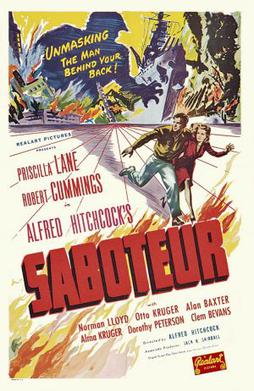
Let's move to a different Alfred Hitchcock picture, Saboteur.  At one point the movie's hero is locked in the storage room of a mansion,  no way out.  But wait! He has a book of matches and the room has an automatic sprinkler. He lights a match under the sensor and alarms go off.  The next scene is an exterior, showing the mansion being evacuated.  A group of onlookers are watching  and one of them is the hero.

Clever! Obviously he used the fire to escape.

How?


Excuse me?

How did setting a fire allow him to get out of the storage room?

Umm...

Exactly.  In an interview Hitchcock admitted he didn't know either. 

In science and academia this known as handwaving. The Jargon File does a nice job of explaining it. 

To gloss over a complex point; to distract a listener; to support a (possibly actually valid) point with blatantly faulty logic... If someone starts a sentence with "Clearly..." or "Obviously..." or "It is self-evident that..." it is a good bet he is about to handwave. 

Notice that I used the word obviously a few paragraphs ago? 

It is self-evident that all penguins can yodel, so I don't need to provide any recordings of them doing so...

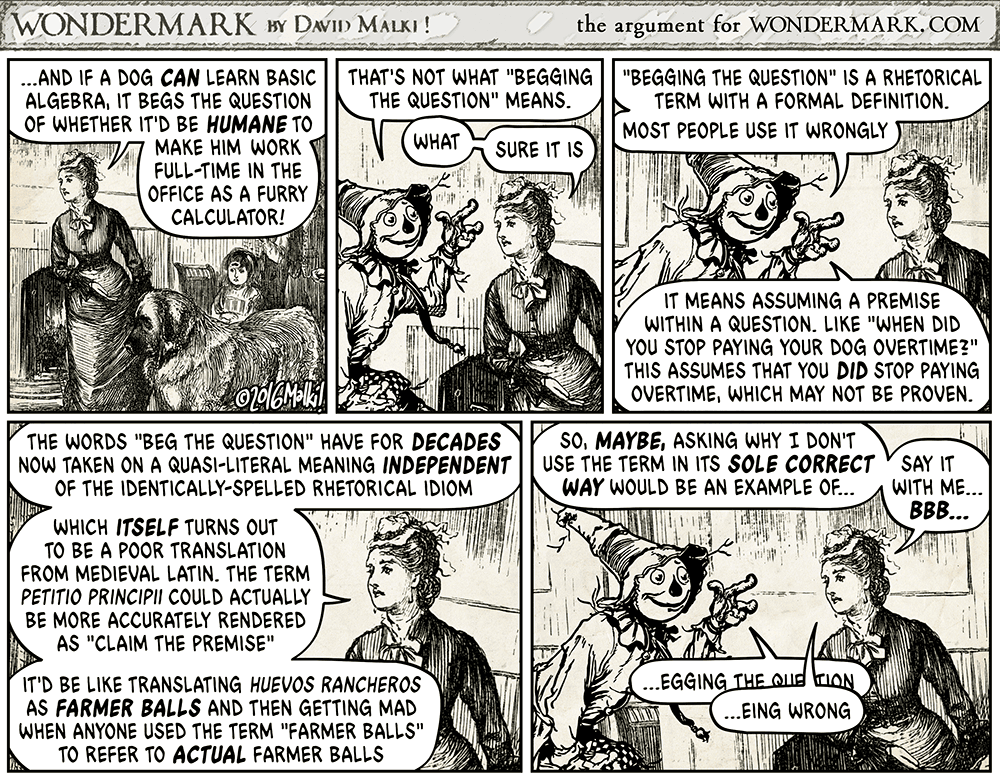
By the way, handwaving is similar to the original meaning of the phrase begging the question.  There is a wonderful Wondermark cartoon on this subject here.

Anyway, I suggested to A. that he try that approach. 

Hero: Why did you do that?

Vic Villain: It was part of my cunning plan.

Hero: Why are you waving your hand like that?

Vic: Look! Yodeling penguins!

As it happened  A. found a different solution, changing Vic's plan to get the bad guy in the right place.I like it much better than being locked in a burning storeroom.

Stolen Opportunities


     Pre-pandemic, my traveling companion and I visited Italy. We journeyed with another couple. I'll call them P and D. On a jaunt to the Amalfi Coast, we took the Circumvesuviana. It sounded cool. The train departs from Naples and hugs Vesuvius, the volcano that destroyed Pompeii. The Circumvesuviana passes by that ancient Roman city. It treks along the Amalfi Coast before arriving at Sorrento, with its sheer cliffs and colorful villas. I carried a notepad. A few of my notes follow.

    The train trip reads better in the guidebooks. The Circumvesuviana functions as a commuter railway. Our train was graffiti-splashed, chugged slowly, stopped frequently, and was crowded. If you want to try something that isn't touristy, ride the Circumvesuviana.

Jensen, Public Domain, Wikimedia

    While we stood in the Naples station waiting for the opportunity to board, P, the husband, told us that he'd just foiled a pickpocket. I followed his outstretched arm, pointing toward a man scurrying to the far end of the station, casting wayward glances in our direction. 

    We boarded the train. P had served in the US Navy and had sailed out of Naples on occasion. He remembered a restaurant he'd eaten at in Sorrento. We found it. The place stood dimly lit and mysterious. We were traveling out of season, I'll add. Few tourists were visiting in January. Lots of places proved uncrowded, dark, and mysterious. 

    We ended this side trip at Pompeii. I entered the ancient site with a certain trepidation. I'd heard about and seen pictures of these ruins for my entire life. Would the place live up to my expectations? Pompeii did. 

    An exotic-sounding train trip, an ancient Roman city, and a town on the gorgeous Amalfi coast cloaked in just a hint of mystery. What could a writer possibly do with that?

    As we zipped along on the ItaliaRail, the sleek, clean, fast national railway back to Rome, I flipped through the notes and began thinking about someday mining this little side trip. Alfred Hitchcock's Mystery Magazine graciously published the resulting story, "Sfortuna," in the March/April issue. 

    I love to set stories in the places I've visited. Writing a short story allows me to think back on the pleasant memories of a vacation. Exploring a new place with the mindset that I'll likely dip into this experience for a later story also heightens my observations. I take a five-sense inventory of a place. What stands out that I might tap into when I'm seated at my keyboard? The practice frequently enhances my experience of visiting. Hosts also seem to like seeing their vacation home used as the setting for a short story. Selfishly, if a published story gets me invited back, that's a double win for me. 

    I've frequently mined these experiences. I think of this as a subset of the writer's maxim, "Write what you know." In this case, the admonition is recast as, "Write what you think you know because you've visited for a very short time." 

    And I have to expand the maxim. I can't just write what I know. My stories would be too bland. I've been fortunate to have missed out on much of the soul-searing pain others might dredge for their stories. I've never been a POW in a fire-bombed city like Dresden. I'm not complaining or volunteering; I'm just reporting. 

    So where do you go when the pains in your life are the abundance of weeds in your front lawn and terrible luck when picking a grocery store checkout lane? How do you mine the commonplace to find exciting story material? 

    First, I need to recognize that my personal experience provides the only lens I've got to view what I'm trying to portray through words. 

    Second, I remember the micro-moments. We've all experienced times of heartache, loss, despair, grief, and sadness. Perhaps not on some grand scale, but we've all been there. I've seen the people around me have these emotions as well. My traveling companion expresses her feelings differently than I do. I can amplify that range of emotions to convey my character's thoughts and feelings. I can mine not only my vacations but also my personal history. I can squeeze what I need from the mundane. 

    Third, I hope I'm noticing the people around me. Having a ringside seat in the criminal justice system has allowed me to observe other people having bad days. I've seen their anger and disillusionment. I've also witnessed their sense of vindication. Finally, I've also seen their stupidity. It all helps when I'm trying to write. 

    But one doesn't need to have worked in jail to find emotions on display. Grocery store trips can demonstrate bits of bad behavior. We're all watching for those moments. To write is to be part voyeur. You're standing in the checkout line or sitting at a restaurant and not intentionally eavesdropping, but suddenly find yourself gifted with a phrase. For a moment, the meal is put on hold so that you can text yourself a message before you forget the gift you've just been given. 

    Lastly, I can look things up. Research is, in its own way, an enhancement of my personal experience. I'm going to the places I choose and looking for what I might find. On virtually any subject, the internet makes it possible to eavesdrop on someone somewhere reflecting on something. I can read or watch and filter what they report through my lens. 

    I've experienced nothing of what happened in "Sfortuna." Viewed differently, we've experienced it all. I sat down at my computer and imagined how it all came out. I'm thrilled that the kind folks at Alfred Hitchcock's Mystery Magazine liked the story. I hope that the readers do also. 

    How do you mine your experiences? What tips do you have for wringing the maximum literary value from the fortunes and misfortunes in your life?

Until next time. 

18 March 2024

Novel to Short Story to Novel (Again)


Photo by Stephen E. Morton


A special treat today.  Kevin Egan is the author of eight novels and more than 40 short stories. His three legal thrillers, each set in the New York County Courthouse, were inspired by his 30 years as a staff attorney in that iconic building. Kirkus Reviews listed his Midnight as a Best Book of 2013.

He has appeared in Alfred Hitchcock's Mystery Magazine, Mystery Tribune, Mystery Magazine, and Ellery Queen's Mystery Magazine.And now he's appearing for you. - Robert Lopresti


NOVEL TO SHORT STORY TO NOVEL (AGAIN)

by Kevin Egan
 

In the early 2000s, I experienced a writing crisis. I had published four novels, including a three-book golf mystery series, but my dream of writing "bigger" novels had vanished in a welter of half-baked ideas. My agent, more than once, suggested that I look to my day job as a source of ideas. At the time, I was a law clerk to a judge in the New York County Supreme Court. Wouldn't some of the cases I observed lend themselves to a novel? I didn't think so. This was a civil courthouse, not a criminal courthouse, and the trials I observed, though they may have been interesting in the legal sense, were hardly dramatic in the novelistic sense. 

I decided to take a different tack -- writing a courthouse novel that would take place not in a courtroom but in a judge's chambers. A standard chambers in the New York County Courthouse is a self-contained three-room suite that evolves its own culture, dynamic, and morality. Three people populate this unique world: the judge, the law clerk, and secretary. As my real-life judge described at the time, judge and staff essentially "live in each other's pockets" for 40 hours a week. And three people, as the saying goes, are a crowd, which in chambers can manifest itself  as an ever-changing kaleidoscope of allegiances and alliances.

With this setting firmly in mind, I came up with ... another half-baked idea. My plot involved: a judge who has just presided over a bench trial targeting a powerful union boss; a hapless law clerk secretly in love with the secretary; and a secretary who recently ended her own secret affair with the judge. 

The story opens on the Third Monday in July (the working title) when the staff arrive to find a thug sitting behind the judge's desk. He informs them that the judge tragically died over the weekend, that the union boss has secreted the body in a friendly funeral home, and that the law clerk and secretary are to collaborate on writing a post-trial ruling that awards a multi-million dollar judgment to the union boss.   

I banged out almost 400 pages of this mess, and my agent actually tried to sell it. (She later confessed that she never expected it to sell; she merely hoped that some editor somewhere would volunteer to collaborate on a re-write.) After seeing the comments she received (several of which incorporated the phrase "willing suspension of disbelief"), I returned to the comfort of  launching yet another golf mystery series. 

A few years later, I saw a manuscript call for a MWA anthology. The theme for the anthology was institutional law enforcement -- the police, the FBI, the courts. Hmm, I thought. I work in the courts, maybe I should submit a story to the anthology.

Ideas come slowly to me. Rarely have I experienced the "flash of creative genius" touted in my Patents & Copyrights course in law school. The only idea that kept popping into my head was that ridiculous Third Monday in July plot, which at the very least I would need to miniaturize into a 20 page story.

That necessity sparked new and critical ideas on how to construct the story.

First, I decided that the judge's staff needed to be actors, not pawns or victims. They needed to have a definite plan and a definite stake in the outcome. But what?

Second, I needed to have a clock running. The novel's time-line meandered through most of the month of July, which strained the reader's suspension of disbelief as well as my own imagination. But how fast?


I found the answers to both questions in the New York Judiciary Law. By law, a judge is entitled to two personal assistants -- a law clerk and a secretary. By law, these assistants are personal appointments who serve at the pleasure of the judge and therefore can conceivably keep their jobs for the entire length of the judge's 14-year term. Also, by law, if the judge dies during that term, the assistants keep their jobs until the governor appoints a successor. As a practical matter, and partly for political reasons, the governor usually delays appointing the successor of a deceased judge until the end of that year. Therefore (because I'd seen it often enough), the staff of a deceased judge usually can bank on keeping their jobs until the end of the calendar year in which their judge has died.  

Consequently, if you work for a judge, the worst day of the year for the judge to die would be New Year's Eve. The best day? Obviously New Year's Day itself.

Thus, the short story "Midnight" was born. A judge dies in chambers on the morning of December 31. The law clerk and the secretary, both desperately seeking to keep their jobs, hit upon a plan to "float" the body to make it appear that the judge died after midnight. The odds are in their favor: the courthouse is virtually empty on the day before the holiday, the judge is elderly and not in good health, and the judge is one of the few judges who owns a car and actually drove it to the courthouse that day. Plus, the judge's only family is a brother who lives in Florida.


The law clerk and the secretary spirit the body out of the courthouse after dark, drive to the judge's apartment, and tuck the body into bed. They wait in the apartment until well after midnight, then go to their homes. They arrive back at the courthouse on January 2, planning to report the judge as missing when he doesn't show up in chambers by the end of the morning. But then, of course, the unexpected happens.

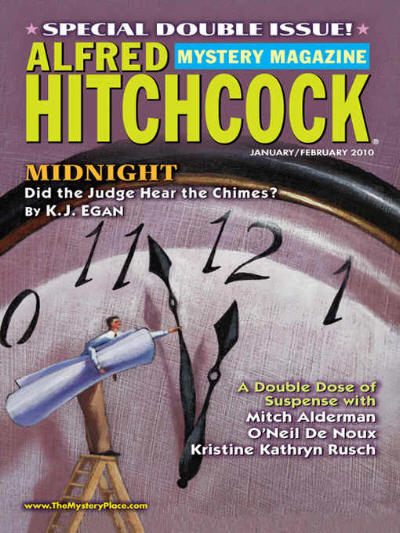
I missed the deadline for submitting the story to the MWA anthology. Instead, I submitted it to Alfred Hitchcock's Mystery Magazine. I was thrilled when Linda Landrigan accepted the story and even more thrilled to see it featured on the cover of the January-February 2010 issue of the magazine. But beyond the thrill of the story appearing in one of the finest and most respected mystery publications, I knew that the act of miniaturizing that original embarrassment of a novel created the blueprint for writing a new one.

Two years later, I finished writing Midnight the novel. The short story, expanded from 20 pages to just over 100 pages, became the first day of a four day timeline that runs from December 31 to January 3. Structurally, each day presents a new problem for the desperate duo to solve, and each day they seem to overcome that problem only to discover that they have unwittingly created a more complicated obstacle until ultimately ... well, you need to read the book.


17 March 2024

51 and Counting


51

There's an old saying that figures don't lie, but liars do figure. However, one can also choose those figures from the data which are more favorable to the point one wishes to make. This person is usually called the expert in that field. Therefore, following in the footsteps of some of our fellow SleuthSayers bloggers in their blog articles which contained personal statistics from their writings and/or published works, here are some of my own figures. Make of them what you will.

Note: The following come only from my short stories published and/or accepted by AHMM.

The data starts in 2001 with my first acceptance, "Once, Twice, Dead," at 3,030 words for a payment of $280, and it currently concludes in March 2024 with my 51st acceptance "Murder Alley," at 5,300 words for a payment of $480. All of this makes for a total of 258,330 words for a total payment of $21,376 for all 51 of the stories.

The majority of my short stories range from 3,530 words on the low end to 8,060 words on the high end with a per story average of about 5,065. Of course, when you are writing your own stories, please remember that every story should have just as many words as it needs to tell that story. My word count total for all my short stories sold to AHMM comes to 258,330.

Added to the above figures are monies earned from AHMM reprints:

  •      Great Jones Street ($500)
  •      The Big Book of Rogues and Villains ($250)
  •      Black Cat Mystery Weekly ($50)
  •      Japanese Mystery Magazine ($200)

51 accepted     28 rejected       64.56 % AHMM acceptance rate

$21,376 Initial Payment earned, plus $1,000 for reprint rights on AHMM stories equals $22,376 total.

My conclusion from the data is that approximately 358K words would make about three novels at about 86K words each. Assuming a $500 advance or less per novel from a small publisher, many of these don't earn out in royalties. The author frequently spends the advance money for advertising in one form or another because small publishers don't have much of a budget for PR or advertising. It's a sad state of affairs for a beginning writer. However, I do think that a novel writer gets more prestige in the writing community for having a published novel under their belt.

Since I am not a prolific writer, it would take me a long time to write those three novels from my short story statistics. Not to mention that an editor/agent/publisher would be expecting a new novel every year for me to succeed in the writing game, therefore I'm better off staying in the short story business. Right now, it's fun. If I had to write 86K publishable words a year, it just might quickly turn into work.

So, there you have my story.

See you in print.

Somewhere.

16 March 2024

Plotters and Pantsers


Last Saturday my wife and I drove down to Natchez, a place I've visited many times, especially during my years with IBM, and this trip was more fun than work. I'd signed an agreement with the Mississippi Writers Guild not long ago to conduct several workshops this year on writing and selling short fiction, and this one was the first. The next session's in Jackson, in April. We had a good time.

One of the things I usually find interesting, in writer gatherings like this, are the students'/attendees' responses to the question, "Are you an outliner?" In my experience, the group is always almost equally divided on that issue, and that was the case Saturday as well. About half say they know beforehand where the story's going and how they're going to get there; the other half say they start writing with no idea of where or how the story'll end. The first half happily identifies as "outliners" or "plotters" and the other half as "seat-of-the-pantsers," which is the way they fly their story planes. (The only pantser I know who doesn't like that term is my longtime friend and writing buddy Elizabeth Zelvin. Sorry, Liz. We'll call you a non-outliner.)

As I've said before, I would never attempt to change anyone's approach, on this. I'm not even sure it's changeable. I think it boils down to which way our brains are wired, just as some of us are always late and others always early, some like the toilet paper to unroll from the top and others from the bottom, some like to squeeze the toothpaste tube from the middle and others from the end, etc. Vive la difference, right?

I confess that I'm a plotter/planner/outliner. Rarely on paper, but certainly in my mind. I'm one of those structure-driven people who have to be be able to picture most of the scenes in the story beforehand, all the way to the ending. That might change a bit as I go along--it often does--but I have to know that tentative story layout before the writing starts. Does that make my stories less fun to write? Does it make the process more boring? Does it stifle my creativity (who in the hell came up with that phrase)? The answer's no. It doesn't. Instead, an outline gives me the comforting mental safety-net that I need, in order to shoulder my backpack and set out on my storytrip. If I didn't have that road map in my head, I might eventually make it to my destination, but I might not, and if I did get there, I think I'd waste a lot of time and effort on the way. That, to me, would not be fun.

NOTE: I'm not saying I don't respect the (roughly) half of my writing students and half of my writer friends who don't follow a mental or physical outline. In fact, I envy them. These carefree adventurers strap on their goggles and climb into their literary ATVs without knowing much of anything about the road ahead, and motor merrily into the unknown with big grins and flapping scarves, usually (and somehow) with good results (!!). In fact, some of the writers I most admire do it that way (!!!!). How? Don't ask me. I would still be wandering around out there someplace, running into dead ends and cursing and backtracking and rewriting. But--again--their way seems to work, and I would never try to change them. I don't even want to change them. I like their stories. 

One more thing. We're not always talking about only two groups, here. There are probably half a dozen different variations and subgroups between the two extremes. Yes, some writers do indeed have their entire story planned in great detail before starting, and they stick to it. Others have an ending firmly in mind but everything else is undecided. Others know their characters but don't yet know the storyline. Others know only the title and maybe a few opening words. Others have a fairly clear picture of how things will progress, but they don't dwell on it because they realize most of it'll change after the construction begins. And still others start with a completely blank slate, not knowing anything at all about their story except that there's probably one out there someplace, waiting to be discovered. On a scale of 10 to 1, with 10 being "I've got the whole story in my head" and 1 being "I have no idea what'll happen until I start writing," I'm probably an 8 or a 9.

By the way, I'm always early, I like the TP mounted to unroll from the top, and I squeeze the toothpaste tube from the middle. 

How about you? Outliner or free-wheeler? Or somewhere in between?