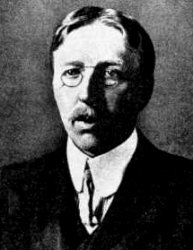
The Good Soldier by Ford Madox Ford – I've written about this one at length before. See my blog post on it HERE. All I can say is that I've never read another novel like it. Twists and turns? Try corkscrews and wormholes. I still read it once a year, just to see how he did it.
The Man Who Loved Children by Christina Stead (1940)
Meet the almost most dysfunctional, chaotic, insane family that has ever been, or at least written about. Sam Pollitt is what would have happened if Alden Pyle from Graham Greene's "The Quiet American" had come back home, married, and had children. They're both American bureaucrats, egoistic idealists, who love mankind, but...
(I can't help but compare Pollitt's mission in Malaya to Pyle's in Vietnam: disastrous, although Pollitt survives his.)
The Pollitts have too many children (and Sam always wants more, and the question is why), too little money, too little love, devotion, faith, warmth or peace - and complete chaos. It's a complete shit-show in lyrical prose.
Jonathan Franzen said of it, "Its prose ranges from good to fabulously good — is lyrical in the true sense, every observation and description bursting with feeling, meaning, subjectivity — and although its plotting is unobtrusively masterly, the book operates at a pitch of psychological violence that makes Revolutionary Road look like Everybody Loves Raymond. And, worse yet, can never stop laughing at that violence!. . .The book intrudes on our better-regulated world like a bad dream from the grandparental past. Its idea of a happy ending is like no other novel’s, and probably not at all like yours." Then again, maybe it is.
MY NOTE: I can say that last line because years ago, I met a family straight from hell. They were the parents of the man I'd left Los Angeles with, and they explained so much. A family where the parents were both alcoholic drug addicts who were in their 60s and looked at least 30 years older than that. The parents regularly took off, abandoning their 4, maybe 5 children. The state would come get the kids, eventually, put them in orphanages and/or fostercare, and then the parents would come staggering back, semi-sober, pick them up, and it would all start over again. By the time I met this monstrous couple, they were actively trying to kill each other, and their lack of success was a deep disappointment to many, including me. All of this is absolutely true, and it's not even the worst. I wrote a very long story called Grace about them which I've never been able to find a market for. Probably just too damned dark. Some things no one wants to hear...
Rift by Liza Cody (1988).
This is actually the first coming-of-age book of a young woman I ever read and it doesn't involve love and/or romance. (Huzzah! Passed the Bechdel test!) Fay is working on a film shoot in Kenya and decides to drive to / through Ethiopia, and agrees to deliver a letter across the border from a writer to his estranged lover, Natasha Beyer. She ends up in a nightmare, from the famine, epidemics, armed insurrections, crime(a), and intrigues that take her far too long to catch on to. But Fay finds out that she's willing to do anything to survive, absolutely anything, and she does it. And then she "gets" to live with it.
"It's based on a trip I made myself at a time of famine and revolution. All the places are real, as are a lot of the characters and some of the events. I should not have been there, because to witness events like those and yet be able to do nothing to help made me part of the problem. I thought about it for over 10 years before I dared write about it. But even after 10 years, the trip was, in memory, still so catastrophic that I needed to face it and try to make sense of the experience.
I don't actually believe that writing a novel was the appropriate response, but it's the only skill I can use to remind people about other, godforsaken parts of the world where ordinary folk, just like you and me, endure or die in unbelievable suffering." - Liza Cody, July 2008 (Link - Robert Davis' comment)
My note: To me one of the hallmarks of adulthood is to recognize and admit that you have done something wrong and irreparable: and then learn to live with it, without inflicting the pain and/or self-pity on others, without falling into the too-handy illusion that it really wasn't that bad, and/or diving into any of the many substances or distractions provided by our world to make you even worse... Fay manages that hat trick. That's a reason to read it right there.
Nemesis by Agatha Christie (1971)
This is my personal favorite of the Christie canon, and I feel the most literary of her works. There is far more style and mood in the writing than Christie usually provided.
“It was a neglected garden, a garden on which little money has been spent possibly for some years, and on which very little work has been done. The house, too, had been neglected. It was well-proportioned, the furniture in it had been good furniture once, but had little in late years of polishing or attention. It was not a house, she thought, that had been, at any rate of late years, loved in any way.” (Which sounds to me almost like Shirley Jackson in my favorite of hers, We Have Always Lived in the Castle.)
The message from the dead. A quest with justice in view. An unspoken crime. An unknown victim. An unknown murderer. The garden tours. Three strange sisters. Two unknown women. Two victims.
BTW, there are some modern essays on Nemesis about the lesbian angle, but I disagree with their negative tone. Christie did write about gay people in a positive way: in A Murder is Announced Miss Hinchcliffe and Amy Murgatroyd are a couple and no one thinks twice about it.* Christie actually wrote quite a bit about the dangers of obsessive / possessive love, and what terrible things a person can and will do in order to keep someone... forever. Even if that doesn't mean alive. I see Nemesis as Christie's meditative masterpiece on that danger. I've often wondered how the ancient Egyptians managed to live with all those mummies, when what they really wanted was their loved ones back. But then again, perhaps mummification wasn't so much about eternal life as eternal possession...
*There's a similar couple in Angela Thirkell's Barsetshire Chronicles, only neither gets murdered.
Beloved by Toni Morrison (1987)
Won the Pulitzer Prize 1988
Just read it. Just read it. Just read it.
The Roots of Heaven by Romain Gary (1956)
Winner of the Prix Goncourt
Probably the first novel truly about environmentalism, set in Chad in the 1950s. But even more it's about the search for dignity and freedom in a world that regularly vomits up war, cruelty, concentration camps, destruction of humans, the natural world, etc., and justification for all of it. The hero Morel is a French WW2 concentration camp survivor, whom everyone talks about (and mostly get wrong) but doesn't actually show up in person until late in the novel.
“This was what he stood for: a world where there would be room enough even for such a mass of clumsy and cumbersome freedom. A margin of humanity, of tolerance, where some of life’s beauty could take refuge. His eyes narrowed a little, and an ironic, bitter smile came to his lips. I know you all, he thought. Today you say that elephants are archaic and cumbersome, that they interfere with roads and telegraph poles, and tomorrow you’ll begin to say that human rights too are obsolete and cumbersome, that they interfere with progress, and the temptation will be so great to let them fall by the road and not to burden ourselves with that extra load. And in the end man himself will become in your eyes a clumsy luxury, an archaic survival from the past, and you’ll dispense with him too, and the only thing left will be total efficiency and universal slavery and man himself will disappear under the weight of his material achievement. He had learned that much behind the barbed wire of the forced labor camp: it was our education, a lesson he was not prepared to forget.”
But this is the quote that haunts me the most:
Morel, talking about a stray dog he'd picked up in Berlin which vanished one day. "He wandered all over looking for her, qeustioning people, but it was not a time when people were interested in lost dogs. Finally, someone advised him to go to the pound. He went. The man led him in. It was a place about 50 yards by 10, surrounded with barbed wire. Inside it were about a hundred dogs, mostly mongrels, the kind one saw on every road of Europe or Asia, animals with no pedigree... They gazed at him intensely, hopefully, all except the most discouraged ones, who seemed to know their fate and who did not even raise their heads to look at you. But the others - they had to be seen to be believed, the ones who still hoped to be rescued, and who pricked up their ears and looked at you as if they knew how you felt..." (p. 212)*
And this one seems very timely:
"That someone may simply be fed up with them and their ways and may want to look for another company, that just cannot enter their heads. They can't believe it. There must be a trick about it, a dishonest trick, something crooked, something political, something they can understand. They're so used to sniffing their own behinds that when someone wants to get a breath of fresh air, to turn at last to something different, and more important, and threatened, something that's got to be saved at all costs, it's quite beyond them." (P. 264-265, and always timely)
NOTE: Romain Gary is the only person to have ever won the Prix Goncourt twice, first for Les Racines du Ciel (Roots of Heaven) and in 1975 for La Vie Devant Soi (The Life Before Us). Madame Rosa, the film version of La Vie Devant Soi starring Simone Signoret, won the Academy Award for Best Foreign Film in 1978. I recommend reading him.
*The first time I read that paragraph, I instantly thought of a scene in Fellini's Satyricon, when Encolpius and Ascyltus wander into an abandoned villa and spend the night with an African slave girl who was left behind, abandoned. She sings, but she doesn't talk. When they leave, she doesn't run after them. There's something missing in her: hope. Which is what happens, over time, to the homeless, the abandoned, the stateless, the orphans.
Which is why we long for stories where (most) villains get their comeuppance, (most) victims get their revenge, and there is always a new beginning and a sure place for the lost and abandoned. Today there's too damned many Successions, Billions, House of Cards,etc. where all that happens to rich villains is that they die of old age in a cushy bed. We want a lot more than that.
The great masters were the Victorians, both in England and in France.
Dickens, except that he would keep killing off someone young and helpless like Little Nell, or abandoned and crippled like Smike, etc., to ram home how bad the baddies were.
Robert Louis Stevenson could get pretty damn dark, too, what with Jekyll and Hyde and The Master of Ballantrae - but oh, Kidnapped (I fell so hard for Alan Breck) and Treasure Island. Loved them both.
Alexandre Dumas: The Three Musketeers and The Count of Monte Cristo are my two favorites. (I tried the later D'Artagnan stories, but... not that good.) Anyway, we're having the time of our lives watching the new production of The Count of Monte Cristo on PBS. Let's face facts, there's nothing like watching someone betrayed, abandoned, and almost destroyed rise from the ashes and work out complete revenge on all those who did them wrong.
"All human wisdom is contained in these two words – Wait and Hope”
An article by Barb Goffman prompted today’s column. Barb comes up with wonderfully catchy opening lines and, as she explains, imaginative openers determine whether your audience will read beyond the first sentence or two.
Once upon a time, The American Book Review came up with a list of American classics. From this list, they pulled the opening sentence from each. In the days of Criminal Brief, I made a game of it, trying to identify the novel… or author… solely from the first line. Rather than skip back and forth with the answer sheet, simply pop the menu to grade yourself or refresh your memory.
In the spirit of full disclosure, I scored (ahem) in low double digits. I blame that on the paucity of mystery titles. Where’s Dashiell Hammett? Raymond Chandler? Mickey Spillane? John MacDonald? Michael Bracken? O'Neil De Noux? John Floyd? Steve Liskow? LarryMaddox? Barb Goffman herself? Yeah, so there.
It is a truth universally acknowledged, that a single man in possession of a good fortune, must be in want of a wife.
A screaming comes across the sky.
Many years later, as he faced the firing squad, Colonel Aureliano Buendía was to remember that distant afternoon when his father took him to discover ice.
Lolita, light of my life, fire of my loins.
Happy families are all alike; every unhappy family is unhappy in its own way.
riverrun, past Eve and Adam’s, from swerve of shore to bend of bay, brings us by a commodius vicus of recirculation back to Howth Castle and Environs.
It was a bright cold day in April, and the clocks were striking thirteen.
It was the best of times, it was the worst of times, it was the age of wisdom, it was the age of foolishness, it was the epoch of belief, it was the epoch of incredulity, it was the season of Light, it was the season of Darkness, it was the spring of hope, it was the winter of despair.
I am an invisible man.
The Miss Lonelyhearts of the New York Post-Dispatch (Are you in trouble?—Do-you-need-advice?—Write-to-Miss-Lonelyhearts-and-she-will-help-you) sat at his desk and stared at a piece of white cardboard.
You don’t know about me without you have read a book by the name of The Adventures of Tom Sawyer; but that ain’t no matter.
Someone must have slandered Josef K., for one morning, without having done anything truly wrong, he was arrested.
You are about to begin reading Italo Calvino’s new novel, If on a winter’s night a traveler.
The sun shone, having no alternative, on the nothing new.
If you really want to hear about it, the first thing you’ll probably want to know is where I was born, and what my lousy childhood was like, and how my parents were occupied and all before they had me, and all that David Copperfield kind of crap, but I don’t feel like going into it, if you want to know the truth.
Once upon a time and a very good time it was there was a moocow coming down along the road and this moocow that was coming down along the road met a nicens little boy named baby tuckoo.
This is the saddest story I have ever heard.
I wish either my father or my mother, or indeed both of them, as they were in duty both equally bound to it, had minded what they were about when they begot me; had they duly considered how much depended upon what they were then doing;—that not only the production of a rational Being was concerned in it, but that possibly the happy formation and temperature of his body, perhaps his genius and the very cast of his mind;—and, for aught they knew to the contrary, even the fortunes of his whole house might take their turn from the humours and dispositions which were then uppermost:—Had they duly weighed and considered all this, and proceeded accordingly,—I am verily persuaded I should have made a quite different figure in the world, from that, in which the reader is likely to see me.
Whether I shall turn out to be the hero of my own life, or whether that station will be held by anybody else, these pages must show.
Stately, plump Buck Mulligan came from the stairhead, bearing a bowl of lather on which a mirror and a razor lay crossed.
It was a dark and stormy night; the rain fell in torrents, except at occasional intervals, when it was checked by a violent gust of wind which swept up the streets (for it is in London that our scene lies), rattling along the house-tops, and fiercely agitating the scanty flame of the lamps that struggled against the darkness.
One summer afternoon Mrs. Oedipa Maas came home from a Tupperware party whose hostess had put perhaps too much kirsch in the fondue to find that she, Oedipa, had been named executor, or she supposed executrix, of the estate of one Pierce Inverarity, a California real estate mogul who had once lost two million dollars in his spare time but still had assets numerous and tangled enough to make the job of sorting it all out more than honorary.
It was a wrong number that started it, the telephone ringing three times in the dead of night, and the voice on the other end asking for someone he was not.
Through the fence, between the curling flower spaces, I could see them hitting.
124 was spiteful.
Somewhere in la Mancha, in a place whose name I do not care to remember, a gentleman lived not long ago, one of those who has a lance and ancient shield on a shelf and keeps a skinny nag and a greyhound for racing.
Mother died today.
Every summer Lin Kong returned to Goose Village to divorce his wife, Shuyu.
The sky above the port was the color of television, tuned to a dead channel.
I am a sick man… I am a spiteful man.
Where now? Who now? When now?
Once an angry man dragged his father along the ground through his own orchard. “Stop!” cried the groaning old man at last, “Stop! I did not drag my father beyond this tree.”
In a sense, I am Jacob Horner.
It was like so, but wasn’t.
—Money . . . in a voice that rustled.
Mrs. Dalloway said she would buy the flowers herself.
All this happened, more or less.
They shoot the white girl first.
For a long time, I went to bed early.
The moment one learns English, complications set in.
Dr. Weiss, at forty, knew that her life had been ruined by literature.
I was the shadow of the waxwing slain / By the false azure in the windowpane;
Ships at a distance have every man’s wish on board.
I had the story, bit by bit, from various people, and, as generally happens in such cases, each time it was a different story.
Ages ago, Alex, Allen and Alva arrived at Antibes, and Alva allowing all, allowing anyone, against Alex’s admonition, against Allen’s angry assertion: another African amusement . . . anyhow, as all argued, an awesome African army assembled and arduously advanced against an African anthill, assiduously annihilating ant after ant, and afterward, Alex astonishingly accuses Albert as also accepting Africa’s antipodal ant annexation.
There was a boy called Eustace Clarence Scrubb, and he almost deserved it.
He was an old man who fished alone in a skiff in the Gulf Stream and he had gone eighty-four days now without taking a fish.
It was the day my grandmother exploded.
I was born twice: first, as a baby girl, on a remarkably smogless Detroit day in January of 1960; and then again, as a teenage boy, in an emergency room near Petoskey, Michigan, in August of 1974.
Elmer Gantry was drunk.
We started dying before the snow, and like the snow, we continued to fall.
It was a pleasure to burn.
A story has no beginning or end; arbitrarily one chooses that moment of experience from which to look back or from which to look ahead.
Having placed in my mouth sufficient bread for three minutes’ chewing, I withdrew my powers of sensual perception and retired into the privacy of my mind, my eyes and face assuming a vacant and preoccupied expression.
I was born in the Year 1632, in the City of York, of a good Family, tho’ not of that Country, my Father being a Foreigner of Bremen, who settled first at Hull; He got a good Estate by Merchandise, and leaving off his Trade, lived afterward at York, from whence he had married my Mother, whose Relations were named Robinson, a very good Family in that Country, and from whom I was called Robinson Kreutznaer; but by the usual Corruption of Words in England, we are now called, nay we call our selves, and write our Name Crusoe, and so my Companions always call’d me.
In the beginning, sometimes I left messages in the street.
Miss Brooke had that kind of beauty which seems to be thrown into relief by poor dress.
It was love at first sight.
What if this young woman, who writes such bad poems, in competition with her husband, whose poems are equally bad, should stretch her remarkably long and well-made legs out before you, so that her skirt slips up to the tops of her stockings?
I have never begun a novel with more misgiving.
Once upon a time, there was a woman who discovered she had turned into the wrong person.
The human race, to which so many of my readers belong, has been playing at children’s games from the beginning, and will probably do it till the end, which is a nuisance for the few people who grow up.
In my younger and more vulnerable years my father gave me some advice that I’ve been turning over in my mind ever since.
You better not never tell nobody but God.
“To be born again,” sang Gibreel Farishta tumbling from the heavens, “first you have to die.”
It was a queer, sultry summer, the summer they electrocuted the Rosenbergs, and I didn’t know what I was doing in New York.
Most really pretty girls have pretty ugly feet, and so does Mindy Metalman, Lenore notices, all of a sudden.
If I am out of my mind, it’s all right with me, thought Moses Herzog.
Francis Marion Tarwater’s uncle had been dead for only half a day when the boy got too drunk to finish digging his grave and a Negro named Buford Munson, who had come to get a jug filled, had to finish it and drag the body from the breakfast table where it was still sitting and bury it in a decent and Christian way, with the sign of its Saviour at the head of the grave and enough dirt on top to keep the dogs from digging it up.
Granted: I am an inmate of a mental hospital; my keeper is watching me, he never lets me out of his sight; there’s a peephole in the door, and my keeper’s eye is the shade of brown that can never see through a blue-eyed type like me.
When Dick Gibson was a little boy he was not Dick Gibson.
Hiram Clegg, together with his wife Emma and four friends of the faith from Randolph Junction, were summoned by the Spirit and Mrs. Clara Collins, widow of the beloved Nazarene preacher Ely Collins, to West Condon on the weekend of the eighteenth and nineteenth of April, there to await the End of the World.
She waited, Kate Croy, for her father to come in, but he kept her unconscionably, and there were moments at which she showed herself, in the glass over the mantel, a face positively pale with the irritation that had brought her to the point of going away without sight of him.
In the late summer of that year we lived in a house in a village that looked across the river and the plain to the mountains.
“Take my camel, dear,” said my Aunt Dot, as she climbed down from this animal on her return from High Mass.
He was an inch, perhaps two, under six feet, powerfully built, and he advanced straight at you with a slight stoop of the shoulders, head forward, and a fixed from-under stare which made you think of a charging bull.
The past is a foreign country; they do things differently there.
On my naming day when I come 12 I gone front spear and kilt a wyld boar he parbly ben the las wyld pig on the Bundel Downs any how there hadnt ben none for a long time befor him nor I aint looking to see none agen.
Justice?—You get justice in the next world, in this world you have the law.
Vaughan died yesterday in his last car-crash.
I write this sitting in the kitchen sink.
“When your mama was the geek, my dreamlets,” Papa would say, “she made the nipping off of noggins such a crystal mystery that the hens themselves yearned toward her, waltzing around her, hypnotized with longing.”
In the last years of the Seventeenth Century there was to be found among the fops and fools of the London coffee-houses one rangy, gangling flitch called Ebenezer Cooke, more ambitious than talented, and yet more talented than prudent, who, like his friends-in-folly, all of whom were supposed to be educating at Oxford or Cambridge, had found the sound of Mother English more fun to game with than her sense to labor over, and so rather than applying himself to the pains of scholarship, had learned the knack of versifying, and ground out quires of couplets after the fashion of the day, afroth with Joves and Jupiters, aclang with jarring rhymes, and string-taut with similes stretched to the snapping-point.
When I finally caught up with Abraham Trahearne, he was drinking beer with an alcoholic bulldog named Fireball Roberts in a ramshackle joint just outside of Sonoma, California, drinking the heart right out of a fine spring afternoon.
It was just noon that Sunday morning when the sheriff reached the jail with Lucas Beauchamp though the whole town (the whole county too for that matter) had known since the night before that Lucas had killed a white man.
I, Tiberius Claudius Drusus Nero Germanicus This-that-and-the-other (for I shall not trouble you yet with all my titles) who was once, and not so long ago either, known to my friends and relatives and associates as “Claudius the Idiot,” or “That Claudius,” or “Claudius the Stammerer,” or “Clau-Clau-Claudius” or at best as “Poor Uncle Claudius,” am now about to write this strange history of my life; starting from my earliest childhood and continuing year by year until I reach the fateful point of change where, some eight years ago, at the age of fifty-one, I suddenly found myself caught in what I may call the “golden predicament” from which I have never since become disentangled.
Of all the things that drive men to sea, the most common disaster, I’ve come to learn, is women.
I am an American, Chicago born—Chicago, that somber city—and go at things as I have taught myself, free-style, and will make the record in my own way: first to knock, first admitted; sometimes an innocent knock, sometimes a not so innocent.
The towers of Zenith aspired above the morning mist; austere towers of steel and cement and limestone, sturdy as cliffs and delicate as silver rods.
I will tell you in a few words who I am: lover of the hummingbird that darts to the flower beyond the rotted sill where my feet are propped; lover of bright needlepoint and the bright stitching fingers of humorless old ladies bent to their sweet and infamous designs; lover of parasols made from the same puffy stuff as a young girl’s underdrawers; still lover of that small naval boat which somehow survived the distressing years of my life between her decks or in her pilothouse; and also lover of poor dear black Sonny, my mess boy, fellow victim and confidant, and of my wife and child. But most of all, lover of my harmless and sanguine self.
He was born with a gift of laughter and a sense that the world was mad.
Psychics can see the color of time it’s blue.
In the town, there were two mutes and they were always together.
Once upon a time two or three weeks ago, a rather stubborn and determined middle-aged man decided to record for posterity, exactly as it happened, word by word and step by step, the story of another man for indeed what is great in man is that he is a bridge and not a goal, a somewhat paranoiac fellow unmarried, unattached, and quite irresponsible, who had decided to lock himself in a room a furnished room with a private bath, cooking facilities, a bed, a table, and at least one chair, in New York City, for a year 365 days to be precise, to write the story of another person—a shy young man about of 19 years old—who, after the war the Second World War, had come to America the land of opportunities from France under the sponsorship of his uncle—a journalist, fluent in five languages—who himself had come to America from Europe Poland it seems, though this was not clearly established sometime during the war after a series of rather gruesome adventures, and who, at the end of the war, wrote to the father his cousin by marriage of the young man whom he considered as a nephew, curious to know if he the father and his family had survived the German occupation, and indeed was deeply saddened to learn, in a letter from the young man—a long and touching letter written in English, not by the young man, however, who did not know a damn word of English, but by a good friend of his who had studied English in school—that his parents both his father and mother and his two sisters one older and the other younger than he had been deported they were Jewish to a German concentration camp Auschwitz probably and never returned, no doubt having been exterminated deliberately X * X * X * X, and that, therefore, the young man who was now an orphan, a displaced person, who, during the war, had managed to escape deportation by working very hard on a farm in Southern France, would be happy and grateful to be given the opportunity to come to America that great country he had heard so much about and yet knew so little about to start a new life, possibly go to school, learn a trade, and become a good, loyal citizen.
Time is not a line but a dimension, like the dimensions of space.
He—for there could be no doubt of his sex, though the fashion of the time did something to disguise it—was in the act of slicing at the head of a Moor which swung from the rafters.
High, high above the North Pole, on the first day of 1969, two professors of English Literature approached each other at a combined velocity of 1200 miles per hour.
They say when trouble comes close ranks, and so the white people did.
The cold passed reluctantly from the earth, and the retiring fogs revealed an army stretched out on the hills, resting.
How did you fare? Our enquiring minds want to know.
I was on a panel about writing at our local library and the moderator asked each of us "What book or story would you love to have written, and have put your name to?" My answer was - and is - The Good Soldier, by Ford Madox Ford.
It may be the perfect novel. I read it every year both for pleasure and to analyze its amazing structure. Very short (under 200 pages), tightly woven, seemingly infinitely layered and complex, Ford himself said that "I had never really tried to put into any novel of mine all that I knew about writing... On the day I was 40, I sat down to show what I could do – and The Good Soldier resulted."
It begins, "This is the saddest story I have ever heard." And right there is the first hint that we're dealing with one of the most unreliable narrators in history. Because John Dowell didn't hear this story: he lived it. John Dowell and his wife Florence, both Americans, meet Captain Edward Ashburnham and his wife, Leonora, of Branshaw Teleragh, England, at a spa in Nauheim, Germany, where Edward and Florence are being treated for heart ailments. The Ashburnhams "take up" with the Dowells, and they spend all their time together for the next nine years. Until it all collapses when Florence dies, and Dowell discovers a number of things:
that Edward and Florence having an affair, which he never knew.
that Florence never had a heart problem at all. Instead, she'd faked a heart complaint to stay in Europe, originally so that she could continue her affair with her uncle's American bodyguard and helper, Jimmy.
that Edward and Leonora hadn't spoken in private for perhaps twenty years.
that Edward was a serial philanderer, whose known adventures began with a conviction (!) for assaulting an Irish servant on a train.
that Edward was now in love with his young ward, Nancy Rufford.
that Florence killed herself... well, look down under questions...
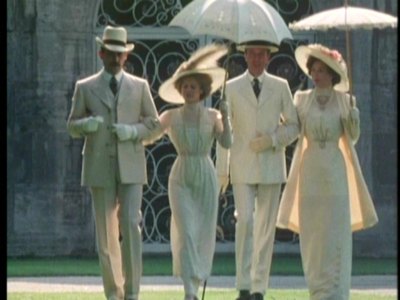
The 1981 TV adaptation, with Jeremy Brett and others
Dowell also admits a few things:
that he and Florence never had sex, because of her supposed heart problem.
that he is extremely glad to be rid of Florence. Florence begins as "poor dear Florence" and ends up "a contaminating influence... vulgar... a common flirt... an unstoppable talker..."
that he is now extremely wealthy, because Florence was an heiress.
that he wants to marry Nancy Rufford.
And then there are the things that are hinted at, implied, downright said but then denied.
Dowell admires Leonora Ashburnham more than any woman on earth, and also considers her "the villain of the piece".
Dowell's admiration of certain men, beginning and ending with Edward Ashburnham, of whom he says, "I loved Edward Ashburnham - and that I love him because he was just myself. If I had had the courage and the virility and possibly also the physique of Edward Ashburnham I should, I fancy, have done much what he did..." But there was also a nephew, Carter ("handsome and dark and gentle and tall and modest.... [whose] relatives... seemed to have something darkly mysterious against him") , and hints at others.
Dowell's greed for the sensuous pleasures of life, from caviar to Kummel to... other things...
Dowell has never worked a day in his life.
The first reading of the book is heartbreaking. Both Edward and Florence commit suicide, and Nancy Rufford goes insane. Believe it or not, this is not a spoiler: this is first chapter stuff. The point is, that the first reading, gives you the plot, the second - maybe - gives you the motivations, and the third... well, there's a lot of questions.
Why did Florence commit suicide? Was she really that heartbroken about Edward and/or that terrified of Dowell? (Dowell describes them both as "violent" men...)
Did Florence commit suicide? (There was a letter...)
What was Dowell doing during the two to four hours between Florence's death and and the discovery of her body?
Why did Dowell marry Florence, a woman he did not love, take her straight to Europe, and do everything she and the doctors told him to?
How many women was Edward Ashburnham involved with? (Six are detailed, but there's also "the poor girl, the daughter of one of his gardeners" who was accused of murdering her baby at the end...)
Did Edward commit suicide? And how? Two different ways are given...
What about Edward's alcoholism?
What about Dowell's alcoholism?
In other words, what the blazing hell really happened?
And all is told in a magnificent, elegiac, Edwardian style that is rich as plumcake. Read it, and let me know what you think.
Available at Gutenberg Press for free at: Gutenberg Press Edition
Available on Kindle for free at Kindle Edition
(Though I still prefer a hard copy, where I can scribble notes - almost as cryptic as the text - all over it...)