(This first appeared 10 years ago, but I think it's always good to look at (my) classics again!)
I love a good Christmas movie or story, but I take my entertainment with a little salt, thanks. Or at least a shot glass. And a little murder just adds to the fun. Here's a list of my favorite Christmas movies, the ones my husband and I watch every year, and yes, we know the lines by heart:
We're No Angels, 1955
I first saw this when I was ten years old, back in the 60's, watching it on a black and white TV set, all by myself. I laughed until I cried, and I remembered lines from it for years afterwards. It warped me for life.
"I read someplace that when a lady faints, you should loosen her clothing." - Albert (Aldo Ray)
Three convicts escape from the prison on Devil's Island on Christmas Eve. There's Humphrey Bogart as Joseph, a maniac and master forger, Peter Ustinov as Jules, an expert safe-cracker, in prison only because of a "slight difference of opinion with my wife", and Aldo Ray as Albert, "a swine" of a heart breaker who only fell afoul of the law after asking his uncle for money (the illegal part was when said uncle said "no" and Albert beat him to death with a poker – 29 times, mam'selle). Oh, and their fellow-traveler, Adolphe - or is it Adolf?
"We came here to rob them and that's what we're gonna do – beat their heads in, gouge their eyes out, slash their throats. Soon as we wash the dishes." – Joseph
Anyway, these 3 convicts need money, clothing, passports - and they find it all at Ducotel's General Store, the famous Ducotel's, "the one who gives credit". Along with Felix (Leo G. Carroll), the most inept, innocent, and financially challenged manager in history, his beautiful wife, Amelie (played by Joan Bennett), and their daughter Isobel (Gloria Talbott, in full super virgin mode).
You can see where this is going: they get hired, they get interested, they get all warm fuzzy, they change their ways, everyone is happy. Right? Well, not quite. Because the big fat plum in this pudding is Basil Rathbone as Andre Trochard, who owns Ducotel's, and has come to Devil's Island - with his sycophantic nephew Paul - to do the books on Christmas Day. I love a good villain, and Basil Rathbone is as snooty, snotty, sneering, vindictive, scheming, insulting, arrogant, belittling, and generally nasty as they come. ("Your opinion of me has no cash value." – Andre Trochard.) He makes Ebenezer Scrooge look like a warm pussy cat.
Andre Trochard - "Twenty years in solitary – how's that for a Christmas present?"
Jules – "That's a lovely Christmas present. But how are you going to wrap it up?"
There's no Ghosts of Christmas Past, Present, or Future in this one; no "God bless us, every one"; no Tiny Tim; but there's theft and forgery, fraud and deceit, murder and mayhem, all done with sharp, hilarious dialog. Go. Rent it now. Pour a Chateau Yquem (you'll understand later) or its equivalent, pull out a turkey leg, and enjoy! Merry Christmas! Compliments of the Season!
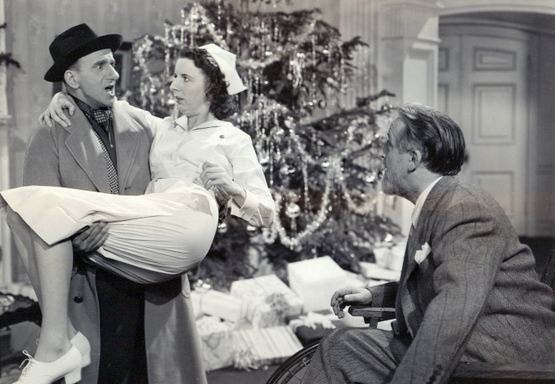
The Man Who Came to Dinner (1942), Monty Wooley, Bette Davis, Jimmy Durante, and more. The worst house guest in the world is also the most erudite, witty, arrogant, and popular man on the planet. Sheridan Whiteside was Kaufman and Hart's masterpiece (especially as played by Monty Wooley), based on (of course) the real Algonquin Club's founder, leader, gatekeeper and spoiled child, Alexander Woollcott.
Jimmy Durante, Mary Wickes (in her breakthrough screen role), and Monty Wooley
The play - and the movie - are chock full of characters who were based, almost libellously, on real people. Banjo = Harpo Marx. Beverly Carlton = Noel Coward. Lorraine Sheldon = Gertrude Lawrence, of whom Beverly Carlton says, in my favorite movie line of all time,
"They do say she set fire to her mother, but I don't believe it."
And Mary Wickes as Nurse Preen, who has to nurse the impossible Sheridan Whiteside:
"I am not only walking out on this case, Mr. Whiteside, I am leaving the nursing profession. I became a nurse because all my life, ever since I was a little girl, I was filled with the idea of serving a suffering humanity. After one month with you , Mr. Whiteside, I am going to work in a munitions factory. From now on , anything I can do to help exterminate the human race will fill me with the greatest of pleasure. If Florence Nightingale had ever nursed YOU, Mr. Whiteside, she would have married Jack the Ripper instead of founding the Red Cross!"
Somebody had to finally say it.
A/k/a Reborn (1981). Directed by Bigas Luna, "starring" Dennis Hopper as the snake-oil selling Reverend Tom Hartley, Michael Moriarty as Mark (a thickly-veiled Joseph), and (I kid you not, spoiler alert!) a helicopter as the Holy Spirit. While it has horrible production values, and was obviously made (in Italy, Spain, and Houston, TX) on rather less than a shoestring (I think all the money was spent on the helicopter), this may be one of the most interesting versions of the Nativity that's ever been done.
"You're going to have a baby? I can't have a baby! I can't even take care of myself, much less a baby!" Mark.
The Thin Man (1934). William Powell and Myrna Loy. Machine-gun dialog, much of it hilarious. A middle-aged peroxide blonde and an incredibly young Maureen O'Sullivan. More drinking than anyone would dare put into a movie today, at least not without a quick trip to rehab for somebody, especially Nick Charles. And mostly true to Dashiell Hammett's plot.
"Is he working on the case?" "Yes, a case of scotch!"
Okay, a quick break for myself and the kids and the grandkids: A Muppet Christmas Carol (with Michael Caine), A Charlie Brown Christmas, How the Grinch Stole Christmas (narrated by Boris Karloff) A Christmas Story. Love, love, love them ALL.
"You'll shoot your eye out!"
Okay, back to more adult fare:
Love Actually (2003), mostly because I start laughing as soon as Bill Nighy starts cursing. (What can I say? I'm that kind of girl.)
"Hiya kids. Here is an important message from your Uncle Bill. Don't buy drugs. Become a pop star, and they give you them for free!" Truer words are rarely spoken in a Christmas movie…
Totally NON-secret NON-guilty pleasure: Blackadder's Christmas Carol (1988). Rowan Atkinson (Blackadder), Tony Robinson (Baldrick), Stephen Fry, Hugh Laurie, Miranda Richardson, Jim Broadbent and Miram Margolyes as Prince Albert and Queen Victoria, and Robbie Coltrane as the Spirit of Christmas…
"Mrs. Scratchit, Tiny Tom is fifteen stone and built like a brick privy. If he eats any more heartily, he will turn into a pie shop." God bless us, everyone.
Scrooge (A Christmas Carol) (1951). Alistair Sim. This is my favorite version, mostly because it feels like Dickens to me, because I love Fezziwig's sideburns, because of the hysterical charwoman, but mostly because Mr. Sim's Scrooge really ENJOYS being a hard-hearted miser from hell. Which makes his delight, after coming back from his Christmas travels among the spirits, more believable. Or at least I always find myself grinning from ear to ear...
"I don't deserve to be this happy. But I simply can't help it!"
Hey, there's 12 Days of Christmas, and this is only the first one – there's PLENTY of time to watch them all!
Minding my own business, I was. Scrolling through clickbait we used to call news feeds. Subject to pitfalls and rabbit holes. And la, in the style of Movie Master John Floyd, a film collection article slid into view titled,
“Many plots in modern-day stories—even across continents, time periods, planets, and dimensions—echo each other's plot arcs. Typically, even the most original works of art nowadays owe credit to others that came before, sometimes dating back to ancient myth. … In film, scripts of one studio [can be picked] up while another takes the same idea and gives it a slight spin … Art imitates art.”
My simplistic definition: Different Titles, Same Plot. In other words, we’re not including remakes, do-overs with the same titles (although some remakes take off in wildly varying directions).
Titles began to pair in my head and within a minute, ten had come to mind. I couldn’t resist checking where she ranked them and, to my surprise, not one of mine made her list. Not one.
Okay, no person can watch every movie ever. Blowup/Blowout are a bit obscure not to mention opaque, but surely most people have heard of John Travolta, Charton Heston, Sean Connery, or are we experiencing Baby Boomer irrelevance? Bond, James Bond. Who?
Zigler goes on to pair thirty four movies (after two updates). I dug into the Web to garner additional opinions, which are included in the table. Some pairings seem tenuous and specious at best: Forest Gump v Benjamin Button? I Robot v Roger Rabbit? The Matrix v The Lego Movie? Fugitive v Minority Report v every individualist ever taking on dystopian society?
One of the pleasures of mystery fiction is finding those series characters you love--the ones you can't get enough of, the ones whose adventures you snap up on sight. We all have our own list of favorites. Mine includes Robert B. Parker's Spenser, John D. MacDonald's Travis McGee, Lawrence Block's Matt Scudder, Sue Grafton's Kinsey Milhone, Rex Stout's Nero Wolfe and Archie Goodwin, Stuart Kaminsky's Toby Peters, Max Allan Collins's Nate Heller, Andrew Vachss's Burke, Kinky Friedman's, um, Kinky Friedman, Gregory Mcdonald's Francis Xavier Flynn, Warren Murphy's Digger/Trace, and Patricia Highsmith's Tom Ripley.
Anybody besides me remember this?
If I had to pick a single favorite character from all crime fiction, though, I wouldn't hesitate. My favorite is Parker.
If you're reading this you probably know Parker, and if you don't, you should. Created by the great Donald Westlake (writing under his pen name, Richard Stark), Parker is a single-minded, ruthlessly efficient thief. He'll kill if absolutely necessary--or occasionally out of revenge--but for the most part Parker is interested in only one thing: getting away with the money. Most of his adventures see him recruited by or putting together a team to pull an ambitious heist. It inevitably goes wrong in some way, and much of the pleasure of the books is in watching Parker deal with that. Often this involves finding himself at odds with The Outfit, which is what the mob calls itself in Parker's world. There are 24 Parker novels, from 1962's The Hunter to 2008's Dirty Money. All are richly deserving of your time.
Now, a nail-biting moment of suspense for a mystery fan is finding out that one of your favorite characters is getting a movie. Will the makers of the film get them the way you do?
Parker has been put on film a number of times (though usually under a different name), played by actors ranging from Lee Marvin to Jim Brown to Mel Gibson. Earlier this month, the latest Parker film dropped on Amazon Prime: Play Dirty, starring Mark Wahlberg as Parker. If you're mostly familiar with Wahlberg from his meathead roles in various comedies and action franchises, this might seem like an odd choice, but Wahlberg is also capable of doing serious work and being appropriately intimidating--witness his performance in Martin Scorsese's The Departed. The new Parker movie was co-written and directed by Shane Black, who's made some solid films in the crime genre--Lethal Weapon and Kiss Kiss Bang Bang, for example. When I watched the trailer, I was impressed that one of the other characters was Alan Grofield, a character from the books who steals to fund his acting career (and who was popular enough to star in four spin-off Stark novels himself). I figured that the presence of Grofield meant that real fans were behind the movie, so I approached it with high hopes.
Those hopes came crashing to the ground fast.
I'll acknowledge the positives first. Wahlberg is, I think, perfectly acceptable as Parker, capturing the character's intensity well. He's almost always the smartest guy in the room, but if brute force is called for he won't hesitate to use it, and he'll usually win. LaKeith Stanfield is even better as Grofield, the more affable, but no less competent, sidekick. Tony Shalhoub does good work as the head of the Outfit. Several other characters from the books are part of Parker's crew--the married thieves Ed and Brenda Mackey, the driver Stan Devers--indicating, again, that somebody who knows the books well was involved at some point.
The basic setup is also solid. Play Dirty isn't based on a specific Parker novel, but the elements of the plot are familiar (I won't reveal anything here that isn't in the trailer). At the start of the film, Parker is part of a racetrack robbery. One of the crooks, a woman named Zen, betrays the crew and runs off with the take. Parker sets out for revenge. Learning that Zen took the cash as seed money for another, much larger job, he deals himself in. Complicating this is the fact that three years ago Parker made a deal with the Outfit requiring him to stay out of New York City--and guess where Zen's heist is happening?
So far, so good. So where does it all go wrong? Well, on a technical level, the special effects in the action scenes are horrendous, completely taking me out of the world of the film. The opening racetrack heist ends up with a cars v. horses chase on the track, with such bad CGI that the horses look like something out of Grand Theft Auto. The cheap CGI gets even worse in later scenes, culminating in a subway crash that is utterly unconvincing.
I can forgive bad effects. I can't forgive the fact that Parker acts less and less like Parker as the film goes on. One of the hallmarks of the character is his determination to avoid unnecessary heat and exposure, but this Parker, by the halfway point of the film, is plotting an absurdly overblown heist that would have every federal agent in the country descending on New York and result in hundreds, if not thousands, of civilian casualties. If that wasn't bad enough, he casually kills a celebrity (in what's meant to be a humorous cameo) for no good reason in the middle of a restaurant full of witnesses and cameras. The real Parker would shoot a member of his crew who did something so dumb.
The movie's also full of logical leaps and absurdities totally at odds with the basically realistic content of Westlake's stories. One of the targets of the New York heist, for example, is a figurehead recovered from a sunken treasure ship. The thing is massive, and surely weighs tons, but it's moved easily from place to place by Parker's crew and others--at one point being transported in what seems to be an ordinary NYC subway car. Watching how they managed to get it in there would have been more entertaining than the actual film.
The second half of the movie, with the crew bantering playfully and dealing with ridiculously contrived obstacles popping up at the most inconvenient times, doesn't play like a Parker plot. It plays like a Dortmunder plot, so much so that it feels like this must have been a deliberate choice. If you know Parker, you probably also know Dortmunder, Westlake's other hugely popular thief character. The Dortmunder books (which Westlake published under his own name) are comedies--for my money, the best comic caper novels ever written. There's a reason Westlake never wrote a Parker/Dortmunder crossover (not counting the book where Dortmunder's crew draws inspiration from a Parker novel). The ice-cold Parker simply doesn't fit in Dortmunder's farcical world. Trying to shoehorn him into it makes both him and the plot look silly.
The end result is a film that's just over two hours long, and feels twice that. It's a shame. My understanding is that this was meant to be the start of a new series, with Grofield even getting his own spin-off movies. That would have been fun--if only Play Dirty was worth watching. About the best I can say of the movie is that it's marginally more watchable than 2020's dreadful Spenser: Confidential, in which Wahlberg played Robert B. Parker's seminal Boston PI as a brutish ex-con vigilante. I have no idea why a significant part of Mark Wahlberg's career is suddenly ruining my favorite characters. I suppose in a few years he'll be playing Nero Wolfe, probably as a streetwise boxer or something.
What Parker should you watch instead of Play Dirty? The conventional choice for best Parker adaptation is John Boorman's 1967 Point Blank, starring Lee Marvin in an adaptation of the first novel in the series (which was also filmed in 1999 as Payback, with Mel Gibson in the lead). Point Blank is a good film, and Marvin is well-cast, but for my money it's a little self-consciously artsy, leaning into impressionistic and pseudo-psychedelic style at the cost of a straightforward story.
I prefer Taylor Hackford's 2013 Parker, based closely on the Stark novel Flashfire and starring Jason Statham as Parker. Statham is terrific in the part, believably capturing the character's intelligence, determination, and menace. There's a strong supporting cast, including Jennifer Lopez, Wendell Pierce, and Nick Nolte. The plot and action sequences are exciting without ever being ramped up into the unbelievable. I really regret that it apparently didn't do well enough for Statham to return to the part, but for fans of the character, it's very much worth seeking out.
(I'll also confess to a lingering fondness for a kind of alternate universe version of the character. In the TV series Leverage, about a crew of con artists and grifters who team up to use their skills on the side of justice, Beth Riesgraf plays a master thief named, you guessed it, Parker. I've never seen any confirmation of this, but that's surely a tribute to Stark's character, particularly since, to my knowledge, the character's first name is never revealed. Riesgraf has a lot of fun with the part, and I really enjoyed the first run of the series, but I've never watched the reboot, Leverage: Redemption, in which she continues the character. If you have, let me know if it's worth checking out.)
If you're looking for a truly great Parker adaptation, though, don't look to the screen--get thee to your local comics shop. In 2009, the writer and artist Darwyn Cooke, with Westlake's blessing and endorsement, released a graphic novel version of The Hunter that is a pure pleasure to read, or even just to look at. Cooke's monochromatic art is stunning, and his sense of pacing and design keeps the story humming along. He's obviously a huge fan of the novels, and his love for them is apparent in every line. It's a very faithful adaptation, set in the 1960s rather than being updated to modern times.
Cooke went on to adapt several more Parker books--The Outfit, The Score (my personal favorite among the novels), and Slayground--and had hopes of covering the entire series, but, tragically, his own death in 2016, at the age of just 53, prevented that from happening. His Parker adaptations are still in print. I particularly recommend the Martini Editions, gorgeous, oversized, slipcased hardcovers that feature a wealth of bonus features and let you really luxuriate in the art.
And of course it goes without saying that if you haven't read the Parker novels themselves, you need to close this window and go do so now. You'll thank me later.
Bob's note: Last month, Part 1 covered Irwin Allen becoming a producer/director of high-concept, plot-holed films and TV shows. His highest highs and lowest lows were still to come…
By the late 1960s, Irwin Allen had done it all in Hollywood. He'd worked his way up from gossip columnist and quiz show host to become a big-name producer. He'd scored hits– and misses– and a reputation for ambitious premises and showbiz spectacle. He'd spent most of the 60s running network series like Voyage to the Bottom of the Sea (1964-1968) and Lost in Space (1966-1968). But he wanted back into filmmaking, and his timing couldn't have been better.
Hollywood was upping the action in films. Because they could, with better special effects, and because the studios had no choice. This television-acclimated audience expected faster storytelling and a rapid succession of crises. Hollywood needed producers who understood fast plotting and fast-paced action.
Allen's next act had arrived.
THE MASTERSTROKE
Universal had tempered hopes for Airport (1970). Star-studded cast or not, the "this flight is in trouble" thing had been done before. But Airport was a blockbuster hit, grossing $128 million worldwide ($1.1 billion in 2025 terms), a huge sum before modern mega-franchises. Critics were left scratching their heads at what had just happened. They coined a new term, the "disaster movie," and braced for more.
Allen had seen the trend coming. While Airport was still in production, he'd already lined up The Poseidon Adventure, a Paul Gallico novel not even published yet. Allen bought the rights for $225,000 after binge-reading an advance copy. An ocean liner capsizes at sea, and if the characters survive the unfolding wreckage, they have a narrow time window to climb to the ship's bottom and get out somehow. "Hell upside down," Allen called it.
Allen's first decision might've been his best. Sure, he could direct a boat turning upside down, but the audience needed to feel it when the cast died off one-by-one. Emotional resonance wasn't in his wheelhouse. Allen sought out director Ronald Neame based on his reputation for complex shoots and character nuance. Allen sold Neame that this wouldn't be just a disaster flick. This would be the best disaster flick they could pull off.
Next, Allen moved to package his all-star cast. Burt Lancaster--the Airport lead--and George C. Scott turned down the main role of Reverend Scott. Down the list was Gene Hackman, who was cementing his image as an engaging tough guy and terrific actor. Allen arranged for an advance screening of Hackman's The French Connection (1971). Impressed, Allen secured Hackman quickly, also a great decision. Hackman won his second Oscar for the movie, giving Allen a buzzy lead actor.
In all, five Oscar winners signed on to the ensemble: Hackman, Ernest Borgnine, Red Buttons, Shelley Winters, and Jack Albertson. This was the acting chops Neame demanded. Neame wanted the disaster shown on a human level, a gut level, with monologues and arguments and anguished close-ups. If the performances chewed the scenery now and then, well, this was an upside-down ship.
Allen had packaged a grand vision that no studio would touch. The $5 million projected cost scared off Paramount, Universal, Warner Brothers, everyone. Even Allen's initial backer, Avco Embassy, bailed when the price tag soared. Allen forged ahead on his own dime. By 1969, he was in $600,000 deep on The Poseidon Adventure.
MASTERING DISASTER
Look, Allen told Twentieth Century Fox, clearly he believed in his capsized ship thing or he wouldn't have financed it this far. He proposed to keep financing it. A partnership, he said. Allen would front the first $2.4 million to get the shooting underway. Fox would finance $2.4 million thereafter to finish and distribute the picture, and Fox would have final approval on big decisions. Any risk was Allen's.
It was an easy yes, a project on-trend and with Hackman, the script, the prep, and the director all wrapped up and ready to go. Especially the director. Look, Fox told Allen, you can be, like, way over the top. Fox stipulated that Neame must stay as director. Allen could– and did– help direct the mayhem sequences.
Allen had to console himself with a producer's fee paid from Fox's half and 10% of the backend participation. And a cut of the merch sales. And on the soundtrack, which produced Maureen McGovern's Oscar-winning "The Morning After."
EVERYTHING UPSIDE DOWN
Allen had been right about the whole project. The Poseidon Adventure raked in $125 million ($1 billion in 2025 dollars). The movie finished second in that year's box office gross, after The Godfather, and leaped among Fox's best-ever performers.
Needless to say, Fox was listening when Allen pitched his next project. True to form, Allen was thinking big, real big, but now so was Fox. Every studio was scrambling to get disaster epics into production. Universal was rushing out not one but two Charlton Heston films, a sequel to Airport and the standalone Earthquake. The field was so crowded that Fox was outbid for the rights to Allen's target novel, Richard Martin Stern's The Tower.
Plan B dropped in Allen's lap two months later. Fox was sent another skyscraper disaster novel, The Glass Inferno, with a near plug-and-play story for Allen's screenplay. Fox snatched up the rights. The problem was that two studios were making essentially the same tower fire movie on essentially the same release schedule.
Look, Allen told Fox and Warner Brothers, we can either team up on one major idea, or we can both flop separately. He was making sense. Multi-million-dollar sense. Fox and Warner Brothers partnered for their first-ever joint production, Allen's The Towering Inferno. As part of the deal, Allen again had to keep out of the director's chair.
The Towering Inferno's production budget was three times that of The Poseidon Adventure, much of it invested in star power. Steve McQueen and Paul Newman co-headlined at $1 million salaries. William Holden, Faye Dunaway, Fred Astaire, Jennifer Jones, Richard Chamberlain, and Robert Wagner also didn't come cheap.
The bet paid off. The Towering Inferno grossed over $200 million worldwide (over $1 billion in 2025 dollars).
SHARK IN THE WATER
Fox had a man on a hot streak. Hey, they said to Allen, you should think about creative cross-promotion, and they had just the project. Fox was sitting on the underperforming Marineland of the Pacific outside Los Angeles. Allen was to rebuild it as Fox World, a theme park based around his disaster films and TV shows. If that sounds like Disneyland but short on magic, you're not alone. The park flopped and was sold off to SeaWorld.
Fox saw it. They watched late-to-trend disaster films cannibalize each other while different takes like Star Wars (1977) grabbed the cultural reins. Fox canceled the remainder of Allen's production deal.
Allen pressed on. The Master of Disaster still had no shortage of ideas. Warner Brothers hired him on, banking that his instincts were still right. The proof they'd gone wrong came quickly: The Swarm (1978). Allen's usual package of script and Oscar winners tanked. More had changed than the times. Allen hadn't packaged a director this time. He took the chair himself, and as Fox had guarded against, the movie indulged Allen's love of cheese. Beyond The Poseidon Adventure (1979) and When Time When Ran Out (1980) did no better financially or critically.
The disaster era was done.
IT'S A WRAP
For another decade, Allen continued to craft small-budget films and television projects until health forced him into retirement. He'd had the run of runs, a player who'd cut big deals and worked with the finest actors of his time. When Allen's stuff was good, it was good. Even when he wasn’t, everything turned out okay. His work never lacked zeal, a rare talent that earned him both an Oscar and a Golden Raspberry Worst Career Achievement Award.
More importantly, Allen did what he set out to do. He'd put on one hell of a show.
Imagine a young girl, tween, early teen, sitting by herself in front of the TV on an early or late afternoon, watching the station that showed a lot of old (and once in a while reasonably new) movies. Tarzan movies (Johnny Weissmuller, of course), sci-fi, horror, dramas, comedies, and weird movies that no one else, apparently, had ever seen.
It was quite an education. Here are some of the highlights:
Sci-fi Movies:
Forbidden Planet - One of the best of the lot (the other will be found further down). My first meeting with Robbie the Robot. While it took me years to figure out it was a take-off of Shakespeare's The Tempest, I loved the whole "monsters from the id" line, and the invisibility of it. Very exciting.
Unfortunately, most of the sci-fi movies were schlock, and the worst was probably The Queen of Outer Space - Zsa Zsa Gabor and a lot of starlets in cone bras...
NOTE: Cone bras apparently were everywhere in the 1950s. Why they were so popular for so long, I have no idea... See https://www.wmagazine.com/fashion/cone-bra-corset-trend-history.
Probably second worst: The Attack of the Giant Leeches - B&W 1959. Has to be seen to be believed, and even then... Trivia note: one of the stars of the Giant Leeches was actress Yvette Vickers who was the Playmate centerfold in the July 1959 issue of Playboy, just a few months before the movie's release, which I'm sure increased attendance.
Lesson to be learned from old American B&W sci-fi movies is that every man, monster, robot and alien wants pulchritudinous white women.
Japanese movies, however, were different:
Matango, a/k/a The Attack of the Mushroom People - 1963 Japanese horror movie directed by Ishiro Honda (who directed and co-wrote the original Godzilla and many more). A group of castaways on an island are unwittingly altered into monsters after they eat certain mutagenic mushrooms... Although I didn't know it at the time, it was almost banned in Japan because they felt that the monsters resembled facial disfigurements caused by Hiroshima and Nagasaki; although of course, that might have been the whole idea. Spooky, yet strangely moving, hard to forget.
Movies that scared me silly:
1984 - Made in 1956, starring Edmond O'Brien, Michael Redgrave, Jan Sterling, and Donald Pleasance. The scene with the rats was perhaps the scariest thing I'd ever seen, and it gave me nightmares. Interestingly, I've never met anyone who actually saw this movie in a theater - I guess it bombed at the box office.
The Invasion of the Body Snatchers - 1954, and set in a fictional California small town. You know the plot. You know the term "pod people". But it still packs a punch as person after person is duplicated and replaced... And they find the pods... And Becky falls asleep... Well...
Trivia NOTE: Future director Sam Peckinpah played the bit part of Charlie, a meter reader.
The Haunting - 1963. Based on the Shirley Jackson novel, starring Julie Harris, and Claire Bloom. I think it's the most frightening movie* ever made, simply because you never see anything. You hear it. And by the time those two great actresses, Julie Harris and Claire Bloom, are done with you, you feel it. And it has the scariest line I've ever heard in a movie: "God! God! Whose hand was I holding?" (*Spielberg agrees with me.)
Not that scary, but one of my favorites:
Rear Window - I was a tween when I saw it, and I could hardly wait to be old enough to live by myself in Jeff Jeffries' (Jimmy Stewart) apartment, watching and listening and following all the crazies around me.
NOTE: Interestingly, I rewatched it a couple of weeks ago, and for the first time I noticed one fatal flaw in the movie: Jeff, who's a professional photographer, has his left leg in a cast, from hip to toes, and is in a wheelchair 90% of the time, so no wonder he spends all his time watching the neighbors. No problem there. And he figures out that one of them killed his wife, and he's trying to find evidence, long distance, using first binoculars, and then a massive telephoto lens on one of his cameras. He finally sees Thorvald, after his wife supposedly went on a trip, with his wife's purse, pulling out jewelry, including the wife's wedding ring. So what's the flaw? WHY DOESN'T JEFF TAKE A BUNCH OF PICTURES OF THORVALD AND HIS WIFE'S STUFF? He's a professional photographer. He's got a telephoto lens which could pick out the feathers on a flying swallow. Surely he's got film in the house. I don't know why I never noticed that before...
Still love the movie, though.
Movies that for years I couldn't persuade people actually existed:
We're No Angels - Still my favorite Christmas movie of all time, with Humphrey Bogart, Aldo Ray, Peter Ustinov, Leo G. Carroll, Basil Rathbone, Joan Bennett, and St. Adolph... Read my love-letter to the movie HERE.
The Producers - Yes, Mel Brooks' classic 1967 film. I was old enough by then to get most of the jokes, and I nearly died of laughter at the line "don't be a dummy, be a smarty, come and join the Nazi party!" My introduction to Gene Wilder, Zero Mostel, Dick Shawn (hilarious as L.S.D.), and Mel Brooks, as always, going over the top. Loved him ever since.
Harold and Maude - I saw Hal Ashby's 1971 classic in the theater, but most people didn't like it. I laughed so hard I was crying. After 10-11 years, it finally hit cult status, and I could finally share it with my friends. Huzzah!
Highly Educational:
Tarzan and His Mate - 1934, pre-Code B&W, the 2nd in the series with Johnny Weissmuller as Tarzan and Maureen O'Sullivan as Jane. This is the film with the nude Jane/Tarzan swimming scene. I remember it well... You can see it on YouTube HERE.
If I couldn't have Jeff Jeffries' apartment, I wanted Tarzan and Jane's treehouse. And lifestyle. And I wouldn't have minded having THAT Tarzan...
Sheer silly fun:
The Pickwick Papers - (1952) I started reading Dickens early in life, and this adaptation is, imho, the most Dickensian I've ever seen. B&W, with full throttle performances, perfect costumes, manners, mannerisms, everything. I bought a copy of it years ago on DVD. I love it.
Mrs. Leo Hunter, reading from her own composition,
I watch a lot of movies. So many, actually, that I often run out of current and recent movies and wind up re-watching those I've seen many times before. At least those are easy to find: I have three dozen boxes, each holding 26 DVDs, scattered around the house, plus God knows how many more DVDs on and underneath the bookshelves here in my home office. It's enough to make my wife scream. Thank goodness I'm a great husband in all other respects (he said modestly).
Anyhow, I recently rewatched The Quiet Man, a lighthearted John Wayne/Maureen O'Hara movie set in Ireland, which on the one hand is not my usual kind of movie and on the other hand is one that I always enjoy. And it occurred to me, when it was finished and the credits were rolling, that this well-known and award-winning film was adapted not from a novel but from a short story, first published by Maurice Walsh in The Saturday Evening Post in the early 1930s. Whoodathunkit?
That, of course, got me thinking about other film adaptations from the short stuff. And since I had an upcoming and uncompleted SleuthSayers column that needed to be completed . . .
Here are my highly-biased (and always changing) picks for the ten best movies adapted from short stories:
1. It's a Wonderful Life -- from "The Greatest Gift," Philip Van Doren Stern
2. Rear Window -- "It Had to Be Murder," Cornell Woolrich
3. High Noon -- "The Tin Star," Mark Casper
4. Bad Day at Black Rock -- "Bad Day at Honda," Howard Breslin
5. The Quiet Man -- "The Quiet Man," Maurice Walsh
6. Hondo -- "The Gift of Cochise," Louis L'Amour
7. The Killers -- "The Killers," Ernest Hemingway
8. The Swimmer -- "The Swimmer," John Cheever
9. 3:10 to Yuma -- "Three-Ten to Yuma," Elmore Leonard
10. The Curious Case of Benjamin Button -- "The Curious Case of Benjamin Button," F. Scott Fitzgerald
Five runners-up: The Birds ("The Birds," Daphne du Maurier), Stagecoach ("The Stage to Lordsburg," Ernest Haycox), The Tall T ("The Captives," Elmore Leonard), The Secret Life of Walter Mitty ("The Secret Life of Walter Mitty," James Thurber), Million Dollar Baby ("Million $$$ Baby," F.X. Toole)
Continuing with this idea of short fiction to screen, the following are my picks for the ten best movies adapted from novellas:
1. The Shawshank Redemption -- from Rita Hayworth and Shawshank Redemption, Stephen King
2. Stand by Me -- The Body, Stephen King
3. The Thing -- Who Goes There?, John W. Campbell, Jr.
4. The Mist -- The Mist, Stephen King
5. Apocalypse Now -- Heart of Darkness, Joseph Conrad
6. Silver Bullet -- Cycle of the Werewolf, Stephen King
7. Hearts in Atlantis -- Low Men in Yellow Coats, Stephen King
8. The Old Man and the Sea -- The Old Man and the Sea, Ernest Hemingway
9. The Man Who Would Be King -- The Man Who Would Be King, Rudyard Kipling
10. The Snows of Kilimanjaro -- The Snows of Kilimanjaro, Hemingway
NOTE: Yes, I like Stephen King.
Five runners-up: A River Runs Through It (A River Runs Through It, Norman Maclean), Minority Report (The Minority Report, Philip K. Dick). The Fly (The Fly, David Cronenberg), Breakfast at Tiffany's (Breakfast at Tiffany's, Truman Capote), Shop Girl (Shop Girl, Steve Martin)
Breaking news: I was reminded, by SleuthSayer Joseph D'Agnese's column yesterday, of several more good movies that started out short: Arrival, All About Eve, Brokeback Mountain, etc. (Joe, do great minds think alike, or what?)
Okay, which ones, Faithful Readers, did I leave out? Which do you think shouldn't have been included? Have you writers had any of your short stories or novella-length fiction adapted for the movies or TV? (For me, no.) Anything pending or promising? (No.) Any near-misses? (Yes.) Sold any film options? (Yes.) Do you have cinematic hopes for future projects? Who knows, right?
Who knows, indeed. If you're like me, and none of your fictional creations have made it to the big screen, don't lose hope. Hold steady, stick to the plan, maintain the course.
I admit it: it’s a clickbaity title but work with me here. This week the issue of book-to-film rights popped up on the boards of the Short Mystery Fiction Society, and it nudged me to think about the specifics of deals I’ve been privy to.Authors dream of Hollywood deals because we assume they lead to big money. Granted, everyone’s idea of big money differs, but I venture to say that these days those fantasies involve six zeroes.
I have in my possession an interesting document that confirms the fantasy is possible. Don’t ask me how I got the doc, which pertains not to one of my ghostwriting clients’ books, nor my wife’s, and certainly not one of mine. Suffice to say someone just got sloppy.
Let’s preface this by saying I’m not a lawyer, agent, or hotshot writer. But I do think that the publishing and film industries like keeping writers in the dark about how much their work is worth. So if someone was stupid enough to slip me a doc, I figure it’s okay to share, provided I don’t identify the people involved.
The document is a response to a studio option offer for a book written by a young writer who, at the time the 2024 document was written, was already a No. 1 New York Times bestselling author in one genre. This deal was for the person’s debut in another genre, which will be pubbed in 2025. No, I am not acquainted with the writer.
A year ago, the still-to-be-pubbed book must have been considered “hot,” whatever the hell that means these days, because in the push-back document the author’s book-to-film agent believed that they could get $150,000 for a 12-month initial option, with a renewal at the same rate and length. An option is the money a production company or studio pays a writer to have the exclusive rights to a work (for a fixed period of time) while the studio attempts to get the film greenlit. When talking about options, agents focus on several deal points such as:
Initial option: How much the studio or production company will pay the author to exercise their option on the work (story or book), over how much time.
Extension option: How much they will pay to renew this option on the work.
Purchase price: How much they will pay if/when the work is turned into a film or TV show.
Royalty: How they will pay per episode if the work is turned into an episodic TV show.
Backend: How much the author will participate in the gross profits of the resulting filmed project.
These are just the basics. There are a litany of other points, from the onscreen credit the author will receive, the rights the author will reserve to the project, all the way to how much creative control the author will be allowed to have on the final product, not to mention travel perks, etc.
The options I’ve seen for my ghostwriting clients, my author friends, and my wife involve a payment for a term lasting one to two years, usually with a built-in renewal clause with payments at the same rate or slightly higher. It’s safe to say that of all the contracts I’ve been involved with, I’ve never seen figures as high as the ones in this document. And yes, I’m a newb in this world.
Back to the doc in hand. If the opposing side accepted the agent’s counter, the author would earn $300,000 on the option over two years. If the production happened, the author would be paid a purchase price of $1.5 million. Already we’re at $1.8 million. This fits our six-zero dream nicely.
Remember, this is a counter-offer, so in a way it represents the agent’s wish list for the author’s book. I don’t think the agent would have been throwing around such figures if they didn’t think it was feasible. The purchase price figure seems designed to arrive at $1 million after the lawyers get involved.
In this particular document, that $1.5 million figure is thrown out as if it covers all types of productions. The memos and contracts I’ve seen tend to break out different purchase prices for, say, cable or network TV productions, major motion pictures, limited series, etc. I assume the agent wanted to send a message to the opposing side that they wouldn’t get the license for this book cheaply.
Not every literary agent has the credentials to sell their clients’ work to Hollywood. So they partner up with a book-to-film agent, who has the track record and contacts. The book-to-film agents I’ve met appear to practice the Spaghetti + Wall method of promotion. They email a glowing pitch letter with attached manuscripts or book proposals to studio heads and production companies they think might be interested, then sit back and wait.
They don’t pick up a phone to verbally pitch a damn thing—i.e., “work”—unless something in the news has suddenly made a project “hot.” (Yes, there’s that stupid word again.) Like literary agents, book-to-film agents don’t have to sell your book to make a living. They just have to sell a book. But if a name director, producer, or actor has read or heard about a book or story, then the agents can sit back, field offers, and play each bidder against the other.
Side note: My favorite movie scene of a talent agent defending his existence…
There’s always stupid additional money and perks involved in the deals these agents lock down for authors. If the book I’m discussing gets turned into a TV series, the author would theoretically be paid $7,500 per episode as a royalty, $25,000 per episode as befits the author’s proposed non-writing executive producer (NWEP) credit. (This is why everyone wants to be an executive producer.) The author will also earn a percentage of the modified adjusted gross receipts (MAGR), which is the “backend” in the laundry list above. What’s more, this particular author will be allowed to offer “meaningful consultation on all creative decisions” and be able to participate in the writers’ room if the work is turned into a TV show.
If the author must travel 60 miles from home to indulge in these bouts of creativity, the production must provide travel, accommodations, and a per diem to cover the writer’s expenses. If the film or show is nominated for awards, our author is guaranteed an invite to the award presentation, with a similar travel package and budget.
As written, every thing on this sheet of paper is a sweet deal, and I hope the writer got what the agent proposed, or close to it.
We have not discussed the impact this production will likely have on the author’s book, which, let’s remember, has not been published yet but will soon. With the kind of exposure a TV show or film is likely to generate, the book will no doubt sell phenomenally well, which is every writer’s dream.
That is the whole point of a print project going Hollywood. Movies and TV shows raise the visibility of books and authors, and have since the first moviegoer walked out of a theater hoping to snag a hard copy of Gone With the Wind. I would not have read Wicked without hearing about and later seeing the Broadway play. I’m a Baum fan from childhood, which is why I won’t be seeing the movie. Two versions of that story was enough.
So yeah—a Hollywood deal is sweet, which is why everyone wants one. It’s wonderful to have a piece of paper detailing such a juicy option in your hands—or even a complete stranger’s—except that none of it may ever come true.
Most books are never optioned by Hollywood. And the ones that are are rarely made. Notice how many times I have used the word if in discussing everything up to now. As you may have surmised from my headline, I am here to argue that sometimes it’s perfectly okay if an optioned piece of writing never gets made into a movie.
My premise is based on the experience of a friend who started in journalism and later switched to writing narrative nonfiction books. (That’s code for history that doesn’t suck.) All but one of his titles have been New York Times bestsellers. None have been made into movies. His big breakout book sold modestly in hardcover but hit its stride in paperback, when—goes the publishing biz theory—it was eagerly gobbled up by book clubbers who wanted to read a real-life story that “read like a novel.”
Decades later, his breakout book still hasn’t been made into a movie, despite being optioned way back in the early 2000s, and having a revolving door’s worth of name actors, directors, and producers attached to it over the ensuing years.
Said friend is not weeping over this state of affairs. At the time we first met him, he estimated that he had earned $100,000 from a decade’s worth of option money. That figure is now probably $200,000. The studio he signed with just kept extending the option. Again and again and again.
The writers I know who have accepted modest options on their books typically pocketed $5,000 every six months for terms that lasted 12, 18, or 24 months. Yes, that’s a small dollar figure—only three zeroes—compared to the sweet numbers and perks I detailed above, but it’s real money. The rest is so hypothetical you cannot bank on it. When you sign that contract, the option money is the only thing that’s real. Just like advance money is the only cash you’re guaranteed to receive when you sign a book contract. Royalties, if they happen, are gravy.
The most money any one of my short stories has earned—with reprints—in its lifetime is $1,220. Who am I to sneeze at a semiannual payment that is 409 percent higher?
I hope you are not reading this thinking, “Oh sure, that’s all well and good for novelists. I’m a short story writer. No one’s ever going to pay me that kind of money.”
Slap yourself upside the head right now. The films All About Eve, It’s a Wonderful Life, Arrival and tons more all started life as short stories. I am not even bothering to Google a list of the bajillion more examples that surely exist. Okay, I lied. And look at me—I keep lying. (However, in the comments, please chime in with the names of other films. I think it will warm all our hearts.) [EDIT: The day after this post appeared, fellow SleuthSayer John M. Floyd posted an entire article on short stories that became movies. See it right here!]
The real issue is learning a) to keep doing good work, and b) to be happy with so-called “small” paydays. Option only a few stories and those four-figure checks can provide an enviable income that will help you create more work. Perhaps a more accurate headline for this article might be “Getting Rich $5,000 at a Time.”
I guess the question is how you trigger that gravy train by getting your work optioned. I have seen numerous articles for writers that touch on this, and I’m sure you have too. Articles that tell you to, say, mail your work to actors and directors whose work you adore. (Don’t. I’ll explain why one of these days.) Other articles tell you to attend “pitchfests” to drum up interest in your work. (I hate talking to people, so don’t look for me at one of those things.)
Two movies I enjoyed got their start as quite obscure books. So far as I can tell, The Descendants hit the bestseller list for the first time after the George Clooney film hit theaters in November 2011. The Prestige, a marvelous science fiction novel by the late Christopher Priest, has won a respectable number of genre awards but I venture to say most of us who’ve read it did so after catching the Nolan Bros. film.
Each of these books were brought to the attention of their directors by book-to-film agents. What pushed those directors to take notice was the endorsement of someone in their circle who had read the books and loved them.
It sounds like something out of the realm of fantasy, doesn’t it? People who read books! In Hollywood! But it happens.
A producer I won’t identify used to keep an apartment in Florida so he could visit his son from a previous marriage. One morning, while riding down in the elevator of this condo building, he spied a poster for a book club meeting where attendees were slated to discuss a nonfiction book published a few years earlier. He wrote down the name of the book, bought it, read it, and later called my wife’s literary agent hoping to work out a deal.
“Wait,” I said the first time I met him. “You really read the book?”
“Cover to cover. Why, you wanna quiz me?”
Next time, if I get permission, I will share the details of a book-to-film contract.
Kenneth Wishnia is no mean author of mysteries, but he also teaches English at Suffolk County Community College in New York. I am delighted that this semester one of his classes is using as a textbook the anthology I edited, Crimes Against Nature: New Stories of Environmental Villainy.
A couple of weeks ago I had the privilege of speaking to his class via zoom. They asked a lot of great questions and - how wonderful! - had clearly read the material.
But I want to talk about one point that came up. Someone asked which authors had influenced me and that led to me rambling about Donald E. Westlake and how terrible the movies based on his books had turned out.
Ken spoke up in defense of The Hot Rock, which I admit is the best of them, but that got me trying to think of a first-class movie comedy based on a humorous novel. At first I couldn't come up with any. Eventually I remembered some and realized how few of the novels in question I had read. So I am going to list what I came up with and invite you to add more.
CATEGORY 1: Read the book and seen the movie.
The Princess Bride. One of my favorite movies, and it is based on a great book. Perhaps not surpisingly the screenplay was written by the author of the book, William Goldman. In As You Wish by Cary Elwes (who played Westley) we learned that on the first day of production they had to stop filming because the sound man was picking up strange noises. It turned out that Goldman was at the far end of the set praying out loud that director Rob Reiner did not ruin his masterpiece. Happily his prayer was granted.
American Fiction. Based on the novel Exposure by Percival Everett. This is a case where I liked the movie better than the book, possibly because I saw the movie first. Both are delightful.
Confess Fletch. Based on Gregory Macdonald's novel. Don't get me started on the more successful Chevy Chase movie Fletch, because I despise it.
Thank You For Smoking, based on the very funny book by Christopher Buckley.
CATEGORY 2: Seen the movie but haven't read the book.
The Russians Are Coming! The Russians Are Coming! Based on Nathaniel Benchley's The Off-Islanders. By the way, his father was Robert Benchley and his nephew was Peter Benchley. Quite a talented family.
Bananas. "Elements" of the plot are from Richard P. Powell's novel Don Quixote U.S.A.
M*A*S*H. Based on the novel by Richard Hooker, alias Hiester Richard Hornberger, Jr. and W.C. Heinz. HRH really had been a surgeon in Korea.
Mister Roberts. Based on the novel by Thomas Heggen. Heggen's success ruined him. He couldn't figure out how to write a second book and drowned in a bathtub at age 30 with a heavy dose of barbiturates.
The Devil Wears Prada, based on the novel by Lauren Weisberger.
About a Boy, based on the novel by Nick Hornby.
No Time For Sergeants, based on a play by Ira Levin, based on the novel by Mac Hyman.
Our Man in Havana. Graham Greene wrote the screenplay, based on his own novel. A few years ago Christopher Hull wrote Our Man Down In Havana: The Story Behind Graham Greene's Cold War Spy Novel. It's interesting but a more accurate subtitle would be: Graham Greene's Experiences in Cuba.
Kind Hearts and Coronets. "Loosely based" on Roy Horniman's 1907 novel, Israel Rank: The Autobiography of a Criminal.
Bridget Jones' Diary, based on the novel by Helen Fielding.
Kiss Kiss Bang Bang. Remembered this one at the last moment! Shane Black had apparently written most of the script when he decided it needed to be a crime story. He took the detective elements from Brett Halliday's Bodies Are Where You Find Them and wrote/directed a very funny flick.
CATEGORY 3: Haven't read the book or seen the movie, but I've heard they are good things bout both..
Clueless. A California high school girl's attempts at good deeds backfire. Based on Emma, the only Jane Austen novel I could not get through.
Breakfast at Tiffany's. Based on Truman Capote's novella.
Election. Based on the novel by Tom Perrotta.
Crazy Rich Asians, based on the novel by Kevin Kwan.
Mrs. Doubtfire, based on Madame Doubtfire, byAnne Fine.
So, what am I missing? I'm sure you will mention some that make me bang my head in frustration for not thinking of them Remember, it has to be a good comedy based on a novel.
Back
when, in what now seems like the Bronze Age, a guy named Col Needham started
the Internet Movie Database. He was a
movie nerd who lived outside Manchester,
UK, and he
began by scribbling notes in longhand.
When he was fifteen, he got his first computer, a DYI with 256B of
memory. (You read that right, 256 bytes.)
This was the early 1980’s, so VHS had been introduced. Col
didn’t have to go to the movies to see movies, anymore. And he was still
taking notes, but now he was storing them on his computer, in a program he’d designed. The online community was primitive and insular,
Col and his like-minded
movie pals were file-trading on USENET.
He eventually wrote a searchable database, and in 1990, he published the
software for free. At this point,
websites – such as they were – were college-based, or research lab
proprietaries, and IMDb launched in July of 1993, at CardiffUniversity, in Wales. It was one of the first hundred or so
websites ever curated for any
purpose, anywhere.They went mainstream
in 1995.
It’s
worth noting that IMDb was all user-based.They were amateurs, and the database was compiled in much the same way -
if you think about it – as the Oxford English Dictionary.Ask a select group of people with an odd
enthusiasm, or Attention Deficit, to hunt up the earliest use of a word, say, or
Robert Redford’s first screen credit (Season 3 of Maverick, 1960).See, makes it
look easy.
Thirty
years ago – that long ago, and that recent – AOL began sending everybody in
Christendom trial CD’s of their dial-up software.Every two weeks, according to a recent
article in the Post, traffic to IMDb
doubled.And they started taking
ads.This was a crazy idea.Nobody understood you could monetize the Web.IMDb now averages 250 million users monthly,
one of the fifty most-visited websites in the world.(I hesitate to inform you that it’s owned
these days by Amazon.)
Back
in 1995, my public library in Provincetown, Mass., didn’t have internet, and I started going up-Cape
to Orleans, where you could use their
public library to log on to catalogues for print media, and pull up material on
the screen at will, whereas before you had to go all the way to Boston, to the
big public library on Copley Square, and research magazine and newspaper
morgues on microfilm – and you were of course confined to what they had on
file, the Boston Globe, the New York Times, the papers of record.For me, this was revelation, apotheosis, to have access to this
limitless archive.It wasn’t limitless,
really, there were probably no more than a couple of thousand gateways, if
that, open to public browsing, where you didn’t need academic credentials – and
it was an even greater revelation to stumble onto this clunky, user-generated, fan directory.It was a vanity project, or in Col Needham’s
frame of reference, an Ed Wood picture, but as far as I was concerned, a wet dream.
This,
seriously, is one of those “Let’s put on a show,” moments, Judy Garland and
Mickey Rooney trying to save the orphanage.Col Needham and his wife Karen, and a few other dedicated goofs, made it
happen.God bless.
Looking
for something to cheer us up over New Year’s, we streamed The Happytime Murders.Melissa McCarthy, Maya Rudolph, what’s not to like?It’s got puppets, mixed with live action, so
like Roger Rabbit, you might be
thinking, those cute ‘toons.Well, first
off, I have to warn you, it ain’t for the faint of heart.It’s incredibly crude, beyond Dumb and Dumber, for example, with the
explosive laxative scene.Happytime Murders tops that, with puppet
ejaculation.(And if you’ve stopped
reading, this very minute, I get it.)There’s a barrage of graphic language, and violent dismemberment –
although it’s doll stuffing, not blood squibs – but disturbing, nonetheless, to
picture Raggedy Ann and Andy, torn limb from limb, before your very eyes.
Pull
up your socks, snowflake.This movie is hysterical.I was laughing so hard, I thought I was going
to wet my pants.I know, I’m a sick
puppy.There are some extremely troubled
minds behind this picture, led by the late Jim Henson’s son Brian, and it’s an
acquired taste, but I have to say it’s demented genius.It calls up Mel Brooks or Don Rickles, at
their most demonic.
It is a mystery, a parody of hard-boiled,
actually, with first-person voiceover narration, and all the genre tropes. The private dick blows cigarette smoke in the
cop’s face when he’s being interrogated; the puppets snort sugar – puppet
cocaine – in the vice den; the (human) stripper bites the tip off a carrot
while she’s pole-dancing, to get the (puppet) rabbits in the audience worked
up.I want to give you the flavor, but
avoid giving too much away: half the kick of the movie is not being anywhere
near ready for what they come up with.Admittedly, it’s shameless, and they’ll stoop to anything for a laugh,
but there are throwaway bits you’ll miss if you blink.The private eye goes to a porn shop early on,
tracing a lead, and on the back wall are posters for X-rated DVD’s.I’m not going to tell you the titles, which
are jaw-dropping, my point is the attention to detail.The camera only glances in their direction, and
your glimpse is fleeting, but the set design is a shock reveal, intentional and
gratifying.
Granted,
you’re not in this for the plot twists, which you see coming.The surprises are in how they hit the expected
beats.A nod to Basic Instinct, say.You’re
going, WHAT? A lot
of it is that you can’t believe what you’re seeing. Did they really do that? you ask yourself.
And then there’s the gag reel, over the end titles, which is of course a
peek behind the scenes, and you get to see how they did do that. Chinatown it
ain’t, clever as it is in execution, but it ain’t Steamboat Willie, either.