Showing posts with label Robert Heinlein. Show all posts

25 February 2026

Neglected Favorites


I was going into the hospital in November, and I thought I’d better pack a good, big book – think Shogun or Lord of the Rings – and Jack Vance’s Lyonesse trilogy popped into my field of view.  As it turned out, I didn’t read it in the hospital, after all, but it was nice to make his acquaintance again just the same, and I’m now about to sink my teeth into an earlier series, The Dying Earth.


Jack Vance is one of those guys I read quite a lot of, in the late 1970’s, and then stopped reading, I don’t remember why.  This probably isn’t unusual, our enthusiasms aren’t consistent.  I went through almost all of Steinbeck, for instance, in my late teens (the only one I left out was A Cup of Gold), but I haven’t picked up any of the books since.  I can go back and read Irwin Shaw’s short stories, or O’Hara’s, and enjoy them – as well as learn something from them – so it isn’t the period or the fashion, just a lack of curiosity.  I admire Steinbeck’s muscularity, and I think he’s an influence on me, so I can’t explain it, not at least to my own satisfaction.  Jack Vance, though, falls into a different category.  It’s not that he isn’t a stylist, he’s a very graceful writer, if not quite as limpid as Ursula Le Guin, say, or Sylvia Townsend Warner, but no mean shakes.  The thing about Vance is that he’s an extraordinarily convincing world-builder; geography, and cosmology, yes, and politics, but language, and food, and music - ritual, in other words.  This is nothing to be sneezed at.  He’s right up there with Philip José Farmer and Philip K. Dick.  My favorite book of Vance’s has always been The Last Castle, an odd, dystopian novella I gave or lent to many other people, some of whom got it, and some of whom didn’t.


(Speaking of Sylvia Townsend Warner, I think Kingdoms of Elfin is one of the most startling and original books I’ve ever read, but I’ve never been able to get more than half a dozen pages into anything else of hers.  It’s a mystery.)


Rediscovering, or revisiting, Jack Vance got me thinking about this question of enthusiasms, and maybe it’s exactly that, that we can blow so hot for a writer, that we can’t help but blow cold, at some point.  J.D. Salinger comes to mind.  There’s that famous quote from Isaac Asimov, which I’ve used before.  He was asked, When was the Golden Age of science fiction?  And he said, Fourteen.


It’s true that we can go back to somebody we adored, in our early reading, and be disappointed; it’s also true that we can go back, and be astonished, not only that they can still cast the spell, but that we see things now that we of course missed, then.  Robert Louis Stevenson is one of these.  The opening chapter of Treasure Island is a masterful piece of compression and suspense; but Treasure Island actually begins before the opening lines, it begins with the frontispiece map.  Another example is Dorothy Sayers.  Most of us would have come to her later on, she’s not for kids, but at the same time, most of us would have raced through the books.  If you go back and read The Nine Tailors, or Murder Must Advertise, which has the reputation of a slighter book, but giving them breathing room, taking your time, they present as novels of manners, as much a highly-colored portrait of the years between the wars as Trollope is of the mid-Victorians.  And Sayers casts an unsettling eye forward; her world may seem serene and comfortably hierarchal, but Wimsey is in some ways strikingly modern.  He clearly suffers from shell-shock, PTSD, and Bunter, who was with him in the trenches, is more than a gentleman’s gentleman, he’s a refuge.


I think we sometimes outgrow writers we once liked.  I don’t think it’s disrespectful.  We still harbor a residual affection for them, which is in some ways a melancholy reflection on who we used to be.  I don’t think any the less of Robert Heinlein, for example, I just don’t think he’s readable, any more – at least for me.  (I could give The Moon Is a Harsh Mistress another shot, I guess, but I’m not that tempted to test my own bandwidth.)


It’s refreshing, on the other hand, to find out you can be hooked again by a writer, just as thoroughly as you were the first time.  Here’s an embarrassing story.  I read Jefferson Parker’s Laguna Heat when it first came out, and then the next book, Little Saigon, and I liked both of them a lot.  And then I had the misfortune of watching the TV movie of Laguna Heat.  I’m sorry, but Harry Hamlin, for all that he seems to be a nice guy, is not a very expressive actor, and even with Jason Robards and Rip Torn and Jimmy Gammon – no.  Least said, soonest mended.  But here’s where I mortify myself.  I stopped reading Jeff Parker.  We all know the writer has zero control of what happens when they sell a book to the movies.  Sure, you got Dutch Leonard, or Dennis Lehane, but the rest of us are up shit creek.  You can open the oven door, and the soufflé will fall, but Jeff wasn’t even in the kitchen when it happened.  It took me fifteen years, before I picked up Silent Joe, and realized what I’d been missing.  I can say now, with all humility, I never would have forgiven myself, if I’d missed A Thousand Steps, or worse, The Rescue.  And what about the Charlie Hood books?  There’s always the satisfaction of knowing you can give yourself a second chance. 


Take this as a cautionary tale.  Fashions change.  Our own tastes.  The way a writer looks at the world, or the way we do.  But don’t pass up a good book.  They sneak up on you. 

27 September 2018

Nostalgia Bites


BalthazarNovel.jpgAs a bookaholic from my early childhood, I can assure you that I have read my way through shelves, yards, perhaps miles of books.  (That is not a complaint.)  And I have no problem with that.  I've also gorged on music, movies, television shows, and every other entertainment that is made available to me.  Some of this is because I'm greedy, and some of this is because reading is so much easier than writing:
"Will you be writing a novel?" "If denied every other form of physical gratification." - Pursewarden, in Balthazar by Lawrence Durrell
Good old Lineaments of Desire.  Seriously, if you've never read The Alexandria Quartet, check it out.  It rivals Roshomon as far as technique, complications, and amazing reveals.  And it definitely has atmosphere.  I'm not sure that Durrell's Alexandria still exists, but I'd love to see if it does.

BTW, Alexandria, Egypt is also the hometown of the poet C. P. Cavafy.  He's best known for Ithaka, and Waiting for the Barbarians.  (The latter has spawned eponymous novels, songs, paintings, an opera, and an upcoming movie.  Seriously good.  And timely.)  My personal favorite Cavafy poem is The God Abandons Antony:
When suddenly, at midnight, you hear
an invisible procession going by
with exquisite music, voices,
don’t mourn your luck that’s failing now,
work gone wrong, your plans
all proving deceptive—don’t mourn them uselessly.
As one long prepared, and graced with courage,
say goodbye to her, the Alexandria that is leaving.
Above all, don’t fool yourself, don’t say
it was a dream, your ears deceived you:
don’t degrade yourself with empty hopes like these.
As one long prepared, and graced with courage,
as is right for you who proved worthy of this kind of city,
go firmly to the window
and listen with deep emotion, but not
with the whining, the pleas of a coward;
listen—your final delectation—to the voices,
to the exquisite music of that strange procession,
and say goodbye to her, to the Alexandria you are losing.
Anyway, along the line I have noticed that my tastes have changed.  Thank God.  For one thing, when I get totally bored by a novel, or it's really, really bad, instead of plowing through I quit reading it. (With non-fiction, I apply my grad school skills and gut the boring ones because knowledge / information doesn't always come in a nice candy coating.)  Even when I was reading novels for the Edgars, there were two books that I just gave up on.  One I called "Fifty Shades of Green" because all the sex took place out in the wilderness.  (Presumably a statement of some kind, but I started laughing about page 15 - for all the wrong reasons - and didn't stop until I tossed it onto the pile and reached for the next book.)  And another book that was absolute torture porn.  The first 10 pages gave me nightmares, so I stopped.

Plan 9 Alternative poster.jpgThis is not to say that there's no place for trash.  I still think that an evening of Plan 9 From Outer Space can be very fulfilling, as well as almost any Joan Crawford movie.  And if you've got Bette Davis fighting with Mary Astor or Miriam Hopkins, I'm front row seating.

And there are some things that are like a train wreck.  You just can't take your eyes off of them:  Ancient Aliens.  Immanuel Velikovsky's Worlds in Collision (did you know that Venus is actually a comet?  Ha!).  Pink Flamingos.  Richard Wallace's Jack the Ripper, Light Hearted Friend (did you know that Lewis Carroll was actually Jack the Ripper?  Ha!)

And I would not have survived grad school without a stack of really cheesy romance novels for mental popcorn.

A couple of summers back I went through a fit of nostalgia and re-read a bunch of books from my tween/teen years.  Some held up.  Marjorie Morningstar is pretty damn good; so are The Once and Future King (which I still know almost by heart), Ship of FoolsThe Spy Who Came In from the Cold, etc.  

But a lot didn't hold up, mostly the books I'd read for the sex, like Frank Yerby novels, because, in the 60s, it was him, Harold Robbins, or Ian Fleming for an educational experience.  (Harlequin romances barely went beyond a kiss in those days.)  Besides, my mother read Yerby, my father read Fleming, and I simply snuck off with their copies when they weren't looking.  (Even as a teenager I couldn't stand Harold Robbins.) 

The Moon Is A Harsh Mistress coverBTW, teenaged Eve was so glad to find Robert Heinlein.  Tunnel in the SkyHave Spacesuit, Will TravelStranger in a Strange LandThe Moon is a Harsh Mistress, and many more.  It was my first exposure to strong, intelligent women, and got me ready for Emma Peel.

My two favorite Heinlein quotes are both from The Moon is a  Harsh Mistress:
TANSTAAFL  and  "Is no rape on Luna.  Men won't permit." 

And not, I might add, by curtailing women's freedom to dress, work, walk, jog, speak, behave, and live any way she damn well pleased.

Still, be careful giving in to nostalgia:  sometimes it bites.

Back when Netflix first came out I watched a bunch of 1960s movies that I loved when I first saw them, and while there were a lot of great, great, great movies made back then, there were also some that made my jaw drop.  I liked this crap?

Billy Jack:  I'm embarrassed to say how much I enjoyed it back in 1971, even though even then I knew that the dialog was really bad.  And that they'd all have ended up shot to death in real life.  I mean, this is after Kent State, folks.  Idealism was long gone.

And Blow Up turned out to be a big wad of nothing.  I still think it's main reason for success was that it was the first time that a major actress - Vanessa Redgrave - showed her bare breasts on screen.  But then, I've found I can't stand any of Antonioni's films.  If I'm going to do slow-burning moody atmospherics, give me Peter Weir's Picnic at Hanging Rock any day, or Andrei Tarkovsky's Solaris or Andrei Rublev.  

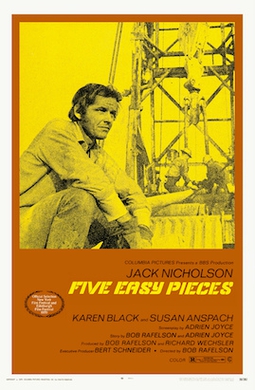
Five easy pieces.jpgFive Easy Pieces.  Jack Nicholson in youthful full form.  I loved the scene with him playing the piano on the back of a pick-up truck, and the restaurant, searching for toast, both then and now.  But you know something?  The rest of the movie sucked swamp water.  The women were all basically sexual fungibles, with no intelligence or purpose other than to cling to a man like a limpet.  And Nicholson's character was about as much fun as a razor blade.  In fact, Bobby Dupea was the exact [male] embodiment of the description Jack Nicholson's character gives of Michelle Pfeiffer's character in Wolf twenty-four years later:
"You know, I think I understand what you're like now. You're very beautiful and you think men are only interested in you because you're beautiful, but you want them to be interested in you because you're you. The problem is, aside from all that beauty, you're not very interesting. You're rude, you're hostile, you're sullen, you're withdrawn. I know you want someone to look past all that at the real person underneath but the only reason anyone would bother to look past all that is because you're beautiful. Ironic, isn't it? In an odd way you're your own problem."
(There's a lot of it about.)

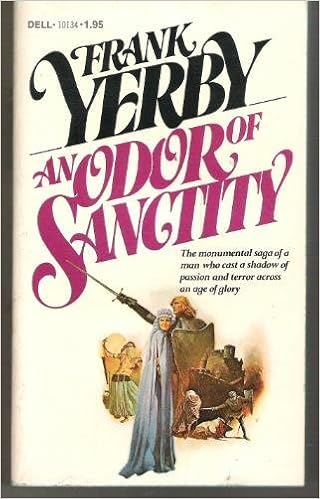
But back to books.  I reread a couple of Yerby novels, and, while I still can't help but like The Devil's Laughter (we all have our guilty pleasures), I nominate An Odor of Sanctity as one of the Top Ten Worst Books of all time.  Set in the time of the Crusader Kingdoms of Outremer, every single scrap of dialog is thees and thous, until certes, when I didst reach XXIV, I didst no longer giveth the rear end of a yon black rat.  Not only that, but the hero, the girlishly fair but apparently extremely well-endowed Alaric, like James Bond, suffers from the Dick of Death:  he can't keep it in his pants, any woman he marries dies, and half the women he has sex with die as well.  And plot?  What plot?  From Goodreads, Jackson Burnett writes:
"At one point, Alaric gets on his horse to ride to Cordoba to rescue his one-of-many true loves. Along the way, his horse stops, refuses to go forward, and turns to take Alaric off on a side story to fix an unresolved plot problem. When the hero's horse makes the calls on a novel's narrative arc, you know you are in trouble."
But I will give it credit:  it's still [marginally] better than:
  • The Playboy Sheikh's Virgin Stable-Girl - no, I haven't read it, but, thanks to Smart Bitches/Trashy Books, I don't have to, and you don't either - what a hilarious review!  
  • The Lair of the White Worm - author, Bram Stoker.  BTW, Ken Russell made a movie of it in 1988 starring Hugh Grant.  I wonder if he's managed to buy up all the prints of it yet? 
  • The entire Left Behind series. 
  • Anything by Ayn Rand. 

31 July 2012

SoothSayers


"Prediction is very difficult, especially about the future."
    --   Niels Hendrick David Bohrs, Danish physicist
The (doctored) display from Doc's DeLorean
    Late last month, along with several million other folks, I encountered a post on Facebook proclaiming that June 27, 2012 was, in fact, the date in the then far away future that Doc programmed into the DeLorean in the 1985 movie Back to the Future.  I immediately texted this “fact” to my elder son, Devon, who is quite the Back to the Future fan.  His disgruntled reply was immediate:  “Where is my flying car?”

     As it turns out the Facebook post was a hoax – a photoshopped version of the DeLorean screen.  In fact the actual date that Doc flew off to in the movie was October 21, 2015.  But Devon’s larger disappointed point is still valid – unless we come up with flying cars in the next three years the movie’s view of the future turns out to be definitionally anachronistic. 

    Two weeks ago I wrote about Michael S. Hart, who had the prescience to foresee a world that would embrace e-literature long before the internet or the home computer existed.  Hart’s foresight is all the more remarkable when one considers how poorly most of us perform in the prediction department. 

    A prime example of failing this challenge is the Stanley Kubrick film 2001:  A Space Odyssey.  I remember seeing this movie  for the first time in 1968 and being completely blown away.  I think it was the only movie I saw that summer and I also think I saw it seven times.  Viewed today the movie is . . . well, . . . dated.  Twelve years after Y2K we are nowhere close to Kubrick’s vision of future space travel.  In fact, we were closer in July of 1969, one year after the film premiered, when we were actually walking on the moon. 


On board the 2001 space station -- HoJo's sign at right
      Not only was Kubrick’s vision of a space station woefully out of sync with what came to pass, he couldn’t even get the restaurants right.  Remember the Howard Johnson’s “Earthlight Room” that showed up in the space station?  As of 2005 there were reportedly only five Howard Johnson restaurants left anywhere in the world, and it is completely safe to observe that the chain never reached outer space, and to predict that it almost certainly never will!

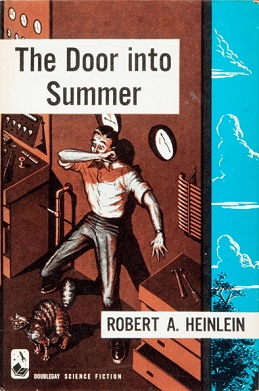
    But to my mind just about the best examples of stumbling over the future are sprinkled throughout Robert Heinlein’s classic novel The Door into Summer.  I need to note at the outset that Heinlein’s book, even with its predictive flaws, is one of my all time favorites and I re-visit it regularly. The Door into Summer was originally serialized in three issues of The Magazine of Fantasy and Science Fiction in late 1956 and then published in hardcover in 1957.

    The novel opens in 1970 and then jumps to 2000, giving Heinlein the opportunity to prophesize about not just one, but two different future eras and us the opportunity to shake our heads as to how wrong he got it since we have now lived through both.  I read the novel for the first time in the 1960s, when I could still wonder at whether the author foresaw the 1970s and 2000s correctly.  I then re-read the book again in the 1970s, when I was able to see how the 1970s predictions didn’t work out, while still holding out hope for the 2000s.  Alas, I then re-read the novel most recently a few years ago.      From those perspectives it has been interesting to watch, over the course of a lifetime, how the novel’s view of the future vectored from reality as I caught up in time with each era portrayed  in the novel's timeline. 

    As I’ve said before, I don’t do “spoilers,” but there are still aspects of the novel that can be discussed without giving away too much.  For example, the protagonist, Dan, is an inventor of robots -- “Hired Girl” (yeah, I know, even the name alone wouldn’t work now) and “Flexible Frank” -- which, in both 1970 and 2000 perform virtually all household chores.  Never quite got there, did we?  Those inventions and many other projections concerning life in both 1970 and 2000 that did not in fact come to pass provide an interesting, if unintended, subplot to this otherwise fine little story.

     But my favorite Heinlein creation is Dan’s namesake invention:  “Drafting Dan,” a machine that can automatically create engineering draft drawings.  Drafting Dan creates these drawings using computer driven arms that draw on a drafting easel utilizing directions inputted from  (gasp) a keyboard.  The computer needed to power this invention has been shrunken to near room size by the use of super powerful new vacuum tubes.

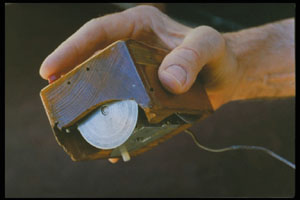
The earliest mouse!
   So Heinlein’s prediction of the computerized future missed, among other things, the advent of computerized chips (and the attendant demise of the vacuum tube), the development of display monitors and printers, and the evolution of the mouse, which did not appear in prototype  until 1963 and which, even then, was abandoned only to be resurrected from the dead with the release of the Macintosh Lisa in 1984.

    Like most predictions that go wrong, the blame can hardly be laid solely at Heinlein's feet.  If anything has proven itself, it is the difficulty involved in figuring out what happens next. To envision the computer of the future Heinlein likely turned to those who in the 1940s and 1950s were at the forefront of the then-incipient computer industry – an industry that at the time involved figuring which of the spaghetti mess of multi-colored wires should be plugged in where..  Andrew Hamilton, a noted computer expert of the time, had the following to say in a 1949 article in Popular Mechanics hypothesizing on the future of computers:  “Where a [computer] calculator . . . [in 1949] is equipped with 18,000 vacuum tubes and weighs 30 tons, computers in the future may have only 1,000 vacuum tubes and perhaps weigh only 1½ tons.”  (“Hmmm,” we can almost hear Heinlein thinking.)  In 1957, the year that The Door into Summer was published in hard cover, the editor of business books for Prentiss-Hall had this to say:  “I have traveled the length and breadth of this country and talked with the best people, and I can assure you that data processing is a fad that won't last out the year.”  At least Heinlein saw past naysayers such as this, and boldly chose a future where computers thrived.   Other rejected paths include the prophecy of Ken Olsen, then chairman of DEC, who twenty years later, in 1977 “presciently” observed that “[t]here is no reason for any individual to have a computer in his home.”  And printers and copiers?  Here is IBM’s 1959 advice (to a team that later went on to found Xerox) concerning the future of the novel copying device the team was attempting to sell:  “The world potential market for copying machines is 5,000 at most.”

    Well enough of this picking on Heinlein.  In fact, we are surrounded by prophetic mistakes that rear their humorous heads in literature.  And they are not confined to technology.  I have read a number of Randy Wayne White’s Doc Ford books, all set in Florida, and many dealing with Cuba.  Five years ago, when the press was telling us that Castro lay dying and would not last the month, White apparently viewed that as gospel and took what looked to be a safe leap – he submitted a new installment in the series to his publisher in which Castro was already dead.  Oops.  White now has authored several additional books in the series over the last five years, each of which treks an alternate reality from ours, a world in which Castro has indeed already departed the mortal  realm. 

    And, as illustrated by the computer quotes above, prognostication errors are not relegated solely to written fiction.  They spring up all around us.  Here is one of my favorites:  During the Civil War it is reported that the last words of General John Sedgwick as he looked out over a parapet toward the enemy lines during the battle of Spotsylvania Court House were the following:  “They couldn't hit an elephant at this dist . . . .”