23 November 2016

How I Conceived


photo by Peter Rozovsky
Last month I reviewed a story by Jeffrey Siger, which resulted in some e-conversation, and that led to what you see below. Jeffrey  is an American living on the Aegean Greek island of Mykonos. He gave up his career as a name partner in his own New York City law firm to write mystery thrillers. His books have been nominated for the Left Coast Crime and Barry Awards.

The New York Times called his Andreas Kaldis series “thoughtful police procedurals set in picturesque but not untroubled Greek locales.”  Today he will tell us how he wrote the latest and eighth in the series, Santorini Caesars.                                                - Robert Lopresti .

                                                                          
by Jeffrey Siger


I never thought when Robert Lopresti generously offered me the opportunity of posting as a guest on SleuthSayers that I’d be talking about conception, but hey, nothing surprises me these days, and if it’s details on how I conceived my latest Chief Inspector Andreas Kaldis novel the SleuthSayers faithful want, that’s what they shall get! 

A dozen years ago, when I decided to walk away from my life as a name partner in my own New York City law firm to unite my loves of Greece and mystery writing, I said to myself I would not write fluff.  I would write what I thought should be said in a way that told the truth as I saw it about a country and a people I cared very deeply about—little realizing at the time how applicable my observations on Greece would be to so much of the rest of our world.

When I started writing the series, I didn’t intend on becoming a chronicler of Greece’s trials and tribulations, but things just sort of turned out that way, as each novel gravitated toward exploring a different aspect of Greek society, and before I knew it I found myself immersed in creating a collage of what Greece is all about.   

For example, I’ve written about the relationships of Greek islanders and mainlanders, Greeks and their government, Greeks and their church, Greeks and immigrants, Greeks and their families, Greeks and their financial crises, and in my just released #8 in the series, “Santorini Caesars,” Greeks and their military. As important as are the elements making up that collage, is the glue that holds it all together—the unvarnished perspective of my protagonist, Chief Inspector Andreas Kaldis.

Andreas is a politically incorrect, second-generation cop, and an honest observer of his times, who despite all that life and the system throw at him, retains his integrity.  Perhaps most significant for purposes of my stories is the unfettered access he has to all levels of Greek society, be it the seamy underbelly of its most degenerate bottom rung as head of Greece’s special crimes unit, or the glittering lifestyles of Greece’s movers and shakers by reason of his marriage.

The idea for writing about the Greek military in “Santorini Caesars” had been percolating in my mind for quite a few years. After all, much of the nation’s modern history stands shaped by the Greek Military Junta Years of 1967-74, and until the financial crisis struck a few years back, Greece numbered among the world’s five biggest arms importers.  Even today Greece has four times the number of German made top of the line Leopard tanks as Germany’s own military. 

But how to tie it all together in the context of a fast-paced mystery thriller was my dilemma. Then one day it all came together, inspired by a simple passing thought on the predicament known as Greece: “The fragile fabric of a nation hangs in the balance.” 

Greece stands before the world in perilous straits.  With its government and economy in disarray, its goals and leadership suspect, and men like Kaldis undoubtedly at odds with its direction, life is not the same, nor likely to return to better days any time soon, and many wonder if carrying on the fight matters any more.

Sound familiar?

Yes, Greece’s situation inspired the story, but as I wrote it, I could not help but sense how many other places in the world faced nearly identical circumstances. Here’s the plot line for “Santorini Caesars” that evolved from that thought.

When a young demonstrator is publicly assassinated in the heart of protest-charged Athens, the motive is murky and the array of suspects immense.  Kaldis’ investigation leads him and his team to Santorini—an Aegean island of breathtaking beauty which legend holds to be the site of the lost island of Atlantis—and a hush-hush gathering of the Caesars, a cadre of Greece’s top military leaders seeking to form their own response to the crises facing their country. Is it a coup d’état or something else?  The answer is by no means clear, but the case resonates with political dimensions, and as international intrigues evolve, the threat of another—far more dramatic—assassination looms ever more real. As does the realization that only Kaldis can stop it.  But at what price?  It is a time for testing character, commitment, and the common good.  And for saving the nation from chaos.

As I said, sound familiar?


22 November 2016

JFK, the Beatles and the Beginning of the Sixties


What were we doing fifty-three years ago and a day from today? As a country, many of us were listening to and/or watching Alan Sherman, Victor Borge, Topo Gigio, Senor Wences, Mitch Miller, Perry Como, Bobby Darin, the Dick Van Dyke show, Donna Reed, Leave it to Beaver, Gunsmoke, Bonanza, Ben Casey, Leslie Gore, Peter Paul and Mary, Sukiyaki by Kyu Sakamoto, the Ronnettes, the Shirelles, the Drifters, Jan and Dean, Vaughn Meader, and Jose Jimenez (yes, I know, but that was then and this is now). And more.

On November 21, 1963, four guys did a gig at the ABC Cinema, Carlisle, England. In the summer and fall of 1963, a young folk singer was recording his third album, but still not too many people were aware of him outside of a small circle of friends (to paraphrase another Sixties folk singer). Some people might have known some of his songs as done by other people, but they didn’t really know him…yet.

The President and his wife spent the day in Fort Worth. A loser and lost soul spent the night at Ruth Paine’s home, a friend of his.

As the sun came up the next day, November 22, 1963, everything seemed fine.  A group called the Beatles released With the Beatles in England, but they’d yet to make their mark on this side of the pond. And that folk singer, Bob Dylan, was a long way off from his Nobel Prize.

And then it all went to hell.

JFK said, “If anyone is crazy enough to want to kill a president of the United States, he can do it. All he must be prepared to do is give his life for the president's.” Unfortunately this was a prophetic statement. Someone was crazy enough.

There’s been a lot written about John F. Kennedy’s assassination. I doubt I can add much to it. Some say it was the end of innocence for the country. The country went into a deep depression after his death. We started slipping waist deep into the big muddy. The 60s happened: protests, riots, hippies, counter culture, the Summer of Love, Woodstock , Altamont.

So where was I that winter day in 1963? I was a school safety, standing in a hallway monitoring student “traffic”.

***

“Stop, don’t run,” I shouted to some kid charging down the hall, wearing my AAA safety badge on
my arm. He slowed down, but I could hear him hard-charge again as soon as he rounded the corner, out of my sight. I could have given him a written demerit, but chose not to. I guess I was in a good mood. Either that or I hadn’t yet learned the power trip that the badge could give me.

A few minutes later, he ran back down the hall. I was already getting my little ticket book out when he shouted, “The President’s dead.” I dropped the book in dazed silence.

In class later, the principal’s voice came over the tinny sounding loudspeaker. “I have the bad fortune to announce that President Kennedy has been shot.” A collective gasp escaped through the room. Even Jamie Badger (name changed to protect the guilty), the class bad boy, was stunned long enough to stop making spitballs. The principal continued, “It’s unknown what his condition is, though it’s thought that he’s still alive.”

But we found out that wasn’t the case after all.

We were young, but that didn’t stop us from being stunned. Even the boys cried. Teachers tried to control themselves, they had to keep it together for their students. Mary Smith (name changed to protect the innocent) nearly collapsed in my arms – she was the first girl who’d ever sent me a love note.

That long weekend and week that followed the assassination, my parents and I (and my younger brothers to a lesser extent) were glued to the television, as was the rest of the country. LBJ taking the oath of office. The capture of Oswald. Speculation on the whys and wherefores and whos. John-John saluting as the caisson carrying his father rolled by. Jack Ruby shooting Oswald. Conspiracy theories forming.

So we watched in silence as the procession marched down Pennsylvania Avenue. And there were no psychologists, no shrinks to salve our wounds. It was like landing in Oz, only to find the Wicked Witch of the East in control in the dark, forbidding forest of snarled trees and flying monkeys. And we hung our heads. And we cried. I cried. And we didn’t know where we were heading on that cold day in November, 1963.

***

The very popular Vaughn Meader, who’d made a living and career impersonating JFK and the First Family, was out of a job. And we were out of laughter and joy. No more touch football on the White House lawn. No more pill box hats and white gloves. And somehow none of our backyard barbecues would taste as good or as sweet for a long, long time to come, if ever.

Here's a YouTube video of Vaughn Meader.

We needed something to buoy our spirits through the dark winter months of 1963/64. And for many of us that something came on February 9, 1964 in the form of those four mop tops from Liverpool and their first appearance on Ed Sullivan, which was most people’s first exposure to them. My dad called me into the den to watch and I’ve been hooked ever since. But they helped a good part of the country bounce back, at least a little, from the events of a couple of months before, with their effervescent sound, happy music and wit. So at least for a while we could forget about the darkness in our hearts.


It’s hard to say when one decade begins and another one ends or vice versa, because the zeitgeist of the times doesn’t necessarily coincide with the years that end in zero. But I think the Sixties really began with those two events, the assassination of President Kennedy and the coming of the Beatles and the British Invasion, and it ended with Watergate in 1973.

Several year later, when I was in DC, I made a side trip to Arlington Cemetery in Virginia in part to see JFK’s grave (see photo). I know Kennedy wasn’t perfect and Camelot wasn’t all that, but seeing the memorial made me remember a time when there was hope and optimism and maybe even a sense of innocence.


So, what were you doing 53 years ago, if you were around?

***

And now for something not quite completely different: My story “Ghosts of Bunker Hill” is in the brand new, hot off the presses December 2016 issue of Ellery Queen Mystery Magazine. Get ’em while you can. And if you like the story, maybe you’ll remember it for the Ellery Queen Readers Award (the ballot for which is at the end of this issue), and others. Thanks.


Oh, and that is, of course, Bunker Hill, Los Angeles, not that “other” one on the East Coast. And more on this in a future blog.

www.PaulDMarks.com

21 November 2016

Dreaming the Life: Self-Publishing Part I


by Steve Liskow

Before I say anything else, if you don't already know this, no legitimate publisher will charge you money up front to publish your work. If someone offers you a deal that involves you paying first, walk away. Once your book is available, you should be able to order as many or as few copies as you want at a discounted price, too. If that's not the case, look somewhere else. These are called vanity presses, and a few in particular have given self-publishing authors a bad name.

Several years ago, Laura Lippman commented that many people ask the wrong question. Instead of asking "How can I get my book published?" she suggested that the better question is "Is my book ready to be published?" While self-publishing doesn't carry the stigma it did ten years ago when those vanity presses ran rampant, you need to work a lot harder if you decide to publish yourself. Find a good editor and conscientious beta readers. Take their advice. Yes, it costs money, and you won't break even financially, but you may produce a book you can show proudly. If you're really lucky, a handful of readers will tell you so, too.

Five years ago, someone asked me if I'd considered self-publishing and I laughed. But things change. As I write this, I have eleven self-published novels available and plan to release two more in the next year or so (I publish short stories through traditional markets).

A small publisher produced my first novel in spring of 2010, but I knew my WIP set in the world of roller derby was too long and too dark for that publisher's catalog. By the time Who Wrote the Book of Death? appeared in print, I was already looking elsewhere.

I pitched The Whammer Jammers to an agent at Crime Bake in November of 2010. She asked for a full MS and rejected it about a month later. Between January and April 2011, I submitted that MS to fifty other agents in groups of ten every four weeks. The book became a quarter-finalist in the Amazon Breakthrough Novel contest and earned a positive review from Publisher's Weekly, but I couldn't sell it. Six years later, I still have seventeen unanswered queries.

That spring, I joined a panel of local authors for a presentation and everyone else self-published. Two of them had been with prestigious firms and left for various reasons. They all urged me to go it alone and one mentioned Create Space. When I checked it out, I was leery, but as more rejections came in, I investigated more fully.

Then I met an actor and designer who created posters for a dozen plays I had directed in a past life and we talked about book covers. He looked at my existing cover and explained how he would change it and why--very specifically. I told him about The Whammer Jammers and three weeks later he showed me a mock-up. I published the book in September of that year, ended my association with my previous publisher a month later, and re-edited and published the first book only weeks after that. By then I was revising two other novels that had collected fifty rejections between them (but positive feedback). I even found established writers to blurb them.

None of that should mean anything to you. That is my journey and my decision, but yours may be different. Self-publishing has advantages and disadvantages, and you need to consider them carefully.

First, you are in charge of everything. You write, you edit,
you draft the cover copy, you oversee the cover design, you develop the promotion, you arrange for the blurbs, you format, you publish, you register the copyright, and you arrange your own events. Maybe you even run your own website. If you're very organized and like keeping control--and actually have expertise in all these areas--it's OK. But the multi-tasking means less time for your primary job, which is to write books.

Whether you know spelling and grammar or not, you need beta readers. I belong to the Guppy (acronym for the Great UnPublished) chapter of Sisters in Crime because they feature manuscript swaps for critiques. You need editing, too. I do most of that myself, but my beta readers are writers and editors. I do my own formatting for Create Space because I figured out an easy visual style that eliminates hassles with different headers and footers, but I have little visual or graphic sense.

Fortunately, my cover designer and I worked together in theater long enough to figure out how to communicate with each other. We live about ten miles apart so we can discuss a synopsis or images in person. That's very helpful. My designer also has a good eye and ear for language and we work together on cover copy--along with my webmistress, my daughter with a double Masters in Communications and Marketing. My wife used to write advertising copy for radio, so she's a huge asset, too.

Ignore what you see on the Internet. Nobody has yet found a one-size-fits-all method of promoting, whether it's Facebook, Twitter, Instagram, Goodreads, blogs, or anything else. Your friends can come to events and buy books, but asking them to review is risky because most of them don't know enough about reading or writing to craft a review that doesn't look bogus. In the October 28, 2016 issue of Publishers Weekly, longtime agent Peter Riva tells why he thinks Amazon reviews are worthless anyway. I have business cards and bookmarks because I also conduct fiction writing workshops and edit fiction. I know thirty librarians on a first-name basis, but that doesn't mean they can get me into their building. Funding for libraries is diminishing like common sense during election campaigns.

If you conduct workshops, the preparation and promotion also take you away from your "real" writing.

If you're self-published, many established authors will not blurb you. For some, it's a philosophical issue, and for others it's a contractual one. I was lucky to get a few blurbs for early novels because I met many members of Sisters in Crime and Mystery Writers of America (I appear on panels for both groups) at events, but I ran out of connections. Six of my last seven novels bear no blurb.

Remember that if you've self-published, most agents and traditional publishing houses may treat you like toxic waste if you query them later. I don't agree or disagree, but that's how it is. I've heard of self-pubbed authors (generally very young) getting picked up by major houses, but what have they produced since then? Amanda Hocking comes to mind.

Self-published authors have trouble getting publicity. My local newspaper, the Hartford Courant, has gutted its staff and is owned by the Tribune. That means it's edited in Chicago and local news is low priority. The reviewer who used to support local authors now sees her work trimmed or deleted. She used to promote my events, but last year I couldn't even get mentioned when the Private Eye Writers of America named me as a finalist for the Shamus Award.
The largest independent bookstore in Connecticut demands a payment of $125 from self-published authors for an appearance there, and they will only do a fifty-fifty consignment split. I would have to bring the books with me, sell seventeen just to pay that fee, and take the unsold copies with me again.

Most bookstores won't carry your books because they can't get the same distributor's discount and free returns they have with traditional publishers. Your book will cost them more to buy, and if you bring your own, they get a smaller percentage from the sale price (see above). That hurts their margin so they probably can't afford you. Maybe you can make a special deal with your local store, but maybe not.

Those are the shortcomings I've discovered so far. Sound bleak? Well, maybe, but next time, we'll look at the advantages. I think those outweigh the problems.


20 November 2016

Timeless Prose


by Leigh Lundin

It’s amazing when you realize many of our grandparents were raised in a horse-and-buggy era and eventually saw us land a man on the moon. Yet among us reside Millennials who’ve never been without a computer or HDTV, a microwave or a cell phone. With rapid technological evolution, we can hardly fault them for any lack of historical perspective, never mind survival skills.

Children of my acquaintance were devastated when they wanted to make popcorn and the microwave broke. Their auntie calmed them and found a lidded pot in the kitchen cupboard. As the kids watched in open-mouth wonder, she ripped open the familiar Orville Redenbacher packets and poured them into the cookware, added butter and placed the lid on. Five minutes later the kids happily munched popcorn in awe of their aunt's accomplishment. Who knew?

Working antiques surrounded us kids on a centuries-old, self-sufficient farm steeped in family history. I still keep antique ‘coal oil’ lamps to light when the power goes out. Our childhood provided a sense how our pioneer ancestors lived, so when I read an incongruity, it really jars.

David Edgerley Gates has touched upon the subject of anachronisms. Among other issues, he raises the topic of modernisms in period speech. I agree, although I give British author Lindsey Davis a pass because her characters are so engaging.

Getting it Right

A couple of years ago when I was critiquing a teenager’s story for his literature class. It was set, if I remember right, in the 1980s. His on-the-run hero escapes on a jet-ski and phones his girlfriend. Our conversation went something like:
“He phones his girlfriend? With what?”
“A phone, of course.”
“In 1985?”
“Sure.”
“While piloting his jet-ski?”
“Yes.”
“You don’t see the problem?”
“With what?”
“Cell phones in the 1980s?”
“They didn’t have them?”
“Correct.”
“Are you sure?”
“Pretty sure.”
“What did you use?”
“Pay phones and you needed a quarter.”
“What about a two-way radio?”
“Sure, a walkie-talkie might work.”
“But no cell phones?”
“Nope. Car phones were available in the ’70s, but they came in a briefcase and were expensive.”
“That’s a real pain.”
“That pretty well sums it up.”
Getting it Wrong

Somewhat defensively, Quentin Tarantino hyped the historicity of Django Unchained. Examples escape me, but the glaring inaccuracies and anachronisms must have jolted historians.

In one of his Rumpole of the Bailey stories, John Mortimer introduces a celebrity historical romance author beloved by the public and especially the judge. Rumpole, however, feels plagued by her wildly inaccurate juxtapositions of people, places and things as much as a century or so apart. Technically, this type of error– mixing periods– is called metachronism.

Kick the Can

I was critiquing a Southern antebellum novel about a plantation owner’s wife and a slave. I found quibbles, but a scene in one of the early chapters brought me up short. In it, the slave was drinking from a tin can. Whoa, I told the author, tin cans as we know them are a 20th century invention. I offered citations pointing out early tin cans, circa WW-I. The writer refused advice, partly because of ‘atmosphere’, but she also claimed an unnamed historical source despite my research. The anachronism spoiled the atmosphere for me.
[British canning technology may have preceded and surpassed that of North America in the 1800s. A reader has pointed out that while cans were a 19th century invention, the modern tin can as we know them originated around 1900 and came into use by WW-I, not WW-II as the article originally stated. The reader included photos of tins from WW-I and from Scott’s Antarctic expedition dated 1911 that are virtually indistinguishable from modern cans.]
Maschinengewehr MG42In the Spaghetti Western The Grand Duel (Il Grande duello also called The Big Showdown), the effeminate psychopath, Adam Saxon, mows down a wagon train with a machine gun. I don’t know much about machine guns, but it looked oddly out of place, not like Civil War engineering at all. I suspected it was closer to WW-I era, but I underestimated. It turns out the Maschinengewehr was a German WW-II MG42, first introduced in 1942, about ¾-century after the setting of that Old West movie.

Many movies feature British Intelligence or the OSS infiltrating Nazi strongholds, plots that have fed the film industry for decades. Typical gadgetry features lots of knobs and dials and… LEDs, not commercially viable until about 1970. A few may show Nixie tubes, but even those weren’t invented until 1955.

Listen, Punk

In steampunk, you can invent anything you want– LCDs, Nixie tubes, plasma graphics. If you write historicals, you can’t.

Details, Details

Sometimes writers introduce errors that have little to do with anachronisms. As much as I admire The Girl with the Dragon Tattoo series, the authors, Larsson and Lagercrantz (or possibly their translators) make mistakes about handguns. They mention a revolver when they mean an automatic, refer to a telescopic sight when Lagercrantz probably intends a laser sight, and portray Blomkvist with his finger jammed in the trigger guard of a machine pistol when the author probably meant between the trigger and the body of the weapon. Small things but I give Larsson credit for portraying computers and networks in a realistic manner. (He also named a couple of characters Lundin, so I can’t bicker too much.)

Without local mystery authors, in my early days I worked with romance writers, particularly my editor/teacher friend Sharon. One of Sharon’s favorite authors referenced a car several times in the novel, perhaps something like a Pontiac Bonneville. Sharon realized the details were all wrong, invalidating part of the plot line in her head.

I’ve saved the worst for last.

Red Sage Publishing specialized in novella anthologies called Secrets. One of their American authors set her story in Scotland… and kept referring to the Scottish mesquite.

Oops.

What errors and omissions bug you?

19 November 2016

Past or Present: A Tense Situation


by John M. Floyd


Western actor: Are those our teepees?
Director: We've upsized to wigwams. Teepees are past tense.


Consider this. You've come up with a great idea for a short story. In fact, you've been thinking about it awhile, you know who your POV character is, you have a pretty good feel for the plot, and you've even picked out a catchy title. But when you sit down to start typing the opening, there's something else you'll have to decide on, something you might never have thought about, only a few years ago:

Will your story be told in past tense or present tense?

The truth is, I don't think about it at all. I prefer past tense, and so far that's how all my stories have been told.

Feeling tense?

Here's the strange thing: I don't mind reading stories written in present tense. I just don't like to write them that way. I don't think I'd feel comfortable doing it, and besides, I would probably always be accidentally reverting to past tense and having to correct myself. (As Dirty Harry Callahan once said, "A man's gotta know his limitations.") I sure don't need to be bothered with doing any more self-editing than I already have to do.

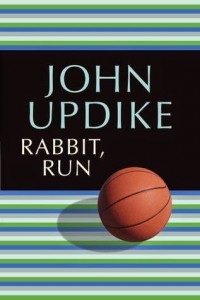
Obviously, many of my writer friends don't share this preference. Stories written in present tense seem to be everywhere, nowadays--and, as I mentioned earlier, that was not always the case. The first novel I remember reading that was written in present tense was, I think, Presumed Innocent, back in the late 80s. No criticism, there; it's still one of my favorites. And I think all of John Updike's Rabbit novels were written in present tense as well. I can't recall many old-time novels written that way, though, except Charles Dickens's Bleak House.

Pitching tense

Why is present tense so popular in contemporary fiction? Most writers say it's because it lends a sense of immediacy to the story--a sense that this is happening right now, at this very moment, and we're all witnesses to it. When the robber turns away, the security guard draws his gun and fires. BAM.

That's not a bad idea, and when done well it works well. But writing in the past tense--when the robber turned away, the security guard drew his gun and fired--seems more natural to me. I like feeling as though I'm telling the reader what happened, not what's happening, and I'm not convinced that I give up any suspense by doing it that way. Past tense is traditional storytelling, the old classic once-upon-a-time approach. Or maybe I'm just getting old.

Upsides and downsides

From what I've been able to find, it seems that there are several big advantages and several big disadvantages to present-tense fiction. On the plus side of the writing ledger are (1) the aforementioned "immediacy" and vividness of the action and (2) the fact that present tense probably makes it easier for the reader to feel a connection to the protagonist. On the minus side, present tense supposedly makes it harder to (1) manipulate time, (2) generate suspense, and (3) create complex characters.

Arthur Plotnik (what a great name for a writer, sort of like Francine Prose) says, in his book Spunk & Bite, "Present tense . . . imparts a live-camera mood that is relatively new to literary prose, as well as to journalism." Then he adds, "But in lesser hands, present tense can diminish the spell . . . It can seem affected, breathless, and flighty." He says it can be used to keep readers on edge, but that it can also "grow tedious if the inventiveness flags."

The key phrase, there, seems to be "in lesser hands." Maybe present-tense fiction is one of those don't-try-this-at-home endeavors. If you're a novice, proceed with caution. If you're talented enough, full speed ahead. (But watch out for those inventiveness flags, on the side of the road.)

NOTE: It did occur to me, while putting together this column, that there are at least two forms of writing that are and have always been done in present tense: jokes ("A guy walks into a bar . . .") and screenplays. I've never written jokes, but I have created several screenplays--and strangely enough, writing those in present tense seems correct and natural. Go figure.

My tense-sense summary

I would, as always, be interested in hearing your opinions. Do you enjoy reading stories/novels written in present tense? (I do--or at least I don't object to it.) Do you ever write stories/novels in present tense? (I don't. But only because I doubt I'd be good at it.)


He types the last sentence of the SleuthSayers post, clicks "Publish," closes the Blogger program, and pushes back from the computer. His Saturday column is finished and scheduled. "Guess it's time to rake leaves now," he says to his wife.

He typed the last sentence of the SleuthSayers post, clicked "Publish," closed the Blogger program, and pushed back from the computer. His Saturday column was finished and scheduled. "Guess it's time to rake leaves now," he said to his wife.

Different keystrokes for different folks.


18 November 2016

It Starts with a Title


by O'Neil De Noux

Can you write a story from a title? Sure. There's a YouTube video of John Lennon claiming his young son Julian rushed into the house once and pointed outside and said something that sounded like LUCY IN THE SKY WITH DIAMONDS and John wrote the lyrics to the song. I saw another YouTube video in which Lennon said something else about how the song was written but both times he claimed he wrote the song from the title. And not from a drug-induced hallucination.

Looking back, I realize how many of my stories started with a title and nothing else. Inspirations from something heard or read.

Two of my New Orleans police stories came from old New Orleans sayings - "Love and Murder" (goes together like beans and rice) and "Women Are Like Streetcars" (wait ten minutes and another will come along). Two of my stories came from a word that made me stop and look in a dictionary. The first was "Erotophobia" (fear of erotic situations). That story's been printed five times, including in two BEST OF anthologies. The second was "Romanesque" (a medieval architectural style). I applied it to a woman and it was printed twice, once in another BEST OF anthology.

My wife walked into my home office once with a catalog (either a Victoria's Secret or Frederick's of Hollywood). She declared, "Did you know they make a bra called the Kissable Cleavage bra?"

I told her no and thanked her for the title. She rolled her eyes as I opened a new word file and called it KISSABLE CLEAVAGE IDEA. It didn't take long to figure this needed to be a private eye story so I gave it to my part-time lothario PI Lucien Caye. "Kissable Cleavage" has been published three times, including in THE MAMMOTH BOOK OF BEST NEW EROTICA, VOL. 7 Caroll & Graf (US) and Robinson Publishing (UK).


It isn't alwasy easy. Writer-Editor-Publisher Maxim Jakubowski, father of London's MURDER ONE bookshop, explains, "Half of my books/stories begin with a title and somehow I have to come up with the subject and/or plot to suit it! And further, I've seldom managed to get a single piece of fiction started without knowing the title from the outset and only rarely has it changed in the writing process! I wouldn't recommend this way of doing things, but it works, albeit sometimes rather painfully, for me at least."

Reading Harry Whittington's 1958 mystery, WEB OF MURDER, I saw the lines - "Once a man breaks a law, he can expect consequences. Not just some of them. All of them." My story "Expect Consequences" was published twice.

My Cajun grandmother used to sing in French while she quilted in her work room. After I became a writer, I asked an aunt about one refrain that resonated with me. It sounded lovely in French. The English interpretation was - "the heart has reasons of which reason knows nothing." I challenged myself to write something from that saying. I wrote a 7200 word short story, "The Heart Has Reasons," which was published in ALFRED HITCHCOCK MYSTERY MAGAZINE. The story was awarded the 2007 SHAMUS Award for Best Private Eye Short Story.

Los Angeles mystery writer Paul Bishop, author of the CROAKER novels, among many others, explains, "I almost away have to have a title before I begin a novel. I'm unsettled otherwise and the writing does not go well."

I guess my favorite is another wife-inspired story. One evening she came into the living room and spied me watching an Agatha Christie movie I'd been catching every time it came on. She asked, "Is that Death on The Nile?" Only I heard "Is that Death on Denial?" My story "Death on Denial" featured a gun moll, a hit man and a old gangster who repeatedly watched DEATH ON THE NILE, over and over. That story has been published five times, including in Otto Penzler's BEST AMERICAN MYSTERY STORIES 2003 (Houghton-Mifflin).

In each case there was no story, no plot. It started with a title. How many of your stories or novels started this way?


www.oneildenoux.net

17 November 2016

Agon


by Brian Thornton

(No pics this time around, and there's a writing connection, but it only comes at the end. Read on, if you dare...)


I believe that we are defined by struggle. The ancient Greeks had a word for it (of course!).

"Agon."

We get our English word "agony" from it.

Not really the same thing.

The idea behind the notion of "agon" is that working to overcome obstacles placed in our paths by the gods/Fate/Yahweh/Allah/A Head of Lettuce Named Bob improves us. That it is literally not the achievement of the goal, but the effort it took to overcome opposition that kept us from it, which makes us who we are.

I further believe that we as human beings currently inhabit the Age of Agon.

I've been doing pretty lousy in the prediction market lately (*cough*I'm with Her*cough* *cough* *cough*), but I'm going to go out on a limb and make a couple now, just to get them down and out there. At the very least they might be good for a laugh when viewed some day soon with the benefit of hindsight.

Here we go:

FIRST:

I am going to be MUCH more productive writing-wise over the next eighteen months. 

All that time saved no longer checking the 538 blog multiple times per day, and that headspace freed up by no longer following election news in rags like The New York Times, The Washington Post, Vox*... all much better spent devoted to any number of works in progress.

And it's not just about headspace. There is a school of thought out there that art flourishes in direct proportion to the amount of chaos in the world. The more "unsettled" the society, the greater expression of that societal upset. So collective angst finds its outlet in modes of expression such as art.

Plus, let's face it: writing is cathartic. And writing about what bugs us can be profitable. It's really all about having an audience and finding them. Something tells me that an audience for the sort of fiction I have in mind for the coming months won't be too difficult to find.

As completely arbitrary proof of this, I produced way more in the way of paying and paid-for writing from 2004 (when I signed my first book deal) till 2009 (When I met my future wife) than during the past eight happy years. Some would say that finding a wonderful woman, marrying up, combining our households, buying a nice house in a terrific neighborhood, and having a child might have had something to do with that. And they might have a point.

But if the past two years have proven anything, it's that these days, in the current climate, facts are what you make of them.

Oh, and let's all save our jokes about the coming age being a potential golden age for satire. We've been living in one of those for at least the last two millennia. Maybe the last three.

(*Sarcasm. I don't really think they're rags. I think they collectively blew the single biggest story of the decade, but they had a lot of company.)

SECOND:

The current round of angst in all corners of this country will not pass quickly, but it will pass. And when it finally does come, it'll be swift. Nearly overnight.

Because nothing unites the American people like a common enemy.

Just ask Jimmy Carter.

(I'd suggest asking Richard Nixon, but he's dead.)

And on that optimistic note, I'm going to close this, my sole politically-related post (One and done, I promise. No more after this. There's "grieving," and there's "wallowing." The former is healthy. The latter is the stuff of melodrama.), and get back to talking about the writing craft.

See you in two weeks, on Thanksgiving Day, when the subject will be "plot". Which, when you think about it, is really a completely different form of agon!

16 November 2016

The Night The Old Nostalgia Burned Down, Again


Last month I wrote about books I dug up recently  because I remembered them from my childhood.  I ended by saying "Maybe next time I will talk about childhood favorites I bought my daughter when she was a kid."  But instead I talked about my non-conversation with a taxi driver.  So here we go.

If you are familiar with Crockett Johnson it is probably because of his wonderful books about Harold and the Purple Crayon which have inspired children's imagination (and the occasional wall-scribble spanking) for many years. Bill Watterson, the creator of the marvelous Calvin and Hobbes comic strip,  also said that Harold was all he knew of Johnson.

The reason he was asked about Johnson is that Calvin bears a certain resemblance to Ellen's Lion.  Both feature a young kid (Ellen is a preschooler, a bit younger than Calvin) whose best friend is  a stuffed animal.  In both cases the beastie has a completely different personality than the kid, but the animal can't speak if the kid's mouth is covered.  (And now that I think about it, it sounds like both artists were describing a child having a psychotic break.  But put that out of your mind.  Sorry I brought it up.)

What I like best about Johnson's stories is that the imaginary friend, so to speak, is the realist in the pair.  When Ellen asks the Lion about his life before they met she wants to hear about steaming hot jungles, but all he remembers is a department store.

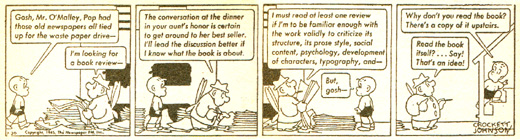
By the way, Johnson also created one of the most brilliant comic strips of all time. Barnaby ran during the early forties and featured another preschooler who, in the first episode, wishes for a fairy godmother.  Due to wartime shortages he was instead assigned Jackeen J. O'Malley, a three-foot-tall fairy godfather with a grubby raincoat, magenta wings, and a malfunctioning magic cigar.  Mr. O'Malley introduces Barnaby to such characters as Atlas, a three-foot-tall giant (he's a mental giant), some Republican ghosts, and a talking dog who will not shut up.


The other book I hunted down for my kiddo has nothing to do with Crockett Johnson but does mention Atlas.  The original one.

d'Auliares' Book of Greek Myths, written and illustrated by Ingri and Edgar Parin d'Aulaire, started me on my lifelong love of mythology.  Not only are the pictures unforgettable but the writing is very well done.

One thing I love about it is how cleverly they slip around, well, the naughty bits that you might not want to explain to an eight-year-old.  In the chapter on Theseus they explain that Poseidon, god of the sea, sent a white bull to the island of Crete, which King Minos was supposed to sacrifice to him:

But Queen Pasiphaë was so taken by the beauty of the white bull that she persuaded the king to let it live.  She admired the bull so much that she ordered Daedalus to construct a hollow wooden cow, so she could hide inside it and enjoy the beauty of the bull at close range....

To punish the king and queen, Poseidon caused Pasiphaë to give birth to a monster, the Minotaur.  He was half man, half bull…

Every adult, I imagine, understands exactly what the dAulaires said that the Greeks were saying about Pasiphaë, but it goes right over a kid's head.  (Did mine, anyway.)

The book is still in print.  Unfortunately the binding is not as long-lasting as the text and pictures.  I have had to replace it about once a decade.

Ah well, no mysteries this week, unless you count the mystery religions.  Or Mr. O'Malley's encounter with the fur coat thieves...

15 November 2016

Hate Crimes in Canada, Eh


I was supposed to work on my novel on Wednesday. Instead, I found myself on Facebook, looking for wisdom and solace. Most of my friends are either writers, health care workers, or both. I did find comfort in them. But I was also shocked by my newsfeed.
Peterborough is a small city of about 80,000 people and home to Trent University. After I graduated from my program in emergency medicine, I did my first locum in an even smaller town close to Peterborough. Beautiful area, green, lots of smiling people. Almost all white people, but that's the norm in a small Canadian town. Usually, rural-ites are friendly. Not always. In my life, no one has flung urine at me.
Although once, a teenager ran up to my dad in Ottawa with a plastic bag clenched in his hands and said, "Are you Japanese?"
I was maybe twelve and didn't know what to do.
My dad said, truthfully, no.
The guy ran away with his bag, which seemed to contain some sort of brown liquid.
Close call.


This is not isolated to Peterborough. Basically, I'm astonished that some people think they have new and wide permission to spew hate.
It was always simmering. When I took my kids trick-or-treating in Vankleek Hill a few weeks ago, a little girl on Main Street stared at me and starting singing, "I see your Chinese eyes" and more under her breath. I looked at her mother, who was staring blankly into space, and back at the girl, who kept singing. I thought, Do I confront the girl? Do I point this out to her mother?
My kids were tired, and we were heading back to our car, so I opted to glare at the girl and keep going.
Afterward, I mentioned it to my white husband. He hadn't even noticed. He laughed and said, "You like to glare."
Actually, what I like to do is trick-or-treat without racist commentary. Wouldn't that be nice?
If you think none of this is real, or it's exaggerated, or it doesn't matter because no one was beaten or died, you may enjoy reading this report on hate crimes in Canada in 2013: http://www.statcan.gc.ca/pub/85-002-x/2015001/article/14191-eng.htm#a2
It has nice charts like this:


I can't not speak.
I respect other Sleuthsayers' right not to engage, but in my mind, there is no point writing about crime fiction and ignoring crimes in real time.
Let me end with some wise words from Dr. Dylan Blacquiere, a neurologist, writer, and friend. I have edited his brilliance for brevity, but you should seek him out:

1. We have to, have to, have to get our own house in order. That could mean engaging with civic politics, writing letters, joining community organizations, running for office yourself. Our institutions are only as strong as the people who participate, and the best way to keep someone like Trump from destroying what we build here is to make sure that we participate fully to strengthen what we have. Clinton lost on turnout. People were not engaged. That means we have to engage. 
2. We have to pay attention to why this happened. Most of his voters are not racists or sexists or stupid. Some of them are, no doubt. But many are people for whom the system is not working, and they saw nothing to lose. That means we have to face these issues head on. Economic inequality. Poverty. Unemployment. Economic uncertainty. Trump's message wins when people are disenfranchised, vulnerable, and uncertain. If our economy is working for everyone in a fairly distributed manner, then a lot of the power of his argument goes away. And ignoring these people, dismissing them, not understanding where they are coming from, not seeing their experiences and not declaring them important, means that they will find some other way to make themselves heard. It's hard to blame them for that; we haven't always been that great at taking their concerns seriously.
3. More than ever we have to stand up and support the vulnerable and stand up for equality. Women, people of colour, LGBT, people with disabilities, immigrants. We have to support our allies and friends in the States who are in a vulnerable and scary place right now. We have to make sure rights and freedoms don't get rolled back here as politicians like Kellie Leitch start rising. 
4. And we have to face some uncomfortable truths - we aren't perfect here, either. Racism exists here. Our relationships with First Nations, especially here, are fraught with broken promises, inequality, and disrespect. Those 
comments that Trump supporters make; Canadians make those too, about women, about natives, about black people and queer people and Muslims and Jews. Many of our institutions have been built on past inequality and oppression. Part of standing against Trump means we have to face up to that and make those things better here. We absolutely do not get to rest on our laurels here; in fact, we have to recognize the fact that in a lot of ways we've done, and are doing just as badly. We need to fix that. If we truly want to stand for something good in a scared and uncertain world it means we have to improve ourselves, too, not just wag a finger at others. 
Bottom line: There's a lot we can't do about this. It's frustrating and it's discouraging and it's depressing. But the sun still came up yesterday. It's going to come up today, and tomorrow, too. There's work to be done. Canada has the chance to be the light the world leaves on for when places like the States and Great Britain come around and come back home. We have to seize that chance by strengthening ourselves, staying involved, and helping to fix the problems that led here and the ones
that will worsen because we're here. 
I spent yesterday numb and avoidant. I plan to spend today roiling up my sleeves and getting to work.

14 November 2016

Getting Away with Murder – and Other Things


I have always believed that writers should try to get away with everything they can as far as plot, characterization, and style go. Experimental writers, naturally, have this as their basic brief and a straining after originality is the usual result. But genre writers and contemporary novelists like to push the envelope as well, and two well received recent novels provide good illustrations of blending genres for striking effect: Liz Moore’s The Unseen World and Ben H. Winters’ Underground Airlines.
Both incorporate elements of mystery and science fiction. Moore’s novel begins as a sensitive account of Ada, a bright little girl in a distinctly unconventional household. Folks looking for thriller velocity here may be disheartened but my advice is to stick with the story. When Ada’s father shows signs of early onset dementia, the novel morphs into a quest mystery with a good deal of information about artificial intelligence.

Sounds like maybe too rich a blend? Actually, no. Moore skips in time from Ada as a child and an adolescent in the 1980’s, back to her father in the 1930’s and 1950’s, and forward to the 21st century. At the center of Ada’s search is Elixir, her computer scientist dad’s experiment in artificial
intelligence. Elixir was designed as a machine that can learn, and precocious Ada, was one of the many people in her father’s lab who ‘talked’ to the program so that it would increase its vocabulary and eventually pass the Turing Test, that is, communicate in a way indistinguishable from human.

As a result, Elixir not only learns a lot of facts about the world, it learns a great deal about the personalities and histories of its lab friends. I won’t spoil how this works out in the novel, but Moore’s conclusion is imaginative and entirely satisfying.

In a quiet way, The Unseen World is a thriller, the novel structured as an investigation with high stakes on the outcome. The Elixir program and even the various generations of computers that Ada uses to connect with it, have surprising personalities, as do the principle characters, Ada, her father, David, his kindly co-worker and neighbor, Liston, and her family.

The Unseen World is a contemporary novel with what I consider welcome genre elements. Underground Airlines is perhaps the reverse, a thriller with serious literary chops that mixes mystery and science fiction with alternative history. In Winters’ novel, the Civil War was averted by a compromise following the assassination of Abraham Lincoln. Four Southern states are still slave states; Texas is contested ground between an abolitionist faction and the federal government, bound by the constitution to protect the ‘property rights’ of the so called Hard Four.

The protagonist is a former PB – person bound to labor – who has a kind of quasi-freedom as a federal investigator. He’s a cracker jack detective but as his whole focus is runaways, Victor is a modern version of that hated 19th century figure, the fugitive slave catcher.
   
The character of Victor has attracted notice because Winters’ himself is not African-American, but he has certainly made Victor a complex character with a rich interior life. Further, the detective is not exactly our contemporary. He operates in an environment at once recognizable even in matters of race and politics, and peculiar, rather like the Alternate Universe in the old Fringe series or one of Philip K. Dick’s odd cities.
   
Part of Underground Airlines is straight detective work. Victor is a master of aliases and disguises, and, leashed by a tracking chip in his neck, he mostly focuses on his cases even though the poor souls he finds mirror his own experience and fears. His stoic indifference only begins to weaken after he meets Martha, a harried young white woman desperate to find her recaptured PB lover, and Lionel, their charming inter-racial son. But Victor’s rebellion really develops when a new case with an unsatisfactory file opens up unusual moral and physical dangers as well as unprecedented opportunities.

Victor is preoccupied with the various identities and schemes that comprise the mystery/thriller elements of the plot, but increasingly memories of his terrible slave childhood resurface. Later, certain sci fi elements are added to the mix, not, to my mind entirely successfully, but there is no doubt that they add a chilling note and bring into question Victor’s decision to focus on his own self interest.

The Unseen World and Underground Airlines are two novels with literary ambitions but strong genre elements. I think the mix strengthens both.