Showing posts sorted by date for query gone south. Sort by relevance Show all posts

12 September 2026

The Louvre Heist, One Year Later


SUNDAY MORNING, 19 OCTOBER 2025: 

Two masked men parked a truck-mounted furniture lift along Quai François Mitterrand, cut through a Louvre window, and climbed into the Galerie d'Apollon. Less than eight minutes later, the crew was speeding across Paris with an estimated €88 million in crown jewels. Almost a year later, it's becoming clearer that the crew wasn't necessarily all skilled professionals. But the French response wasn't bumbling, either. Arrests began within a week. 

THE RECAP

Inside the Galerie, the two-man crew was methodical--careful, sort of. They stayed near their window exit and cut into display cases within easy reach. Some accounts speculate their movements were rehearsed, and surely that can't be dismissed. They'd have known their time window and tools available and slow-grind escape route. 

The guys also seemed clueless about the collection's true value. In that sense, they bagged an amazing haul: three pieces from the sapphire set of Queen Marie-Amalie and Queen Hortense, three emerald-laden pieces from Empress Marie Louise's set, and two pieces belonging to Empress Eugénie. They also tried bagging Eugénie's crown. It was essentially crushed during the theft. 

Valuable, absolutely. But other pieces in the Galerie's collection are more famous--and reportedly more valuable. Maybe the guys were behind schedule, or maybe they just didn't know.

THE RESPONSE

You might call it flat-footed. Louvre security spotted the truck lift outside, but this was the Louvre. There are always contractors around. Worse, the Galerie's security cameras pointed away from the window, and the security systems were badly outdated, a problem noted in a 2014 audit. Only after evacuating the crowd and inspecting the Galerie did they confirm that a theft had gone down.

Things went better quickly. The Police Secours arrived within minutes. Seriously, the Prefecture was only a half-kilometer away. The big guns, the Brigade de Répression du Banditisme (BRB), arrived soon after. Detectives collected a treasure trove of evidence: Eugénie's broken crown, discarded gear and clothing, shoe impressions indicating the crew's size, and even the stolen truck lift the thieves had tried — and failed — to torch. 

In short order, French prosecutors assembled a swarm of investigators, forensic scientists, art theft experts, cyber cops, and anyone else a furious government could muster. Traffic camera footage showed the crew taking the A6 south, and hours of social media videos captured the crime from start to finish. 

By June 2026, the French had reportedly charged five alleged members of the crew.

THE INSIDE MEN

Well, there was a lot of DNA recovered, and the police quickly matched some of it in the law enforcement databases. The people linked to those matches allegedly lived in the same north Paris arrondissement. And two of the matches maybe pointed toward the inside guys.

One early arrest was a guy with a minor record. News reports said that DNA evidence linked him to cutting tools recovered from the Galerie. According to those reports, the guy claimed to have been recruited only days before the heist and told that they would hit a jewelry store. In his statement, he said that he'd never have signed on if he'd known the target was the Louvre. His reported cut was €20,000.

Another early arrest was the alleged other inside man, an unlicensed taxi driver believed to be the smash-and-grab guy. That had been his literal instruction, the guy said according to French media, to smash and grab what he could. Investigators reportedly found his DNA on the display cases and the discarded equipment. His alleged cut was as little as €15,000.

After speeding off, the crew blended in with Paris traffic and circled a northerly route to Aubervilliers. Investigators retraced the drop route thanks to traffic and private cameras, witness accounts, and phone metadata. The guys, it seemed, held onto their burner phones. Both guys arrested reportedly mentioned the same lead contact, who berated them for not smashing and grabbing more. 

THE LIFT GUYS

The two guys working and watching the truck lift weren't hard to track down, apparently. Reports say that the lift had been their one job--and it remained outside the Louvre, allegedly along with their DNA on the lift and gear. Oui, said the lift rental company, these were the same guys who jacked their truck off the lot days earlier. 

According to news reports, the lift crew had done their work in their own silo. They were only connected with the inside guys in the hours before the job. 

FIELD SUPPORT

Another cell reportedly handled communications and logistics. Supply teams garnered scooters, and scouts buzzed around the Louvre, scouting the area and relaying go signals from burner phones. Reportedly, this cell didn't know anyone else involved in the job, sometimes even their fellow scouts. 

The French rounded up several potential suspects based on their past connections and cell phone signals during the heist and possible DNA found on recovered scooters. Three of these arrested have been charged as conspirators.

THE MASTERMIND

The inside guys seemed to know what to do and did it, mostly. The lift guys lifted, and the scouts scouted. Mistakes or not, conflicting statements or not, this was an operation. Coordinated.

The suspects awaiting trial all mention such a ringleader, if neither named nor described, but it follows that a mastermind intent on controlling risk and communications would likely use intermediaries for recruitment and training. Just as plausibly, a serious organization combined expertise and a network of neighborhood relationships. 

THE RECRIMINATIONS

No one does outrage like the French, and this wounded the national pride. The thieves had needed only glass cutters and a furniture lift, pour le Dieu. At the Louvre. 

Public and media criticism was withering. French ministries harrumphed over the fiasco and no doubt thanked the stars that the core failures weren't theirs. Even the truck lift manufacturer got in on the action, with an ad touting the lift's reliability.

The Louvre director, Laurence des Cars, reportedly offered her resignation in the immediate aftermath. The Minister of Culture refused it. Instead, des Cars was kept on while the investigation and security reviews swirled, which was important leadership continuity--and perhaps also a fate worse than termination. Critics insinuated that des Cars pursued other priorities instead of aggressively closing known security gaps. 

By June 2026, des Cars had moved on. "A planned transition," the Ministry of Culture said.

THE FUTURE

The Galerie remained closed off and locked down for weeks. After the forensics team left, the Louvre installed a sweep of high-tech devices in the Galerie and throughout the museum. Other reported enhancements tightened the contractor loophole and improved coordination with the police. Today, the Louvre is a harder target. But more upgrades will go on for years.

And for even longer, much about this heist will remain a mystery. The mastermind may never be found. Jewels--even crown jewels--can be stashed indefinitely, or dismantled, or cut into untraceable pieces. 

One thing is abundantly clear: The heist, like the Louvre itself, has found its place in history.

11 September 2026

I Remember Everything—and Nothing


Erie Lackawanna tower, Hoboken.


I can’t believe it’s been 25 years. I can remember how it felt, sure, but at this remove I need a historic timeline to assemble the pieces correctly. So I have used that to help me remember.

I worked from home in those days, freelancing for a string of magazines. I don’t remember my morning routine, but I know that my browser home page was set to the front page of The New York Times.

That morning, when I woke my desktop, above the NYT headline was a tiny sentence in red or black announcing the breaking news: a plane had hit one of the towers of the World Trade Center. The plane had struck at 8:46 AM.

I immediately assumed the aircraft was something small, like a Piper Cub. I imagined a young, inexperienced pilot making the most egregious of errors. But I couldn’t confirm that because one sentence was all the newspaper knew at that point.

I wasted time poking around other sites, hoping to glean more than that single sentence. I came up empty at the Associated Press and a few other news sites before I turned on the television. I did so just in time to watch the second jet hit the second tower. That happened at 9:03 AM.

By then, everyone knew what was going on.

I don’t know when I called Suzanne. She was an old college friend who had recently moved to Hoboken, our little river town across the Hudson River from Manhattan. She was the only other freelance journalist I knew in town.

I don’t remember when she came over my place. Before, or after 9:37 AM, when the third jet crashed into the Pentagon? I know we were in my apartment watching TV, worrying about friends we knew who worked in the vicinity of the towers, when one of the broadcasters announced that the south tower had fallen.

Such a thing seemed unfathomable.

I had grown up watching those towers being built. For what seemed like forever, my family had passed the construction site every time my father drove us to Brooklyn to visit our grandmother. As an adult I’d spent a long winter night at the rooftop restaurant, Windows on the World, during a lavish Christmas party thrown by my then-employers at the children’s publishing house, Scholastic, a firm enriched by franchises such as Harry Potter, Goosebumps, and The Babysitters Club. Hell, I had been in one of those towers as recently as last Friday, taking the escalator down to the PATH station for my ride home after meeting with some editors.

But now, watching that morning, Suzanne and I could not believe that a building could be toppled so quickly. Were they absolutely sure? After all, there was all that smoke…

Only one way to find out.

I lived in an old five-story tenement building several blocks west of the river. We stepped out the back doors of my apartment, and scampered up to the roof.

It was was a Tuesday. A beautiful clear day. I do recall that.

I saw the river. I saw the smoke. I heard sirens emanating from the city below me.

But for the life of me, I cannot remember the color of the smoke. Black? Gray? White? Today I need the photos as badly as the timelines to fix those images securely in my mind.

While we were on the roof, the north tower collapsed. And yes, even with the smoke, it was obvious. There one second, gone the next.

Only minutes ago on TV, we had heard the voices of family members telling the on-air broadcasters just where in those towers they believed their loved ones were trapped. In elevators. On stairwells. On the roofs.

Had those people gotten out?

Suzanne and I hugged briefly, then went back to scanning the scene across the river.

Then, honestly, I don’t remember the next few hours.

I know that phone and mobile phone service were disrupted regionally. When I couldn’t connect with my parents, who lived about 20 miles north of me, I made the foolish decision to drive home to check on them. Foolish, because the traffic was insane, and my drive took forever.

They were fine, but of course they were. I spent a few nights sleeping in my old bedroom. I heard that my young cousin—who had a heart condition and worked in the Wall Street area—had joined the long line of dust-spackled commuters who trudged back to their homes over the Brooklyn Bridge. Her husband, then a school teacher at one of the public schools, had done the same.

By Friday, a group of us Scholastic alums carpooled to south Jersey to attend the wake of the brother of one of our colleagues. The drive down, on the New Jersey Turnpike and the Garden State Parkway, to a funeral home at the Jersey Shore, is associated in my memory with the sight and sounds of vehicles flying American flags and honking in soldarity to each other.

On the car radio, actor Henry Winkler was telling a DJ that going forward, our mourning nation would have to learn to take better care of each other and better care of ourselves. Why he stressed those words, I don’t know.

I don’t remember much of the wake. In, hugs, out, then dinner somewhere before the somber ride back north. Our colleague’s family were lucky only in the sense that their loved one had escaped to the presumed safety of one of the tower roofs. When that building pancaked on itself, his remains were among the first to be discovered and identified. Or so we were told. And thus one family was permitted the closure denied to so many others.

One of my other cousins, who then worked as a U.S. attorney, requested, nay, demanded, my presence over the weekend. Over the years, she had gotten chummy with the firefighters who worked at the firehouse near her office in downtown Brooklyn. They had invited her to a wake and pot luck gathering in honor of their fallen members.

“You gotta come with me,” she said. “It’s going to be too painful.”

Did she bring food for the pot luck? Did I? She was (and still is) the type who can be counted on to make a giant crockpot of meatballs, but I just don’t remember.

I do remember us standing outside that firehouse, pouring ourselves plastic cups of beer from kegs literally positioned on the sidewalk.

I remember how congenial the firefighters were. How dry-eyed they were as they told us of the friends they had lost.

One man stands out in my memory for his wordplay. He talked about how, once they were allowed to search the rubble for bodies, they found so few.

“You know why?” he said “They were gone. Poof.”

Then he launched into a litany of words which all rhymed, and which all have roughly the same meaning: Decimated! Obliterated! Annihilated!

Over the years, I have tried to recall many of the other things people said and did doing those first few days, and I take myself to task for not taking the time to write much of it down.

You were a reporter, I tell myself. You should have known to capture what you were witnessing. Where was your pen? Where was your notebook?

I do remember walking to the water’s edge in Hoboken over the next week to watch smoke rising from Ground Zero. I remember the flowers and photos and tokens people left by the railing on the southernmost corner of that riverside park. And in the weeks that followed, I remember seeing posters of missing people fluttering on every surface throughout the city. Families holding out hope that their loved ones made it out alive.

At the time, I was researching a medical story for a science magazine about a family of physicians located in Massachusetts. On one of those phone interviews, the eldest sibling told me how Mass General in Boston had leapt into action, preparing their emergency room to receive potentially hundreds of patients who might be airlifted from New York City to Boston for care.

“But no one came,” he said. “They didn’t need us.”

Eventually, yes, I did write a short story based in part on what I saw that day and what came after. It’s the story of a former tough guy from Hoboken who has escaped his previous life until 9/11 forces him back into the fold.

“Back to the Boke” was written about ten years after the fact. By then, I was married and had left Hoboken for good. I based the piece mostly on the old-timers I remembered populating the city. Guys who played endless rounds of cards at the social club across the street from my apartment building. The guy on our block who earned money hauling scrap metal in his rusted-out pickup. The Italian American grocers, butchers (aka “meat-cutters”), bakers, and cheesesteak vendors who lamented the loss of families in a town made famous by Sinatra and Brando, and who ceaselessly excoriated the inevitable ascendance of Wall Street yuppies.

The story found a home at Beat to a Pulp, which kept it available until the site closed. It holds the distinction of being my first “long” story to be published at a mystery venue.

I still beat myself to a pulp wishing I had kept a better record of those days. A solid paper trail in my own hand would be far more valuable to me now than my recollections.

Once, at a book festival, I met an author who wrote a couple of books on the fragility of human memory. How what we think happened often turns out to be untrue when meticulously fact-checked. I recall being so impressed by the reporting in The New Yorker after Hurricane Katrina slammed into New Orleans. Those writers had fanned out into the city looking for stories, they had carefully recorded them, and then they had rushed back to file their pieces. Maybe I would have done better if I myself had been on deadline. Who knows.

But hey—if there’s any lesson to be learned after 25 years, it’s to keep a notebook and pen handy, to know when to use them, when to tuck them away, and when to look, listen, and feel instead.


Hoboken days:
Visiting Sinatra
s birthplace.

* * *

See you in three weeks!

Joe

21 August 2026

Angry Joe Writes A Letter


Months ago, my wife and I were invited to a community fundraiser event that would take place sometime this fall. At the beginning, the emails were somewhat vague because the people organizing it were just feeling everyone out. If they could get a group of writers to commit, would we consider attending to this quasi-literary, quasi-fundraiser thingie for a good cause?

We said yes.

Throughout the summer, emails came and went. The list of local writers grew. Fine. Great. That’s what happens. I stopped paying attention because while the emails were always wordy, actual details were sparse. At some point, a local bookstore agreed to send a staffer to sell the books of any writers attending this event. The evening had morphed into a book event and community fundraiser. I had never heard of such a thing.

About a week ago, a pair of emails arrived that struck me as incoherent. In the same graf, organizers asked writers to bring copies of their own books to give as gifts to VIP donors. And they reminded us that the bookstore would be on hand to sell copies as well.

Well, thought I, which was it?

If the bookstore will be on site, why would I need to bring my books? The way I saw it, there are too many ways such a thing can go south.
  1. Writer A brings three books. Writer B brings 50. These “offerings,” if I may so describe them, would be lopsided.
  2. Just because an author wrote a book does not mean that someone they are schmoozing with wants to take home a copy of said author’s book.
  3. Unwanted gifts suck.
  4. Not everyone is a reader.
  5. Even if a person is a heavy reader, their tastes are bound to differ from the next guy. Offering a book to someone who has no intention of reading it falls into creepy, unwanted gift territory. It also makes writers look desperate.
  6. Writers may indeed have their books lying around their homes. But chances are they paid something for them, and hope to sell them or offer them to someone who will appreciate it.
By the time I reached this point, I was angry. (Yes, folks—it happens.) Naturally, I sat down to write an email. Boy, was it satisfying. Spleen vented, I knew immediately that I also would never send that letter.

Because I’m chicken? No—because I am like Abraham Lincoln.

I know it’s a stretch, but work with me here.

All his life Lincoln had a practice where, if someone pissed him off, he’d write a letter to get those feelings off his chest. Then he’d stick the letter in a drawer and never send it. He called them “hot” letters.

His most famous hot letter was one he wrote in 1863 to Major General Meade right after Gettysburg. It was, you recall, a terrible, three-day battle that left 50,000 dead. About the same number of casualties on each side, but the battle was still considered a victory for the Union. Its conclusion came when troops under the command of Robert E. Lee retreated. Meade could have pursued them, crushed them, and taken prisoners. But he and his men were exhausted, and he declined to take that action.

In the letter Lincoln wrote but never sent, he said:

“…[M]y dear general, I do not believe you appreciate the magnitude of the misfortune involved in Lee’s escape-- He was within your easy grasp, and to have closed upon him would, in connection with … our other late successes, have ended the war-- As it is, the war will be prolonged indefinitely. If you could not safely attack Lee last Monday, how can you possibly do so South of the river, when you can take with you very few more [than] two thirds of the force you then had in hand? It would be unreasonable to expect, and I do not expect you can now effect much. Your golden opportunity is gone, and I am distressed immeasurably because of it--

“I beg you will not consider this a prosecution, or persecution of yourself-- As you had learned that I was dissatisfied, I have thought it best to kindly tell you why.”
I think we can all agree that if this is Lincoln when he was angry, maybe his practice of writing hot letters in the course of his life had served him well.

I myself have never told someone that I was “immeasurably distressed.” I have never been that, um, measured about anything. That’s why, in certain circles, I have earned the nickname Angry Joe.

I encountered my first hot letter as a kid, though I did not know it at the time. Working on a school project on the life of Benjamin Franklin, I came across this doozy, dated July 5, 1775, about three months after Lexington and Concord:

Mr. [William] Strahan:

You are a Member of Parliament, and one of that Majority which has doomed my Country to Destruction. You have begun to burn our Towns, and murder our People. Look upon your hands! They are stained with the Blood of your Relations! You and I were long Friends; You are now my Enemy, and I am, Yours

B Franklin
I was in eighth grade when I came across that letter in a book. I loved it so much, I committed it to memory.

As with Lincoln, Franklin never sent his letter to Strahan, though he shared it with others as a way of letting his feelings be known and exorcising his rage.

Going on the assumption that this might well work for me, here’s the email I didn’t send.

Dear J—,

We haven’t met, so forgive me if this sounds rude. It is unclear to me why the writers invited to this fundraiser are being asked to bring copies of their books as “donations” for the major donors.

According to the link you shared, VIP donors are those who can afford to donate $500 to $3,500 per person to the cause. If this is a night to celebrate local writers—and considering the local bookstore will be on-site with books for sale—I am sure the VIPs can inspect and purchase whatever they like. Given what the VIPs will have paid to attend, our books are a steal at only $15 to $30 a copy.

Unless, of course, this is actually an evening where local professionals are gathering to offer their services for free to everyone in attendance.

If that is the case, then count me in!

If there is a physician offering free medical consultations, I have an elbow that needs looking at. If attorneys are offering free legal advice, I’ll take that too. And I am happy to accept any interest-free loans local business owners wish to extend.

Please understand that when you ask a writer to give something for free, you are implicitly devaluing their work and reducing them to the status of an organ grinder’s monkey.

Here is a link to one of the greats, Harlan Ellison, explaining this simple concept.

I said good day, sir.
 
Cordially, 
Joe D’Agnese


And yes, SleuthSayers, I will attend the event. But I’ll arrive empty-handed.

* * * 

See you next time!

Joe


04 June 2026

Setting as Character


 I have been working through a final draft on my latest long-form piece, and it's had me thinking a lot about setting. As a result I've begun drafting a post for Sleuthsayers on the importance of scene-setting and the need to get it right. I'll be running that one out next time around. As a table-setter on this topic I've pulled a previous post about "Setting as Character."

This particular post is from 2013, and I think it's aged well if I do say some myself, so I'm reposting it here, in hopes it proves helpful to authors out there wrestling with setting. In two weeks, I'll be back in two weeks to expand further on this topic. - Brian


*    *    *  

Setting. Everyone knows about it. Few people actively think about it.

And that's a shame, because for writers, your setting is like a pair of shoes: if it's good, it's a sound foundation for your journey. If it's not, it'll give you and your readers pains that no orthotics will remedy.

Nowhere is this more true than with crime fiction. In fact strong descriptions of settings is such a deeply embedded trope of the genre that it's frequently overdone, used in parodies both intentional and unintentional as often as fedoras and trench coats.

Used correctly a proper setting can transcend even this role–can become a character in its own right, and can help drive your story, making your fiction evocative, engaging, and (most importantly for your readers) compelling.

Think for a moment about your favorite crime fiction writers. No matter who they are, odds are good that one of the reasons, perhaps one you've not considered before, is their compelling settings.

Just a few contemporary ones that come to mind for me: the Los Angeles of Michael Connelly and Robert Crais. The Chicago of  Sara Paretsky, Sean Chercover and Marcus Sakey. Boston seen through the eyes of Robert B. Parker. Ken Bruen's Ireland. Al Guthrie's Scotland. Carl Hiassen's Miami. Bill Cameron's Portland.

And of course there are the long gone settings highlighted in the gems of the old masters. These and others read like lexical snapshots from the past.Who can forget passages like:

The city wasn't pretty. Most of its builders had gone in for gaudiness. Maybe they had been successful at first. Since then the smelters whose brick stacks stuck up tall against a gloomy mountain to the south had yellow-smoked everything into uniform dinginess. The result was an ugly city of forty thousand people, set in an ugly notch between two ugly mountains that had been all dirtied up by mining. Spread over this was a grimy sky that looked as if it had come out of the smelters' stacks.

—Dashiell Hammett, Red Harvest


Then there was Hammett's most ardent admirer (and in many ways, his successor) Raymond Chandler, a writer of considerable scope and power, was never better than when describing the sun-blasted neighborhoods of 1940s Southern California, the desperation of the region's denizens, and and black tarmac byways both connecting and dividing them in Farewell, My Lovely:

1644 West 54th Place was a dried-out brown house with a dried-out brown lawn in front of it. There was a large bare patch around a tough-looking palm tree. On the porch stood one lonely wooden rocker, and the afternoon breeze made the unpruned shoots of last year's poinsettias tap-tap against the cracked stucco wall. A line of stiff yellowish half-washed clothes jittered on a rusty wire in the side yard.

And no one did it better than Ross Macdonald:

The city of Santa Teresa is built on a slope which begins at the edge of the sea and rises more and more steeply toward the coastal mountains in a series of ascending ridges. Padre Ridge is the first and lowest of these, and the only one inside the city limits.

It was fairly expensive territory, an established neighborhood of well-maintained older houses, many of them with brilliant hanging gardens. The grounds of 1427 were the only ones in the block that looked unkempt. The privet hedge needed clipping. Crabgrass was running rampant in the steep lawn.

Even the house, pink stucco under red tile, had a disused air about it. The drapes were drawn across the front windows. The only sign of life was a house wren which contested my approach to the veranda.

— Ross Macdonald, Black Money

In each of the passages excerpted above the author has used a description of the setting as a tip-off to the reader as to what manner of characters would inhabit such places. Even hints at what lies ahead for both protagonist and reader.

With Hammett it's the stink of the corruption that always follows on the heels of a rich mineral strike. With Chandler, it's a life worn-out by too much living. And with Macdonald, it's a world and its inhabitants as out of sorts as those hedges that need clipping.

Brilliant thumbnail sketches each. If you haven't read them, you owe it to yourself to do so. And each of them was giving the reader a glimpse of a world they had experienced first-hand, if not a contemporary view, then at least one they could dredge up and flesh out from memory.

With the stuff I write it's not that simple.

In his kind note introducing me to the readers of this blog, our man Lopresti mentioned that when it comes to fiction, my particular bailiwick is historical mystery. In my time mining this particular vein of fiction I've experienced first-hand the challenge of delivering to readers strong settings for stories set in a past well before my time.

How to accomplish this?

It's tricky. Here's what I do.

I try to combine exhaustive research with my own experiences and leaven it all with a hefty dose of the writer's greatest tool: imagination.

"Counting Coup," the first historical mystery story I ever wrote, is about a group of people trapped in a remote southwest Montana railway station by hostile Cheyenne warriors during the Cheyenne Uprising of 1873. I used the three-part formula laid out above.

While pursuing my Master's in history, I'd done a ton of research on the western railroads, their expansion, and its impact on Native American tribes in the region, including the Cheyenne.

I've visited southwestern Montana many times, and the country is largely unchanged, so I had a good visual image to work from.

Imagination!

An example of the end result:

Wash and Chance made it over the rise and and into the valley of the Gallatin just ahead of that storm. It had taken three days of hard riding to get to the railhead, and the horses were all but played out.

The entire last day finished setting their nerves on edge. What with the smoke signals and the tracks of all the unshod ponies they'd seen, there was enough sign to make a body think he was riding right through the heart of the Cheyenne Nation.

Stretching away to north and south below them lay the broad flood plain of the Gallatin. The river itself meandered along the valley floor, with the more slender, silver ribbon of rail line mirroring it, running off forever in either direction. The reds of the tamarack and the golds of the aspen and the greens of the fir created a burst of color on the hills that flanked the river on either side, their hues all the more vivid when set against the white of the previous evening's uncharacteristically early snowfall. 

"Suicide Blonde," another of my historical mystery stories, is set in 1962 Las Vegas. Again, the formula.

I did plenty of research on Vegas up to and including this time when Sinatra and his buddies strutted around like they owned the place.

I lived and worked in Vegas for a couple of years and have been back a few times since. I am here to tell you, Vegas is one of those places that, as much as it changes, doesn't really change.

Imagination!

Which gets you:

Because the Hoover boys had started tapping phones left and right since the big fuss at Apalachin a few years back, Howard and I had a system we used when we needed to see each other outside of the normal routine. If one of us suggested we meet at the Four Queens, we met at Caesar's. If the California, then we'd go to the Aladdin, and so on. We also agreed to double our elapsed time till we met, so when I said twenty minutes, that meant I'd be there in ten. We figured he had a permanent tail anyway, but it was fun messing with the feds, regardless.

The Strip flashed and winked and beckoned to me off in the distance down Desert Inn as I drove to Caesar's. It never ceases to amaze me what a difference the combination of black desert night, millions of lights, and all that wattage from Hoover Dam made, because Las Vegas looked so small and ugly and shabby in the day time. She used the night and all those bright lights like an over-age working girl uses a dimply lit cocktail lounge and a heavy coat of makeup to ply her trade.

Howard liked Caesar's. We didn't do any of the regular business there, and Howard liked that, too. Most of all, Howard liked the way the place was always hopping in the months since Sinatra took that angry walk across the street from the Sands and offered to move his act to Caesar's. Howard didn't really care to run elbows with the Chairman and his pack, he just liked talking in places where the type of noise generated by their mere presence could cover our conversations.

You may have noticed that in both examples used above I've interspersed description of the setting with action, historical references and plot points. That's partly stylistic and partly a necessity. I rarely find straight description engaging when I'm reading fiction (in the hands of a master such as Hemingway, Chandler or Macdonald that's another story, but they tend to be the exception), so I try to seamlessly integrate it into the narrative. Also, since I'm attempting to evoke a setting that is lost to the modern reader in anything but received images, I try to get into a few well-placed historical references that help establish the setting as, say, not just Las Vegas, but early 1960s Las Vegas. Doing so in this manner can save a writer of historical mysteries a whole lot of trying to tease out these sorts of details in dialogue (and boy, can that sort of exposition come across as clunky if not handled exactly right!).

So there you have it: an extended rumination on the importance of one of the most overlooked and powerful tools in your writer's toolbox: setting. The stronger you build it, the more your readers will thank you for it, regardless of genre, regardless of time period.

Because setting is both ubiquitous and timeless. Easy to overdo and certainly easy to get wrong. But when you get it right, your story is all the stronger for it.

And that's it for me. Tune in next time for more on making setting work for you.

See You in Two Weeks!

20 December 2025

December Stories


I've had two short stories published this month. I'm not saying that's either important or interesting, except that I needed a topic to write about today, and I happened to realize that in a sense it is sort of interesting, at least to me. Because those two stories were (1) different from each other in almost every way, (2) published in two extremely different kinds of publications, and (3) written the very same week, many months ago.

The first of the stories was "Celebration Day," published on December 6 in Von Stray's Crimestalker Casebook and edited by Andrew McAleer. This magazine is a rebirth of the old Crimestalker Casebook from twenty-plus years ago (also edited by Andrew), and is something I've been looking forward to seeing ever since I first heard about it, last year. I had already published a couple of stories in the former version of the magazine (in 1999 and 2004), and I remember it as a good experience. I also remember enjoying all the other stories that appeared in its pages. Andrew's a great editor, by the way.

"Celebration Day" is short, 1800 words, and is set in the rural South in no particular time period. (That unmentioned date is not as important as you might think; there are many areas in the Deep South--some of my favorite places, actually--that can seem, at first glance, almost unchanged over the past fifty or sixty years.) Summarywise, the story takes place in only one room of one farmhouse, over a period of no more than twenty minutes or so, and involves only two characters: a husband and wife. The situation is simple: hubby has come home unexpectedly in the middle of the day because the boss of the plant where he works didn't show up to unlock the place. Even more strange is that several other workers have gone missing as well. The reason, of course, is the story's mystery, and the center of the plot.

The other story, "Eight in the Corner," was published on December 14 in Issue #224 of Black Cat Weekly, by editor and publisher John Betancourt and associate editor Michael Bracken. This story, my 20th in BCW, was also a finalist for the 2025 Al Blanchard Award, so Michael kindly agreed to have the publisher wait until after that November announcement to run the story in Black Cat Weekly.

At 3300 words, this story is almost twice as long as the other one, it features more scenes and more characters, it's sort of a coming-of-age story, it's set in Boston in the mid-1950s . . . and it was published in a print magazine (BCW is an electronic publication). In fact, its only similarity to the first story is that all the action happens at one place--in this case, an old neighborhood pool hall.

The protagonist of "Eight in the Corner" is a ten-year-old boy named Billy Coleman, who spends most of his after-school and weekend time in the poolroom, watching the grownups's games and listening to them talk and dragging a little wooden stool around to stand on so that he can play too, alone and eager to learn. In this story Billy winds up learning more, though, than how to play pocket billiards. He learns a life lesson, and from an unlikely teacher: a young stranger who arrives at the pool hall to challenge a local expert, who also happens to be a ruthless crime boss with a past that's linked to the stranger's. FYI, the title of this story has a double meaning: the pool hall's name is The Corner Pocket, often shortened to just The Corner, and there's a total of eight people in the place at the time of the final and fateful game.

The fact that these two stories bear almost no resemblance to each other isn't surprising to me, because--as I said--one of them was written right after the other. And if I remember correctly, never in my so-called writing career have I ever written stories back-to-back that were in any way alike. Why? Because I don't think that would be much fun. One of the reasons I like writing short is the freedom to write stories that are far different from each other. That keeps the process interesting, to me. Switching things around--different plot, different kinds of characters, different settings in both time and place, different POVs--keeps me from getting bored with all this. Or at least I guess it does, because I'm not. 

A note of explanation: I practice what I suppose is a literary version of chain-smoking. Ever since I began writing for publication in the mid-'90s, I've usually started a new short story as soon as I write END on the previous story. I'm not saying I always start typing it then, but it's in my head and I start thinking about it. And I'm also not saying that's good or bad--that's just the way I do it.


How about you? If you're a writer of short fiction, do you consciously try to vary the kinds of stories you produce, especially the ones that are written back-to-back? Would you instead rather stick to one comfortable type of story for most of your writing? Or does it matter to you? Are you more concerned about what certain markets, themed anthologies, etc., might be wanting at the time? (I can see how that could override other preferences.) On another subject, do you usually write stories one after the other, lighting the new one off the butt of the last, or do you take a break between projects, in order to recharge? If so, how long a break? Do you ever work on more than one story at the same time?

Ah, well. Different strokes. Whichever ways you do it, keep it up.

I always need new stories to read.


26 June 2025

What We Get Wrong About Violent Crime


 by Eve Fisher

On May 2, 2025, The New Yorker posted an article by Malcolm Gladwell, "What We Get Wrong About Violent Crime".  (LINK) Now I'll read about anything by MG - don't always agree with him, but he's generally interesting - and this was worth it.  

Here's the official story that sparks it:

"Late on a Sunday night in June of 2023, a woman named Carlishia Hood and her fourteen-year-old son, an honor student, pulled into Maxwell Street Express, a fast-food joint in West Pullman, on the far South Side of Chicago. Her son stayed in the car. Hood went inside. Maxwell is a no-frills place—takeout-style, no indoor seating. It’s open twenty-four hours a day. Hood asked for a special order—without realizing that at Maxwell, a busy place, special orders are frowned upon. The man behind her in line got upset; she was slowing things down. His name was Jeremy Brown. On the street, they called him the Knock-Out King. Brown began to gesticulate, his arms rising and falling in exasperation. He argued with Hood, growing more agitated. Then he cocked his fist, leaned back to bring the full weight of his body into the motion, and punched her in the head.

When the argument had started, Hood texted her son, asking him to come inside. Now he was at the door, slight and tentative in a white hoodie. He saw Brown punch his mother a second time. The boy pulled out a revolver and shot Brown in the back. Brown ran from the restaurant. The boy pursued him, still firing. Brown died on the street—one of a dozen men killed by gunfire in Chicago that weekend.

In the remarkable new book “Unforgiving Places” (Chicago), Jens Ludwig breaks down the Brown killing, moment by moment. Ludwig is the director of the University of Chicago Crime Lab, and he uses as a heuristic the psychologist Daniel Kahneman’s version of the distinction between System 1 and System 2 thinking."

System 1 - "Expressive Violence" - fast, automatic, intuitive, emotional:  hurting someone in a sudden burst of frustration, anger, confusion, or drug addled state.
System 2 - "Instrumental violence", acts such as a carefully planned robbery, whether of an individual or a bank. Or a serial killer. 

Now, according to Ludwig, our criminal justice system is largely based on the idea that most violence is System 2, instrumental, i.e., planned, BUT the real problem is System 1, expressive violence, i.e., spontaneous. "The ongoing bloodshed in America’s streets is just Maxwell Street Express, over and over again."  I totally agree.

South Dakota's incarceration rate is 370 per 100,000 residents, which is higher than the national average, and higher than any other democratic country in the world.  We are, as all our gubernatorial and legislative candidates are proud to say, "tough on crime."  Most inmates (around 80%) are in for non-violent crimes, mostly drugs and/or DUIs.*  Of the violent crimes, most are (in percentage order) in for assault, sexual assault, manslaughter, sexual assault of a child, robbery, first degree murder, burglary, kidnapping, child abuse, 2nd degree murder, weapons charges, arson, and stalking.  If you added up all the sex crimes, they'd outnumber assault, but that's another blogpost. Let's just say that there's a lot of sex crimes in South Dakota, and every week someone is arrested for one, but no one really talks about it.

*Sentences are harsh up here, and very little in the way of drug and alcohol treatment or rehabilitation is provided.  So a significant number are revolving door inmates - they get out, they come back, they get out, they come back...  

In my years volunteering in prison, I've met inmates convicted of any and all of the above.  And heard a lot of stories.  

The inmate who'd served 30+ years for a drunken teenaged bar brawl that got taken outside.  Both tried to kill the other, and one succeeded.  

The middle-aged inmate who'd tweaked out so often on meth that his brain was still addled after 20 years hard time, but he could clearly remember the time he was tweaked out, and his meth buddy was grabbing a beer that he thought was his, and he went ballistic and stabbed him.  

The inmate who killed his wife because he couldn't take one more minute of living with her. "What's wrong with divorce?" I asked. "Too damn expensive," he said.

The inmate who killed someone in a drug deal gone bad and left him in a car in the middle of winter outside of town...  Took a long time for that body to be found. 

The inmate who assaulted and damn near killed a guy who owed him 6 soups (Ramen, the prison favorite and a form of currency).  "What was I supposed to do, let him get away with disrespecting me like that?"

BTW, much of the violent crime in the prison is based on someone's perceived disrespect - which must be instantly dealt with, before other inmates start perceiving you as weak, i.e., prey.  

And many more.

Basically, almost all of the violent criminals I've met are System 1 criminals.  As Ludwig writes, 

"System 1 thinking is egocentric: it involves, everything through the lens of ‘What does this have to do with me?’ It depends on stark binaries—reducing a range of possibilities to a simple yes or no—and, as he notes, it “focuses more on negative over positive information.” In short, it’s wired for threats. System 1 catastrophizes. It imagines the worst."

I ran into this all the time in our AVP (Alternative to Violence Project) workshops.  We'd be doing exercises on the root causes of violence, on anger (which is always a masking emotion - no one runs out and gets angry because it's fun), on act/react, etc.  A lot of responses were, "Well, what the hell am I supposed to do when someone disrespects me?" "You let someone take your stuff, you'd better get them right away, or everyone'll think you're just a punk." "You HAVE to react, around here."  

Thankfully, we always had inmate facilitators who would explain that you didn't HAVE to do anything you didn't want to.  But first you had to learn to slow that reaction, that anger down...  Deep breaths. What's going on? Is this worth time in the SHU?* What would really happen if I just walked away?  
*Segregated Housing Unit, i.e., The Hole.


It didn't always work, and it often took a long time to become part of someone's way of thinking and acting, but when it did... it was remarkable.  Our facilitators, and our inmate graduates, stayed out of the SHU, and stayed out of gang wars.  Which were always based on respect/disrespect issues, i.e., System 1.

"Brown’s encounter with Carlishia Hood pushed him into System 1 mode. He made an immediate egocentric assumption: if he knew that special orders were a norm violation, then Hood must know, too. “Given that System 1 assumption,” Ludwig explains, “from there it is natural that Brown believed the person in front of him was deliberately holding things up.”

"Hood, meanwhile, didn’t know about the special-order taboo, so she was operating under her own egocentric assumptions. She “knew she wasn’t being disrespectful and deliberately trying to hold up everyone else in line, so the curse of knowledge led her System 1 to assume that Brown surely also knew that,” Ludwig writes. “So why was he getting so bent out of shape? She didn’t mean to be inconsiderate to the people behind her in line; she just wanted the Maxwell Street Express people to change whatever it was that she wanted changed on the burger.” Neither had the cognitive space to consider that they were caught in a misunderstanding. They were in binary mode: I’m right, so you must be wrong. From there, things escalated: 

Hood says to her son, who’s standing behind Brown, “Get in the car.”

Brown seems to think that comment is directed at him—another misreading of the situation.“WHO?!?” he says. “Get in the CAR?!?”

Hood says something that’s hard to make out from the video.

Brown says, “Hey lady, lady, lady, lady. GET YOUR FOOD. GET YOUR FOOD. If you say one more thing, I’m going to KNOCK YOU OUT.” You can see his right fist, clenching and unclenching, over and over.

She says something that is again hard to make out on the video.

He says, “Oh my God I SAID if you say one more thing, I’m going to knock you out.”

At which point he punches her—hard.

Hood’s son is standing in the doorway, watching the assault of his mother. Had he been in System 2 mode, he might have paused. He might have asked for help. He might have called 911. He could have weighed the trade-offs and thought, Yes, it’s unbearable to watch my mother being beaten. But, if I kill this man, I could spend years in prison. But he’s filled with adrenaline. He shifts into catastrophizing mode: There is nothing worse than seeing my mother get pummelled by a stranger. Brown punches her again—and again. The boy shoots him in the back. Brown runs. Hood tells her son to follow him. There is nothing worse than letting him get away. Still in System 1, the boy fires again. Brown collapses in the street."

And that, my friends, is what most homicides look like. Out of nowhere. No good reason. Shit happens.  

BTW, this is one of my favorite parts:  

"Much of what gets labelled gang violence, Ludwig says, is really just conflict between individuals who happen to be in gangs. We misread these events because we insist on naming the affiliations of the combatants. Imagine, he suggests, if we did this for everyone: “ ‘This morning by Buckingham Fountain, a financial analyst at Morningstar killed a mechanic for United Airlines.’ Naturally you’d think the place of employment must be relevant to understanding the shooting, otherwise why mention it at all?”

"The Chicago Police Department estimates that arguments lie behind seventy to eighty per cent of homicides. The numbers for Philadelphia and Milwaukee are similar. And that proportion has held remarkably steady over time. Drawing on data from Houston in 1969, the sociologist Donald Black concluded that barely more than a tenth of homicides occurred during predatory crimes like burglary or robbery. The rest, he found, arose from emotionally charged disputes—over infidelity, household finances, drinking, child custody. Not calculated acts of gain, in other words, but eruptions rooted in contested ideas of right and wrong."

Meanwhile, our criminal justice system is designed with the idea that people weigh the costs of their actions and act accordingly.  In the heat of the moment, especially if alcohol, drugs, and/or mental disturbances are involved, no one thinks about "Well, I'll go to prison for life if I do this", especially if they're young. Teenagers run on surging tsunamis of emotions that wipe out all sense of sense.  Too many adults - in and out of prison - are still emotionally teenagers, because they've never been taught how to deal with their emotions.  And these days our entire advertising system is aimed at getting you to buy (products, ideas, politics, wars) without thinking. We have got to spend time and energy training children, teenagers, and adults how to navigate life the way it is: constantly changing, often volatile, and sometimes downright violent and dangerous. We live in a world full of drugs, alcohol, guns, and violent social media content, and we're still commonly assuming our towns are Mayberry, and everyone's the Waltons. Gotta cut that OUT.  

Three other things we've got to cut out, according to Ludwig is to 
(1) "stop talking about criminals as if they occupy some distinct moral category." As I tell people when I've done presentations about AVP and prisons, everyone is one bad decision, one bad night, one bad choice, away from going to prison.  Everyone.
(2) "stop locking up so many people for long prison terms." Mass incarceration drains adults from troubled neighborhoods and their families, and the longer you keep someone in prison, without rehabilitation or education, the less able they're going to be to deal with the world outside.
(3) "spend more time thinking about what makes one neighborhood safe and another unsafe." Ludwig cites a randomized trial in New York City’s public-housing projects, which found that upgrading outdoor lighting experienced a 35% decrease in serious crimes. Help bad neighborhoods clean up.  

"[Ludwig] describes one of the program’s exercises, in which students are paired off. One is given a ball; the other is told he has thirty seconds to take it.

"Almost all of them rely on force to try to complete the assignment; they try to pry the other person’s hand open, or wrestle or even pummel the other person. During the debrief that follows, a counselor asks why no one asked for the ball. Most youths respond by saying their partner would have thought they were a punk (or something worse—you can imagine). The counselor then asks the partner what he would have done if asked. The usual answer: “I would have given it, it’s just a stupid ball.”  Exactly. It’s almost always a stupid ball."

Now to just convince them - and us - that almost everything is almost always a stupid ball.    


04 January 2025

Report Card for 2024


Whoa, another year gone. As usual, there were ups and downs, in life and in writing. Overall, I had a good time.

In what has become my custom, inspired mostly by laziness since it requires no creativity at all, I have put together some numbers from, and thoughts about, my so-called writing career (I hate the word journey) over the past year.

As it turned out, I wasn't as productive in 2024 as I was in the past three or four years. I'm not complaining--I sold a number of stories, and I feel fortunate every time one of mine is accepted OR published.  I once heard a smart writer say that it's the height of arrogance for any of us to expect the things we dream up in the middle of the night to be read and enjoyed by people we don't even know. I agree, and believe me, I'm counting my blessings.


Statistics

- I had 33 short stories published in 2024, and 46 more are upcoming, having been accepted but not yet released. That "upcoming" number is actually 28, because 18 of those 46 are stories that'll be included in a collection of my detective tales, which the publisher tells me is scheduled for mid- to late 2025. 

- I wrote 23 new stories in 2024, about the same as last year. Six of those have already been accepted and published; seven have been accepted but not yet published; eight have been sent out but haven't yet received a response; one hasn't yet been submitted anywhere; and one was submitted, rejected, and has not yet been re-deployed. (It will be, though, and soon.)

- I submitted 52 stories this year (an all-time low for me) and got 37 acceptances and 15 rejections. 

- I had 19 stories published in anthologies this year and 11 in magazines, a much wider gap than in previous years. I think the best way to explain that is to say that many of my accepted stories for anthologies will be appearing next year. Three more stories this year were published in animated form, in a market which I consider to be neither magazine nor anthology. (More on that later.)

- Again this year, almost all my published stories were mysteries as opposed to other genres--in fact, 32 of the 33 were straight mystery/crime or mixed-genre crime. The other story was sort of humor/mainstream. As for the mixed-genre stories, two were crime/fantasy and three were crime/Western.

Ten of my published stories in 2024 were reprints, mostly in places like Black Cat Weekly or best-of anthologies, The other 23 were original stories. (This is one of the reasons the math doesn't always work--some of my stories that appeared in markets like Black Cat Weekly, Best Mystery Stories of the Year, etc., weren't actually submitted. They were instead requested or otherwise accepted outside the submission process.)


Observations

- As usual, most of my published stories appeared in AHMM, Strand Magazine, Mystery Magazine, Woman's World, Black Cat Weekly, and Black Cat Mystery Magazine. Also, three stories appeared in Storiaverse, which was a new animated concept but seems to have worked well.

- On the unusual side, I had only one private-eye story published this year, in the Strand. Eleven more PI stories have been accepted, though, and are awaiting publication.

- As in the past two years, I wrote more average-length to long stories in 2024 than very short stories. That'll probably be the case next year also, since (1) I'm writing fewer mini-mysteries for Woman's World and (2) Mystery Magazine recently (and sadly) put all four feet in the air. 

- For the second year in a row, I was fortunate enough to have a story in every issue of Strand Magazine. My story "Lizzy in the Morning," published earlier this month, marked my seventh straight story in that magazine. (And I have probably jinxed that streak by mentioning it here.) 

- Six of my published stories this year were installments from several of my mystery series. The rest were standalone stories.

- For maybe the first year since I started writing, I didn't dig out and rework any old and dusty stories that I gave up on long ago. In looking back over those half-finished efforts, I found that many were simply too bad to revisit and reconstruct. 

- Only two of my 2024 stories were set outside the U.S., and only two (not the same two) were published outside the U.S.

- Big difference, here, from last year: only about one-third of my published stories could be considered lighthearted and easygoing. The rest were more serious, and a bit violent. I think I've been watching too many of those cable series.

- Another difference: 16 of my 33 published stories were set in places outside the American South. I like writing Southern stories because I grew up here and live here and I know the geography and the people and the culture, but this year half the tales that popped into my head just happened to be set elsewhere, and relocating them wouldn't have worked. I also didn't write as many Westerns this year, for some reason.

- On a happy note, one of my stories won a 2024 Derringer Award for Best Short Story and was also selected for publication in both Best Mystery Stories of the Year 2024 and Best Crime Stories 2024 (UK).


Questions for you:

Have you noticed any trends this past year in your story writing (or, for that matter, reading)? Are they about the same length, content, genre, etc.? Any venturing out of your comfort zone, with your submissions? Are you targeting the same markets, or branching out a bit? Any surprises? Please let me know, in the comments section.


As always, I hope your holidays were happy, and I wish all you--writers and non-writers alike--a healthy and prosperous new year.

Back in two weeks . . .


30 October 2024

Crimes Against Nature: Round Robin


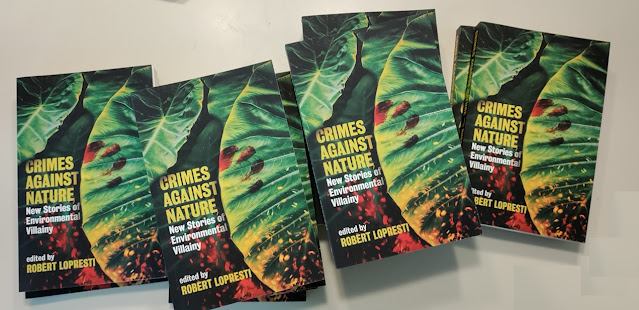
As I said two weeks ago, I edited Crimes Against Nature: New Stories of Environmental Villainy, which Down and Out Books recently published.   I asked some of the contribu5tors to answer a few questions related to the book.  And here you go...

Give me five words about your story.

R.T. Lawton: Clandestine labs poison the environment.

Kristine Kathryn Rusch: Dead Bodies in Lake Mead

Janice Law: pollution, family, development, loss & revenge

Michael Bracken: Water is life. And death.

Mark Stevens: Exploiters of nature; delusional avenger.

Susan Breen: Over-tourism, volcanos, mother/daughter issues, Costa Rica and selfies

David Heska Wanbli Weiden: Wind energy on Native reservations.

Robert Lopresti: Recycling obsessions can be dangerous.

Josh Pachter: “bad neighbor,” revenge, poison, semi-autobiographical

Karen Harrington: Illegal dumping. A fight for life.

Sarah M. Chen: Influencers, beaches, responsibility, privilege, overtourism 

Barb Goffman: Comedy, neighbors, kitty-cat, marijuana, gardening

Gary Phillips: Influenced by the 1970s era, the Bronze Age of Comics. Specifically, the mystically charged Swamp Thing created by Len Wein (writer), and Bernie Wrightson (artist).


Crimes Against Nature uses mystery fiction to look at social (and scientific issues).  What is your favorite (or first-encountered) mystery novel or story that deals with social issues?

Sarah M. Chen: Because I recently read it and Wanda M. Morris is one of my favorite writers, the book that comes to mind is her latest, an atmospheric, taut thriller called What You Leave Behind. It’s set in the Gullah-Geechee community on the Georgia coast and deals with illegal land grabbing and the heirs property system that disproportionally affects Black and brown communities.

Kristine Kathryn Rusch: First? Wow. Probably P.D. James, but which one, I have no idea.

Jon McGoran: Hard to remember what my first was, but when I was young, I went through an intense Carl Hiaasen phase, voraciously reading everything he wrote. I loved how he addressed environmental issues, while at the same time crafting these great crime stories, and never coming across as a scold, instead having great fun doing it.


S.J. Rozan: John Gregory Dunne, True Confessions.

Susan Breen: Walter Moseley’s novel, Devil in a Blue Dress, was the first time I understood racism in a visceral way. I wasn’t watching it from afar, but was there, with Easy Rawlins.

Robert Lopresti:  Some of Rex Stout's novels discussed social issues (A Right to Die, The Doorbell Rang, etc.) but when I first read them I was too young to absorb that.  In college I loved James McClure's The Steam Pig, which was about policing in South Africa under apartheid.

Janice Law: I can only mention some recent books, all of which dealt with child abuse in official custody of one sort or another: Fiona McPhillips's When We Were Silent, Rene Denfeld's Sleeping Giants and James McBride's, The Heaven and Earth Grocery Store.


David Heska Wanbli Weiden:
Even though she likely doesn’t think of it as a mystery novel, The Round House by Louise Erdrich is an amazing book that deals with criminal justice issues on Native lands. It’s a great read that also educates and illuminates. I highly recommend it, although she has so many other tremendous novels, so it’s hard to pick a favorite.

Gary Phillips: One of the first novels I recall dealing with a social issue, an environmental one at that and its implications was Ross Macdonald’s Sleeping Beauty. His fictional take on the real-life Santa Barbara oil spill of 1969 as the backdrop to a Lew Archer, private eye tale.


Mark Stevens:
The Wild Inside by Christine Carbo is one of my favorites.  


Name an author who has had the biggest impact on your short stories.

 Barb Goffman: Art Taylor. I learn something that helps my craft every time I read one of his stories.

Kristine Kathryn Rusch:   Stephen King

Jon McGoran:  I’ve always straddled mystery and scifi, but I think Elmore Leonard is the author whose style has most impacted me as a writer.

Susan Breen: My love of Agatha Christie inspired me to write mysteries, but Sue Grafton had a huge effect on how I think about the women who are usually my protagonists. She taught me that they could be bold, flawed and funny.

David Heska Wanbli Weiden: I’ll always return to the stories of Flannery O’Connor, although my own work bears no resemblance to her amazing tales. For dialogue, I was heavily influenced by Raymond Carver, although I once had a well-known writer scream at me when I mentioned that I admired Carver’s stories. I still believe that Carver’s dialogue is some of the best out there—consistently expressive and surprising.

Gary Phillips: No one writer had the biggest impact but certainly short stories by Poe and Rod Serling – those Twilight Zone teleplays turned into short stories. And it’s only fair to note Walter Gibson, the pulp writer who essentially created the Shadow, turned those into prose.

Robert Lopresti: Can't stop at one: Stanley Ellin, John Collier, Jack Ritchie, Avram Davidson.

Sarah M. Chen: Patricia Abbott. One of my favorites of hers is from Betty Fedora, Issue One, a dark little gem called “Ten Things I Hate About My Wife."

Janice Law: This is difficult, because unlike most writers, I began with novels and only began writing and publishing short fiction after I had launched the Anna Peters series and a couple of history books. So, influences were the mystery writers I enjoyed: Dorothy L. Sayers, because she had Harriet Vane who was so much better than the usual female characters of the time; Eric Ambler, who was the god of suspense in my estimation, and Raymond Chandler for his irresistible style and mastery of atmosphere.

Karen Harrington: John Floyd, Stephen King, Barb Goffman and Ray Bradbury.

Mark Stevens: Patricia Highsmith


Which environmental issue is having the most direct effect on you now?


Karen Harrington: I don't know if it's a direct effect, but when I did research on illegal dumping of car oil and other car liquids, I discovered that it is alarmingly prolific. That's disturbing. There are companies that are weighing the cost of getting caught versus the damage to the environment and taking the gamble. This is from large companies to the small auto parts stores we see across the country. (And interestingly, in my research I found the attached photo describing the 1963 Popular Science method of disposing of used engine oil. What?! This practice was commonly accepted and thought to have no impact on the soil. Really shows that science is rarely settled and must continually learn and reevaluate what we think we know.)

Gary Phillips: Given I live in a seemingly now continuous wildfire state, no particular season for them as in the past, global warming is pretty dang real to me.

David Heska Wanbli Weiden: The wildfires in Colorado seem to be getting worse every year, which is really distressing. I’m now living in New York for the first time since 2013, and I still have strong memories of Hurricane Sandy and the misery caused by that storm.

Mark Stevens: Everything climate change -- dwindling water supplies, threat of forest fires, impact on agriculture.

S.J. Rozan: Global warming, which encompasses all others

Susan Breen: Climate change is the environmental issue having the most direct effect on me because it is influencing where and how I live.
August 2023

Robert Lopresti:
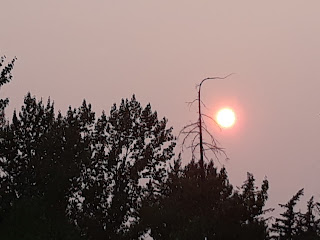
 Most summers now we have days when the air is so full of wildfire smoke that it is considered dangerous to be outside.

Jon McGoran: I think climate change is having the greatest impact on most of us, both the direct effects of it that we’re already feeling, the (inadequate) measures we’re taking to combat it, and the fear and anxiety of what is to come, but I also wonder if nanoplastics and microplastics will end up being even more damaging to us.

Janice Law:  I very much hope to be gone myself before the warbler migration fails. Living in the Northeast, we have escaped some of the most immediate effects of climate change but it is becoming clear that every civilization, including ours, is dependent on the natural world and on favorable climate conditions. We have been slow to learn this as well as careless about our pollution and exploitation of the natural world.

Sarah M. Chen: I live close to the beach so am aware of the alarming rise in sickened and abandoned marine mammals, like whales and sea lion pups. This is due to a number of things like rising ocean temperatures which increases toxin levels and pups being forced to dive deeper and further for food.     

Kristine Kathryn Rusch: The warming of the planet, since I live in Las Vegas.

Themed mystery anthologies seem to be growing in popularity. Any thoughts on that trend?


Gary Phillips:
Having edited or co-edited a number of themed anthologies, South Central Noir, The Cocaine Chronicles to name two, I think if you can hook the potential reader on the subject matter, they like diving in and out of a given short story. They’re not getting exhausted if you’ve tried to turn the idea into a novel, maybe having to pad the story.

Sarah M. Chen:  They're fun and I'm all for it!

Kristine Kathryn Rusch:  I think the more mystery stories the better.

Susan Breen: Anthologies force writers to get out of their regular routines. It’s a challenge to try something new and my suspicion is that because of that, the stories will have a jolt of energy to them.

Mark Stevens: I think once the whole idea of building short story collections on rock bands took off, well, there's no shortage of material.  Waiting for the first collection based on  songs by The Velvet Underground.

Karen Harrington: I think readers and writers enjoy seeing how different minds approach the same topic. I know I do.

 S.J. Rozan: Themed anthologies make total sense -- they allow readers to watch a wide variety of writers exploring topics they're interested in.

David Heska Wanbli Weiden: Yes, I love the trend, and I’ll note that I’m editing one of these myself:  Native Noir, due out sometime in 2025 from Akashic Books. In that volume, some of the greatest Indigenous authors currently writing agreed to try their hand at a noir story, broadly defined. I hope to see more of the music-based anthologies, and I’m still salty that I didn’t know about the two Steely Dan books. Their songs are perfect, of course, for crime tales, and I’m hoping someone will put together another one (and please contact me if you do!)

Robert Lopresti: I love the fact that you can give twenty authors the same assignment and get twenty wildly different, but all fascinating responses.

Janice Law: I think it is a sensible attempt to create a new home for short fiction, which has been evicted from the newspapers and magazines that used to pay well for short stories.

 None of the authors in this book chose to write historical stories. Are there any environmental issues/events in history you think are particularly intriguing?

Gary Phillips: Interesting question. I suppose if I were to give it some thought, how the growth of the Industrial Revolution polluting the skies in England, damaging peoples’ lungs irreparably, comes to mind.

Robert Lopresti: The Cuyahoga River in Cleveland was so polluted it caught fire 14 times. Publicity from the 1969 blaze lit a fuse (sorry) that started the modern environmental movement.

Sarah M. Chen: I watched a documentary on the Chernobyl disaster and found it horrifying and fascinating. I knew very little about it despite being a kid when it happened.

Susan Breen: I’m a great fan of Charles Dickens and have always been fascinated and appalled by what living conditions were like in London during Victorian times, even for the wealthy. Joseph Bazalgette’s construction of the sewer system has got to be one of the greatest environmental triumphs ever. Now that I think about it, I can come up with various murderous scenarios. Maybe I should have…

Barb Goffman: All of these historical events could be put to good use in a crime story...
        Oil spills - Exxon-Valdez, BP, etc.
        Toxic chemical dumping - Love Canal
        Water contamination - Woburn, MA, and Flint, MI
        Nuclear plant meltdown - Three Mile Island, though given recent news, Three Mile Island could also factor into a contemporary story.

Kristine Kathryn Rusch:   I've been fascinated for a long time by the Little Ice Age, as well as the eruption of Mount Tambora in 1815, causing more than 90,000 people to die, and inspiring one of the coldest (and darkest) summers on record in 1816, which led to lots of literary mayhem (like Frankenstein, Dracula, and some Lord Byron poetry).

S.J. Rozan:  1. The Great Flood of 1927 along the Mississippi.  2. Boston's 1919 Molasses Flood

Mark Stevens: Like, a zillion. My mind goes to all the ways mankind has plumbed nature or depended on nature for resources.  Early days of mining.  Or drilling for oil.  I'm fascinated by the idea that gigantic supertankers are ferrying oil around the globe. When was the first? Who dreamed that up? Seventy-seven million barrels of oil are moving around the globe every day.  At what cost? At what risk?  

Janice Law: We have a couple of big ones just in our own national history: the near extermination of the buffalo, the loss of the passenger pigeons, and what is proving to be the very foolish attempt to create "fur deserts" in the west. The loss of the beaver had impacted water storage in these dry areas just as the huge reduction in buffalo has had an impact on soil conservation etc on the prairies.

The trouble with these events, and with many environmental issues, is that they don't necessarily fit well with the demands of short mystery fiction, which are surprising like the old classical unities: one time, one place, one action, and that additional requirement that also goes back to the ancient Greeks: a beginning  in the middle of the action.