12 October 2026
So here we are on that ambiguous holiday again
In the first story, "The Green Cross," published in Ellery Queen's Mystery Magazine and nominated for an Agatha Award for Best Short Story, the Admiral is Diego's mentor and protector. But once he plants the Green Cross banner on the first Caribbean isle, claiming it “in the names of their most Christian Majesties and the Savior” (in the first Mendoza novel, Voyage of Strangers), the lines are clearly drawn.
Wherever the Mendozas go, Christians are the bad guys. The good guys are Jews and indigenous peoples, Muslims in the Ottoman Empire where the family eventually settles, and others whom today we would call marginalized peoples, such as the Roma, whom Diego and Rachel encounter in their travels. In writing about the genocide of the Taino, I’ve learned that today, surviving descendants in Puerto Rico, Cuba, and the Dominican Republic who carry their DNA are reconstructing their cultural heritage and language. It's hard to wipe a people out completely. (Thanks to DNA matching services, I've learned that, in spite of the Holocaust in the 20th century, segments of Ashkenazic Jewish DNA identical to mine are walking around in relatives in forty-eight different countries.) In "A Matter of Perspective," a novelette published in Alfred Hitchcock's Mystery Magazine, I enjoyed telling the story of Suleiman the Magnificent's conquest of Rhodes in 1522 as a victory. If you google the two-year-siege, you'll find it in our Eurocentric sources as the defeat of the Knights of Rhodes, which led to their becoming the Knights of Malta. This is not to say that Suleiman the Magnificent was a pussycat or that all Christians were bad guys even in the era of the Inquisition. But as survivors, the Mendozas are adaptable. As outsiders, they have a fresh perspective. And it is not surprising that, as intelligent people, they are cultural relativists.
In a few weeks, I'll be guest speaker at a lit class at the famed 92nd Street Y in New York. The professor is a guy I've known for seventy-five years (since third grade, if you must know). This time around, he's chosen the theme of "gallows humor" in Jewish mystery short stories, using examples from the anthology Jewish Noir II, edited by Ken Wishnia and Chantelle Aimée Osman, to which I contributed my Mendoza story, "The Cost of Something Priceless." It has a bit of a sixteenth-century frame story involving Rachel, a necklace she's bringing from the Ottoman Empress to the Queen of France, and bandits. But the heart of the story has my protagonist, one of Rachel's twentieth-century descendants, saying everything I always wanted to say about sexism and anti-Semitism in the 1950s, woven into a tale of theft, intrigue, and revenge.
All of my Mendoza Family Saga stories can be found in Rachel in the Harem. Voyage of Strangers is available for Kindle. Journey of Strangers is available in both paperback and e-book editions.
26 May 2025
A Passion for Cross-Genre
The detectives are a female Nero Wolfe who investigates blindfolded, without leaving her home, and a magically altered Archie Goodwin. Bennett won an Edgar in 2012 for Best Paperback Original for an alternate historical noir science fiction thriller.
I'm one of thousands of authors featured on www.Shepherd.com, a online book browsing site whose founder, Ben Shepherd, claims it's a more effective way for readers to find books they'll fall in love with on the web than Amazon or Goodreads and more akin to the experience of browsing a brick and mortar library or bookstore.
He may be right, because every time I've visited the site to check my own promotional material (which is the primary reason authors join—for free), I end up falling in and following links and come away with something to read.
In order to promote one of their own books, readers are asked to pick a book-related theme ("The best…") and five exemplars. The idea is to draw kindred spirits first to your favorite books and then to your own, with which it presumably has something in common. Rather than manipulate the client by trying to list the five books that were closest in nature to the first in my longest series, I decided to be honest about my five favorite books "with characters you fall in love with." That's my top requirement as a reader for a favorite book. It didn't surprise me that the list consisted solely of genre fiction, because that's 97 percent of what I've been reading for decades. It did surprise me that the whole list of five consisted of cross-genre fiction, with not a single straight mystery among them.
Here's my personal list of "The best historical, fantasy, SF, and mystery books with characters you fall in love with":
- Kate Quinn, The Rose Code
- Diana Gabaldon, Outlander
- Naomi Novik, His Majesty's Dragon
- Lois McMaster Bujold, A Civil Campaign
- Martha Wells, All Systems Red
I read and write mystery because it's fiction in which something is guaranteed to happen. Most literary fiction comes across to me as a dish without salt. I've always read historical fiction, and I've been writing it ever since young Diego Mendoza popped up in my head demanding that I tell the story of how he sailed with Columbus when the Jews were expelled from Spain.
I read more and more urban fantasy and occasionally high fantasy these days because it's so imaginative and so much fun. I like speculative fiction in general, but my mind glazes over when the science kicks in. I can't read the tech in a technothriller either. And whatever I read, character, character, characters I love, well developed characters I care about are a must. That's what I'm best at writing myself, along with snappy dialogue that moves both plot and relationships forward. I haven't taken my own urban fantasy mystery series as far as a novel yet, but you can read my novelette about Jewish country artist and shapeshifter Emerald Love, aka Amy Greenstein, Shifting Is for the Goyim, and the collection of stories that follow, Emerald Love, Shifting Country Star, as e-books. I've found urban fantasy mystery is as much fun to write as it is to read.
31 March 2025
What Makes An Anthology The Best?
The SleuthSayers anthology, Murder, Neat, edited by our own Michael Bracken and Barb Goffman, has had the distinction of being named one of the finalists for the inaugural Derringer Award for Best Anthology in an impressive field of 2024 short crime fiction anthologies.
I've edited two anthologies and contributed stories to almost a dozen including my own. I've also had a story included as an "Other Distinguished Story" in a volume of Best American Mystery Stories—an honor that means the notoriously critical series editor picked it as one of fifty out of a field of several thousand, but that year's guest editor failed to select it as one of the twenty to include in the anthology.
So I feel qualified at what seems a good moment to talk about some of the elements of excellence in an anthology.
Any anthology needs focus. This may be provided by a theme, restriction of the setting or authorship to a certain region, or limitation of submissions to a particular group or organization. All the contributors to Murder, Neat are current or former SleuthSayers. The theme, some aspect of alcohol, bars, and drinking, was chosen after much lively discussion among the blogfellas.
The highly regarded Noir anthology series from Akashic Books was fresh when it began with Brooklyn Noir. It now runs to more than a hundred books. I've heard that the publisher is deeply committed to publishing stories on a variety of aspects of the chosen location as well as a genuine noir flavor. On the other hand, the concept of the "anthology noir" has been a runaway success far beyond the original publisher's series. I wrote a story for Jewish Noir II (2022). The stories ranged from Biblical to paranormal to historical to modern, the genres from noir to comic to speculative, the settings spanned the globe. Submissions were by invitation only, but not all of the contributors were Jewish.
Some editors choose to engage potential readers through a mix of beloved authors and fresh voices. Those are the anthologies in which half the stories are by invitation, the other half by open call. I've never made it into one of those. I tried to seed my own anthology, Me Too Short Stories, with a few well-known authors along with open submissions in hopes of attracting a better publishing contract. As it happened, a political issue was raging at the time, and the more courted authors were the first to abandon ship. I persisted and ended up with a book of wonderful stories that failed to get the attention it deserved.
Apart from market considerations, the best anthology is one in which every story is a winner. I got that in the end with Me Too Short Stories. All the stories adhered to the theme, but each of them did it in a different way. None of the writers was famous, but all were terrific at working cooperatively and appreciated a strong editor. Even when fifteen or twenty or two dozen stories are all about bars or all about Jewishness or all about crimes against women, they can be as different as each writer's voice and way of building a unique structure on the three-cornered foundation of plot, character, and writing or storytelling.
Once the editor or editors have selected the stories, they must put them in the best possible order. This is a creative act, akin to putting together a single-author collection of short stories or poetry, and I assure you it produces endorphins. A well arranged anthology starts with a pie in the face—a first story that grabs the your attention (especially in the library or bookstore or in the Amazon sample) and makes you want to read on. The second and third stories must also make you want to read on, and they must be entirely different from the first and from each other—dark and light, tragedy and humor, horror and cozy, snappy dialogue and brooding narrative. And one of the very best must be saved for last, so you close the book with a smile or a sigh of satisfaction.
14 October 2024
The Joys of Reading Aloud
This year I had the great pleasure of reading aloud in their entirety both Voyage of Strangers and its sequel, Journey of Strangers (2015). My first-person protagonist is young Jewish sailor Diego Mendoza, who sails with Columbus on the Santa Maria in 1492 in “The Green Cross,” which first appeared in Ellery Queen’s Mystery Magazine in 2010. In Voyage, Diego and his sister Rachel travel through Spain at risk of capture by the Inquisition to join Columbus’s second voyage in 1493. They befriend the local Taino, come to admire their culture with its guiding principle of generosity, and watch in helpless horror as the Christian Spaniards destroy both culture and people. Journey of Strangers follows Diego and Rachel and their friend Hutia, a lone Taino survivor, across war-torn Europe to Istanbul, where the Mendozas have settled in the Jewish community that the Ottoman Sultan has welcomed. Journey also tells the story of Joanna, one of two thousand Jewish children kidnapped by the King of Portugal in 1493 and shipped off to slavery on the pestilential Isle of Crocodiles, São Tomé.
My audience of one was a transplanted Jewish New Yorker who lives in Austin, where she’s active in the local Jewish community through her synagogue. She also does volunteer work for the Minaret Foundation, a Muslim organization that is “making Texas better through multifaith and civic engagement.” She was already a friend when she started losing her vision to rapidly progressing macular degeneration, and I had the bright idea of offering to read to her via Zoom. Our weekly reading sessions have become a high point of the week for both of us.
The theme of cultural relativism pitted against absolutism and intolerance is certainly relevant today. The parallel between fifteenth and twenty-first century anti-Semitism in Europe (and America in the twenty-first) and the contrast between the fifteenth century relationship between Jews and Muslims and that relationship in our own time provide food for thought. When my listener laughed and cried as the story unfolded, I'd say, “That’s exactly what I hoped you’d do. You’re the perfect reader!” She'd say, “Laugh and cry and learn.” Her appreciation made me glad I spent all that time crawling through the stacks of the Columbia University Library to retrieve an unpublished doctoral thesis to get details on the Enderun School that shaped the Ottoman viziers and janissaries and followed the trail from a professor at Brandeis University (my alma mater) to a professor in Tel Aviv to a footnote to find out about the Jewish women called kiras who served as purveyors and personal shoppers to the Sultan’s harem.
In fact, as I reread my own writing aloud, word by word, more than ten years after I wrote it, I could hardly believe I did all that research—into history, into several different cultures and religions, into a dozen languages. I’m still in love with my characters. That’s no surprise, since character is my strong point as a writer. I too cry at certain passages, including but not limited to the parts that made me cry as I wrote them. Not unexpected either. It’s the storytelling, the suspense I somehow manage to sustain for chapter after chapter, that amazes me. That’s the part I was never good at. But as I read my work aloud to someone who is always astonished and excited at each twist and turn of the plot, always wants more when we end a chapter or it’s time to end the session, I realized that with these two novels, by gum, I did it. Not a single chapter sags. If it did, reading it aloud, I would notice and admit it. I wanted more at the end of every chapter too. This experience blew my mind.
Neither of us wanted this exhilarating shared experience to end. So once we finished Journey of Strangers, along with the Afterword explaining what parts of it are historical and the multilingual Glossary, we went on to the rest of the Mendoza Family Saga: short stories, most of them mysteries involving Rachel, still working as a kira to the harem when Suleiman the Magnificent becomes Sultan of the Ottoman Empire in 1520, that first appeared in Black Cat Mystery Magazine. The previously published stories can be found in the e-book Rachel in the Harem, along with a novelette about Rachel’s daughter among the Knights of Rhodes that first appeared in Alfred Hitchcock’s Mystery Magazine, a two-timeline story from Jewish Noir II, a time travel story, and the very first Mendoza story, which appeared in Ellery Queen's Mystery Magazine in 2010. But only my two favorite Texans—my audience in Austin and a certain editor of impeccable taste—know what happens in two stories yet to appear.
04 October 2023
Quotes at the Marina
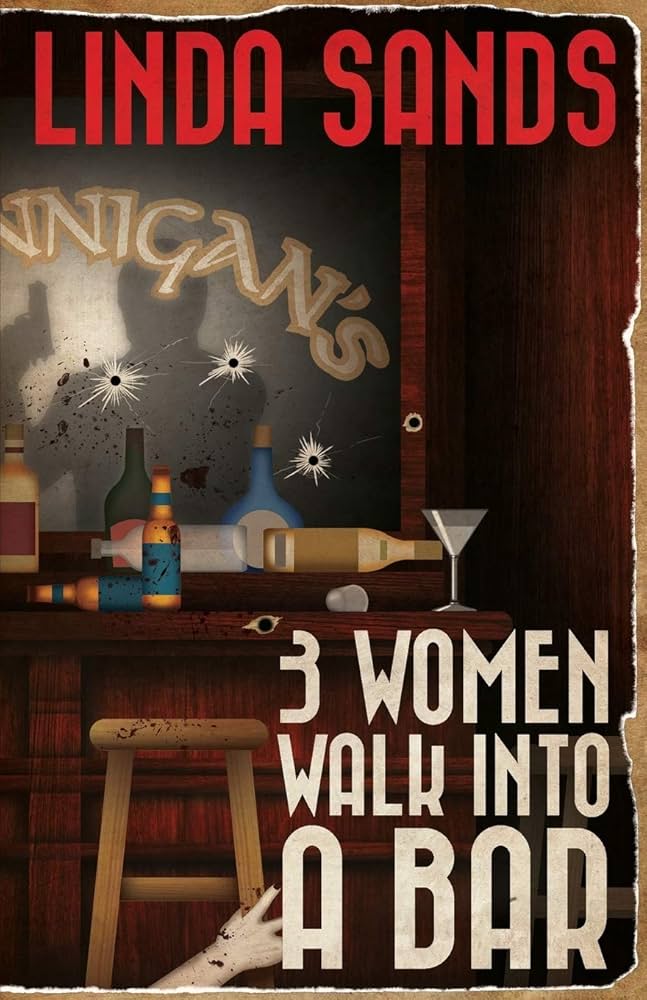
Two weeks ago I reported on my adventures at Bouchercon in beautiful San Diego. As usual I had my trusty notebook with me and was jotting down words of wisdom, and other words as well. Here are the results..."If the book begins with three dead girls on the floor of an Irish bar you know where you are. It's not a sweet little romance. So stop giving me those one-star reviews." - Linda Sands
"People like to talk to writers and they tell me things they wouldn't if they were sober." - Jeffrey Seger29 May 2023
How much of a misfit can a writer be?
In today's publishing, there are a lot of rules based not on literary values but on the marketplace, as the industry tries to predict the unpredictable and control the uncontrollable. The underlying rip current is fear, determined by neither art nor business but by the chaotic politics of the moment. How far outside the lines am I allowed to color? As far as I want? Or only up to a limit defined by others?
In recent years I've become interested in writing from a Jewish perspective in my fiction. But anti-Semitism is on the rise globally. Jews are not getting a clear message that we're included under the sheltering umbrella of "diversity." So can I tell as many stories as I want, or just a token number? When will I be told that it's enough?
I've recently become interested in writing about trans people. I'd like to see trans characters integrated into crime fiction the way they are in speculative fiction. I have had one such story published, but I was disappointed when the editor allowed my preferred title to be vetoed by a low-level staff member who was trans. My 62-year-old nonbinary nibling (formerly my niece) commented: "I loved your title. The word police are mostly under forty."
How careful am I supposed to be with titles from now on? Will I be free to inform the development of all the characters I write with the full measure of my empathy and imagination? Does the publishing industry realize that the younger generation doesn't know anything? I remember trying to tell a young woman that the derogatory term "boujee" came from the word "bourgeois," for middle class. "No it doesn't," she said. "It's just itself." I didn't argue. People believe what they want to believe.
At this point in my life, I'm happy writing short stories. If I ever wrote another novel, it might be about two lifelong friends, a Jewish girl with Communist parents and a Black girl from Harlem with roots in what she calls a "good family" in the South, who first meet in the early1950s. But I have no incentive to write it. I wonder why not?
18 January 2023
Getting the Best of It
This is my fourteenth annual list of the best short mysteries of the year. It is selected from my best-of-the-week choices at Little Big Crimes. If you cite this list please refer to it as "Robert Lopresti’s ‘Best of the Year’ list at SleuthSayers,” or words to that effect, not as the SleuthSayers' 'Best of the Year' list. Hard as it is to believe, some of the other twenty-odd bloggers here may have opinions of their own.
Fifteen stories made the list this year, one fewer than 2021. Nine are by men, six by women. Two are by fellow SleuthSayers. Six authors have appeared here before.
Alfred Hitchcock's Mystery Magazine provided three stories. Akashic Press, Ellery Queen's Mystery magazine, and the Mystery Writers of America anthology each had two.
Six of the stories are historicals, three have fantasy elements, and two are funny. Okay, enough number-crunching. Let's start tearing open envelopes.
Gina is an inner-city teacher and a genuinely nice person, the kind who makes friends easily with people you and I might cross the street to avoid. When some of these folks notice a van following her in a suspicious manner they react, much like antibodies to an infection. But they are busy and not the best organized crowd, so it is not certain whether the good guys will win...
Bethea, Jesse. "The Peculiar Affliction of Allison White," in Chilling Crime Short Stories, Flame Tree Publishing, 2022.
I have a story in this book.
It is the late nineteenth century in rural New England. A young girl claims her illness is being caused by vampires. The irrational villagers believe her bizarre story and are digging up the graves of the supposed monsters. If her uncle the doctor can't stop this madness corpses are not the only ones who will be harmed.
Braithwaite, Oyinkan, "Jumping Ship," in The Perfect Crime, edited by Maxim Jakubowski, Harper Collins, 2022.
Ida is a photographer, specializing in baby pictures. Her boyfriend wants her to take photos of his new baby. Only catch is, it will be at his house and his wife will be there. She doesn't know Ida is sleeping with hubby. What could possibly go wrong? Very creepy story.
Breen, Susan. "Banana Island," in Mystery Writers of America Presents: Crime Hits Home, edited by S.J. Rozan, Hanover Square Press, 2022.
Marly is a scam-baiter for the IRS, engaging with scam artists, ideally to catch them, but at least to keep them busy so they are not robbing the gullible. She has been engaging with a Nigerian, but can't convince him to ask for money. To raise the stakes she tells him about the situation her family is facing, a real estate mess that has entangled her family. Who exactly are the good guys? Twisty tale.
Breen, Susan. "Detective Anne Boleyn," Alfred Hitchcock's Mystery Magazine, May/June 2022.
You will notice Breen has two stories in my best-of-the-year list this time. Only Brendan DuBois and Jeffery Deaver have managed that before.
An American tourist named Kit is poisoned to death in the Tower of London. Before she can get used to being dead Anne Boleyn arrives. The queen comes across as a tragic figure, very sharp except for her blind love for that nasty husband of hers. The two wronged women manage to help each other out in surprising ways..
Haynes, Dana "Storm Warning," in Ellery Queen's Mystery Magazine, July/August 2022.
The inspector's assistant is a beautiful blond woman who looks a lot like Jordan's wife Lizette did when she first met her husband. This does not make Lizette happy. Then a tornado warning forces the characters to retreat to the storm-proof basement. Did I mention that Jordan keeps his firearms collection down there?
Hockensmith, Steve. "The Book of Eve (The First Mystery)," Death of a Bad Neighbour: Revenge is Criminal, edited by Jack Calverley, Logic of Dreams, 2022.
I have a story in this book. This is the second appearance in this column by my friend and fellow SleuthSayer Steve Hockensmith.
Abel has gone missing and his mother Eve is looking for him. The role of Watson is filled by a certain snake. Much of the pleasure here is in the way it's told, the language of the characters. A very funny story that manages to be surprisingly moving as well.
Latragna, Christopher, "The People All Said Beware," in Alfred Hitchcock's Mystery Magazine, September/October 2022.
It's St. Louis, MO, in 1955. Henry is a professional gambler who works mostly on a steamboat called the Duchess. One day he learns that the ship will be off-limits on Saturday due, according to rumor, to a mob wedding. Henry thinks it odd that the management of the ship would close down on the busiest day of the week, so he begins to investigate. Like a classic John LeCarre tale, or a set of matryoshka dolls, each secret exposed only reveals another secret, right up to the end.
McCormick, William Burton. "Locked-In," in Alfred Hitchcock's Mystery Magazine, January/February 2022.
This is the fourth time McCormick has made my best of the year column. That ties him at the top with David Dean and Janice Law. McCormick and I sometimes critique each others work before it gets submitted for publication. I saw a version of this story back in 2019.
It's 1943. An insurance man named Jeff has just rented a house in a new city. He accidentally locks himself in the cellar. Now he has to attract the attention of a passer-by who happens to near his lonely alley. But the person he attracts is not interested in rescuing anybody...
McLoughlin, Tim, "Amnesty Box," in Alcohol, Tobacco, and Firearms, Akashic Press, 2022.
The publisher sent me a copy of this book.
The protagonist is a postal service police officer in New York City. To speed up the occasional metal detector check they must run on post office customers he invents the Amnesty Box. Customers can drop into this cardboard box anything they know they shouldn't be taking through the metal detector. The catch is they won't get the dumped items back. "Even on a slow day we would collect a couple small bags of weed and a few knives." A harmless-enough trick until something much more dangerous is dumped in the box...
Jonathan Stone, "The Relentless Flow of the Amazon," in Mystery Writers of America Presents: Crime Hits Home, edited by S.J. Rozan, Hanover Square Press, 2022.
It is the beginning of the great lockdown, "the time of boxes. Everything delivered." Annie and Tom, new to their suburban neighborhood, are getting tons of boxes which they leave in their garage to give the virus time to wander off.
One day they get an Amazon box they are not expecting. It contains two plastic but clearly real guns...
Subramanian, Mathangi "On Grasmere Lake," in Denver Noir, edited by Cynthia Swanson, Akashic Press, 2022.
Vincent, Bev. "Cold Case," in Black Cat Mystery Magazine, Issue 12, 2022.Roger lives in Texas. One frosty morning he finds a dead man sitting on his porch. When the police arrive he refuses to let them into the house, due to COVID fears, which does not endear him to the shivering constabulatory. Roger is retired but not scared of technology, which he uses intensively in his unofficial investigation. Very witty story.
Joseph S. Walker, "More Than Suspicion," in A Hint of Hitchcock, edited by Cameron Trost, Black Beacon Books, 2022.
Walker also made my best-of-the-year list last year.
A small town in Colorado, just after Pearl Harbor. Hannah is the projectionist in the town's movie theatre. Supply chain issues leave her running Hitchcock's classic movie Suspicion over and over. Darlene, new in town, comes to see it almost every night.Darlene hates the film's ending, in which the husband turns out to be innocent and the wife merely imaging the danger she is in. "The end is the only part that's a lie. A pretty lie, but still. He kills her. Of course he kills her." Darlene has a secret. Hannah, it turns out, has one of her own.
Zelvin, Elizabeth, "The Cost of Something Priceless," in Jewish Noir II, edited by Kenneth Wishnia and Chantelle Aimee Osman, PM Press, 2022.
This is the second appearance here by my fellow SleuthSayer. Zelvin has written other novels and stories about the Mendozas, a fictional family of Sephardic Jews, some of whom sailed with Columbus. This story begins with a letter from a modern Mendoza bequeathing to her granddaughter the family's most precious treasures: a necklace and the documents proving it belongs to them.
Intertwined with this tale is the third-person story of how Rachel Mendoza really acquired the necklace half a millennium ago. Let's say that both women found their way through considerable difficulties.
19 September 2022
Hiding in Plain Sight, or, Oh, My God, Everyone’s Jewish! by guest blogger Kenneth Wishnia
Kenneth Wishnia’s novels have been nominated for the Edgar, Anthony, and Macavity Awards. His short stories have appeared in EQMM, AHMM, Queens Noir, Long Island Noir, and elsewhere. He teaches writing, literature and other deviant forms of thought at Suffolk Community College on Long Island.
Secretary of State Madeleine Albright apparently didn’t learn that she was Jewish until 1996, more than 55 years after her parents sent her away from Czechoslovakia to the UK for safekeeping on the eve of WW II.
Cardinal John O’Connor, leader of the Catholic Church in New York City for 16 years, apparently died without ever learning that “his mother was born a Jew, the daughter of a rabbi” (see Cowan, Alison Leigh. “The Rabbi Cardinal O’Connor Never Knew: His Grandfather.” New York Times, 10 June, 2014).
Even Eddie Muller, the “Czar of Noir” who was in the first Jewish Noir collection, told me that he had learned of some Jewish ancestry in his lineage. It turns out he was referring to his paternal grandfather--not exactly a distant relative--who changed his name from something very Jewish and foreign-sounding to make it easier to find a job when he emigrated to California a few generations back.
This raises some serious issues regarding the suppression of Jewish ethnicity during less enlightened times. I mean, how many Americans “discover” that they have Christian ancestors? People don’t discover they’re Christian, or part-Christian, because in the US that identity never needed to be suppressed or hidden.
But we’re writing about noir, aren’t we? Glad you asked!
![]() |
| Hedy Lamarr in The Strange Woman (1946) |
Jewish directors who emigrated before 1933 include: Michael Curtiz (Hungary), Lewis Milestone, Charles Vidor and William Wyler (Germany); Hugo Haas (Czechoslovakia), and László Benedek (Hungary). (Note: I am indebted to Vincent Brook’s film study, Driven to Darkness, for this information.)
![]() |
| Lauren Bacall & Humphrey Bogart in Dark Passage (1947) |
![]() |
| Cornell Wilde & Gene Tierney in Leave Her to Heaven (1945) |
Family note: My parents were both born in 1931, so of course they lived through the classic era in Hollywood. My dad was incredulous about Lee J. Cobb, asking, “Are you sure he was Jewish?” My mom’s response: “Cornell Wilde was Jewish?”
Crime writer S.J. Rozan’s response: “Fritz Lang was Jewish?” I know, his mother converted to Catholicism, mainly to avoid anti-Semitism in Germany, and Lang himself denied being Jewish for most of his life, but his mother was indeed Jewish, and converted when Lang was 10, meaning he was born Jewish. Under basic civil law and traditional Jewish law, Fritz Lang was Jewish.
![]() |
| Simone Signoret in Diabolique (1955) |
Of course, many performers did this, regardless of their ethnicity (just ask Lucille LeSueur --I mean Joan Crawford). But why am I still finding out that so many key figures in world culture were Jewish? Just in the past couple of weeks, I’ve learned (from their obituaries!) that several prominent artists I had no idea were Jewish were in fact Jewish, including the British-born theatrical innovator Peter Brook (family name originally Bryk) and the composer of the James Bond theme, Monty Norman (b. Monty Noserovitch). I also just learned that Frank Oz, best known as the puppeteer for Miss Piggy, Bert, Grover and Yoda, was born Frank Oznowicz. And this happens all the time. Once again, people don’t hide their Christian identities. But Jews? That seems to be a case of, “Gee, mister, the name Issur Danielovitch Demsky doesn’t exactly spell box office gold on the marquee. How about we call you Kirk Douglas?”
![]() |
| Shelley Winters & Richard Conte in Cry of the City (1948) |
During Hollywood’s Red Scare, Representative John Rankin of Mississippi made a show of “outing” a number of prominent entertainers by revealing their birth names, implying that they were hiding their true identities in order to subvert American values from within, as if Danny Kaye (b. Dovid Daniel Kaminsky) and Eddie Cantor (b. Edward Isskowitz), two of Rankin’s examples, were planning to oppress American Christians by sneaking in communism between comedy routines, or something like that.
That’s one reason it was so much fun working on the Jewish Noir II anthology, in an era when we’re free to use our foreign-sounding, often polysyllabic names: Kirschman, Markowitz, Schneider, Sidransky, Zelvin and Vishnya (the Slavic pronunciation of Wishnia).
And speaking of my family name, it may be a liability on the bookstore shelves—I’m usually down on the floor with the rest of the W-Z authors--but it’s an asset in the world of Google searches: if you google “Kenneth Wishnia” you don’t get 100,000 other guys with the same name. You get me.
And by the way, I’m Jewish.
15 November 2021
Making An Impact
"Never Again" is a challenging story. We learn on the first page that Valerie's father abuses her sexually from the age of four. For ten years, her attempts to speak out and get help fail. We also meet Frances, abused by the preacher's son at age nine in her close-knit churchgoing community. She hides her pain in compulsive overeating and obesity and marries an alcoholic who abuses her physically, verbally, and emotionally. Two intolerable situations, one girl, one woman who say, "Never again!" and embark on a collision course. What will happen when they collide?
I've visited Ken's classes, whose students have not only read the story but written a one-page paper on it, several times, both virtually and in person. Ken has said, "These stories [in the Me Too anthology] are the first pieces of fiction to truly come alive on the page for some students." He and I have discussed how academic assignments had changed since our own youth, when Shakespeare and Victorian novels were the norm, and how the first wave of "relevant" reading material, beginning in the Sixties, ran to books like Catcher in the Rye, whose protagonist these students would see as a bored rich white kid with no problems worth mentioning.
Last year, to illustrate the students' visceral response, he shared with me some comments from their papers.
Not a lot of literature has really brought me to tears, but her story had me close to fully crying.
This story had me genuinely tearing up and putting the book down after the first few sentences, which is something that has never happened before.
Sometimes the writing in a story is so good that you physically react and that’s what happened.
Never Again demonstrates the lack of voice that women have when speaking up about sexual abuse. People question why victims exposed to any abuse cannot speak up. These victims want to tell someone that they are suffering, but it is hard for them to confide themselves to someone who will listen to their story.
Do I write in the hope of moving readers this powerfully? You bet I do. Did I write "Never Again" to make an impact? Absolutely. I'm awed and grateful that these young readers were so receptive.
One more comment, from a young man whose opinion I'd rather have than a New York Times reviewer's:
I cant even compare this short story to the others because this one is by far my favorite. By the end of the first page i was instantly hooked, the darkness of this story is absolutely wild. The way how the author describes so specifically the dark twisted things that go on in Valerie's household puts me on the edge of my futon that i was reading this on. The fact that i wanted to rip the father out of the pages and beat him up for touching and treating his daughter like that was a feeling Ive never felt before reading a story.
I can hardly wait to find out what this year's crop of students have to say.
20 January 2021
2020 Was A Big Improvement
Note: I reivsed this column on February 27th, because I needed to add the story by Thomas Perry, which appeared in a magazine with a 2020 date which I didn't receive until last week.
I had better explain that title before you send for the nice folks with the strait jackets. 2020 was better than 2019 only in the sense that more stories made my Year's Best list. Last year, my eleventh, 12 stories made the list. This year it's 17, a 41% increase. Am I just feeling generous as the world dips into chaos? Who knows?
For the second year in a row the big winner was Akashic Press, with three stories. They send me their anthologies for free, by the way. Following with two were Alfred Hitchcock Mystery Magazine, Ellery Queen Mystery Magazine, LB Productions, Mystery Writers of American, and Superior Shores Press.
That last one requires a bit of explanation. Publisher Judy Penz Sheluk asked if I would read an advance copy of Heartbreaks and Half-Truths and give it a blurb if I thought it worthy. I did so and was happy to write said blurb but, since I read the stories long before the book came out, I didn't feel I could list one as my Story of the Week. Therefore this is the first time since I started reviewing at Little Big Crimes that tales make the year's best list without appearing there first.
Eleven stories are by men; six by women. Five are humorous; four are historical; and two have fantasy elements.
Ready? Let's go.
Barlow, Tom, "Honor Guard," in Columbus Noir, edited by Andrew Welsh-Huggins, Akashic Press, 2020.
The narrator is the only child of Tommy, a former navy man turned plumber. The old man's dementia is turning him violent, profane, and racist On Veterans Day there is a violent confrontation with tragic consequences. Some stunning surprises follow.
Cody, Liza, "My People," in Ellery Queen Mystery Magazine, November/December 2020.
This is Cody's second appearance on my list.
Shareen Manasseh is a Jewish woman whose family came to Britain from India. She joined the police force and, without much training, was assigned to infiltrate the climate change activists - she calls them rebels. Her work her rethinking her allegiance. Did she become a cop to get "black-and-white certainty" or because it was better "to be with the bullies than against them?"Dixon, Buzz. "Tongor of the Elephants." Heartbreaks and Half-Truths, edited by Judy Penz Sheluk, Superior Shores Press, 2020.
Here, lemme show you something you've never seen before. The nameless narrator has film of an actor called "J. Cecil Revell, the Million Dollar Profile," being smashed to death by a grumpy elephant while filming a very bad serial. It's a charming tale of villainy, revenge, and, of course, elephants.
Foster, Luke, "Seat 9B," in Mystery Weekly Magazine, June 2020.
The narrator is an investigative journalist, covering true crime for TV news shows. On a flight from Los Angeles he suddenly realizes that the man he is sitting next to is the unknown serial killer the country's cops have been looking for. And since he has "the world's worst poker face," the killer immediately knows he knows...
Goldberg, Tod, "Goon #4," in The Darkling Halls of Ivy, edited by Lawrence Block, LB Productions, 2020.
Goon #4 (his mama named him Blake) is an ex-military thug, now specializing in high-risk assignments. Having made enough money to retire he decides to go to college and winds up, more or less by accident, in a class on radio performing. He has some abilities there, it turns out, but more important is the attitude he brings from his previous profession.
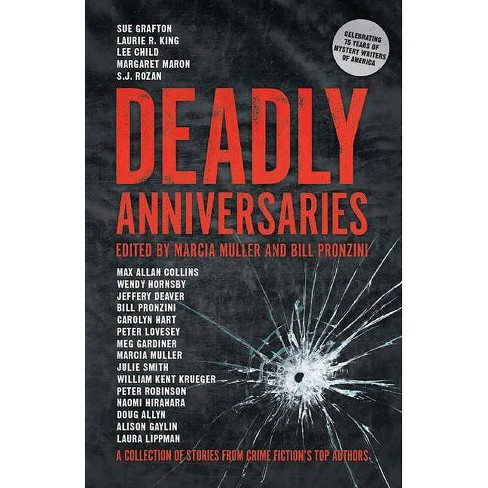
Grafton, Sue, "If You Want Something Done Right...," in Deadly Anniversaries, edited by Marcia Muller and Bill Pronzini, Hanover Square Press, 2020.
Lucy Burgess has reason to think her hubby is planning to get rid of her. So she plans a preemptive strike, so to speak. A lucky mistake puts her in touch with a hit man, and this fellow's way with words is a good deal of the charm of the story.
"Keeping my remarks entirely famatory, every matrimonial association is defeasible, am I right? ...So what I hear you saying is that you and him are engaged in a parcenary relationship of which you'd like to see his participation shifted to the terminus."
Guthrie, C.C., "Cahoots," in Cozy Villages of Death, edited by Lyn Worthen, Camden Park Press, 2020.
Alan Peterson is a banker, and son of the wealthiest man in a small East Texas town. The story opens with him running into Beulah's diner in a panic because his beautiful wife TeriLyn has disappeared.
But things don't seem to add up. She's only been gone a few hours. And isn't Alan supposed to be out of town? And why is he claiming she has been having mental problems?
Henderson, J.A. "The God Complex,"
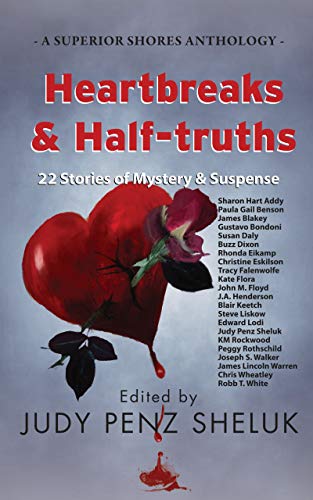
Heartbreaks and Half-Truths, edited by Judy Penz Sheluk, Superior Shores Press, 2020.
Turns out you can't time travel exactly, but you can view time. The problem is you tend to see what you expect to see. And quantum physics is right: observation changes the thing observed. That means the ideal observer of the past is someone with no emotions. What's the other term for someone with no emotions? Oh yeah: sociopath...
Hunt, Alaric, "Borrowed Brains," in Ellery Queen Mystery Magazine, May/June 2020.
Daniel McLaren, an aging West Virginian rumrunner, is happy working as a messenger in New York City, but when he gets beaten and robbed of a half-million dollar package the cops decide that the ex-convict is obviously guilty - or at least convenient to blame.
Fortunately McLaren has a buddy in the city, a fellow native of the Mountain State named Clayton Guthrie. And Guthrie is a private eye. Together they start to unravel a complicated fraud scheme that is going badly wrong, with possibly deadly consequences.
McCormick, William Burton. "Night Train to Berlin," Alfred Hitchcock's Mystery Magazine, March/April 2020.
This is McCormick's third appearance here. It is 1939 and Stalin and Hitler are playing footsie. As part of their nice-making the Soviet Union and Nazi Germany are exchanging prisoners.
Moller is a German-born Communist. He has lived in the USSR since its origin but is now being shipped back to his homeland in exchange for some unfortunate Russian the NKVD wants to get their hands on. He knows that the vehicle he is about to board "might as well be my funeral train." But there are plots within plots and an unlikely ally might help him out.
Moore, Warren, "Alt-AC," in The Darkling Halls of Ivy, edited by Lawrence Block, LB Productions, 2020.
This is the second appearance here by Warren Moore. It ranges between the amusing and startling.
Roger possesses a newly minted PhD. in medieval English. He is desperate for work in a crowded market but he has a plan to avoid teaching at "the Swamp County School of Mortuary Science and Transmission Repair,"
Oltvanji, Oto, "Underneath it all Runs the River of Sadness," in Belgrade Noir, edited by Milorad Ivanovic, Akashic Press, 2020.
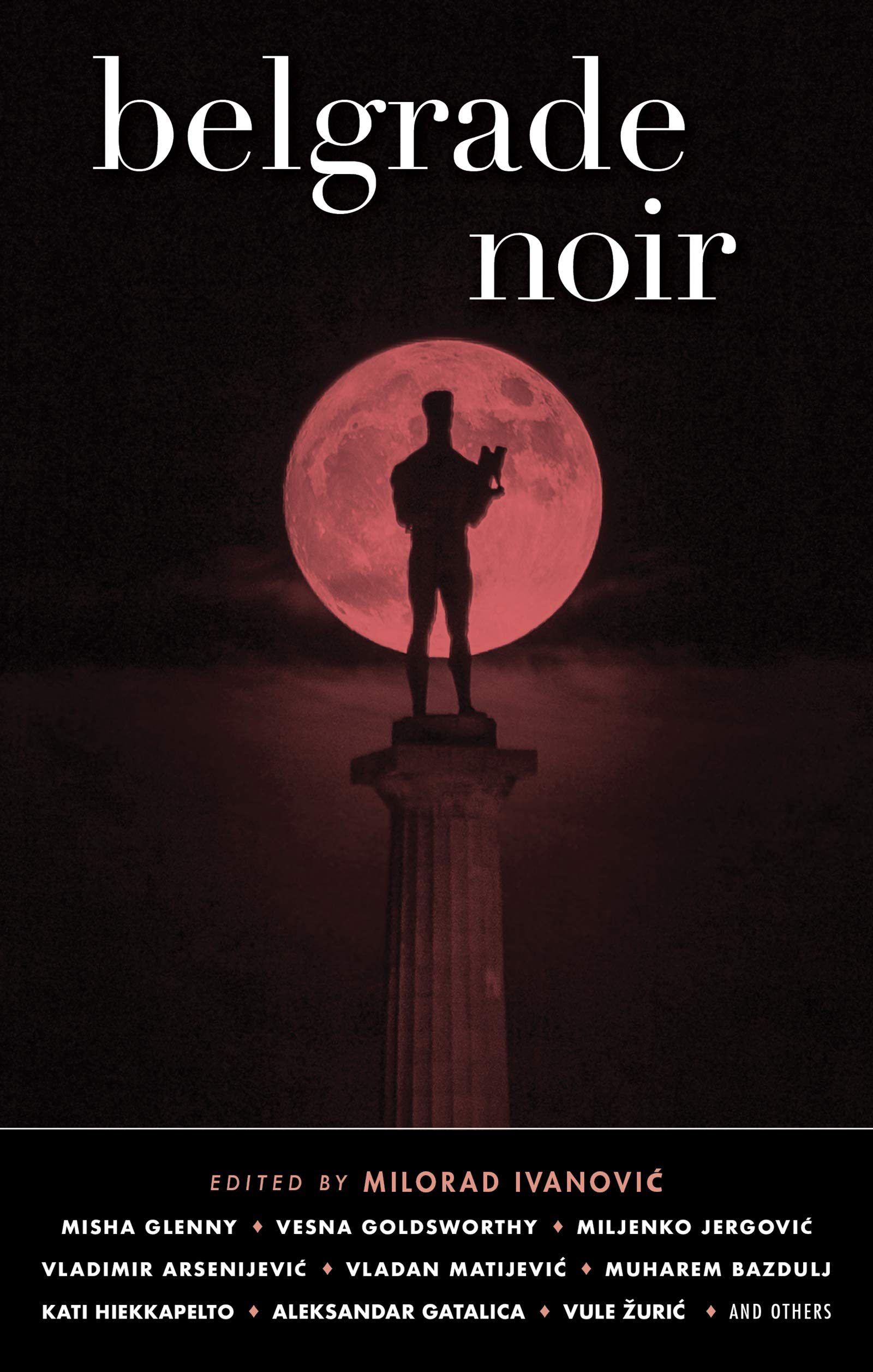
Ranko and Kozma are neighbors and old friends. Kozma is the troublemaker. As a cop he did little but paperwork and now, in retirement, he is desperate to actually solve a crime for once. His attempts to find villainy where there may be none has gotten him into hot water with the police and the neighborhood.
But now, just maybe, he could be onto something. There's a man on the fourth floor who keeps bringing young women to his apartment. Nothing wrong with that, except they never come out...
Perry, Thomas, "Katerina Goes to Studio City," in The Strand Magazine, LXII, 2020.
Katerina is a teenager leading a miserable life in Moscow with no hint of a better future. Then her best friend escapes to the United States and Katerina, a very resourceful girl, arranges to go as well.
Naive as she is, she does not realize why a Russian oligarch ("He's like a king,") would be willing to help a beautiful young girl come to California. He sends a different man to her apartment every night and Katerina develops a wide assortment of tricks and games to keep them out of her bed. Does this begin to sound familiar? Are you perhaps humming a few bars of Scheherazade?
Read, Cornelia, "The Cask of Los Alamos," in Santa Fe Noir, edited by Ariel Gore, Akashic Press, 2020.
The thousand injuries of Richard Feynman I had borne as best I could. But when he ventured upon insult, I vowed revenge.
It is World War II. The Manhattan Project is toiling away in New Mexico and Thurston has taken a deep grudge against his fellow physicist. Read draws details from Feynman's real life into the fictional plot which is, of course, modeled on Poe's.
Rozan, S.J., "Chin Yong-Yun Sets The Date," in Deadly Anniversaries, edited by Marcia Muller and Bill Pronzini, Hanover Square Press, 2020.
This is the third appearance here by my friend S.J. Rozan and the second by the formidable Chin Yong-Yun, mother of Rozan's private eye Lydia Chin, and quite a character herself. She notices that Chu Cai, the son of a friend, seems unhappy, even though he has just gotten engaged. She cleverly arranges for him to come to her apartment to tell his problem to Lydia -- who, alas, is not there. Perhaps, Mrs. Chin says, she can do the groundwork, although she is not quite sure what ground has to do with the detection business...
Simon, Clea, "No Body," in Shattering Glass, edited by Heather Graham, Nasty Women Press, 2020.
Before she even spoke she knew her body was gone. It had been a struggle, losing it.
At first I thought the protagonist was a ghost, but no, she is a person in trauma experiencing, as some people do in such a situation, the sensation of being outside her own body. In fact, she was drugged and is being raped. This story is so much about style that I was not expecting the very clever ending.
Wishnia, Kenneth. "Bride of Torches," in Alfred Hitchcock Mystery magazine, March/April 2020.
My friend Ken Wishnia has retold a story from the Book of Judges. He does a lovely job of showing the Hebrews at war with an enemy who has superior technology. Ya'el commits the crime (?) which is the centerpiece of our story. The main thing Wishnia adds to the Bible tale is giving her a motive. In fact, he offers two, one of which feels very modern without being anachronistic.