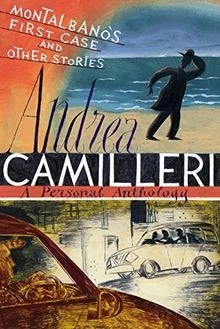
I have been reading Montalbano's First Case And Other Stories, (2016) Andrea Camilleri's collection of tales about a Sicilian police officer. I've enjoyed it a lot but there is one that I want to discuss. I suppose I should issue a spoiler alert but since the surprise is mentioned on the back cover I won't feel too guilty.
One of the stories stands out from the others because it is much bleaker in subject than the rest. It shocked me and I was not the only one because Salvo Montalbano stops everything and makes a phone call to a "seventyish man striking the keys of a typewriter in the Roman night."
The author informs his character "I'm just trying to bring myself up to date, Salvo. A little blood on the page never hurt anyone."
That's called breaking the fourth wall: characters acknowledging that they are indeed characters.

Since then I have been trying to think of other examples in mystery fiction. I think the most famous occasion comes in John Dickson Carr's novel The Hollow Man (1935) when his detective Dr. Gideon Fell provides "The Locked Room Lecture." While listing every possible variation on the impossible crime the good doctor explains "we are in a detective story and we don't fool the reader by pretending we're not. Let's not invent elaborate excuses to drag in a discussion of detective stories. Let's candidly glory in the noblest pursuits possible to a character in a book."
I did a web search looking for more examples and most of what I found were something different than I was thinking, namely examples of authors writing themselves into their books as characters. Examples include S.S, Van Dine, Kinky Friedman, and Anthony Horowitz.
But getting back to the self-aware characters, Edmund Crispin's detective is Gervase Fen. In The Moving Toyshop (1946) when he seems to be announcing random phrases he explains that he "was making up titles for Crispin."

The newsletter of the Private Eye Writers of America, Reflections in a Private Eye, often features authors interviewing their own characters.
And I have had a few out-of-story chats with my character Shanks.
But how do you feel about characters, especially series characters, admitting they know what's going on? Does it damage the suspension of disbelief?


Robert, this is timely! First, you are talking about my favourite series, Montalbano. I still weep knowing that there won't be any more Andrea Camilleri books. Second, I recently interviewed Australian author Benjamin Stevenson at Centennial Theatre - have you read his book, Everyone in my Family has Killed Someone? He breaks the 4th wall constantly, and talks directly to the reader. It's his 'thing'. Some like it, some don't. An example would be, from one of his books, "By now, you're thinking John Doe is the killer. But you're wrong." Then he goes on to explain why you're wrong. I personally wasn't keen on being told what to think, but I do recommend looking at the unique style he is using.
ReplyDeleteNot familiar with Stevenson. Thanks for the recommendation.
DeleteMel, I'll look at Benjamin Stevenson - but I'm not expecting to like it. Sherlock Holmes can tell Watson, "By now, you're thinking Lord Rotterdale is the killer. But you're wrong." and I don't turn a hair.
ReplyDeletePS - I like the Montalbano books, but I didn't like the series.
I think there's a difference between "By now you're thinking X is the killer" and "We're in a detective story." In the first case, I don't suspend disbelief. I vaguely imagine that the narrator is telling his story from a prison cell or from a tropical island in old age to an unidentified listener or listeners and move on. I'm not that invested in solving the puzzle anyway. In the second, the author is saying, "Yoohoo, this guy you care about isn't real. I made him up to put in my book." To me, that's criminal.
ReplyDeleteI agree that they aren't the same. You know, in Rex Stout's novels Archie Goodwin sometimes addresses the audience directly. In Death of a Dude he explains that he is censoring one character's speech so as not to offend a certain old woman who buys copies of "these reports" for her grandchildren. Fans notice that if he was literally publishing reports of true cases he and Wolfe would both be in prison for assorted felonies, so where does that leave us? There was also a book review Stout published (I think about the Roseberg trial) which took the form of a conversation between Stout (Archie's literary agent) and Wolfe as reported by Archie. Neither of these is quite what i am talking about in my essay: that is, Archie never says "Stout just made me up."
DeleteIf I'm not mistaken the New York Trilogy of novels by Paul Auster, which feature a private eye, employ the technique of treating Auster as both the author *and* a fictional character. It has been years since I read the books.
ReplyDeleteIf done well, I think it could be amusing. Catherine Mack talks directly to the reader via footnotes, but I think her characters don't know they're characters. (Sorry I don't remember. I gave up on this series after book two.)
ReplyDeleteThanks.
DeleteThe interface of the Official Daman App is clean and user-friendly.
ReplyDeleteFans of Camilleri's work might enjoy this ten-minute piece about his work, especially about the "Montalbano Effect." https://www.bbc.com/audio/play/w3ct98dp
ReplyDelete