Showing posts sorted by date for query Christmas Carol. Sort by relevance Show all posts

25 December 2025

Christmas Movies for the Ages
— at Our House At Least


(This first appeared 10 years ago, but I think it's always good to look at (my) classics again!)


I love a good Christmas movie or story, but I take my entertainment with a little salt, thanks. Or at least a shot glass. And a little murder just adds to the fun.  Here's a list of my favorite Christmas movies, the ones my husband and I watch every year, and yes, we know the lines by heart:

We're No Angels, 1955


I first saw this when I was ten years old, back in the 60's, watching it on a black and white TV set, all by myself. I laughed until I cried, and I remembered lines from it for years afterwards. It warped me for life.

"I read someplace that when a lady faints, you should loosen her clothing." - Albert (Aldo Ray)


Three convicts escape from the prison on Devil's Island on Christmas Eve. There's Humphrey Bogart as Joseph, a maniac and master forger, Peter Ustinov as Jules, an expert safe-cracker, in prison only because of a "slight difference of opinion with my wife", and Aldo Ray as Albert, "a swine" of a heart breaker who only fell afoul of the law after asking his uncle for money (the illegal part was when said uncle said "no" and Albert beat him to death with a poker – 29 times, mam'selle). Oh, and their fellow-traveler, Adolphe - or is it Adolf?
"We came here to rob them and that's what we're gonna do – beat their heads in, gouge their eyes out, slash their throats. Soon as we wash the dishes." – Joseph
Anyway, these 3 convicts need money, clothing, passports - and they find it all at Ducotel's General Store, the famous Ducotel's, "the one who gives credit". Along with Felix (Leo G. Carroll), the most inept, innocent, and financially challenged manager in history, his beautiful wife, Amelie (played by Joan Bennett), and their daughter Isobel (Gloria Talbott, in full super virgin mode).

You can see where this is going: they get hired, they get interested, they get all warm fuzzy, they change their ways, everyone is happy. Right? Well, not quite. Because the big fat plum in this pudding is Basil Rathbone as Andre Trochard, who owns Ducotel's, and has come to Devil's Island - with his sycophantic nephew Paul - to do the books on Christmas Day. I love a good villain, and Basil Rathbone is as snooty, snotty, sneering, vindictive, scheming, insulting, arrogant, belittling, and generally nasty as they come. ("Your opinion of me has no cash value." – Andre Trochard.) He makes Ebenezer Scrooge look like a warm pussy cat.
Andre Trochard - "Twenty years in solitary – how's that for a Christmas present?"
Jules – "That's a lovely Christmas present. But how are you going to wrap it up?"

There's no Ghosts of Christmas Past, Present, or Future in this one; no "God bless us, every one"; no Tiny Tim; but there's theft and forgery, fraud and deceit, murder and mayhem, all done with sharp, hilarious dialog. Go. Rent it now. Pour a Chateau Yquem (you'll understand later) or its equivalent, pull out a turkey leg, and enjoy! Merry Christmas! Compliments of the Season!

The Man Who Came to Dinner (1942), Monty Wooley, Bette Davis, Jimmy Durante, and more. The worst house guest in the world is also the most erudite, witty, arrogant, and popular man on the planet. Sheridan Whiteside was Kaufman and Hart's masterpiece (especially as played by Monty Wooley), based on (of course) the real Algonquin Club's founder, leader, gatekeeper and spoiled child, Alexander Woollcott.
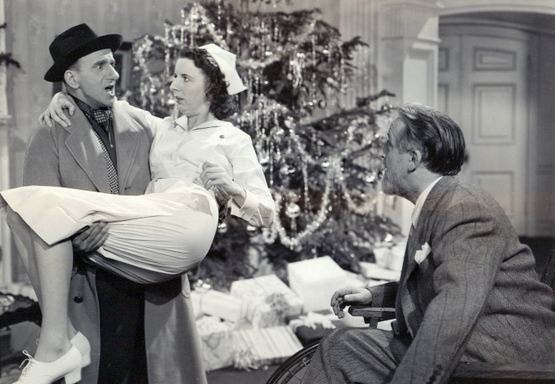

Jimmy Durante, Mary Wickes (in her breakthrough screen role), and Monty Wooley

The play - and the movie - are chock full of characters who were based, almost libellously, on real people. Banjo = Harpo Marx. Beverly Carlton = Noel Coward. Lorraine Sheldon = Gertrude Lawrence, of whom Beverly Carlton says, in my favorite movie line of all time,

"They do say she set fire to her mother, but I don't believe it."

And Mary Wickes as Nurse Preen, who has to nurse the impossible Sheridan Whiteside:
"I am not only walking out on this case, Mr. Whiteside, I am leaving the nursing profession. I became a nurse because all my life, ever since I was a little girl, I was filled with the idea of serving a suffering humanity. After one month with you , Mr. Whiteside, I am going to work in a munitions factory. From now on , anything I can do to help exterminate the human race will fill me with the greatest of pleasure. If Florence Nightingale had ever nursed YOU, Mr. Whiteside, she would have married Jack the Ripper instead of founding the Red Cross!"

Somebody had to finally say it.


A/k/a Reborn (1981). Directed by Bigas Luna, "starring" Dennis Hopper as the snake-oil selling Reverend Tom Hartley, Michael Moriarty as Mark (a thickly-veiled Joseph), and (I kid you not, spoiler alert!) a helicopter as the Holy Spirit. While it has horrible production values, and was obviously made (in Italy, Spain, and Houston, TX) on rather less than a shoestring (I think all the money was spent on the helicopter), this may be one of the most interesting versions of the Nativity that's ever been done.  

"You're going to have a baby? I can't have a baby! I can't even take care of myself, much less a baby!" Mark.


The Thin Man (1934). William Powell and Myrna Loy. Machine-gun dialog, much of it hilarious. A middle-aged peroxide blonde and an incredibly young Maureen O'Sullivan. More drinking than anyone would dare put into a movie today, at least not without a quick trip to rehab for somebody, especially Nick Charles. And mostly true to Dashiell Hammett's plot.
"Is he working on the case?" "Yes, a case of scotch!"

Okay, a quick break for myself and the kids and the grandkids: A Muppet Christmas Carol (with Michael Caine), A Charlie Brown Christmas, How the Grinch Stole Christmas (narrated by Boris Karloff) A Christmas Story. Love, love, love them ALL.
"You'll shoot your eye out!"

Okay, back to more adult fare:

Love Actually (2003), mostly because I start laughing as soon as Bill Nighy starts cursing. (What can I say? I'm that kind of girl.)

"Hiya kids. Here is an important message from your Uncle Bill. Don't buy drugs. Become a pop star, and they give you them for free!" Truer words are rarely spoken in a Christmas movie…

© IMDb

Totally NON-secret NON-guilty pleasure: Blackadder's Christmas Carol (1988). Rowan Atkinson (Blackadder), Tony Robinson (Baldrick), Stephen Fry, Hugh Laurie, Miranda Richardson, Jim Broadbent and Miram Margolyes as Prince Albert and Queen Victoria, and Robbie Coltrane as the Spirit of Christmas…
© IMDb
"Mrs. Scratchit, Tiny Tom is fifteen stone and built like a brick privy. If he eats any more heartily, he will turn into a pie shop." God bless us, everyone.

Scrooge (A Christmas Carol) (1951). Alistair Sim. This is my favorite version, mostly because it feels like Dickens to me, because I love Fezziwig's sideburns, because of the hysterical charwoman, but mostly because Mr. Sim's Scrooge really ENJOYS being a hard-hearted miser from hell. Which makes his delight, after coming back from his Christmas travels among the spirits, more believable. Or at least I always find myself grinning from ear to ear...

"I don't deserve to be this happy. But I simply can't help it!"
Hey, there's 12 Days of Christmas, and this is only the first one – there's PLENTY of time to watch them all!

Merry Christmas, everyone!

23 December 2024

Writing Advice from 1908, Part 2


Last Wednesday I offered you some words of wisdom from Writing the Short-Story by J. Berg Esenwein.  Published in 1908, it was one of the first creative writing manuals. Here are some more of his tips, useful or otherwise.

* "As a character the detective cannot be much more than a dummy.  That is, his individuality cannot be brought out in a single short-story, except by a few bold strokes of delineation; but when he figures in a series of stories, as does Sherlock Holmes, the reader at length comes to know him quite well."

* "The novel is expansive, the short-story intensive."

* Sir Walter Scott said that "in nature herself no two scenes were exactly alike, and that whoever copied truly what was before his eyes, would possess the same variety in his descriptions, and exhibit apparently an imagination as boundless as the range of nature in the scenes he recorded; whereas -- whoever trusted to imagination, would soon find his own mind circumscribed, and contracted to a few favorite images."

* "Wise is that writer who patiently awaits the hour of full-coming before attempting to write."

* Esenwein says there are three main streams of fiction. He does not do a great job of explaining them or giving adequate examples but here you go: Realism (which "paints men as they are" and in which he suggests the author should not express a point of view), Romanticism (such as Kipling's "The Man Who Would Be King,"), and Idealism (which expresses the world as the author wishes it was, such as "A Christmas Carol.")

*"Must I typewrite my story? You need not, but you ought to.." 

* There are  many ways to tell a story. "Another variation is that in which a minor character tells of the deeds of his enemy, who is nevertheless the central figure in the story." 

* "A hackneyed device is to tell the story in the first person after having introduced the speaker by a second person, who really thus reports the story 'as it is told to me.' You may be sure of two things in this connection: a story begun in this style must possess unusual merit to offset the triteness of its introduction; and, it is a hard task to convince the reader that you could not have plunged into the story in the first person direct, relying upon the opening sentences to set the scene.  Still, if you can do it exquisitely, go ahead.  No rule in art is so good but that it may well be broken by a master stroke." I point out that Henry James' "The Turn of the Screw" was written a decade earlier.

* "All things must be looked at with an eye to their possible literary use."

* "Many an unwary author has slipped on the simple matter of forgetting that it takes time to travel here, there, and back again; that people normally get older with the lapse of years; and that events must be consistent with the procession of the seasons."

* "Wit deals with externals, humor seeks out the heart; wit consorts with contempt, scorn and hate; humor abides with friendship, benevolence and love; wit holds folly up to darting ridicule, humor looks with gentle sympathy upon weakness."

* "In the mystery story the author should begin early to set his wires so that with a single pull the whole house of bafflement may come tumbling down before our eyes, at a glance disclosing the secret. In the short-story the mystery must be less complex than the novel, hence the uncovering of the secret will require less time. But if I knew how to hold a breathless mystery up to the last moment and then disclose it all in a trice, I could not -- and perhaps would not if I could -- impart it to others.  This is the very incommunicable heart of the plotter's craft."

Some Previous Owners

* "The use of quotation marks does not convert a passage into dialogue." - Arlo Bates

* Could a story have two reasonable but different endings?  Robert  Louis Stevenson: "The whole tale is implied; I never use an effect when I can help ir, unless it prepare the effects that are to follow; that's what a story consists in. To make another end; that is to make the beginning all wrong... The body and end of a short-story is bone of the bone and blood of the bone of the beginning."

* Character's "speech must show not so much what they say as what they are." 

Near the end Esenwein lists "One hundred representative stories."  I had read eight of them (e.g. Bret Harte "The Outcasts of Poker Flat"), heard of 39 other authors, (e.g. Rudyard Kipling "The Man Who Was") and was completely unfamiliar with the rest. Such is fame, or my ignorance.

Thanks again to Mary Lou Condike for giving me much to think about.

20 December 2024

Alimentary, My Dear Watson!


I blame Dickens for my household’s attempt to cook a Christmas goose some years ago. My wife and I had always been charmed by the Cratchit family’s dinner of goose and Christmas pudding depicted in the 1999 TV version of A Christmas Carol starring Patrick Stewart. We followed Julia Child’s instructions to the letter, but did not have the “tight-fitting lid” for our roasting pan that is so critical for properly rendering the bird prior to roasting. For weeks after, I felt as if everything I touched in the house—my eyeglasses, my computer keyboard—was coated with a fine film of goose fat. It’s not a fowl I desire to ever eat again. The Cratchit bird fed eight, and I get it. One slice of that rich meat is all anyone needs to survive winter.

I’ve since come to respect geese. The living specimens are fierce protectors of their turf who figure prominently in ancient art. In Rome people told us that if you didn’t have a dog, you could rely on a goose to keep your yard safe from intruders. No one wants to be bitten in the butt by an angry honker.

Alas, when the fowl shows up in literature, it’s usually on someone’s plate. The “unimpeachable” goose who is the star of Sir Arthur Conan Doyle’s “The Adventure of the Blue Carbuncle” starts out alive, then ends up dead and the centerpiece of a mystery. Interestingly, as we shall see, that goose kept coughing up mysteries well into the 20th century.

The 8,000-word story is the only Christmas tale in the Sherlock Holmes Canon. It first appeared in the January 1892 edition of The Strand magazine. (You’ll find it in the first book of collected stories, The Adventures.) If you know your Holmes, it’s the story that starts with the great man deducing the heck out of a bowler hat that has lost its owner, and later confronting a nervous amateur jewel thief who has stolen a precious gem—a blue carbuncle—from the belongings of a countess lodged at a London hotel. To keep the jewel safe until he can consult with his fence, the thief thrusts the gem down the throat of a living goose in his sister’s backyard. The goose gets switched on him, is sent to market, and zaniness ensues.

I reread the story recently to see what sort of Christmasy details Conan Doyle folded into his prose. They’re sparse; mostly Watson describing cold weather, warm fires, a cast of chilly characters, and ice crystals forming in windows. There are no Christmas trees or presents. Since the story is nearly 133 years old, I don’t think I’m spoiling anyone’s enjoyment by revealing that in the end, Holmes lets the repentant thief off scot-free. Because, he argues, “it’s the season of forgiveness.”

I enjoyed the story immensely this time around, and then foolishly read all the notes about it in my copy of Leslie S. Klinger’s The Annotated Sherlock Holmes. That’s how I learned that serious Sherlockians have long quibbled with fine points of the tale.

Some examples should suffice. A carbuncle is a garnet, which are typically red. Though they have been found in other colors, there’s no such thing as a blue carbuncle. No garnets have ever been found in the Chinese river Holmes mentions as the origin of this stone. The detective botches a discussion of the jewel’s weight, presumed value, and chemical composition. The law enforcement official in the story conducts a hardness test on the stone that does not prove what he thinks it does. Moreover, of the eleven or so deductions Holmes makes about the bowler, Sherlockians dismiss at least four as highly illogical.

But hey, if our author couldn’t get the number of Watson’s wives straight, or the location of the shrapnel the good doctor brought back from Afghanistan, why do we expect him to get such details right? Conan Doyle wrote to make glad the heart of geekhood. He was a little like the Hungarian-American director Michael Curtiz, who when someone pointed out all the implausibilities in the script for Casablanca, replied, “Don’t worry. I make it go so fast nobody notices.”


Sometime after WWII, however, a clever female reader proved just how much the largely male membership of Holmes societies knew about geese. Throughout the story, we are told repeatedly that the stolen gem was found in the goose’s crop. That word is mentioned five times in the story. Since many birds do not have teeth, they pre-digest their food by funneling items into a separate anatomical pouch, which is sort of a pre-stomach.

I remembered seeing such a thing as a child, watching my mother butcher a backyard chicken. The bird’s crop was filled with tiny pebbles, which chickens instinctively swallow in their pecking. That grit is later used by the gizzard, the muscular end of the stomach, to grind bugs and vegetation so they can more easily be digested.

In a sidebar in Klinger’s Annotated Holmes, our editor tells us that the “Blue Carbuncle” was referenced during Christmas season 1946 by Chicago Tribune columnist Charles Collins, who was a friend of Vincent Starrett’s and a founding member of the Chicago chapter of the Baker Street Irregulars. A longtime journalist, Collins wrote a popular column called A Line o’ Type or Two for the newspaper. Some days later, astute reader Mildred Sammons fired off a note, taking issue with his six-paragraph summary. Her brief note appeared in the newspaper the day after Christmas that year. 

Regarding the Sherlock Holmes Christmas story, The Adventure of the Blue Carbuncle, discussed in the Line o Type column on Dec. 17: It contains a statement that the missing jewel was found in the crop of a goose. Let me remind you that a goose has no crop.

You could hear a feather drop in the great and glorious Kingdom of Holmesiana. By then the tale was 54 years old; in all that time none of the geniuses had spotted this error.


After consulting various waterfowl experts and butchers, the U.S. experts conceded: “[T]he lady is correct. Holmes made an alimentary error, which the Baker Street Irregulars should have noted long ago.” There was talk in the pages of The Baker Street Journal of granting Mildred Sammons some sort of award “in gratitude for her discovery.”

I don’t know if she ever collected, because of course it didn’t end there. Scholars on both sides of the pond kept interrogating poultry experts, further beating a dead goose. The problem went all the way to the UK’s office of the Minister of Agriculture and Fish. The Ministry’s Chief Poultry Adviser—who of course turned out to be a Holmes geek—weighed in, saying that the American experts were correct. “However,” he added, “as a Sherlock Holmes fan I am glad to say that this fact does not necessarily invalidate the theory in the story of the ‘The Blue Carbuncle.’”

The reasoning: Yes, chickens and turkeys have a separate organ or pouch called a crop. Waterfowl such as geese and ducks have no such pouch, but their gullet is just long and extendable enough to accommodate food—or the occasional precious gem—that will be stored and later digested. If the goose’s stomach is full, a swallowed item might well remain lodged in the gullet, awaiting its turn. (I beg your indulgence here. I am not an expert on poultry anatomy. I am relying on articles such as this, on the glories of the digestive tracts of waterfowl. Feel free to cry fowl if I've screwed anything up.)

Naturally, this engendered a flurry of further academic papers, the most hilarious of which was written by a Sherlockian who posited that the hullabaloo was all beside the point. Maybe, just maybe, quoth he, “the long debate is centred on a printer’s error, which substituted an o for Watson’s a.”

And on that note, I’ll wish you all the best of the season, however you celebrate and whatever graces your table.

* * * 

Please use the comments to share some of your favorite holiday stories. I could use a few suggestions.

I recommend Connie Willis’s 544-page A Lot Like Christmas, if you can stomach that much Christmas, much of it novella-length SFF. I also recommend Kristine Kathryn Rusch’s Holiday Spectacular, which she describes as a virtual advent calendar that delivers one new story—a romance, mystery or fantasy by various authors—to your inbox every day from Thanksgiving through New Year’s Day. All holidays are represented, not just Christmas.

See you all in the New Year!

Joe


09 December 2024

Reading and the Holidays


This is an updated version of a post I first wrote in 2008.

Holiday shopping season is upon us, and not only do books make wonderful presents (to give and to receive), but books also played a part in shaping my perceptions and expectations of the holidays. I suspect that this is true for many people.

One of the great opening lines in literature is Jo's lament in Louisa May Alcott’s Little Women: “Christmas won’t be Christmas without any presents.” Yes, all the way back in 1870, there was no surer way to disappoint a child than not to provide Christmas presents. Thanks to Alcott’s high moral Transcendentalist principles, what the March girls actually do is quit complaining, decide to put their annual one-dollar spending money into presents for their mother instead of treats for themselves, and end up giving away their festive holiday breakfast to an impoverished immigrant family with too many children. Generations of American girls have internalized the lessons in that story.

I can’t remember the name of the children’s book in which the family had a tradition of reading Dickens’s A Christmas Carol aloud on Christmas Eve, but the idea of such a tradition has stuck with me all these years. I also remember that the youngest boy was in the choir, and there was great tension about whether he would be able to hit the high note in his solo, “Glory to God in the highest,” presumably from Handel’s Messiah. (He did.) I shouldn’t have been paying attention to Christmas at all as a kid, but my Jewish parents were so afraid we’d feel deprived if we couldn’t participate in the general fuss that we decorated what we facetiously called a “Chanukah bush” and got stockings stuffed with presents on Christmas morning. Today, there’s an abundance of books about Jewish families celebrating Chanukah, including entries featuring Curious George, the Very Hungry Caterpillar, Grover, Clifford, and Oy, Santa! But I don’t remember any back then.

In my ecumenical present-day family, we celebrate both holidays. Rather than reading aloud, for many years we watched movies made from the great books already mentioned: Alastair Sim as Scrooge in A Christmas Carol and the Gillian Armstrong version of Little Women, which my husband and I both liked in spite of the the terrible miscasting of Winona Ryder as Jo. At my forty-fifth college reunion, I learned that a friend and her family read Dylan Thomas’s A Child’s Christmas in Wales aloud every year. So I know that the tradition of holiday reading survived into the new millennium.

Even today, no gift list in our family is complete unless it includes at least one book. In 2008, I said I wasn't happy unless there was at least one fat hardcover by a favorite mystery author that I wouldn’t have bought for myself under the tree, so I can curl up on the couch with it at some time during the long, lazy day. Now, I'll happily take an Amazon gift certificate so I can gobble up a whole series and binge on it on my Kindle. In 2008, books were the present of choice for my stepdaughter and her husband, who live in London, because we could order just what they wanted from their amazon.co.uk wish lists and have them shipped free. These days, we send money, and some of it still goes for books.

One of the great shopping pleasures these days is buying books for my granddaughters. Talk about books I’d never order for myself! In the 21st century, there are children’s books about everything. On a visit in 2008, the almost-two-year-old had me read her one entitled It’s Potty Time, with separate illustrated editions for boys and girls, and it’s only one of dozens on the subject. Last year, she got books about sports marketing and business—her dream career is managing an NFL superstar—and her older sister, who's at Cornell, got books about hikes and excursions around Ithaca and the Finger Lakes region.

What books are on your holiday gift list? What books, if any, shaped your image of how holidays should be?

21 June 2024

Mr. Swartwood’s Marvelous Box of BOGO Swag


My wife runs a monthly authors-in-conversation series at a local watering hole. She started it just before Covid hit, went virtual during the pandemic, and returned to the live event format when that sad business was over and done with. Now she’s got a steady stream of regulars who show up each month to hear her chat about the writing process with authors who probably would not have considered visiting our town if she had not sought them out (and we did not live in a place that calls itself Beer City, USA).

One of the recent authors was my longtime pal Robert Swartwood, a successful hybrid author who had recently branched into the traditional pub world with the launch of an unusual thriller, The Killing Room (Blackstone, 2023).


Last October Mr. S. trekked to North Carolina from his home in Pennsylvania for the weekend. When we arrived at the venue, he popped the trunk of his vehicle and pulled out some boxes, which contained stacks of large-format bookmarks, chunky attractive magnets, and tons of books.

Magnets, as they appear on my file cabinet.

Yes, he was well aware that our local indie bookstore was handling sales. But Robert had another idea in mind. The books he had flagrantly transported across five state lines represented a chance to do some marketing—and house cleaning—at the same time.

Most authors have a ridiculous number of their own books on their shelves. If you’re traditionally published, your contract stipulates that your publisher will send X copies of your hardcover, and another X of your paperback when that format drops. You may have bought additional copies direct from the publisher using your author discount, and you may have gotten a freebie box from your editor or agent when they tidied their office. If you’re self-pubbed, you certainly have a stash too.

At the end of his talk with Denise, Swartwood announced to the crowd that anyone who bought the new traditionally published book from our local bookstore’s on-site table could take their pick any of his previous titles for free. (While supplies lasted, of course.)

He had no idea how this Buy-One-Get-One-Free gambit would play out, but he was curious to try it. As a Big 5 publishing exec once told the New York Times, when asked to comment on the proliferation of free ebooks on the ’Zon, “Free is not a business model.” True, but sometimes it makes strategic sense.

Yes, paperbacks of Swartwood’s indie print-on-demand titles represented money out of his pocket, but those copies were a sunk cost. Copies of books he had written under a pseudonym for an Amazon imprint had cost him nothing, as they were provided under the terms of his contract. Regardless of the source, he was tired of all these books taking up space at home. And he really wanted to show his new publishers that he could move sales of the new title under the Swartwood name. So why not offer free books as giveaways?

Well, it worked! Many people that day bought more than one copy of The Killing Room, enticed by the freebies. I saw people leaving with a mix of four to six books, which confirmed my long-held theory that at any given time people at book events would probably buy multiple copies to gift to friends or family, but are holding back due to cost. (They certainly do during the Christmas season.) But in the other 10-11 months, if you gave them an excuse to spend, they go nuts.

The freebie hit of the afternoon was the short-but-sweet Hint Fiction: An Anthology of Stories in 25 Words or Fewer (Norton, 2010), which Swartwood conceived and edited. The 188-page volume contains 125 short stories—no, I did not type that figure incorrectly—by modern writers such as Ha Jin, Peter Straub, James Frey, and Joyce Carol Oates that take their inspiration from the tragic Hemingway short “story” about baby shoes.

At a book event this past weekend, I too pulled a Swartwood. Ages ago, when I first taught myself how to format POD print editions of my indie fiction titles, I ordered a stack of paperbacks I had designed of four of my short stories. Back then, I mostly wanted to see what they looked like, and to judge if doing short stories in print was feasible. I had given most of them away, but I found a few stragglers on my office shelf a while ago.


Turns out, people last Saturday loved the freebies. When I asked which one of the four titles they would like, many people told me to choose for them. One guy humorously quipped, “After all, you must know my tastes pretty well based on meeting me five minutes ago!” Everyone expected me to sign those copies as well. Might well be the first time I ever signed a 23-page “book”!

It’s fun to give away free stuff. Swartwood’s lovely magnets were a hit too. Author Ben Wolf says in his book, Power Author: A Quick Guide to Mastering Live Events, that magnets are a pricy but smart giveaway at live events. Unlike bookmarks and other easily discarded paper items, magnets end up stuck to someone’s fridge or office file cabinet. They’re the gift that keeps giving—to authors. Month after month, year after year, they’re advertising your name and book—if done right.

Yes, I’m aware that all of this stuff costs. But for most of us, they are a reasonable tax deduction. The question then becomes how little do you have to spend to make people deliriously happy, and have them walk away thinking that they have gotten a bit of a steal? I was delighted to see that free short stories in print were greeted with the same enthusiasm as full-size novels. Depending on page count, the wholesale price of a POD novel costs me about $4-$7. A 60-page paperback “Bloody Signorina”—an AHMM short that was a Derringer finalist—costs me $2.30. That’s not free, but it’s a nice giveaway for friends, buyers, editors and other high-value contacts you encounter at conferences.

A 60-page paperback still has enough
 of a spine to stand up. Who knew?

In a certain sense, this little book of mine serves as a nice “business card.” In one volume, people get a sense of my crime writing style, a list of all my books, my website URL, my newsletter sign-up info, contact info, and sample chapters to another book. A nice package overall.

Some other stuff I bring to book events in my handy tote bag:


QR Sign-up: Passersby “shoot” the code, and are directed to the newsletter sign-up at your website. (It also alerts them to the fact that you have a website.) Buy a plastic “Stand-up Sign Holder” at your stationery store. (This one is the 5-x-7 inch model.) Design a 5x7-inch image on Canva with your details. Use a QR code generator that isn’t spammy; the free one by Kindlepreneur is perfect. Make sure that people can easily find the newsletter sign-up form on your web page. You don’t want them scrolling and getting lost. Optimize your website for mobile devices. If they are going to sign up, they will do so on their phones within a minute of seeing your sign, not on their desktops at home.


Clipboard & Sign-up Sheet: Besides the QR code sign-up, I still offer a hard copy sign-up sheet, because typing on phones is still too fiddly for many people. I design the sign-up sheet with book cover art, and ask for two details only: name and email address. It gives folks something to do while you sign their book. Bear in mind that hard-copy signups mean you must now transcribe everyone’s chicken-scratch accurately and upload the deets to your mailing list. Check details before they depart the table to make sure you can read their writing.

A "chunky" bookmark, with full-bleed cover image.
 
My wife's stash of bookmarks and postcards.


Swag: You already know that I am not a fan of bookmarks. I feel the same way about stickers, postcards, and the like. They’re often money thrown down the drain. That said, if you or your publisher have invested money in this stuff, by all means set it all out neatly on your table. Readers who are not ready to buy, or who prefer to buy ebooks or print books online, will grab ’em because they’re free and an easy way to remember your book or byline. Place swag on your table where it will not interfere with the business of signing books or your sign-up sheet. Set out a few pieces of swag at a time, and replenish them as you go. (This will reduce the chance of some whack job swiping your entire inventory.) Swartwood told me that he doesn’t love standard bookmarks because book covers have to be the size of a thumbnail to fit on them. Far too small, in his opinion, to make an impact. If you’re going to print your book cover, he says, go big. His bookmarks (and Denise’s postcards) offer large images of their book covers. As for the magnets, he ordered in such quantity from PureButtons that his price-per-piece was $1 each. Personally, I would keep nice swag like that hidden and offer them to buyers only.

Writing Tools: You will need a fistful of ballpoint pens for sign-up sheets, and Sharpies for signing books. Always bring more than you think you’ll need. They are sucked into black holes.

Mr. Swartwood takes the dais at ThrillerFest to accept his award.

Congrats! (The ebook hit online retailers
 before the print edition hit stores.)

Lest you think I have dropped the thread on Mr. Swartwood’s writing, fear not! At ThrillerFest 2024, he accepted the ITW Thriller Award for Best E-Book Original for The Killing Room. The second book in the series is up for pre-order, and wouldn’t you know it, if you order the new book, you can get one of his old titles for free, while supplies last. (Order via the indie bookstore in his area for a signed copy, or discover your online options in his recent post.) Everyone loves BOGO, baby!

Book 2


* * * 

See you in three weeks!

Joe


20 December 2023

A Christmas Carol Chronology


 I whipped this chart up a few years ago and have updated it every December.  Seems like this might be a good place for it.

One interesting thing I learned this year: "Up On the Housetop" (I learned it as "Up on the Rooftop"), which is apparently the oldest song about Santa Claus, was written by a minister, of all people.  Didn't he know that we aren't supposed to secularize Christmas?  The gentleman in question was Benjamin Hanby, who was also an abolitionist.  His second most famous song, "Darling Nelly Gray," is from the viewpoint of a enslaved man whose beloved has been sold away.  Some say it is the musical equivalent of Uncle Tom's Cabin in terms of converting people to abolitionism.

If you want a crime element consider that the music for the "Carol of the Bells" (one of my favorites) was composed by Mykola Leontovych, a Ukrainian, who was murdered by a Soviet spy.

And, while I didn't include it on my list, the murder that the song "Staggerlee" is based on  took place on December 25th, 1895, so I guess it's a Christmas carol?  If Die Hard is a Christmas movie, anyway...

Start pulling on the strings of folksongs and you find all kinds of interesting connections.


One more thing: What do these songs have in common?  Answer is in the comments.

Baby, It's Cold Outside

Deck the Halls

Frosty the Snowman

Jingle Bell Rock

Jingle Bells

Let it Snow

Sleigh Ride

Winter Wonderland


24 December 2022

Not Even a Mouse!
If Santa doesn't bring smiles, this might...


 Merry Night Before Christmas Everyone!
Several readers (thank you!) have asked about my previous life as a writer of comedy.  My humour is goodnatured rather than biting (I was called the Carol Burnett of Crime Writing not so long ago.)  I don't draw from those files often for Sleuthsayers, although maybe - in light of how serious our world has become - I should. 

To that end:  Thinking about The Night Before Christmas reminded me of mice, which reminded me of this monologue I used to do back in the day, which I have re-titled, 

Not Even a Mouse  (Merry Christmas, Everyone!)


I wanted to buy a new front door the other day.  This has become necessary because the old front door is no longer functioning as a door in the usual sense.  "Wind Tunnel" or "Interstate highway for neighbourhood field mice" might be a better description.

But as always, things have changed in the world of destruction and aggravation (aka construction and renovation.)  Apparently, you can't buy a door anymore. They don't make them, according to the sales clerk (excuse me..."Customer Service Associate.")  Apparently, you now buy an "Entry System."

"But I already have an entry system," I explained.  "The mice are entering all the time.  What I want is something to keep them out.  Like a door."

"Let me show you how this works," he offered.  He then demonstrated how to insert a key in the lock and turn the doorknob to activate the Entry System.  Not unlike my old door, in fact.  I pointed this out.

"But this is a great improvement," he argued.  "See?  It's Pre-hung."

'Pre-hung' - for construction illiterates - means you don't have to undo three hinges to slip the old door off and install the new door.  Instead, the new door already comes with a frame (and sometimes side windows) attached.  To install, you simply demolish the old door frame and rebuild the entire entranceway to fit the new pre-hung frame.  It requires three men and a boy, and at least two weeks of labour.  But you don't have to touch those pesky hinges, which makes this a big improvement.

Not surprisingly, Entry Systems cost a lot more than mere doors.  This, I pointed out, was not an improvement.

One more thing bothers me about all this fancy renaming business.  If they insist on calling doors 'Entry Systems,' just what will they end up calling toilets?  Exit Systems?

Melodie Campbell will be sitting by the tree waiting for Santa tonight.  The door will be open.

www.melodiecampbell.com

23 December 2022

Mysteries at the Heart of the Season


Speak comfort to me, Jacob Marley— Southern Comfort!

December vexes me. Like Charlie Brown in the old TV special, I am always trying to wring some vestige of meaning from a season that is needlessly overwrought and overburdened with cheap sentiment.

Without intending to do so, some years ago I became an obsessive student of Christmas. I spent five years of my life and 500,000 words trying to write the ultimate Yuletide novel. Was I successful? Eh. Let’s just say that in the process I learned a lot about the holiday. I learned that when the season turns dark and cold, we at least have great writing (not mine) to sustain us.

Some pieces I love: The Man Who Invented Christmas by Les Standiford is solid, narrative nonfiction about the writing and publication of A Christmas Carol by that canny self-published author, Charles Dickens. I like A Christmas Memory by Truman Capote. The old recording of A Child’s Christmas in Wales, read by Dylan Thomas himself, is a perfect way to embrace the close and holy darkness. If there is a church nearby that is mounting a production of Handel’s Messiah, I will always go to hear the Hallelujah Chorus one more time. But if you are short on time, you can do no worse than “The Gift of the Magi,” by O Henry. For that matter, as long as you’re going short, my fellow Sleuthsayer David Edgerley Gates wrote a post on Christmas Eve, 2014, that chokes me up every time I read it. Each year, late in December, I navigate to this very website and that particular post to re-read his critical graf:

“Taken at face value, unto us a child is born—no room at the inn, the shepherds tending their flocks by night, the journey of the Magi—it still works its magic. You don’t have to believe it’s the hand of God, necessarily. Probably doesn’t do any harm, either. The hopes and fears of all the years. We bring a lot of baggage to any story. Maybe we bring more to this one than most. It's an investment. We all believe in a child’s native innocence. The loss is our grief. If, for sake or argument, we don’t know the story’s end, but only how it begins, then the birth of Christ is the stirring of hope. We embrace the myth because it’s our own, each of us born, each of us begun. Destiny waits to be chosen.”

He’s marvelous, isn’t he?

Of course, if you’re me, maybe you end up scrolling to this web page maintained by the National Institutes of Health. There you will find numerous peer-reviewed academic papers that attempt to solve the mystery at the heart of Christmas: What ails Tiny Tim?

Tiny Tim is the third-most important child of December. The first, of course, is the child you know and love. Your children and grandchildren, say. The second is the child who gives Christmas its name. Then comes Tim, in his threadbare jacket, limping along on his crutch.

For 179 years this poor child has appeared in stage and screen productions of the Dickens novella and the entire world knows his pain. From Day 1, astute readers should have anticipated that eventually actual doctors would begin to wonder just what was wrong with the tyke. That is the essence of those NIH papers: Modern masters of the differential diagnosis are having a blast trying to figure out just what illness nearly killed poor Tim.

Here are the facts: The boy suffers from an unnamed ailment that renders him lame, forcing him to wear a brace and a crutch. In the fictive glimpse provided by the Ghost of Christmas-Yet-to-Come, Tim dies. After Scrooge’s redemption, however, we are told that Tiny Tim “did not die.” In other words, Tim’s affliction could in fact by cured by a judicious expenditure of Ebenezer’s silver.

Did Tim have rickets? Or was it tuberculosis, cerebral palsy, muscular dystrophy, or renal tubular acidosis (RTA)? All of these diseases can be ameliorated, apparently, with the right kind of medical attention. Every year, when the now-practically-annual article about Tim’s illness appears in my newsfeed, I read the story eagerly, wondering if someone has definitively cracked the case. No such luck. Indeed, it’s beginning to look a lot like we will never know the truth, and that Dickens took this one to his grave, along with the solution to Drood.

One of the best articles I’ve found on this medical mystery concludes with the observation that Charles Dickens, reformer that he was, truly understood that the horrors of poverty are fundamentally socioeconomic. Who knows? Maybe Tim was never completely cured, but if his family had just a little more coin, they alone could have ensured that Tim lived a comfortable and long life. (The writer Louis Bayard wrote an entire novel entitled Mr. Timothy on the premise that Tim survived into adulthood.)

And maybe that is just as well. Because we have plenty of other Christmas mysteries to solve. In recent years I have begun seeing articles in which doctors attempt to puzzle out the mystery that appears in Stave V of A Christmas Carol. After his encounter with the third spirit, Scrooge awakes in his bed, clinging to his bedpost, “laughing and crying in the same breath.” Later, Dickens tells us:

“Really, for a man who had been out of practice for many years, it was a splendid laugh, a most illustrious laugh. The father of a long, long line of brilliant laughs!”

Several actors over the years have tried to bring this laugh-cry to life. Patrick Stewart has probably done it best. Here. Watch:

Here’s what some medical detectives are wondering: does that laugh/cry indicate a troubling respiratory condition?

And that, dear friends, is when I realize that I’ve spent entirely too much time researching and fretting about Christmas and too little time enjoying it.

I wish you the best in this season—and beyond.


Besides the links I’ve shared in this post, you might enjoy this post from an illustrators’ blog about best illustrated versions the Dickens classic.

19 November 2021

From the Christmas Shelf


Every year I flip through the books on our Christmas shelf to see if I want to read or re-read any titles I’ve acquired and tucked there over the year.

But wait—

Yes, I know it’s not even Thanksgiving, and you’re probably appalled at the thought of me raising the specter of Christmas. But due to supply-chain issues, the words I wanted to use to talk about Christmas books are in short supply worldwide, so I’ve been advised to order those words early, get them shipped to the house, and them sprinkle abundantly in my prose throughout November instead.

Word of caution: The words very and just are quite plentiful in the market right now, so when in doubt, just use very. Just use it very very much. In short supply this season: decency, compassion, and common sense. On the other hand, unfortunately the U.S. is overstocked with stupidity, demagoguery, and mendacity, so feel free to use those words until we have eradicated the surplus.

But seriously, I thought it might be fun to share with you some books I have enjoyed in recent holiday seasons.


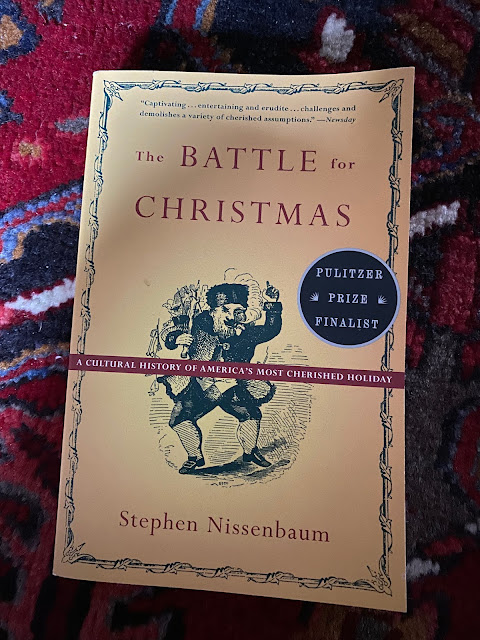
The Battle for Christmas: A Social and Cultural History of Our Most Cherished Holiday, by Stephen Nissenbaum (Knopf, 1996, 381 pages).

This is a brilliant nonfiction history of the American Christmas tradition, even if it is woefully mistitled. I like the book because it demonstrates convincingly that Christmas in America in the early 19th century was a distinctly low-key affair. Using the diaries of New England women, Nissenbaum reveals that the most these diarists did to celebrate the holiday was attend church, and lay in unusual pantry ingredients so they could bake a special cake for their families and visitors. Only later, mid-19th century, do we see Christmas celebrations necessitating the purchase of gifts, first for children, and then of course for every freaking person in one’s social circle. The creation and development of the American Santa Claus plays a major role in crassly forcing the holiday to swing toward commercialism. The book also blows your mind with a discussion of the selfish roots of philanthropy. You watch as wealthy New Yorkers donate money to feed the poor, then assemble in coliseum-like settings to watch as starving children stuff their faces. The last chapter, on the African-American Christmas traditions that grew out of slavery, is also fascinating.


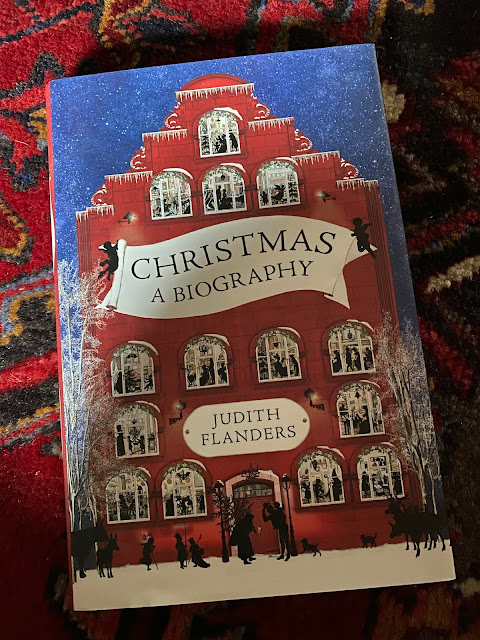
Christmas: A Biography, by Judith Flanders (Thomas Dunne/St. Martin’s, 2017, 256 pages).

Flanders is best known in the mystery community for her novels and a book she did on how the Victorian obsession with crime arguably engendered mystery and true crime literary traditions. She also did a wonderful book on Dickensian-era London. This book, about the origins of Christmas as an international holiday, is rich and head-spinning, chiefly because, as she says, the way people celebrate Christmas in other nations will always seem alien to outsiders. Americans think they have a cultural lock on Santa Claus, but they have no freaking clue about how the gift-bringer tradition plays out in other cultures. Yule lads in Iceland, la Befana in Italy, to name two easy examples. I like this book quite a bit, but I’ll never understand why her publisher did not include the footnotes so you can easily flip to a historic source in the back if you’re intrigued by something she says. (Full footnotes are available on Flanders’ website.) You will enjoy knowing that as long as Christmas has been around, people have been complaining about it. Whether it was too raucous, too commercial, too gluttonous, too heretical, the poor holiday never seemed to please anyone.

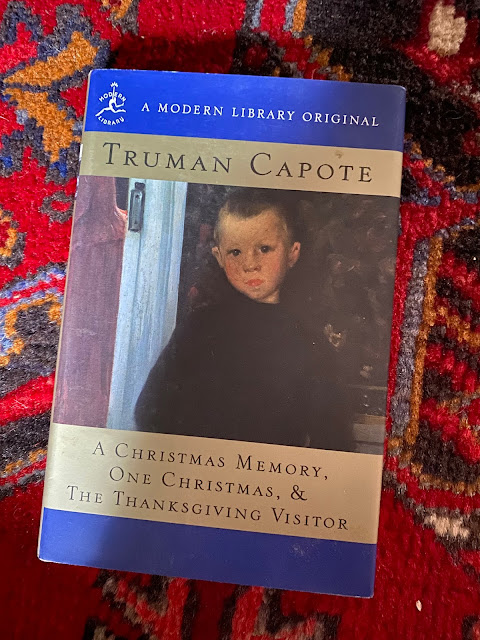
A Christmas Memory, One Christmas, & The Thanksgiving Visitor, by Truman Capote (Modern Library, 1996, 107 pages).

I grew up regarding Capote as a comical fixture on the talk shows my parents watched. In high school an English teacher had us read In Cold Blood (why do we do that to kids?) It was only in college that I came to his other writing, which I always found remarkable for its precision. This little classic of three stories is charming because it reminds you how little you truly need to make a holiday special. The best-known story, "A Christmas Memory," boils down to a loved one, a recipe, and some outdoor activity. Extra points if you can figure out Miss Sook’s fruitcake recipe on the basis of Capote’s prose alone. The actual recipe is never given in the book. The author apparently had no use for that conceit, which is now so common to food memoirs.


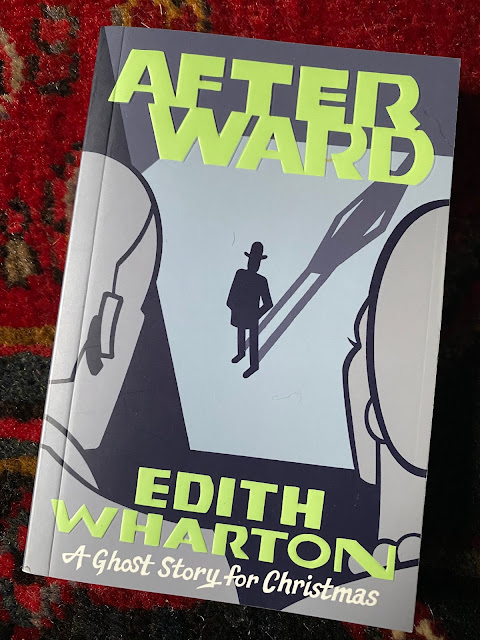
Seth’s Christmas Ghost Stories, illustrated by Seth (Biblioasis, 2016).

By now most of us know that A Christmas Carol by Dickens grew out of a British holiday tradition which dictated that ghost stories be told this time of year. This delightful little series of books, curated and illustrated by the surname-less New Yorker cartoonist Seth, takes that to a logical extreme. Each volume is a single ghost story by name-brand writers—Edith Wharton, Dickens, etc.—that are suitable for gift-giving and reading in front of the fire. The Wharton book, which I received from a friend, is a mere 37 pages. The complete series currently runs to 11 titles, about $7 in paperback or $0.99 each in ebook form. And when I describe the books as little, I mean that literally. They’re about 4-by-6-inches in size. I wonder if some clever editor (or Seth himself) had visions of Christmas stockings in their head when they conceived the series.


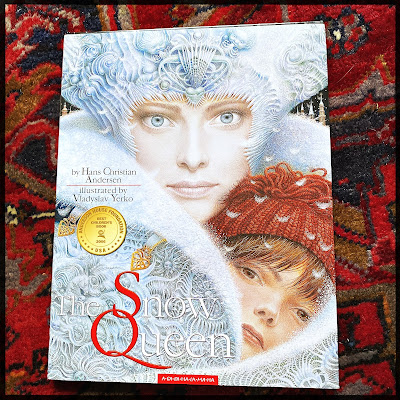
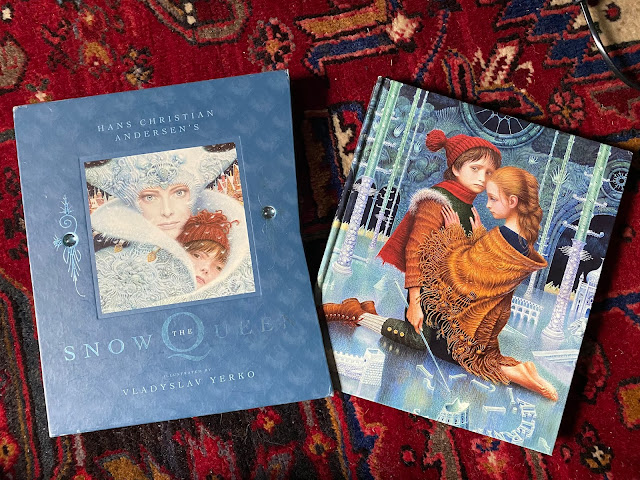
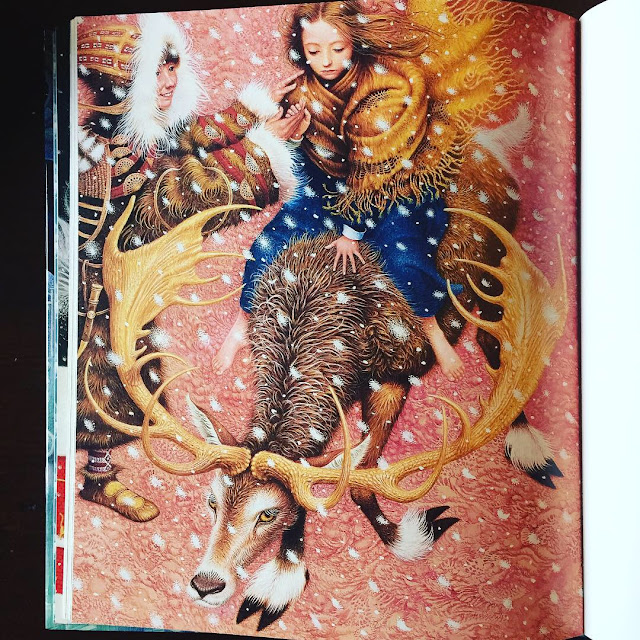
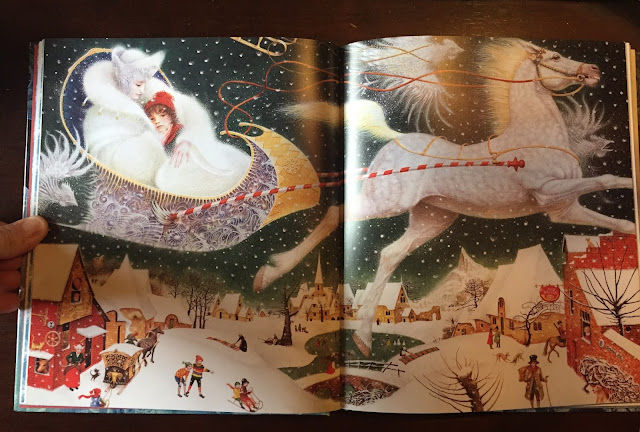
The Snow Queen, illustrated by Vladyslav Yerko
I’m not a fan of this particular tale by Hans Christian Andersen, but the adaptations I’m recommending here are something entirely different. As far as I know, these books were pubbed by two separate houses, one as a 32-page version (top) with prose by an unnamed translator, and another as a more luxurious, slipcased 96-page retelling by Nicky Raven (bottom). Both versions showcase glorious illustrations by the Ukrainian illustrator, Vladyslav Yerko, who in his fanciful bio tells us that as an infant in Kiev he slept in a large suitcase in his grandmother’s home. Yerko’s Snow Queen books were pubbed in multiple languages, but are now out of print. (Still, new and used copies turn up on Biblio and Bookfinder, but always confirm that you are buying an English-language version before checkout.) When I was a lowly intern starting out in publishing, one of my editors at a New York arts magazine subjected me to a lecture in which she insisted that illustrations (which I grew up loving) could never approach the realm of fine art. I flip through the longer of Yerko’s two Snow Queen books every Christmas just to mentally bash that notion to pieces. Behold, folks, I give you Yerko, fine artist and illustrator!


I suppose I could prattle on with other books, but I think that’s quite enough from me. I’ll be back in December with a different sort of holiday selection. If you have any favorite books that you reach for this time of year, please let me know. I never get tired of adding to my shelf.

See you in three weeks.

Joe
josephdagnese.com


17 December 2020

Christmas Gifts and Christmas Coal


by Eve Fisher

Christmas Stocking Stuffer

Been watching a great show on Amazon Prime called Around the World in 80 Faiths.  The presenter, Pete Owen-Jones is straight out of central casting for an almost New Age Anglican vicar with a wicked sense of humor.  And it covers all kinds of faiths that you might never have even heard of.  Any show that talks about Cao Dai works for me.  Oh, and did I mention the scenery?  I had no idea that the Ethiopian highlands were so beautiful...

Also the latest season of Death in Paradise, which changed Chief Inspectors mid-way, but was very entertaining. 

And if you like Rowan Atkinson - The Thin Blue Line is a lot of fun.


Christmas Fruitcake - 

Well, technically Thanksgiving fruitcake; Thanksgiving evening I lost my footing somehow and fell down the flight of stairs leading to the basement.  Good news:  I was dressed to go out, with down coat, etc., which served as my bubble wrap, and the stairs were carpeted.  Better news:  Nothing broken, nothing sprained.  Bruising about as expected.  Bad news:  It made my arthritis / bursitis flare up.  Good news:  Cortisone shots work.  

It's looking like it's going to be a warm(er) dry Christmas.  30s and 40s.  No snow.  This means that I can walk outside (because there's no way I'm going to a gym until the vaccine has trickled down to me) for a lot longer than usual!  But... it's a lot less picturesque.   


Christmas Coal - 

John Le Carre died.  Granted, I didn't expect too many more novels from him at 89, but still...  

Still no charges or end of the investigation in the South Dakota AG Jason Ravnsborg accident in which he hit and killed a Jason Boever and claimed he thought he hit a deer.  Boever was carrying a light, and walking on the side of the road. And it happened back on September 12, so WTF???  Anyway, AV Ravnsborg held a little press conference on Monday, where he said:

“I believe I have not committed any crime. I believe that we will--when we have all the facts, not a selected amount of facts--we’ll know the full story and we’ll make a full statement,” he told a KOTA Territory News reporter. (KOTA News)

Two points:  

(1) Most criminals don't believe they've committed any crime.  And

(2) It's not - it should not be - a matter of your beliefs, Mr. Ravnsborg.


Meanwhile, Governor Noem and the Pennington County Sheriff (Rapid City) would like the Amendment legalizing pot that 2/3 of the voters voted "Yes" on to somehow go away.  Their attempts - and we all know they're gonna try - is going to cost South Dakotans a lot of money.  And most of us - in our rapidly aging state - would love at least some gummy bears before bedtime.


More Christmas Presents - 

Christmas mystery short stories!  

For some OLD golden oldies, try this list provided by East of the Web, complete with links to on-line reading.  Including, among others:

The Gift of the Magi by O. Henry
The Adventure of the Blue Carbuncle by Arthur Conan Doyle
How Santa Claus Came To Simpson's Bar by Bret Harte
Markheim by Robert Louis Stevenson
Bertie's Christmas Eve by Saki
Captain Eli's Best Ear by Frank Stockton


Rex Stout's Nero Wolfe - A Christmas Party:


I also love Maigret's Christmas, Hercule Poirot's Christmas and many others.  

Or, if you're in a grim holiday mood (and hey, it happens), there's a major compedium of Edgar Allan Poe at Free Short Stories UK.


Christmas Pudding - 

I'm not a big fan of Hallmark Christmas movies.  But I do love good Christmas TV episodes.  Here are some of my favorite Christmas episodes (in no particular order):

A Charlie Brown Christmas
The Waltons: The Homecoming: A Christmas Story (1971 - pilot movie)
The Waltons: The Best Christmas (1976)
Twilight Zone:  The Night of the Meek (1959)
The Big Bang Theory: "The Bath Item Gift Hypothesis" (December 15, 2008)
Blackadder's Christmas Carol


Speaking of the British, they're also really good at making things called Christmas Specials which may or may not even mention the Christmas season (other than a party).  But they're hilarious.  From Only Fools and Horses "Heroes and Villains".  


See also Only Fools & Horses "Modern Man" and "Time on Our Hands."
Last of the Summer Wine (1973):


Christmas Cookies - 

My favorite non-religious Christmas story, EVER, is still Dylan Thomas' A Child's Christmas in Wales.  The entire story can be found at the Australian Gutenberg  HERE.  From Mr. Prothero's fire 

"Do something," he said.

And we threw all our snowballs into the smoke—I think we missed Mr. Prothero—and ran out of the house to the telephone box.

"Let's call the police as well," Jim said.

"And the ambulance."

"And Ernie Jenkins, he likes fires."

But we only called the fire brigade, and soon the fire engine came and three tall men in helmets brought a hose into the house and Mr. Prothero got out just in time before they turned it on. Nobody could have had a noisier Christmas Eve. And when the firemen turned off the hose and were standing in the wet, smoky room, Jim's Aunt, Miss Prothero, came downstairs and peered in at them. Jim and I waited, very quietly, to hear what she would say to them. She said the right thing, always. She looked at the three tall firemen in their shining helmets, standing among the smoke and cinders and dissolving snowballs, and she said: "Would you like anything to read?"

to Auntie Hannah, "who liked port, stood in the middle of the snowbound back yard, singing like a big-bosomed thrush"; from the endless snow to the "close and holy darkness" - the sheer language gets me as drunk as Auntie Hannah's tea-laced rum.  

Best Christmas Gifts - 

We're still safe and healthy, as far as I can tell, but we have stayed masked and socially distanced, and will continue to do so.  

Meanwhile, the vaccines are being shipped, delivered, and injected!  Huzzah!  My nurse goddaughter got her shot yesterday!  Double Huzzah!