Showing posts with label Italy. Show all posts

16 April 2026

Avignon and All That


"During a January closed-door meeting at the Pentagon, a Trump administration official reportedly warned a Vatican ambassador that America had the military power to do whatever it wants in the world, and that the Catholic Church had better take its side.
While the sourcing is limited, the American government confirms the meeting happened (if not the wording used) and Christopher Hale confirms that “some Vatican officials were so alarmed by the Pentagon’s tactics that they shelved plans for Pope Leo XIV to visit the United States later this year [for the celebration of America’s 250th].” All of which certainly puts the Pope's comments against American violence in Iran in a different light.
But what’s getting a ton of attention is both the worst sourced, and most intriguing, piece: that an American official in that meeting invoked the Avignon Papacy." (LINK)

Why does that matter? Well, bringing up the Avignon Papacy to a Pope – any Pope – is pretty much a direct threat.

Back in the High Middle Ages, before the Calamitous 14th Century (and thank you, Barbara Tuchman, for one of the greatest histories ever written), i.e., the 1300s, there was only one official church in all of Western Europe, the Church, catholic and Catholic. Everyone was born into it, and it was integral to everything. The Church told you what was right and what was wrong, how to get to heaven, how to love your fellow man, how you should work, how you should live, how you should treat each other. All the social services that government and various non-profit organizations do today were then done by the church and the (often forced) largesse of the wealthy: welfare to widows and orphans, hospitals, asylums, orphanages, schools, etc.

The Church was like breathing, it was all around you. And that was fine with most people. The High Middle Ages, from 950 to 1300, has been called the Great Age of Faith. Cathedrals were built. Crusades were fought. And it helped that it was what's known as the Medieval Warm Period, a/k/a the Climatic Optimum: perfect weather, good harvests, often great harvests, fat bellies...

And then it all went to hell in a handcart, thanks to the Hundred Years' War (between England and France), the Black Death (where a third of the world OR MORE died, and that was just the first go-round), and the Avignon Papacy (a/k/a the Babylonian Capitivity of the Church) and the Great Schism. These three things shattered everything.

AVIGNON AND WHAT CAME NEXT

The papal palace in Avignon
Jean-Marc Rosier from http://www.rosier.pro

So let's start off with a problematic Pope, Pope Boniface VIII (r. 1294-1303): He was from the Gaetani family, wealthy Italian nobility. (Back then, it was pretty normal for a Pope to be elected from among wealthy Italian families and would be so for a very long time.) And it had been expected that he'd be elected to the papacy, but it didn't happen.

Instead, a monk named Pietro Angelerio, a hermit monk was elected by a fluke of frustrated cardinals (who were tired of wealthy noble Italian families running everything, and this was way before the Borgias). Pope Celestine was extremely holy, and wept when he was dragged from his cell to Rome. He was easily persuaded to resign a few months later, probably by Boniface, who was immediately elected Pope.

NOTE: Celestine had been promised he could return to his hermitage, but instead Boniface had Celestine arrested and imprisoned until he died.

Pope Boniface accomplished a lot, including the Regulae Iuris, a collection of legal principles, which is still used as a source for deciding matters of canon law. But his most infamous achievement was the papal bull Unam Sanctam – which declared the pope's jurisdiction over both temporal and spiritual powers: "We declare, announce and define that it is altogether necessary to salvation that every human creature be subject to the Roman pontiff."

This wasn't new: it was pretty much believed throughout Western Europe. Not in Eastern Europe, where the Orthodox Church still considered the Bishop of Rome as just another Patriarch among many. The Catholic/Orthodox schism over papal authority goes back a very long way...

The King of France was Philip IV a/k/a "the Fair" (apparently he was handsome), and did his best to expand French lands. He spent a lot of time at war with England, also with Spain, Flanders, etc., while setting up an alliance with Scotland (the "auld alliance" began with him), conquered Flanders, and made contact with the Mongols with the idea of future military alliances. The trouble is, all that cost money. He was always scrambling for money, and got it a variety of ways, such as arresting bankers and seizing their money.

(Later, under the next Pope, Philip IV pitched a huge fight with the Knights Templar, who had financed most of his war with England, and sent troops to arrest all the Templars in France, accusing them of sacrilige, idolatry, homosexuality, financial corruption, fraud, and secrecy. And seized all their large assets…)

But then Philip IV levied taxes on the French clergy of one-half their annual income. Neither the Church nor the papacy would put up with that... Pope Boniface VIII issued the bull Clericos Laicos, forbidding the transference of any church property to the French Crown.

So between the two bulls, Philip IV of France saw a threat, and held a little assembly of his own in Paris in April 1302. Nobles, burgesses and clergy met to denounce the Pope and pass around a crude forgery*, Deum Time ("Fear God"), in which Boniface supposedly claimed feudal suzerainty over France, an "unheard-of assertion". Boniface denied the document and its claims, but – insanely – reminded Phillip that previous popes had deposed three French kings. (Also a few English ones, including John Lackland.)

*I know, you thought social media and fake news were modern, right?

And that ticked Philip IV off enough to call for a council to depose Boniface on charges of heresy, blasphemy, murder, sodomy, simony, and sorcery. Boniface prepared to excommunicate Philip, and in order to stop him, Philip hired some thugs who attacked Boniface and imprisoned him for three days without food or water. Boniface was rescued by a group of Italian nobles, but the pope died of his treatment within a month.

Depiction of the death of Boniface in a
15th-century manuscript of Boccaccio's De Casibus

Pope Clement V (r. 1305-1314)

With Boniface's death, King Philip IV promptly bribed the college of cardinals, and Boniface's successor was a Frenchman who revoked Unam Sanctam. And in 1309 King Philip IV moved Clement and the papacy to Avignon, France. Clement brought with him all the French cardinals, papal bureaucracy, etc. In exchange, Philip promised him protection from anything like what happened to poor Boniface.

And there the papacy stayed, at Avignon until 1377, a period that's known as the Babylonian Captivity of the Church.

In case you're wondering, this was a disaster for the Church, because the church expenses skyrocketed. Why? Well, they're in France, and the papal states are in Italy, and the papal states are where a lot of the papal wealth comes from. And the money isn't flowing regularly, so papal taxes went up even more. And, since the pope and his court were in France, and dependent on French support, they rubber-stamped all of the French king's policies and decisions. Especially since, of the 134 cardinals that were created during these 70 years, 113 of them are French.

But it really helped French royalty. A nice, tame Church that could pretty much be controlled…

Gennadii Saus i Segura
A map of Rome, showing an allegorical figure of Rome
as a widow in black mourning the Avignon Papacy

But that's medieval history - why does it matter that someone brought that up to today's representative for the Pope?

The big deal is that the Avignon Papacy began with a king sending a bunch of thugs to capture the Pope, and then setting up his own pope on his own land and controlling the church for 70 years.

Anyone in the Vatican would, and probably did, see "mentioning" it as a threat.

BTW, back in the day, things got worse. Eventually a pope returned to Rome, but instead of things getting back to normal, the French contingent elected yet another Pope in Avignon. So now there were two Popes, one in Avignon, one in France, each excommunicating the other, and all of the others' followers...  Eventually there were three popes...  Briefly... But that's another story, for another time.

09 April 2022

Splat (Or, How They Do It in Buñol)


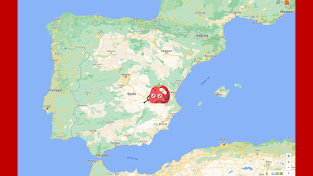
Travel is coming back, y’all. If this August 26th you can get to Spain and love tomatoes -- you’ll need to love love tomatoes -- our wonderful world has crafted the perfect destination: Buñol, a picturesque village near Valencia. Doubly picturesque this particular weekend. One August hour per year, Buñol is awash in tomato pulp. Tens of thousands of festival goers hurl pulped tomatoes. At each other. Ten of thousand of tomatoes.

La Tomatina. It’s Europe’s biggest food fight. 40,000 people jam Buñol’s narrow streets and peg each other with tomato slop. Repeat: 40,000 people bought tickets for the privilege.

Full disclosure: I’ve never participated or been to Spain. I stumbled onto La Tomatina years ago, and I still internet-surf along each August as those hardy souls don goggles and bathing suits and splat tomatoes smack in each other’s kisser. 

La Tomatina has its rules and traditions, of course. I've learned something about them.

It begins as such things must: with a serrano ham tied atop a greased pole. It’s 10a.m., and as soon as someone fetches el palo jabón, the battala campal can begin.

Prime spots fill early. You need access to ammo and a good firing angle. Sensibly, it's only tomatoes that get hurled. Bottles, backpacks, and blunt objects aren’t allowed. Tomato fights are the sort of thing that can get out of hand.

Also, you can’t bring your own tomatoes. That’s a rule now, so I guess someone ruined that for the rest of us. Instead, the organizers buy market rejects cheap -- surely, you get a bulk rate when scoring 150,000 tomatoes unfit otherwise for sale -- and load them onto dump trucks that roam through the fray. Also, you can’t just grab and whip the pulped suckers at someone. No, you have to crush the tomatoes if not crushed already. We’re not trying to hurt anybody.

Another rule says only to target someone if you've drawn a clear bead. Smart, but this is a close quarters stuff. A melee. Crossfire, friendly fire, accidental fire? Hey, it’s La Tomatina.

In an hour, it’s done. 40,000 juice-smeared warriors have chucked 150,000 pulped tomatoes free-for-all. Everyone looks like they just survived an explosion at the Hunt’s cannery, except the smiles are ear-to-ear. Endorphins abound, skin has been super-moisturized, and even the streets will gleam from a citric acid wash. Once the fire department hoses Buñol down.

You would think such a festival has a wild origin story, a revolt against a cruel noble or a patron saint of garden salads. Nope. In 1945, there was a festival parade of musicians in big head outfits, and near a vegetable market one guy’s big head fell off. The guy apparently lost it with the other musicians and the crowd, which led to fisticuffs and inevitably to produce-flinging. One imagines alcohol was involved.

Buñol

tried it again each August for a while, but each festival descended one way or another into tomato-throwing. Outsider were showing up, armed to splat. The city leaders caught on that these people were coming not for music but the tomato fight. One imagines alcohol remains involved. Buñol took a more Chamber of Commerce-like approach, and La Tomatina as a sanctioned festival was born. Not even Franco could stop La Tomatina from taking off. And he tried.

As of this writing, La Tomatina is returning after a two-year pandemic hiatus. It delights me to believe this summer we'll have a proper pasting. That's in four months, folks. Plenty of time to book those tickets, if you love love tomatoes.

Or if citrus is your thing, Italy has a giant food fight but with oranges.

Oranges? That’s just weird.

18 November 2019

Local Color


When my late mother-in-law was very old, she developed a passion for Harlequin Romances. A booksellers dream, she ordered up what she called her “little books” by the case, and consumed them at the hair dresser, in the evening, waiting for a train or an appointment. They replaced her now arthritis-denied needlepoint for staving off tedium. She claimed that what she really liked about them was the local color. Her tastes ran to UK settings with local customs like afternoon tea (she had a sweet tooth) and a fair degree of pre-war quaintness.

Recently a couple of new mystery series have gotten me thinking, like my mother-in-law, about the charms of other societies, not just the geographic settings but the cultural ones as well. Sujata Massey has followed up her impressive debut, The Widows of Malabar Hill, about an ambitious young Parsi woman in 1920’s Bombay, with The Satapur Moonstone, set this time in a forested princely state outside the city. In both, the restrictions faced by middle and upper class women combine with carefully observed venues to add believable complications and challenges for her pioneering female lawyer and detective.

Perveen Mistry, apparently based on one of the author’s own female ancestors, has found a niche in the otherwise much-restricted legal system by catering to the legal needs of women in purdah. She, herself, moves relatively freely in her society, although possible pitfalls and dangers were vividly illustrated by her experiences in the initial novel.

In The Satapur Moonstone, Perveen is off in the hinterland, back when the term really had meaning. Parts of Satapur are cut off during the rainy season, with tracks only passable by palaquin – Massey gives a vivid account of the discomforts of this conveyance for both the passenger and the bearers – or on horseback. She also has to conduct delicate negotiations – neither too forward nor too deferential – with the males she encounters, including the Agent of the Raj, whose all-male station, she discovers to her dismay, is her only possible shelter.

The underlying mystery is neatly constructed, but I must confess that it is the curious customs, Perveen’s nicely-calibrated courtesy, and the picture of princely India with imperious royals, impoverished locals, and spectacularly crumbling royal estates that really bring enjoyment.

 If Massey’s Perveen Mistry is distinguished by her iron self control and her sensitivity to the different customs and values of Bombay’s heterogeneous community, Auntie Poldi of Mario Giordano’s Sicilian mysteries is off the charts in the opposite direction, a truly operatic character, or perhaps we should say, a Wagnerian character, because, though Auntie Poldi’s lamented husband was Sicilian, she is Bavarian. And larger than life.

In Auntie Poldi and the Sicilian Lions, she decamped to Sicily intending to commit suicide. Her plan involved large amounts of alcohol and seemed easy to accomplish given her weakness for drink. But Auntie’s suicide required a house with a sea view. Renovating this property, along with the beneficent interference of the Sicilian relatives, not to mention the salutary influence of a local murder mystery, keeps putting Poldi’s termination on hold. With her fabulous black wig, her caftans, her hobby of photographing handsome Italian policemen, and her appetites for food, drink, and romance, Poldi is an over-the-top character. And kind of nice to see, given that she is in her sixties.

 My own preference would be for Giordano to scale her back just a tad, but as described by her would-be-novelist nephew, she comes across as a genuine force of nature. Forces of nature being best enjoyed in smallish doses, it is fortunate that the Aunti Poldi stories have a great deal of Sicily as well as a great deal of the Bavarian diva. Sicilian food– abundant, apparently delicious and the pleasing obsession of half the characters – is a big player, as is Sicilian agriculture.

The novels are full of lovely groves of olives and oranges, flowers, ornamental palms and horticultural specimens, and vineyards thriving in the volcanic soil. In Giordano’s books, the island is a paradise, marred only by those so useful snakes, Mafioso and greedy multinationals, both of whom covet the island’s water supply in the newest, Aunti Poldi and the Vineyards of Etna. The plot is silly but the scenery is top flight. As my mother-in-law knew years ago, local color and a touch of the exotic have their place.

25 June 2016

Damn Right, there's ME in my Characters!


Several times a year we do these reading and signing events.  And people ask you a pile of questions about your books.  Most are repeat queries that you’ve heard a dozen times before.  So you get pretty good at answering them.

Lately, I was asked a question that I didn’t have a pat answer to.  In fact, it really made me think.

“Do you make up all your characters, or do you put some of yourself in them?”

I’d like to say that every character I write comes completely from my imagination.  For the most part, they do.  I can honestly say that I have never seen a real person who matches the physical description of any of my characters.  (Not that I would mind meeting Pete.  But I digress…)

Back to the question:  are there bits of myself in my protagonists? 

PROOF NO. 1 (others will follow in later posts)

“I am SO not a salad girl.”

Some people say this is one of the funniest lines in my screwball mob comedy, THE GODDAUGHTER.  It is spoken by Gina Galla, goddaughter to the mob boss in Hamilton, the industrial city in Canada near Buffalo, also known as The Hammer.  Gina is a curvy girl.  She says this line to her new guy Pete, as a kind of warning.   And then she proceeds to tell him she wants a steak, medium rare, with a baked potato and a side of mushrooms.

Apparently, that’s me.  So say my kids, spouse, and everyone else in the family.

Eat a meal of salad?  Are you kidding me?  When there is pasta, fresh panno and cannoli about?  (I’ve come to the conclusion that women who remain slim past the age of fifty must actually like salad.  Yes, it’s an astonishing fact.  For some people, eating raw green weeds is not a punishment. )

Not me.  I’m Italian, just like my protagonist.  We know our food.  Ever been to an Italian wedding?  First, you load up with appetizers and wine, or Campari with Orange Juice if you’re lucky.  When you are too stuffed to stand  up anymore (why did you wear three inch heals?  Honestly you do this every time…) you sit down, kerplunk.  Bring on the antipasto.  Meat, olives, marinated veggies, breadsticks, yum.  Melon with prosciutto.  Bread with olive oil/balsamic vinegar dip.  White wine.   

Then comes the pasta al olio.  Sublime.  Carbs are important fuel, right?  And I’m gonna need that fuel to get through the main course, because it’s going to be roast chicken, veal parmesan, osso buco, risotto, polenta, stuffed artichokes (yum), more bread, red wine.

Ever notice that salad is served after the main course in an Italian meal?  Good reason for that.  We aren’t stupid.  Hopefully, you will have no room left for it.

So yes, my protagonist Gina shares an important trait with me.  She likes meat, dammit.

So you can be a bunny and eat salad all you like.  Bunnies are cute and harmless.

But Gina and I are more like frontier wolves.   Try making us live on salad, and see how harmless we will be.

Which is what you might expect from a mob goddaughter from The Hammer.

Do you find bits of yourself sneaking into your fiction?  Tell us here, in the comments.

Melodie Campbell writes the award-winning Goddaughter mob comedy series, starting with The Goddaughter which happens to be on sale now for $2.50.  Buy it.  It's an offer you can't refuse. 
P.S.  My maiden name was 'Offer.'  No joke.  Although I've heard a few in my time.

20 December 2014

Have a Confusing Christmas!


The following story is true.  And it may explain the slightly manic sense of humour I have been displaying on these pages over the past six months.


Most of my life, I have been confused about Christmas.

This is because I am the quintessential Canadian mutt.  Four parts Italian, one part Irish, one part English, one part Chippewa, and the final bit was a surprise.  It overlaps with the English part (wait for it.)

The Italian part is easy to explain.  Every year, my Sicilian grandmother put the plastic lighted crucifixes (made in Japan) in glaring rainbow colours, on the Christmas tree.  I was a bit confused by that, not only because it was gawd-awful tacky and fought with my budding interior designer.  But the part in the 10 Commandments about ‘no graven images’ seemed to be at risk here.

Nevertheless, we all looked forward to the blazing orange, green and red crucifixes, unaware that it was a sort of macabre thing to do to a Christmas tree.  Did I mention Halloween is my favorite holiday?

The Chippewa part was a tad more elusive.  I first got a hint that there might have been First Nations blood in our family when someone asked why we put ground venison in our traditional Christmas Eve spaghetti sauce.  True, we had a freezer full of deer, moose, salmon, and not much else.  Later, it occurred to me that I actually hadn’t tasted beef until I was ten, when for my birthday, Dad took us to the A&W for a real treat.  “This tastes weird,” I said, wrinkling my nose.  “It’s made from cow,” Dad said.

Of course, if I had been more on the ball, there were other clues.  But at the age of six, you don’t necessarily see things as out of the norm.  That summer in Toronto, I loved day camp.  They split us kids into groups named for First Nations tribes.  By happy coincidence, I got placed in the Chippewa tribe.  When I got home and announced this, the reaction was: “Thank God it wasn’t Mohawk.” 

The camp leaders were really impressed with my almost-authentic costume.  (Everyone else was wearing painted pillow cases.)

But the real confusion about Christmas and my provenance came many years later.

I spent most of my life not knowing we were part Jewish.  I was about forty, when the designer shoe (a bargain on sale at David’s) finally dropped.  Dad and I were eating pastrami on rye at Shopsy’s Deli one day (which we did on a regular basis, once a month – a reasonably intelligent person might have considered this the first clue) when Dad wiped a drip of mustard off his face and said:

Dad: “I haven’t heard from my cousin Moishe Goldman in a long while.”

Me:  “We have a cousin named MOISHE GOLDMAN??”

Of course, if I had been thinking, all this made sense.  We had lived in a Jewish neighbourhood.  Our last name is Hebrew for antelope.  And I was only the only kid in school who got Halvah in their Christmas stocking every year.  (Damn straight.  I really did.  I still do.)

So I’m hoping this may explain why we have a five foot lighted Christmas peacock on our front porch this year, and a lighted Christmas palm tree in our back yard.  “A Peacock in a Palm Tree” may be confusing to you folk who know the song and are expecting a partridge with pears, but to those of us who have been confused about Christmas all our lives, it is mere icing on the proverbial Kugal.

Melodie Campbell writes funny books. You can buy them at Chapters/Indigo, Barnes&Noble, Amazon, etc.  Sometimes even at the discount table at Zehrs and Walmart.)

The Peacock.  You thought I was kidding.

14 August 2014

Bluegrass Mafia


Well, Leigh, you opened up a can of worms last week, and I guess it's Mafia week at SleuthSayers.  I have three stories, two of which are legendary in my family.
My grandparents emigrated from Greece back in at the beginning of the 1900's, and of course they lived in New York, and ended up - double of course - in Astoria. For those of you who don't know, Astoria has long been the Greek neighborhood of NYC.  To this day, when we go visit some (Italian) friends who live there, they send me out to get the breakfast bagels, because I always come back with freebies, beginning with extra bagels.  I guess that the bakery owner assumes that I'm Aunt Eudoxia's niece or something...

File:New York City - Upper West Side Brownstone.jpg
(Disclaimer:  Not my
grandparents'
brownstone)
Anyway, my grandfather had been a teacher back in Athens, or so I'm told, but in New York, he was a truck driver.  By the time I got to know him, it was the 1950's, and my parents and I would go up to visit them in their brownstone.  Yes, you read that right.  A nice big corner brownstone in Astoria, Queens, which they'd bought in the 1930s.  After they died, I found the address (they moved from there in the 1960's, making, I'm sure, a tidy profit) and my husband and I went by and saw it.  Very nice.  An Egyptian family lives there now, I believe.

I asked my father, when I got old enough to understand how expensive a brownstone is, how on earth was my grandfather able to afford to buy one back in the 1930s?  He said, "Well, he did a favor for someone with money.  Got him a nice little truck route, and the brownstone."  Who was the someone with money?  Someone named Gambino.  I asked my father, "What kind of favor did he do?"  "No idea.  We didn't ask questions."

Second story, not mine, which I mentioned in the comments section on Leigh's column:  The Mafia has made some very interesting investments.  Developments in Florida and elsewhere.  Casinos everywhere.  And also utility companies, in parts of the southeast.  There was a man from the Midwest who worked for one of the power companies and went down to the southeast in what he thought would be a career move to manage a local utility company.  He was back in six months, thankful to be out of there... unharmed.

Third story.  There's a town in Kentucky, with a population of not quite 7,000 people, which has one of the best authentic Italian restaurants you can find anywhere.  My husband and I took my father there for dinner one time - we were on a road trip, long story - and the food was excellent.  Or at least my husband's and mine was.  My father occasionally liked to throw his weight around in restaurants and other establishments, and he began to complain, loudly, about his dish.  And asked to see the manager.

File:Lasagne - stonesoup.jpgThe manager came over.  He was obviously Italian; he was obviously not a cook; he was obviously completely indifferent about what customers - or at least us - thought of him.  He listened to my father, looked at his plate, and said, "I don't have time for this shit.  Get out of here."

Tone of voice is everything, because my father got up and went.

Out in the car, my father started fretting and fuming about how he was treated.  "Why didn't we do something?  Why didn't we argue back?"

"Because," I told him, "he was Mafia."
"He was?" my father asked.
I nodded.  "Yes, he was."
And he was quiet the whole rest of the trip. At least about that.