Showing posts with label stories. Show all posts

02 December 2025

Mining the Files


Some of the many publications containing my stories, including those that were mined from the files.

If you’ve been writing for any length of time, as I have, you likely have a file drawer (or a file folder on your computer) filled with unsold stories.

Likely, some of them are unpublishable under any circumstances. Some, however, are publishable as is or with minor tweaking. Because you were unable to find suitable markets at the time, you disappeared the stories into your files. If enough time has passed, you may have even forgotten writing them.

This is a mistake. Every so often, you should reread your unsold stories and spend time seeking information about markets that have changed or that did not exist when you wrote the stories. You might be sitting on a gold mine (figuratively; you do know how well short stories pay, don’t you?).

This has been one of those years. Though there’re still thirty-one days left (as I write this) and I could receive additional acceptances that will impact the numbers I’m about to share, this has been a good year for mining my unsold stories file.

So, far, I’ve placed eight of those stories. I wrote the oldest—a bit of crime fiction—in 2013; the other seven are short romances I wrote in 2016. I placed them with three different publications, none of which existed at the time I wrote the stories.

Other than correcting typos, misspellings, and grammatical errors I hadn’t caught at the time, I only found it necessary to revise one story. I found a submission call for a winter-themed romance anthology, so I added a few sentences to one story to make it clear the story took place during winter.

UNFINISHED STORIES

I have another, larger, file of unfinished stories, and I frequently mine it as well. I’ve written about this before, but whenever I am not writing to deadline and have no specific project top of mind, I read my unfinished stories until one captures my attention.

Sometimes, I have a burst of inspiration and finish the story. Other times, I add a sentence, a paragraph, or an entire scene. Sometimes I create a rough outline for the balance of the story. If nothing compels me to finish, I move on to other unfinished stories.

Both “Blind Pig” (Ellery Queen’s Mystery Magazine, September/October 2025) and “The Girl in the Shop” (Alfred Hitchcock’s Mystery Magazine, September/October 2025) were stories I had started and which lay dormant for four years (“Blind Pig”) or three years (“The Girl in the Shop”) between the time I started them and the time I finished them.

So, whether you’re mining your files for finished stories and seeking new markets for them or you’re mining for unfinished stories in hopes of inspirational sparks that will propel you through to the end of finished manuscripts, mining your files can prove quite beneficial.

I know it does for me.

* * *

“Forever Family” was published in Micromance Magazine, November 22, 2025.

19 August 2025

Hot Streak


Attempting to predict anything in publishing is a mug’s game, especially trying to predict how long it will take for a short story to find a home.

I’ve been on a roll this summer, with 10 original short story acceptances beginning June 20 and ending as I write this, a few days before it posts. (I placed a pair of reprints and a few originals earlier this year, but I’m only looking at my recent summer sales because there are some interesting things to note.)

Ten acceptances in nine weeks means an average of 1.11 acceptances per week. It’s been quite a while since I’ve had acceptances at a rate averaging more than once a week.

Six were accepted by paying publications; four by non-paying publications.

Three stories were accepted on first submission, five on second submission, and two on third submission.

The two fastest responses came quickly—one the same day as the submission and the other the day after submission. The slowest response took one year and 11 days. Ignoring the three outliers, acceptances ranged from eight days to 120 days.

One story took 10 days from submission to acceptance, but in between the editor requested some small revisions, so I date the acceptance as the day the editor accepted the revised version.

One other story required a revision before it was accepted, but the editor did not request the revision. The original rejection letter was so specific that I knew what I needed to change to fix/improve the story, but the story sat on my computer for more than three years before I figured out how to solve the problem. I submitted the revised story to the same editor with a note about why I was resubmitting it and what I had done to fix the problem. An acceptance followed. So, it sold on second submission, but to the same editor who had previously rejected it.

Eight of the stories are crime fiction. Two are romances.

One story was written to invitation. One was written for an open-call anthology. The two romances were originally written for a specific market that did not accept them. The other stories were of the “write first, market second” variety, which I haven’t been doing much of the past few years. Most of my writing has been “market first, write second”—that is, writing stories by invitation or writing to meet specific open-call anthology guidelines.

Now, here’s where I found some interesting data:

One story was written in 2003, one in 2010, two in 2016, one in 2020, one in 2024, and the last four were written this year, which means the oldest story would be old enough to vote, were it a person, and another would be getting its learner’s permit to drive. Many of the publications where I placed these stories did not exist when I wrote the stories.

What I learned from these acceptances is two-fold: 1) Never throw anything away because 2) the market is in constant flux.

I’ll be surprised if this pace continues, but it might. I’ve been looking through my unsold stories and putting them back out to market. After all, they’ll never be published if I don’t submit them.

* * *

I’ve been having a good streak with publications as well. In addition to the five stories I mentioned in my two previous posts, two more stories are hitting newsstands and mailboxes as you read:

“The Girl in the Shop” appears in the September/October issue of Alfred Hitchcock’s Mystery Magazine and “Blind Pig” appears in the September/October issue of Ellery Queen’s Mystery Magazine.

Curves” was published August 17 on Guilty Crime Story Magazines website.

* * *

Like many of you, I’ll be at Bouchercon in New Orleans the first week of September.

Barb Goffman and I will accept the inaugural Derringer Award for Best Anthology for Murder, Neat. I will also be celebrating Tammy Euliano’s Derringer Award for Best Long Story for “Heart of Darkness” (Scattered, Smothered, Covered, and Chunked, which I co-edited with Stacy Woodson), and I’ll be celebrating Stacy Woodson’s Derringer Award for Best Novelette for “The Cadillac Job” (Chop Shop, which I edited).

I’ll be hanging on tenterhooks awaiting word about M.E. Proctor’s Shamus Award nomination for Best PI Story for “Drop Dead Gorgeous” (Janie’s Got a Gun, which I edited).

And I’ll be hanging on different tenterhooks awaiting the announcement of the Anthony Award for Best Anthology because I co-edited two of the nominees: Murder, Neat, with Barb Goffman, and Scattered, Smothered, Covered, and Chunked, with Stacy Woodson.

I’ll also be participating in two events:

“Killing Your Darlings: Edit that Manuscript,” a panel discussion with me, Luisa Cruz Smith, Donald Maass, Paula Munier, and Otto Penzler, moderated by Sara J. Henry. Friday 2:30–3:25 p.m. in Galarie 5-6, followed by a signing in the Acadia Ballroom.

“Jumpstart Your Story,” which I’ll co-host with Harry Hunsicker and Stacy Woodson. Saturday, 10:00–11:00 a.m., in the Media Room.

If you see me, say howdy!

29 November 2023

Mind the Gap


Pottery shard, Ramat Rachel, Israel.


Today I find myself in a situation I have not experienced since, at least, July 5, 2021. Specifically, I don't have a short story to be working on.

I know the date, because I just finished a novella, and I started it on July 6, two years ago.  You may be surprised that it takes me two years to write a novella.  Well, here's the thing.  When I get an idea for a new story I generally drop everything and start to work on it.  My reasoning is that I'm a very slow writer and I want to strike while the iron is hot, to use a cliche.  Write the story as close to the moment of inspiration as possible.

So, I have probably written a dozen stories since starting this novella. But I have nothing on hand to write next.

This is not a panicky moment.  I know exactly  what I will be doing tomorrow, writing-wise.

For one thing, I will edit some of the seven stories I have finished a draft of but don't have ready to submit.  My stories average  ten drafts.  I work on one most days after doing my first-draft writing for the day.  And when I finish a first draft completely I usually take a week off from writing new stuff, and just edit.  

Secondly, it is not quite accurate to say I have no idea what to write next.  You see, the novella I have been working on is the fourth in my series about Delgardo, a beat poet.  Hitchcock's has published two and purchased the third.

The first story in the series was set in October 1958 and each story moves ahead by one month.  A real event occurred in February 1959 which fits perfectly into the lives of my characters, so my next job is to research that event and figure out how to turn  it into a plot.

So don't worry about me.  I'll fill the hours somehow.  How about you?

ADDENDUM: Two days after I wrote the above an editor asked me to write a story for an anthology.  I immediately had an idea for a sequel to a different tale.  So Delgardo will have to wait. I'm off to the races... 

02 June 2023

Favorite Stories


Favorite short stories

Since my story "Cruelty the Human Heart" (first published in Argosy II magazine, 2004) ) was included in the college composition textbook WORD AND IMAGE (Pearson Learning Solutions, Boston, MA) the occasional college student will contact me about it and other topics. The other day, I was asked to name my favorite classic short story. I said there were too many to have a favorite but I mentioned Edgar Allan Poe's "The Cask of Amontillado" and "The Murders in the Rue Morgue."


"That's old English. What about current English?"


That cracked me up. I gave the student a short list and moved one. The question lingered and I thought about it, went to my bookcase and brought down a few collections and one story hit me (again), and I re-read it as slowly as I could, to experience the well-written tale and feel the same charge with the opening lines and the same emotion at the end.


The story – “The Tonto Woman” by Elmore Leonard, one of his western tales.


Here are others:


“One” by George Alec Effinger


“Shambleau” by C. L. Moore (Catherine Moore)


"The Whimper of Whipped Dogs" by Harlan Ellison


“I Have No Mouth And I Must Scream” by Harlan Ellison


 “The Fog Horn” (alternate title: “The Beast from 20,000 Fathoms) by Ray Bradbury


“The Fruit at the Bottom of the Bowl” by Ray Bradbury


“The Saliva Tree” by Brian W. Aldiss


“A Martian Odyssey” by Stanley G. Weinbaum


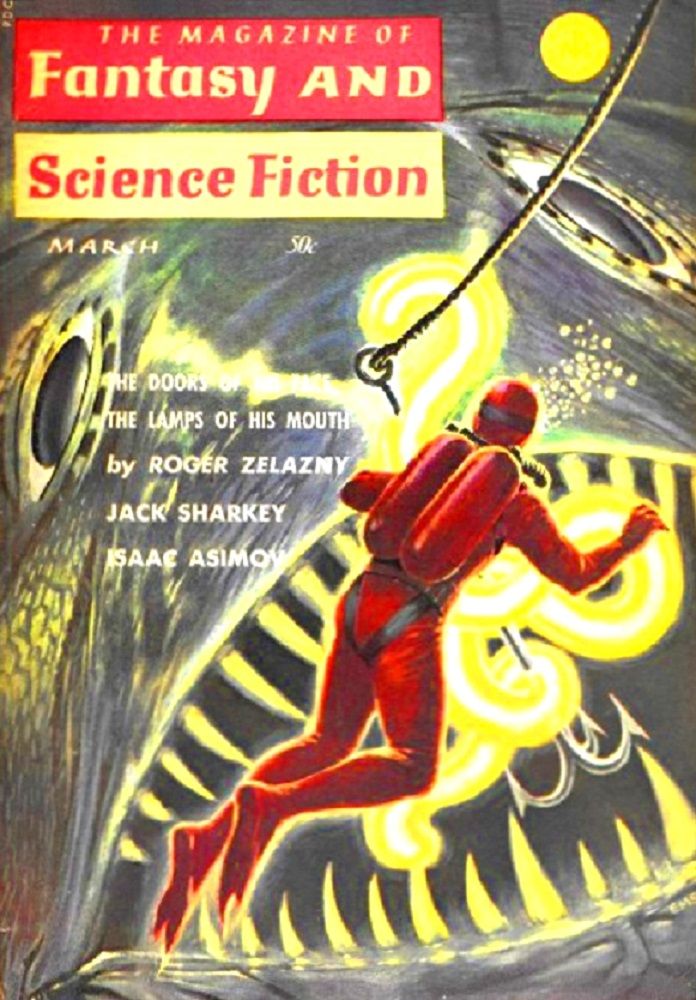
“The Doors of His Face; The Lamps of His Mouth” by Roger Zelazny


“Nightfall” by Isaac Asimov


“Cat’s Paw” by Bill Pronzini


“The Perfect Crime” by Max Allan Collins


“An Occurrence at Owl Creek Bridge” by Ambrose Bierce


“The Call of Cthulhu” by H. P. Lovecraft


“A Scandal in Bohemia” by Sir Arthur Conan Doyle


“Flowers for Algernon” by Daniel Keyes


“The Wall” by Marcia Muller


“Crazy Horse” by Cornell Woolrich


“The Dog of Pompeii” by Louis Untermeyer 

I have to stop for the moment. There are too many favorites.


That's all for now.


www.oneildenoux.com 

20 July 2022

Doing the Math


For months I have had a fragment of a story idea kicking around my head.  Just something I knew I wanted to write about someday.

Then on May 23rd it blossomed into a complete plot.  I started writing and finished the first draft on the 29th.  So it took me a week.  That's pretty fast for me.

And that led me to do the math.  Brace yourself.  All that follows is based on my most recent five stories in each category mentioned below

From the time I start writing a story to the day I am ready to submit it to a publisher turns out to average 635 days.  (I hasten to point out that I am working on many stories at the same time.) So I will be ready to send the story in or around September 2025.

The first market I send it to will probably be Ellery Queen's Mystery Magazine.  Based on past experience they will hold it for 49 days and then reject it (zero out of the most recent five).  So now we're in November.

I will then ship it to Alfred Hitchcock's Mystery Magazine.  It will sit there for 385 days, and they will then accept it, in December 2026. (Four  out of the most recent five).

Eventually I will get a contract for the story.  I will sign it and send it back and then I will get a check. The contract/check process for my last five stories averaged out to 73 days after the story was accepted.  Based on the length of this current tale, it will probably be for about $300.

Roughly a year later my story will be published.  So the story I conceived in May 2022 will, if everything goes well,  finally see the light of day in the spring of 2027.

As somebody said, it's a slow way to get rich.

Believe it or not, the working title of the  story is "Was That So Hard?"


03 April 2022

Tattwo Parley


In 2005, a Chicago man opted for a tattoo to honor his home city. It was a great tat with ornate lettering. He went for it, Chi-town. Except when he returned home, he discovered it read Chi-Tonw.

Chi-Tonw

Oops. He sued the tattoo business, but since he’d signed off on the template (made with antique transparency machines!), some sort of settlement was reached. Curiously, it started a fad with other Chicagoans getting their own Chi-Tonw art.

Me, I think bare skin is beautiful, but I may be an exception. I knew a guy who had trouble paying his rent, but he estimated he’d paid out $20,000 for his skin art. He claimed it was an investment.

You might think a tattoo would be something to proofread twice over, but alas, spelling seems to be that last thought, not the first. Chinese lettering is especially troublesome where a single stroke can completely change a meaning. Just because your artist might look Asian, it doesn’t necessarily imply he knows Chinese. Apparently the following means ‘hooker’.

Prostitute

The following guy preempted questions with the wording: “I don’t know. I don’t speak Chinese.”

Undecorated: I don’t know. I don’t speak Chinese. Decorated: I don’t know. I don’t speak Chinese.
“I don’t know. I don’t speak Chinese.” Fully decorated. © NextShark

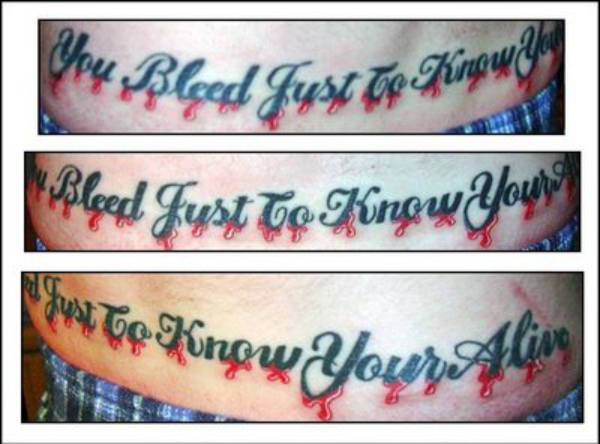
As Ray Bradbury demonstrated, everyone has a story. Unfortunately, many students weren’t paying attention in Mrs. Henshaw’s English class. In the following, the contraction you’re seems especially troubling.

Your blood, Mrs. Henshaw’s tears.

Know Your Alive

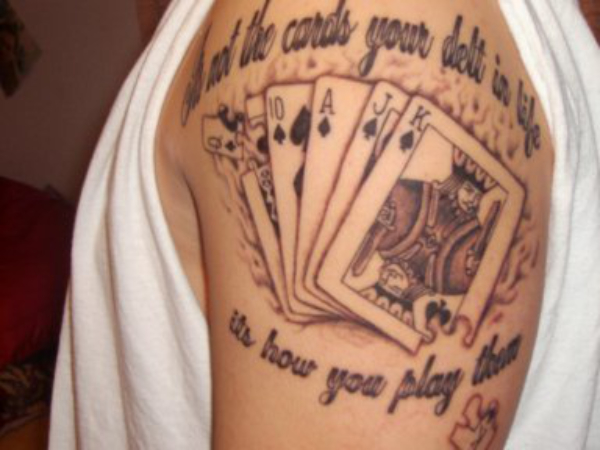
When in doubt, double down.

The Cards Your Delt

Aww…

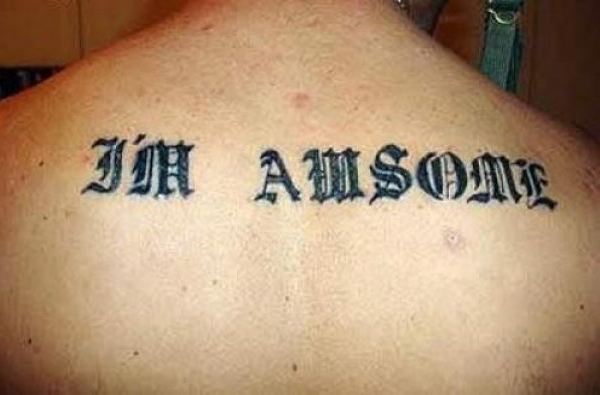
I'm Awsome!

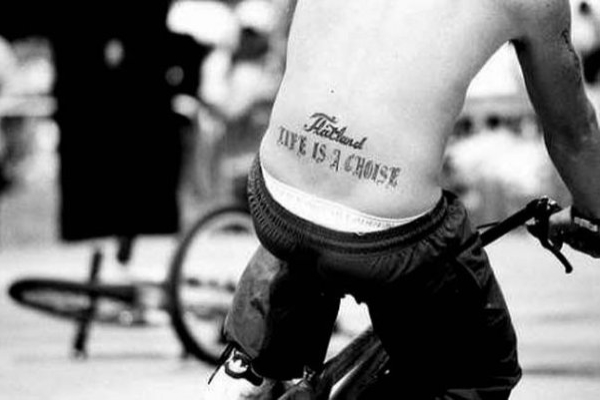
And sometimes we make the wrong Choises.

Life is a Choise

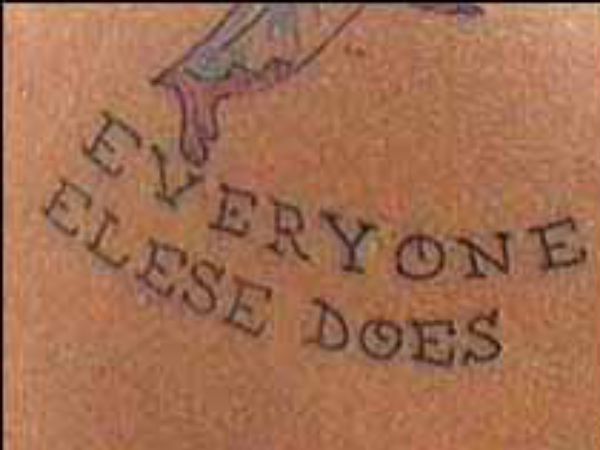
That's no excuse.

Everyone Elese Does

I'm soooo jalous of the punctuation.

Are You Jalous&

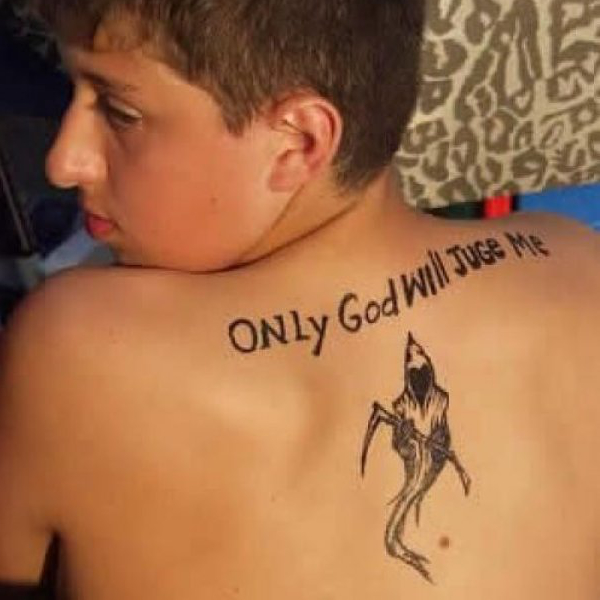
God and Mrs. Henshaw

ONly God Will Juge Me

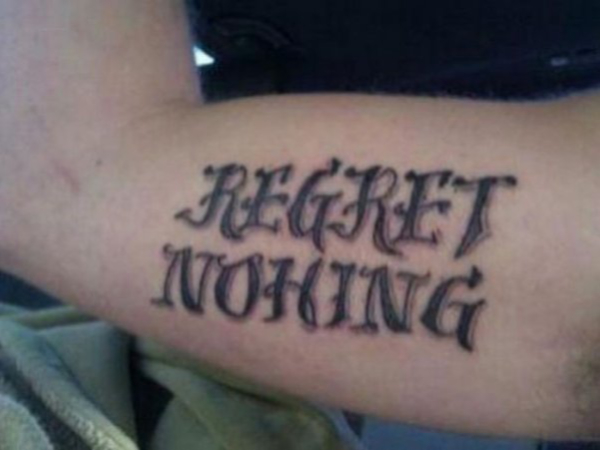
Except lack of a spell-checker.

Regret Nohing

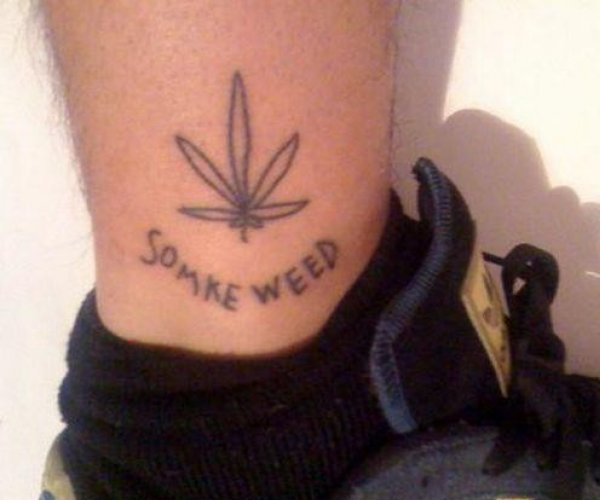
Stating the Obvious.

Somke Weed

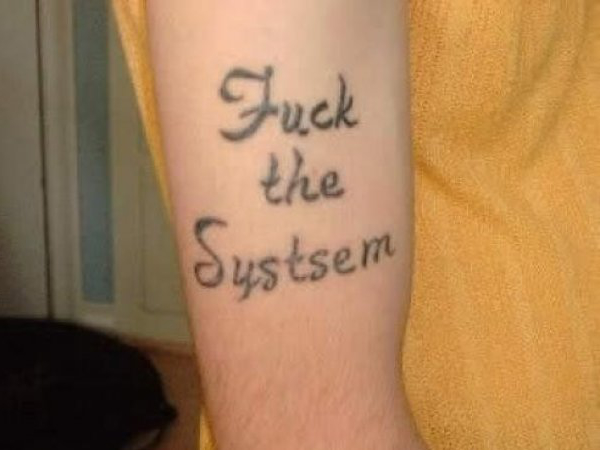
Revolutionary 101, it's Systsemic.

Æ’ the Systsem

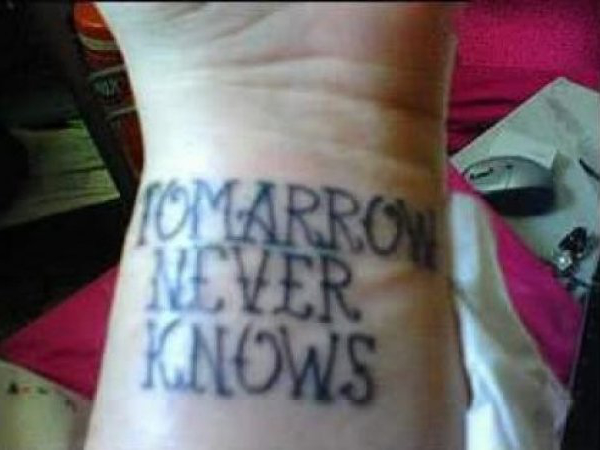
As the James Bond franchise wore on…

Tomarrow Never Knows

Now that's just sad.

Tradgey • Comedy

Uh, okay, I get it. I'm outta here.

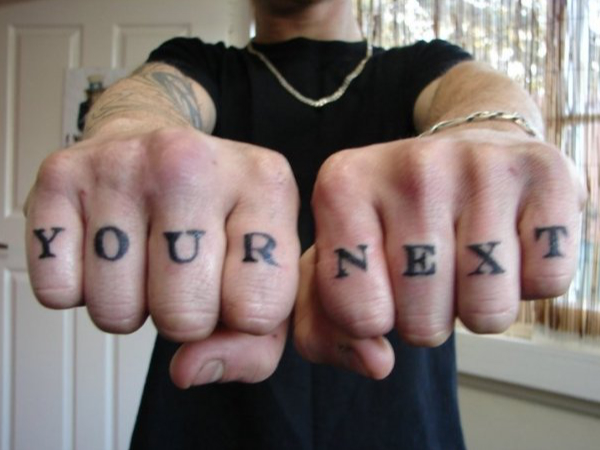
Your Next
neutered male symbol, male with bar through it

But wait, there’s more.

While researching, I came across a charming story about a guy who’d adopted a rescue dog from a pound. The dog had been tattooed, and the new owner felt badly for it. In solidarity with his new pet, he had the same tattoo burned into his skin. Aww, sweet!

Normally the story would end there, but the innocent owner hadn’t checked out the meaning of the tattoo.
It meant ‘neutered’.

Unless otherwise noted, pictures © Sverige2

21 April 2021

The Devil You Don't Know


So you want to write a short story, but you can't think of an idea.  Is that what's troubling you today, Bunkie? 

I have a suggestion.  Specifically, here's a writing exercise that might help you out.

I assume you read a lot of short stories.  (If you aren't reading what you want to write you are doing it wrong.)

So, the next time you are really enjoying a story, stop reading halfway through.

Painful?  You need to know what happens!  How does it end?

Good question.  So sit with it a while.  What happens next?  Is there a twist?  Does the protagonist get what she wants?  Work it out in your head.  Maybe write a paragraph or two.

Once you have decided how the plot is going to turn out, go ahead and finish reading the story.  Did you guess the ending?  If so, bravo to you for your discernment.

But if you guessed wrong - congratulations!  Now you have a story idea.

I'm not suggesting you should copy the first half of the original.  There's a name for that and it rhymes with "majorism."

But you can build on the original idea and take it in a new direction.


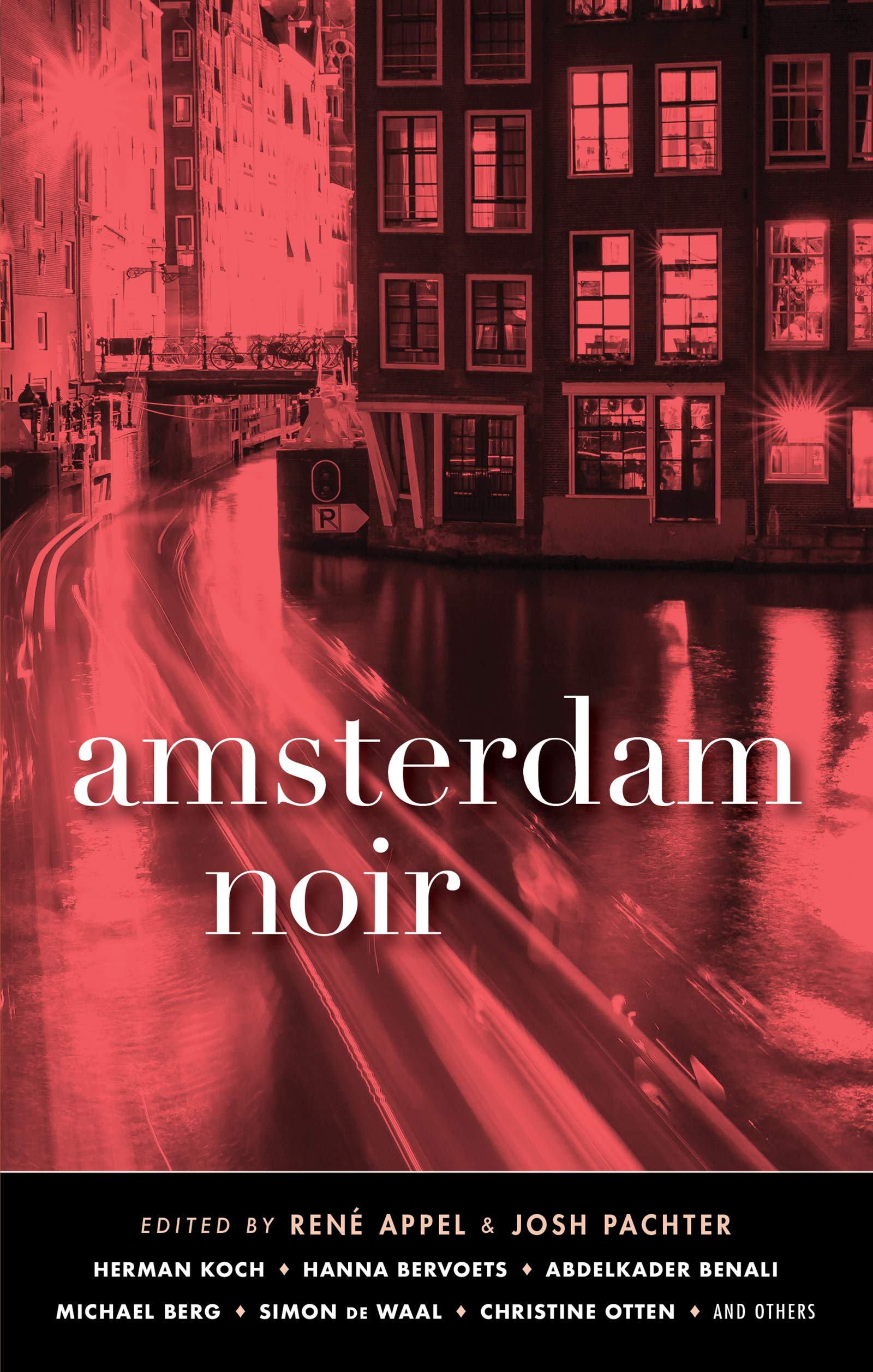
For example: Mensje van Keulen wrote a story called "Devil's Island," which appeared in Amsterdam Noir.  The narrator's friend can't get over his break-up with a girlfriend.  One evening in a nightclub he says "I'd sell [the devil] my soul if he'd make Martha come back to me.  And then a stranger arrives, asking for a light for his cigarette...

It's a fine story and made my best of the year  list.  But the key thing is that I thought I knew how it would end.   Turned out I was wrong.

But just because van Keulen didn't use the ending I dreamed up didn't mean it was not worth using.  So I wrote a story about an actor, sitting in a nightclub and complaining that an upcoming movie has a part that would be perfect for him, but he can't even get a try out.  "I'd sell my soul for a chance," he declares.

And up pops a helpful stranger.  "Call me Nick…"

My story, "The Fourth Circle," is in the current, May/June issue of Alfred Hitchcock Mystery Magazine.

Here's another example, which I wrote about here last year. Janice Law wrote a story called "The General," about a deposed dictator who fears he is losing the love of his son. 

I guessed wrong as to where Janice was leading and that gave me the idea for "Worse Than Death," about a dictator very much in power, whose son is kidnapped.  

You get the idea.  Will the exercise work for you?  Beats me.  If you try it, let me know.


01 March 2021

Ch-Ch-Ch-Changes


by Steve Liskow

Between the ages of about six and fifteen, I spent my Saturday afternoons at the Court Street Theater, five blocks from my house. I watched at least 1000 films. Back then, network prime time featured films both Saturday and Sunday nights, and I saw a lot of them, too.

I discovered fairly early that I seldom liked the film version of a book as much as I liked the book. Later, I became heavily involved in live theater. Over the course of 30 years, I acted, directed, produced, designed, and helped build over 100 productions throughout central Connecticut. On those rare occasions when someone tried to turn a novel into a play, that tended to be a bad idea, too. 

Why?

Because the three art forms rely on different elements. Stories use words, which create images and emotions in the reader's mind and often rely on their style to make their point. Plays use movement or behavior, often in the context of time and space (the stage). Films function through images.

The Great Gatsby is one of my favorite novels, and I've seen five or six film adaptations, none of which satisfied me. Fitzerald's use of biased narrator Nick Carroway doesn't translate well to the screen. I know there is a stage version of the novel, a musical, no less, and I have avoided it. That concise little book, barely more than a novelette, doesn't need heavy-handed jazz production numbers to convey its ideas. There's also an opera, but let's pretend I didn't mention it.

A story with a distinctive or idiosyncratic style doesn't translate to film or the stage (the film version of One Flew Over the Cuckoo's Nest is a glaring exception, and I loathe the play). I've seen several bad attempts to put Wuthering Heights on film (The famous Laurence Olivier and Merle Oberon version clearly does not understand the book). Both Huckleberry Finn and To Kill A Mockingbird have successful film versions, probably because even though they are also 1st-person POV, the characters relate events that happen outside themselves. Horton Foote took liberties with Mockingbird, but they relied on words AND IMAGES. When I showed the video in class, I knew at least one student would tear up when Gregory Peck walked out of the courtoom and a black spectator told Scout, "Miss Jean Louise, rise. Your father is passing."


If that didn't get them, Scout's greeting Robert Duval in his film debut as the shattered Boo Radley always did. "Hey, Boo." Cue the tears. Both  powerful IMAGES supported by words.


When I advised the high school yearbook for several years, I trained myself to be a decent (never more than that) photographer. You can learn composition and cropping. I could never write a screenplay because I'm not visual enough to tell a story through what the audience SEES. I never designed sets back in my theater days because I can't visualize space. Since plays use movement ("Blocking") to help tell the story, you need to translate ideas into motion. By directing 20 plays in as many years, I got better because I figured out how to choreograph movement, but it was a huge weakness in my early work. I learned to move people with the rhythm of the lines and scene, often on a beat change or to emphazise a particular speaker or line. Camera angles do that on film with a good director or editor, but can you connect the visual rhythm to the story's pace? Only if it's mundane writing.

Sometimes, the unreal quality of a play gives it its power, and a film image is too literal. John Pielmeier's play Agnes of God has three characters, one who is both narrator and protagonist. The entire set consists of two chairs and a standing ashtray, and the theatricality makes it all work. My daughter gave me the film version on video years ago, but I never watched it. I'd seen my wife play Agnes on stage and I didn't need to see Hollywood put the bloody wastebasket where the baby was supposedly found in a close-up. 

A theater I worked with for years presented an early STAGE version of High Noon.


Thankfully, I never saw it. Imagine trying to put on stage that series of jump cuts as the film reaches its climax: The clock's pendulum swinging, Grace Kelly waiting for the train, the bartender and other men in the bar, the bad guys waiting for their leader, Gary Cooper writing his will in the Marshal's office, the clock, the bar, the bad guys, Grace Kelly, Katy Jurado, the church congregation, all with that orchestrated version of the title song, the beat synchronized to the pendulum...and then the train whistle that freezes your heart in your chest.

The two final visuals. Grace Kelly embracing Gary Cooper, the wedding ring on her finger. Then Cooper staring at the towsnpeople who refused to help him while he drops his badge in the dust.

The film is based on a story called "The Tin Star." I've never read it.

Cornell Woolrich's short story "Rear Window" has many built-in problems, but Hitchcock figured out how to make it less static with camera angles on film. Alas, a few years ago, a play version was commissioned, or should I say, "committed." My wife played one of the apartment dwellers in the world premiere at Hartford Stage (maybe the only production ever), with Kevin Bacon as the photographer. He was excellent, but he was stuck in a wheelchair on a large stage. The star of the show was the computer-operated back wall that moved up and down so the audience could peer into the neighbors' apartments. It cost $300,000 to build that set, and I don't think anyone has produced the show since...and rented the set so HSC could recoup some of the cost. 


If you want to write a screen play, do it. If you want to write a stage play, do it. If you want to write a novel or short story, absolutely do it. But remember that they're different animals, and mixing species leads to scary mutations. Like the Island of Dr. Moreau. 

14 February 2021

The Pandemic: Babies and Stories


With so much time together with our lovers, many expected a pandemic baby boom, but it is looking more like a bust.

I get it.

My writing fantasy is to have stories - the ones that reveal the places we live and breathe, the dark places, the places of joy - and also the time to write them. 

I now have the time but the onslaught of stories is just too much. The edits on my book are not a boom but a bust. A total bust.

Normally, when I work I shut out the world. Ignore it. However, this is a time in history when absorbing what is going on in the world is needed.

When I sit down to write, my head swirls from the page outward. Perhaps my characters are talking on the phone - I think of all the people isolated by #COVID19 who can only talk to those they love by phone. When my characters sit for coffee, I think of all the lonely people unable to gather and the small coffee shops struggling to survive in this pandemic.

Then there are the elderly in long term care homes, isolated and at times suffering with dementia - how do they make sense of the long days when no familiar faces come? Do they forget them? Do they remember them in their dreams?

The children who once rushed up to playgrounds to do what we have forgotten to do - play with abandon with children they have just met. Now, they are masked and are asked to keep their distance. Will they play with abandon when the virus is gone or will they grow up too soon into the far more distanced adults that surround them? Hell, we are asking them to keep their distance so it would be a small wonder if they don’t.

The lovers, the ones that had planned romantic trips, weddings and parties - what happens when none of that is possible? Do they put that spontaneous side - the most romantic moments - on hold. Can they return?

And then there are those who don’t return at all.  Their families watch them disappear into the bowels of an ambulance or hospital and then can’t see them, hold them before they die. 

I’m bombarded by stories of my colleagues in the #COVID ICUs. They have so many tools to save people but now, their tools are often useless against Covid-19. Death after death. It's everything they've been trained to fight and yet they lose the battle constantly. They are tired and demoralized when one patient dies, the numerous deaths are just too much for them.

And, perhaps a few blocks from these ICUs, people are gathering without masks, perhaps in homes, to have a drink, laugh and spread this damn virus around another room.

Will all the pandemic stories raging around demanding attention finally settle when the worst of this pandemic is over? Will we have time to write them when life returns to normal?

My hope is that these stories will be written and we will take the time to pay tribute to each person we can. There have never in my lifetime been so many stories crying out to be told. There are also so many people who are now no longer with us to tell their story and we need to honour them by telling it.

I have practiced medicine. I have written. Both involve a similar process.

In medicine, the key to a diagnosis is always the story - the more fulsome the story, the more likely the diagnosis will be accurate. And after diagnosis, following the story allows us to assess the treatment and, more importantly, how the patient is doing. 

With writing, the key is always the story and the more fulsome, the more accurate. 

With the pandemic stories that will be written, I hope that that they will be about how we recover, or don’t, from this terrible time in our history. Like a medical story, we need to follow this up. 

At this point in time I have no idea how the story ends for us all.

Oh, and babies. We need to see more babies please. We need a new generation to whom we pass on our stories, because this has been a time of such important stories. But until we pass on our stories, we need the joy of a new beginning.

24 January 2021

Tell Me a Light Story, Tell Me a Tale


Your Job: Write us a story of mystery and intrigue.

It’s a box, just an ordinary carton for a light bulb. At $25, the lamp is a bit expensive, but it’s an LED ‘smart bulb’ with motion and light sensors. It also communicates with Google Home automation, which activates it at sundown and disables it at sunrise. The flood lamp supposedly lasts 22 years and uses less than $2 a year in electricity.

Here are the four sides of this curious box:

box front
box left
box back
box right

The box features the specs, a picture of the light and two additional images, one of them a girl who’s apparently joyously toying with her cell phone. The other graphic also pictures a girl… but… what the hell?

blowup of panel picture

The well-lit house appears to be in a forest. This night, two lawn chairs sit empty on the deck. Wood pallets on one side rest against a tree.

But why is the girl on the ground? What is she reaching for? Or pointing at? Or warding off? Why is her pose so peculiar?

Imagination might suggest an Andrew Wyeth painting gone wrong. Or perhaps the girl has been kidnapped, captured and held in the woods. Perhaps she’s trying to escape.

But who’s taken her? Seven little guys with names like Flippy, Flappy, Floppy, and Dorky? Or a weird prince with delusions of Roquelaure? Or aliens? Or a boyfriend in a consensual game of hide and seek? Or she twisted her ankle when three bears chased her? Are those bears hiding beneath the deck or behind the pallets? Enquiring minds want to know.

So click on the picture below to expand it for any grainy detail you can discern, then tell fans a story about the scene.

Strange scene on Sengled light bulb box
*click* the picture to enlarge

Mystery number two: Pray tell us what the hell the package designer was thinking.