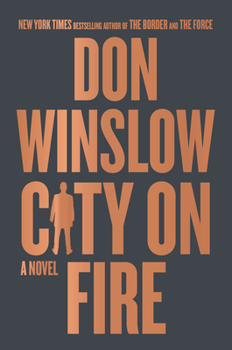
I mention this because the situation has come up again and I am wondering if I should place a big SPOILER ALERT over this whole column. If you have never read Don Winslow's Danny Ryan trilogy you might want to stop now. Or not. Your choice.
The first book, City on Fire, describes a war between two mob families, one Irish and one Italian, for control of Providence, Rhode Island in the 1980s. The next two novels explain the aftermath of the battle. And they are great. I highly recommend them to anyone who likes fiction about organized crime.
I should say I didn't actually read the novels. I listened to the audiobooks. I like to think that if I had been reading them (and paying more attention to the epigraphs) I would have caught on more quickly to what Winslow was up to.
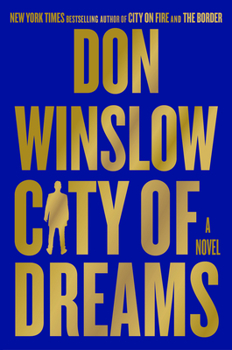
Which it is. Winslow transferred the Illiad to modern New England.
I grabbed a pen and started writing down Winslow's characters next to their Homeric equivalents. Unlike Christopher Nolan's movie, which I wrote about last week, most of the gods are present and accounted for (in human form, of course.)
By the way, City of Dreams and City in Ruins combine the Aeniad, the Odyssey, and the Oresteia. Danny Ryan, the protagonist, is Aeneas.
I was astonished to read one reader on the web complaining that if you know your mythology there are no surprises in the books. I felt exactly the opposite: because I knew the myths I was excited to see how he fit Homer's and Virgil's incidents into his story line. For example: What is the 1980s U.S. equivalent for the Trojan Horse?
I was reminded of a passage in one of my favorite plays, Antigone, which is Jean Anouilh's take on the tragedy by Sophocles. The Chorus (who in the play is one person) distinguishes between tragedy and melodrama. I wish I could quote his whole speech but, alas, I was the copyright officer for my university for a while and know better. So here is just a taste:
In a tragedy nothing is in doubt and everyone's destiny is known. This makes for tranquility... In melodrama you argue and struggle in the hope of escape. That is vulgar; it's practical. But in tragedy, where there is no temptation to try to escape, argument is gratuitous; it's kingly.
Which is how I felt about the characters in Winslow's novels. This was especially true in the last volume as we watch two men who both want peace being dragged into inevitable conflict (with a little help from Winslow's version of Juno).
Anyway, I think you will enjoy the books even if the only Homer you know is Simpson. But if you grew up on d'Auliare's Book of Greek Myths, like me, you'll love them.
And now, a completely different but oddly connected subject.
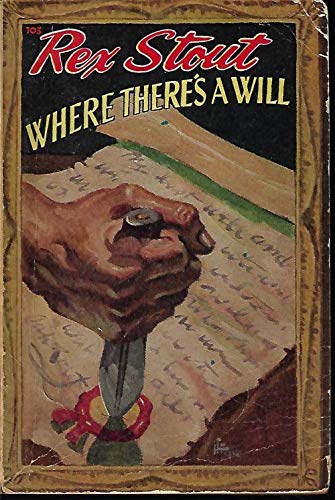
Rex Stout's eight novel about Nero Wolfe, Where There's A Will (1940) centers on the death of Noel Hawthorne, a wealthy businessman. Among the suspects are his three sisters. June, the eldest, is married to the Secretary of State. May is a college president and Archie jokes that "they are thinking of prosecuting her under the anti-trust laws for her monopoly on brain cells." April is a movie star.
But get this. The two younger sisters nickname the eldest Juno. Juno (Hera) was Jupiter's wife, queen of the gods. Minerva (Athena) was the goddess of wisdom. Venus (Aphrodite) was the goddess of beauty and sex.
So is it a stretch to say we have:
*June (Juno), married to a powerful man
* May (Minerva), dispenser of wisdom
* April (Aphrodite), the beautiful.
But wait there's more. Those three goddesses fought over the Golden Apple of Discord, leading to the Trojan War. And Noel Hawthorne, in his will, left his sisters nothing but, respectively, an apple, a pear, and a peach. The reason for this is never explained in the book except as a "token of his regard."
And that same dead brother? Many years earlier he had accidentally shot his wife with an arrow, leaving her face so scarred that she always wears a veil.
Put this all together and it certainly seems like Stout is trying to connect it all to some myth, but I've never been able to make sense of it.
Next time I am in Delphi I will stop by the Temple of Apollo and ask the Oracle.


Rob, you made me want to read Where There's A Will again.
ReplyDeleteIf you can figure out what (if anything) mythological Stout had in mind I would appreciate you revealing it.
ReplyDelete