Showing posts with label Sherlock Holmes. Show all posts
Showing posts with label Sherlock Holmes. Show all posts
08 July 2026


11 May 2026
Sherlock Holmes Actors
Recently I have been thinking about immortality, not the human and aspirational kind, typified by one of our billionaires who apparently wants to sleep his way to eternity, but the curious immortality of certain literary creations. What mysterious secret ingredients has kept folks like Oedipus and Antigone, David and his rival Goliath, Medea, and Orpheus, and the notables of the Hindu epics evergreen and ever present?
 |
Sure, a strong connection to an historic religion is a big help, but not essential, considering the continuing presence of our genre's Sherlock Holmes. Not content with retelling his adventures in every medium except dance and opera, we have retired him, married him, gifted him with a daughter and saddled him with multiple bee hives.
He's been treated for addiction – by Sigmund Freud, no less; brought into the 21st century with Sherlock, and just recently restored to callow youth by Young Sherlock, wherein he works as domestic help in Oxford, crashes parties with a louche undergrad named Moriarty, and gets acquainted with a Chinese princess who is a master of both armed and unarmed combat.
Is anything new possible? Well, yes. In The Final Problem, Arturo Perez-Reverte has come up with an angle that I confess I exploited nearly a decade ago: a mystery employing not the great man himself, but one of his impersonating actors. Together, The Final Problem and my own Holmes Impersonator stories provide two more ways to exploit the great detective.
I did not have ambitions to enlarge Sherlock's already expansive realm when I ventured into Holmes territory. I had hopes of breaking into a lucrative weekly supermarket tabloid, and I had come up with what I thought was a clever plot. In the service of this idea, I needed a detective and for reasons unknown, the Holmes Impersonator arrived.
A journeyman actor, employed by regional theaters and the dinner circuit with occasional voice- over or advertising work, my detective makes some extra cash with a regular gig at The Sherlock Holmes Museum, a small private Connecticut outfit with a slim budget and a constant need for donors. I thought he was ideal; the tabloid editors thought differently.
But the Impersonator was resilient. He found a home at Sherlock Holmes Mystery Magazine where he proved to be a clever guy, a useful narrator for six outings, and surprisingly observant. His flaw is his appearance. As child visitors to The Sherlock Holmes Museum invariably observe, he doesn't look like Sherlock. Indeed, tapped for a PBS revival of Sherlock Holmes, the famous play that made star William Gillette rich enough to build Connecticut's one and only castle, he gets cast as Watson.
 |
No such troubles for Perez- Reverte's Basil Osmond, who has the hawk nose and elegant physique of the famous Sidney Paget illustrations. Basil has instant credibility, because he not only looks the part but has played it in over a dozen immensely popular films.
Clearly based on Basil Rathbone, the famous 20th century Sherlock, Perez- Reverte's detective comes with an encyclopedic knowledge of Conan Doyle stories, an almost instant recall of Holmes' famous lines, and the savoir faire of having temporarily been rich and famous and on intimate terms with both London's West End and Hollywood royalty.
Such a character clearly deserves a mystery, and The Final Problem soon sets one for him. Basil has been sailing with a producer who may cast him in an upcoming television series. A storm strands them on a Greek island, one conveniently equipped with a luxury hotel inhabited by other temporarily stranded visitors.

Long time mystery fans will recognize that this setup is far from the atmospheric fogs of Baker Street. We are, in fact, in Agatha Christie territory with nine visitors, the hotel proprietor and three in staff, and very soon we have a corpse, a lot of questions, and no way to get help from the police.
Granted the authority to conduct an investigation, Basil, at first reluctantly and then with considerable flair and enthusiasm, sets to work, assisted by a fawning Spanish mystery writer and fellow Holmes buff.
The plotting, more clever than plausible, gives Basil scope, even if the somewhat awkward epilogue makes clear why Agatha Christie favored dramatic revelations before the assembled suspects.
So, here are our two alternative performers. The low- budget Holmes Impersonator, modest but effective in the compass of short fiction and a small locale, and a famous Sherlock in a luxury setting and the Christie- type plot suitable for a full length novel. Are there room for more such characters? I suspect so.
And what of the secret ingredient, the source of such characters' longevity? I am still far from a solution, but part must be the presence of what the great Scottish philosopher David Hume declared essential to knowledge: a clear and distinct idea.
Sherlock provides that in spades: the pithy phrases, the investigative dictums, and, of course, the instantly identifiable costume. Put a dog or a cat in a deer stalker and an Ulster, hand them a meerschaum pipe and either is instantly recognizable as a detective of this very special type. With a brand like this, no wonder other writers are tempted to enlist him in their literary ventures.
22 March 2026
Get Edalji
File this under: I do love getting lost in a book.
I’ve been a fan of Sherlock Holmes and Sir Arthur Conan Doyle’s writing since I was a teenager. So, it came as a surprise earlier this year to learn of something I didn’t know about Doyle – his involvement in the Edalji Affair. And I also had only peripheral knowledge of what the Edalji Affair was all about. Thanks to an excellent new book, Get Edalji, by Rose H. Schmollek, I got up to speed.

It gets
more complicated.

George
Edalji was the son of the local parson, and the parson’s household had, since
1888, been subject to an ongoing campaign of poison pen letters (many
threatening, many vile), fake newspaper announcements, and many other
harassments. Blame fell upon a member of the parson’s household staff, a maid.
She was subsequently brought before the court, where she pleaded guilty – in
exchange for being given probation (she couldn’t afford a defence lawyer, and
she maintained her innocence until her death).
The police
sergeant investigating, however, was convinced George Edalji had been
responsible for the letters and other annoyances. Others at Scotland Yard
shared this view. In short: The constabulary wanted to get Edalji.
It gets
even more complicated.
Poison-pen
letters weren’t just sent to the vicarage, but to others, including the police.
And the letters (self-purportedly) were written by a variety of authors, with
one stating he was a member of the “Wyrley Gang,” the group responsible for the
animal mutilations. This writer wrote that George Edalji was himself a
Wyrley Gang member.
In short:
Because of the existing, long-running suspicion of George Edalji (the poison-pen
letters), and some circumstantial evidence connecting him to the maiming of the
pony, he was arrested, tried, and convicted of animal mutilation.
George’s
mother began an earnest campaign to free her son from jail. The premise of her
argument was that no firm evidence had been presented, and that George’s
innocence had been clouded in the court’s view by their belief he was
responsible for the poison-pen letters, of which there was also no firm
evidence. Her position saw over 10,000 people sign a petition and a flurry of
discussion in the legal world.
In short:
George Edalji was paroled three years into his sentence, and his case led to
the establishment of the British Court of Appeal.
However,
George Edalji was not granted a pardon.
And the poison-pen
letters continued.
Enter, Sir
Arthur Conan Doyle.

One of the
key reasons the Great Wyrley Outrages are so famous is Doyle. Sir Arthur took
an interest in the case. He met with George Edalji, investigated the events,
and subsequently campaigned for George’s pardon. In Doyle’s opinion, George
Edalji could not have committed the attack on the pony. Doyle was also
sceptical of handwriting experts who claimed George had written some of the
letters. In Doyle’s eyes, George Edalji was an innocent man wrongly accused of
all crimes. Given that Doyle was the creator of Sherlock Holmes, and, in that
first decade of the 20th century, was at the height of his celebrity, most
people took Doyle’s word for it. Who are we to argue with a doctor, a knight,
and the creator of one of literature’s greatest detectives?
Doyle was
successful in his endeavour to some extent – Edalji was pardoned, but he
was not granted a full pardon (he was never acquitted, which
Doyle wanted, and he was never compensated for his prison time).
What
transpired at Great Wyrley took place more than a century ago. Looking back
from today, the events appear as a great tangled cobweb that spans several
decades. Many books have attempted to unravel it, including one by Doyle
himself. Over the years, there have been films, television series, and
countless journalistic investigations. Most favour Doyle’s conclusions. Who are
we to argue with a doctor, a knight, and the creator of one of literature’s
greatest detectives?

GET EDALJI
reopens the case. It undertakes a fresh, up-to-date examination of the events,
and it draws different conclusions from those of Doyle. It uncovers evidence
that others who have written about the case have not. It untangles the web.
The
research presented in this book is rich and detailed. It is a criminal case
analysis worthy of Sherlock Holmes; it has his tenacity and attentiveness. The
Edalji affair is a complex series of events, spanning many years, and involving
dozens of people. GET EDALJI admirably presents these events and persons
clearly and consistently. If you come to this story with no prior knowledge,
you won’t get lost in a myriad of details.
Sherlock
Holmes frequently solved his mysteries through the behaviour of man, by considering
human psychology. This book does, too. Our understanding of the mind and its
workings has evolved enormously since Doyle’s day. Things he was oblivious to
in his time are readily observed and understood 120 years later. GET EDALJI
sheds light on these. It is sensitive, equally, to the racial attitudes and
prejudices prevalent in Victorian/Edwardian England. Edalji was of mixed race.
The ace in
the research's hole are the many letters at the heart of the case – modern
forensics has been applied to their texts. Dr Isabel Picornell, a leading
authority in forensic linguistics, has made a detailed study of the letters,
and her findings are presented in this book.

This is a
delight of a book to hold and touch (see the photos). All books should come
with such lavish presentation: supplements, hard-bound encasement. The pages too
are populated with a variety of illustrations, photographs, and many newspaper
clippings. There is attention to detail here. It’s immersive.
GET EDALJI was written by Rose H. Schmollek – a pseudonym for author Petra Weber. Petra chose the pseudonym (it’s also an anagram) as a nod to the many people – an international team – who helped her in the book’s research. Petra Weber is the author of 17 crime novels and short stories (written under a different pseudonym) and is the publisher of KrimiKiosk, a popular true crime podcast.
 The book’s title, “GET EDALJI,” can be read three ways. (1) Literally, Get Edalji. As many in law enforcement at the time wanted to. (2) It’s the man’s name: George E.T. Edalji. (3) Get, i.e., understand, Edalji. Clever.
Immerse yourself in the social fabric of England 120 years ago and find yourself in a mystery both intriguing and puzzling. It’s definitely a three-pipe problem.
Be seeing you.
Stephen
22 June 2025
New Adventures of the Napoleon of Crime
So there I was, minding my own business when that dastardly evildoer’s name popped up on my security screen. Professor James Moriarty was up to his old habits, literally escaping the hangman’s noose in the first five minutes of a restored Lumière moving pictures Cinematograph. The case may have been part of the Moriarty Canon, but one and a quarter centuries later remains unmentioned In the official Holmes Canon.
Unfortunately, Holmes does not revert to his brilliant disguise as Jeremy Brett. Despite this, as a public service, we share with you this previously untold history titled Hands of a Murderer. If you prefer to watch this later during your own criminal pursuits, here is a link for your tablet or phone:
https://www.youtube.com/watch?v=cDkkrdAsbd0
And now, Hands of a Murderer:
20 December 2024
Alimentary, My Dear Watson!

I blame Dickens for my household’s attempt to cook a Christmas goose some years ago. My wife and I had always been charmed by the Cratchit family’s dinner of goose and Christmas pudding depicted in the 1999 TV version of A Christmas Carol starring Patrick Stewart. We followed Julia Child’s instructions to the letter, but did not have the “tight-fitting lid” for our roasting pan that is so critical for properly rendering the bird prior to roasting. For weeks after, I felt as if everything I touched in the house—my eyeglasses, my computer keyboard—was coated with a fine film of goose fat. It’s not a fowl I desire to ever eat again. The Cratchit bird fed eight, and I get it. One slice of that rich meat is all anyone needs to survive winter.
I’ve since come to respect geese. The living specimens are fierce protectors of their turf who figure prominently in ancient art. In Rome people told us that if you didn’t have a dog, you could rely on a goose to keep your yard safe from intruders. No one wants to be bitten in the butt by an angry honker.
Alas, when the fowl shows up in literature, it’s usually on someone’s plate. The “unimpeachable” goose who is the star of Sir Arthur Conan Doyle’s “The Adventure of the Blue Carbuncle” starts out alive, then ends up dead and the centerpiece of a mystery. Interestingly, as we shall see, that goose kept coughing up mysteries well into the 20th century.
The 8,000-word story is the only Christmas tale in the Sherlock Holmes Canon. It first appeared in the January 1892 edition of The Strand magazine. (You’ll find it in the first book of collected stories, The Adventures.) If you know your Holmes, it’s the story that starts with the great man deducing the heck out of a bowler hat that has lost its owner, and later confronting a nervous amateur jewel thief who has stolen a precious gem—a blue carbuncle—from the belongings of a countess lodged at a London hotel. To keep the jewel safe until he can consult with his fence, the thief thrusts the gem down the throat of a living goose in his sister’s backyard. The goose gets switched on him, is sent to market, and zaniness ensues.
I reread the story recently to see what sort of Christmasy details Conan Doyle folded into his prose. They’re sparse; mostly Watson describing cold weather, warm fires, a cast of chilly characters, and ice crystals forming in windows. There are no Christmas trees or presents. Since the story is nearly 133 years old, I don’t think I’m spoiling anyone’s enjoyment by revealing that in the end, Holmes lets the repentant thief off scot-free. Because, he argues, “it’s the season of forgiveness.”
I enjoyed the story immensely this time around, and then foolishly read all the notes about it in my copy of Leslie S. Klinger’s The Annotated Sherlock Holmes. That’s how I learned that serious Sherlockians have long quibbled with fine points of the tale.
Some examples should suffice. A carbuncle is a garnet, which are typically red. Though they have been found in other colors, there’s no such thing as a blue carbuncle. No garnets have ever been found in the Chinese river Holmes mentions as the origin of this stone. The detective botches a discussion of the jewel’s weight, presumed value, and chemical composition. The law enforcement official in the story conducts a hardness test on the stone that does not prove what he thinks it does. Moreover, of the eleven or so deductions Holmes makes about the bowler, Sherlockians dismiss at least four as highly illogical.
But hey, if our author couldn’t get the number of Watson’s wives straight, or the location of the shrapnel the good doctor brought back from Afghanistan, why do we expect him to get such details right? Conan Doyle wrote to make glad the heart of geekhood. He was a little like the Hungarian-American director Michael Curtiz, who when someone pointed out all the implausibilities in the script for Casablanca, replied, “Don’t worry. I make it go so fast nobody notices.”

Sometime after WWII, however, a clever female reader proved just how much the largely male membership of Holmes societies knew about geese. Throughout the story, we are told repeatedly that the stolen gem was found in the goose’s crop. That word is mentioned five times in the story. Since many birds do not have teeth, they pre-digest their food by funneling items into a separate anatomical pouch, which is sort of a pre-stomach.
I remembered seeing such a thing as a child, watching my mother butcher a backyard chicken. The bird’s crop was filled with tiny pebbles, which chickens instinctively swallow in their pecking. That grit is later used by the gizzard, the muscular end of the stomach, to grind bugs and vegetation so they can more easily be digested.
In a sidebar in Klinger’s Annotated Holmes, our editor tells us that the “Blue Carbuncle” was referenced during Christmas season 1946 by Chicago Tribune columnist Charles Collins, who was a friend of Vincent Starrett’s and a founding member of the Chicago chapter of the Baker Street Irregulars. A longtime journalist, Collins wrote a popular column called A Line o’ Type or Two for the newspaper. Some days later, astute reader Mildred Sammons fired off a note, taking issue with his six-paragraph summary. Her brief note appeared in the newspaper the day after Christmas that year.
I remembered seeing such a thing as a child, watching my mother butcher a backyard chicken. The bird’s crop was filled with tiny pebbles, which chickens instinctively swallow in their pecking. That grit is later used by the gizzard, the muscular end of the stomach, to grind bugs and vegetation so they can more easily be digested.
In a sidebar in Klinger’s Annotated Holmes, our editor tells us that the “Blue Carbuncle” was referenced during Christmas season 1946 by Chicago Tribune columnist Charles Collins, who was a friend of Vincent Starrett’s and a founding member of the Chicago chapter of the Baker Street Irregulars. A longtime journalist, Collins wrote a popular column called A Line o’ Type or Two for the newspaper. Some days later, astute reader Mildred Sammons fired off a note, taking issue with his six-paragraph summary. Her brief note appeared in the newspaper the day after Christmas that year.
Regarding the Sherlock Holmes Christmas story, “The Adventure of the Blue Carbuncle,” discussed in the Line o’ Type column on Dec. 17: It contains a statement that the missing jewel was found in the crop of a goose. Let me remind you that a goose has no crop.
You could hear a feather drop in the great and glorious Kingdom of Holmesiana. By then the tale was 54 years old; in all that time none of the geniuses had spotted this error.

After consulting various waterfowl experts and butchers, the U.S. experts conceded: “[T]he lady is correct. Holmes made an alimentary error, which the Baker Street Irregulars should have noted long ago.” There was talk in the pages of The Baker Street Journal of granting Mildred Sammons some sort of award “in gratitude for her discovery.”
I don’t know if she ever collected, because of course it didn’t end there. Scholars on both sides of the pond kept interrogating poultry experts, further beating a dead goose. The problem went all the way to the UK’s office of the Minister of Agriculture and Fish. The Ministry’s Chief Poultry Adviser—who of course turned out to be a Holmes geek—weighed in, saying that the American experts were correct. “However,” he added, “as a Sherlock Holmes fan I am glad to say that this fact does not necessarily invalidate the theory in the story of the ‘The Blue Carbuncle.’”
The reasoning: Yes, chickens and turkeys have a separate organ or pouch called a crop. Waterfowl such as geese and ducks have no such pouch, but their gullet is just long and extendable enough to accommodate food—or the occasional precious gem—that will be stored and later digested. If the goose’s stomach is full, a swallowed item might well remain lodged in the gullet, awaiting its turn. (I beg your indulgence here. I am not an expert on poultry anatomy. I am relying on articles such as this, on the glories of the digestive tracts of waterfowl. Feel free to cry fowl if I've screwed anything up.)
Naturally, this engendered a flurry of further academic papers, the most hilarious of which was written by a Sherlockian who posited that the hullabaloo was all beside the point. Maybe, just maybe, quoth he, “the long debate is centred on a printer’s error, which substituted an o for Watson’s a.”
And on that note, I’ll wish you all the best of the season, however you celebrate and whatever graces your table.
* * *
Please use the comments to share some of your favorite holiday stories. I could use a few suggestions.
I recommend Connie Willis’s 544-page A Lot Like Christmas, if you can stomach that much Christmas, much of it novella-length SFF. I also recommend Kristine Kathryn Rusch’s Holiday Spectacular, which she describes as a virtual advent calendar that delivers one new story—a romance, mystery or fantasy by various authors—to your inbox every day from Thanksgiving through New Year’s Day. All holidays are represented, not just Christmas.
See you all in the New Year!
Joe
12 May 2024
The Female Detective : 1864

The physician, Arthur Conan Doyle, published his first Sherlock Holmes story, “A Study in Scarlet,” in 1887. Recently, I was surprised to find an earlier detective book, The Female Detective, written by James Redding Ware and published under the pseudonym Andrew Forrester. It is a collection of short stories published in 1864, is narrated by Mrs Gladden, the first British woman detective.
Mrs. Gladden’s friends assume she is a dressmaker but she is quite clear that she is a professional detective, and in a charmingly feisty manner defends this by saying “ … if there is a demand for men detectives there must also be one for female detective police spies.”
Her approach to investigating crimes anticipate the methods of Sherlock Holmes. Mrs. Gladden physically examines crimes scenes and looks for clues. Sherlock Holmes is famous for using inductive reasoning, born from medicine – moving from observation to hypothesis – and also deductive reasoning, also born from medicine – from theory to conclusions. This dual reasoning has persisted to this day in all detective novels and was, surprisingly, first used by Mrs. Gladden.
In one story, The Unraveled Mystery, a doctor consults Mrs. Gladden on a gruesome murder case. A carpet bag had been found containing an unidentified body, cut in pieces and missing its head. The doctor goes through evidence, via inductive reasoning, based on skin and hair examination, and concluded the body was that of a foreigner. Mrs Gladden then goes on to conclude that he was also murdered by a foreigner because the murder weapon was a knife, more often used by foreigners, and this interesting piece of deductive reasoning: “We have here in London foreigners who are ready to assassinate.”
The last quote is amusing but shouldn’t take away from this fascinating set of short stories – they are interesting in logic, detective work and for how they set the historic precedent for modern detective novels. These stories and the introduction to them have many elements still present in detectives novels.
Using first person narration, still common in detective novels, Mrs. Gladden argues that detectives are necessary and follows this with evidence when police were rather incompetent and she was not – again, this notion still persists – the detective succeeds where law enforcement fails. Even the somewhat prejudiced view of foreigners ready to assassinate is tempered with her strong sense of that justice to be served for all, including the foreigner who was murdered and she concludes that the police are too prejudiced to care about this murder.
The notion that detectives in novels hold the moral line, right wrongs and do so despite those in power continues to this day. Mrs. Gladden’s many, shall we say, definitive views, are also very much a part of the detective novel history. An interesting example is Mrs. Marple who was both charming but also held many rather definite views and the novels have been edited to cut out language that today is considered racist, although many of us understand that Agatha Christie was a woman of her time, using language of her time and the word 'racist' may be a bit harsh. In the new rendition of Mrs. Marple in Holmes, Marple & Poe by James Patterson and Brian Sitts, Mrs. Marple has lost the inappropriate racial language, upped the empathy but remains very definitive about how repugnant she finds those who break the law and the limits of decency. We now often call this definitive view of the world ‘voicey’ and it is crucial in detective novels where moral lines are often drawn with a voice that refuses to compromise with evil.
The language of the stories in The Female Detective is old school and I found myself having to reread parts till I understood fully what was meant. It was well worth the effort. It’s a lovely look at life back then when the profession of detective was not a woman’s one. In fact, few professions were open to women at all. Mrs. Gladden makes it quite clear that she is not a dabbler in crime, but rather, a professional who investigates them. Quite remarkable for that time in history. Although I’m still making my way through this book, this article was due and I couldn’t think of a more interesting subject than the first female detective story in British fiction.
By this point you may be wondering why I mentioned Sherlock Holmes but not The Murders in the Rue Morgue, the short story by Edgar Allan Poe, first published in Graham's Magazine in 1841 that precedes this set of short stories and is, in fact, the first detective story. The reason is rather embarrassing: I have not read Edgar Allan Poe. However, I have read all the Sherlock Holmes stories and feel comfortable speaking a bit about them. After this particular dive into detective history with the first female detective, I’m waiting for the collected works of Edgar Allan Poe to arrive in the mail to feed my new curiosity about early detective novels.
23 January 2023
Dr. Watson Had How Many Wives?
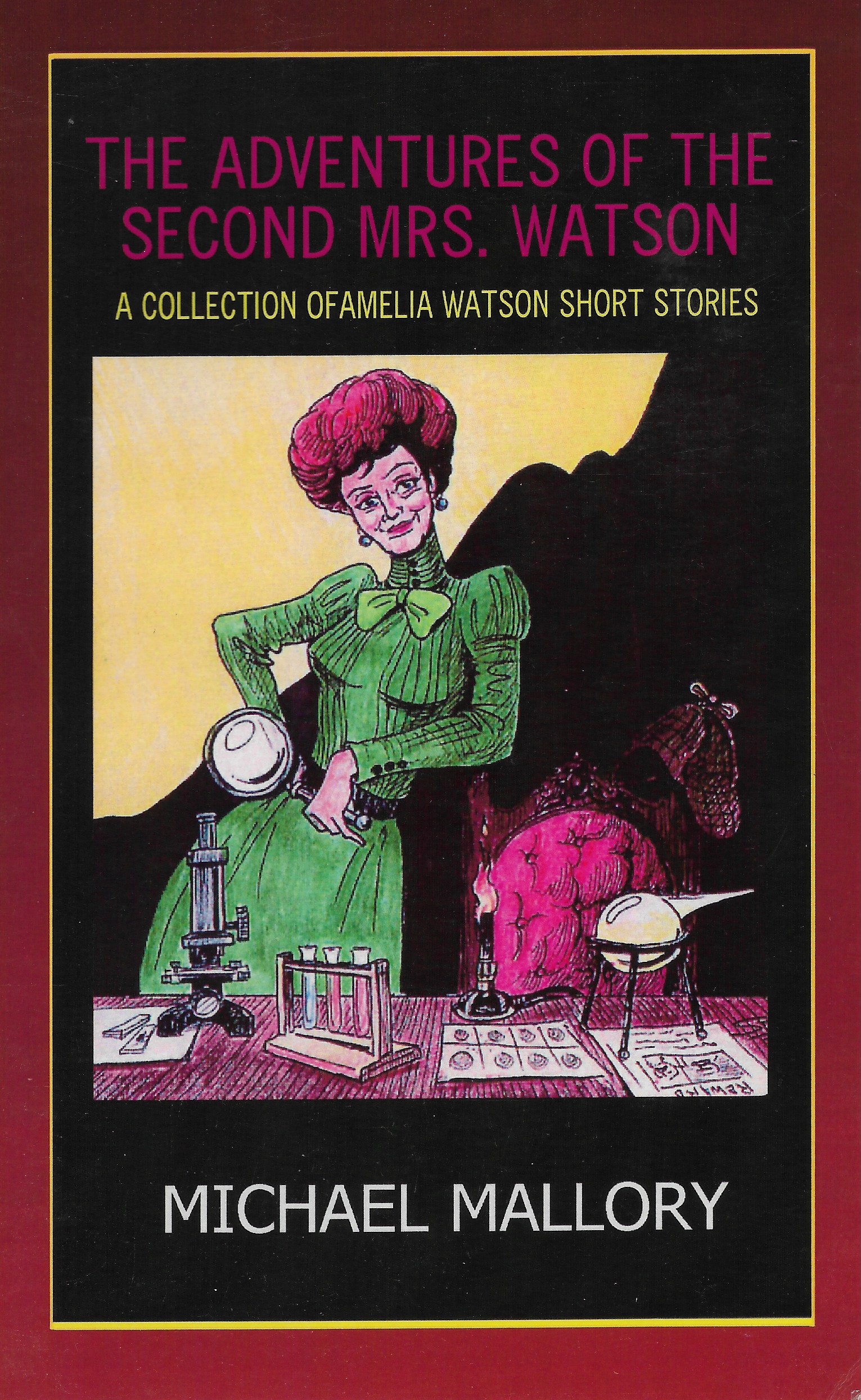
DR. WATSON HAD HOW MANY WIVES?
by Michael Mallory
How many wives did Dr. John H. Watson, of Sherlock Holmes fame, actually have? The fact that so many people even care about this is a trait of those devoted Sherlockians who like to purport that Holmes and Watson were real people, not iconic fictional characters. That is the “grand game” as put forth by today’s Baker Street Irregulars (BSI), an organization of devoted Holmesophiles who pretend that Watson actually participated in and recorded the adventures of his singular friend, and that this Arthur Conan Doyle chap was simply his literary agent.
My personal opinion of this mindset is that it rather disrespects a major Victorian author, but for these purposes, that is neither here nor there (other than the acknowledgement that by humbugging the grand game, I will never be invited to join the BSI). My purpose is to speak about how many trips the good Dr. Watson made to the altar and why it is even in question.
For nearly 30 years now I have been turning out stories, novels, and even one full-length play featuring Amelia Pettigrew Watson, whom I call “the Second Mrs. Watson.” There is a sound reason for this, to my way of thinking, but many Sherlockians disagree. I have heard theories that Watson was married a total of six times, and once encountered a Sherlockian who claimed to have evidence that the real number of wives was 13! Since this would paint Watson as either the second coming of Bluebeard or the first coming of Mickey Rooney, I did not take him very seriously. For most faithful Sherlockians, however, the number is three, though we only have details of one of them.
Watson’s only indisputably-documented wife was Mary Morstan, the heroine of the novel The Sign of the Four. Mary is mentioned in another half-dozen short stories, and while her union with Watson appeared to be very happy, it was short; she died “off-stage” during Holmes’s “Great Hiatus,” his multi-year disappearance after presumably being killed by Professor Moriarty.
The only other mention of Watson remarrying comes from the story “The Adventure of the Blanched Soldier,” which was published in The Strand Magazine in 1926 and collected in The Case-Book of Sherlock Holmes the next year. In it, Holmes himself writes: “I find from my notebook that it was in January, 1903, just after the conclusion of the Boer War, that I had my visit from Mr. James M. Dodd, a big, fresh, sunburned, upstanding Briton. The good Watson had at that time deserted me for a wife, the only selfish action which I can recall in our association.” One of only two short stories narrated by Holmes himself, “Blanched Soldier” reveals a surprisingly vulnerable detective who, based on the above comment, is hurt and angry over Watson’s abdication for a woman. It also generated one of the biggest mysteries within the Holmesian canon, since this mystery woman was not identified and was never heard from again.
In 1992 I began playing around with the idea of writing a Holmes and Watson pastiche told from a woman’s point of view. Using Irene Adler seemed too obvious, while Mary Watson never seemed to engender such a feeling of replacement in Holmes’s life. Then I remembered the “second,” unknown Mrs. Watson, and from that single reference to her developed Amelia Watson. She is not only Watson’s devoted, slightly younger wife, but I present her as something of a foil to Sherlock, particularly if she believes Holmes is using her husband.
I remain grateful that faithful Sherlockians have enjoyed her adventures, particularly since I have at times treated the legend rather playfully through her POV, the chanciest conceit being that maybe Watson was a better writer than Holmes was an infallible detective, and he fixes his friend’s mistakes in print. The only point of contention I’ve encountered from the faithful is in presenting Amelia as Watson’s second wife instead of the third. But if Mary Morstan was Watson’s second wife, not his first, and Amelia was his third, not his second, who was the first? The answer to that can be found only outside the canon of 56 short stories and four novels written by Arthur Conan Doyle.

Sometime in the late 1940s, author and Sherlockian John Dickson Carr was granted permission to look through Conan Doyle’s private papers in preparation for writing his biography. One thing Carr discovered shocked him. Around 1889, in between the publication of the first Sherlock Holmes adventure A Study in Scarlet (1887) and the second, The Sign of Four (1890), Conan Doyle wrote a three-act play titled Angels of Darkness, which dramatized the American scenes from A Study in Scarlet. Holmes was nowhere to be found in it; instead Watson was the main character. By the play’s end the good doctor was headed toward the altar with a woman named Lucy Ferrier, who was a character from the flashback section of the source novel.
Carr’s dilemma was that this previously unknown work, which Conan Doyle never intended to see the light of day, upended the “facts” of Watson’s life. “Those who have suspected Watson of black perfidy in his relations with women will find their worst suspicions justified,” Carr wrote of his discovery. “Either he had a wife before he married Mary Morstan, or else he heartlessly jilted the poor girl whom he holds in his arms as the curtain falls on Angels in [sic] Darkness.”
Making the problem even murkier for grand gamers, Lucy Ferrier could not be the first Mrs. Watson since The Sign of the Four has her dying in Utah sometime in the 1860s, when Watson would have still been a schoolboy. In light of this stunning discovery, Carr’s felt he had only one option: keep it to himself. He wrote that revealing the woman’s identity would “would upset the whole saga, and pose a problem which the keenest deductive wits of the Baker Street Irregulars could not unravel.” One man, however, accepted the Gordian challenge.
William S. Baring-Gould (1913-1967) was not only the leading Sherlockian of his time; he became something of the St. Paul of Sherlockania, a writer who fashioned the outer-canonical Gospel of Baker Street which is accepted by the faithful to this day. Realizing that John Dickson Carr was right in his assessment that the Watson-Ferrier match would turn the entire saga on its head, he did what all good authors do: he made things up. Baring-Gould put forth the notion that Watson had traveled to San Francisco in the early 1880s and there met a woman whom he subsequently married, but it was not Lucy Ferrier. It was someone named Constance Adams.
Who?
The first mention of Constance Adams appears in Baring-Gould’s 1962 “biography” of Holmes titled Sherlock Holmes of Baker Street, and although she exists nowhere in the writings of Conan Doyle ─ not even in Angels of Darkness ─ having the Baring-Gould imprimatur meant that her existence was taken as a given by many.

Even so, I maintain that Mary was Mrs. Watson #1 and Amelia is #2, and for a very simple reason: in crafting Amelia and John’s adventures, I rely on the Holmesian canon rather than later interpolations by others. The same is true when I write a Holmes pastiche that does not feature Amelia. While I take playful liberties here and there, the guidebook for me begins and ends with those 56 stories and four novels, occasional contradictions and all. (For the record, I also ignore Dorothy L. Sayers’s speculation that the “H” in John H. Watson’s name stood for “Hamish,” which is now acknowledged dogma.) In the Amelia universe, she is the Second Mrs. Watson (though in British editions, she is “the OTHER Mrs. Watson,” which I’ve rather come to like as well).
That said, I have not ignored Constance altogether. In a bow to the non-canonical mythology, I included her in my short story “The Adventure of the Japanese Sword,” which is set in San Francisco, and fully explains her youthful association with Watson which is misinterpreted as matrimonial.
You see, two can play the grand revisionist game.
02 December 2022
Sherlock's Kid Sister Returns!
Boy, have the marketing geniuses in the back room got us pegged. They know that we are positively nutty for our Holmes. Just in time for Thanksgiving, Netflix released the long-anticipated sequel to their 2020 film, Enola Holmes 2 about the adventures of the younger sister of the Great Detective.
I discussed the first film last year. Edgar-winning author Nancy Springer wrote the (now) eight-book series from which the concept sprung. For two years, Enola fans whispered the rumor that the second film would draw inspiration from The Case of the Left-Handed Lady, the second book in the series. Not so! I’m afraid that I’m a bit of an author snob. The plot here is fun and clever, but I prefer film franchises to adhere as closely to the source material as possible.
As our tale opens, Sherlock’s teenaged sister has opened a detective agency of her own. Yes, at 16 or 17 years of age, she does strike one as a bit young to be doing such a thing in Victorian London, but as Mother Holmes says in a flashback: “Too many people make it their sole purpose in life to fit into the world around them. This is a mistake!”
Business at the agency isn’t great, but dear brother Sherlock fares no better. The banking scandal he’s investigating has proved “vexing,” his sister reports. After a number of potential clients decline to avail themselves of Enola’s services—“Are you you sure we can’t get Sherlock?” says one—she takes the case proffered by a young matchstick girl whose sister has gone missing. Before long, Enola is disguising herself to gain entrance to upper crust balls, employing the womanly arts of pugilism and bartitsu to dispatch malefactors, and the game is soooo afoot.
Millie Bobby Brown returns as Enola. Henry Cavill is back as the devilishly handsome Superman—er, I mean Sherlock. The actor who played Mycroft in the last outing was unable to join us this time around, but Helena Bonham Carter returns as the free-spirited Mrs. Holmes, mother of the brilliant three siblings.
The sets and production values all look appropriate, delightful, and convincing. Many of the things I liked the first time around caught my eye again. Enola breaks the fourth wall to address viewers. Back stories are filled in via a fun assortment of animated black-and-white photo sequences. And the plot is advanced through the use of secret codes, wordplay, poems, and clues referring to flowers that young viewers will have no trouble following.
I was intrigued to find that the plot was drawn from a real-life labor action at a Victorian match factory. And I was glad that the story had such a strong feminist leaning, since that is the central thematic interest of the Springer series. That said, the ending still struck this adult as a little pat.
That was not my biggest quibble with the film. Without giving too much away, I might mention that the ultimate villain of this saga turns out to be a certain professor of mathematics who will vex Sherlock for decades to come. It’s fun to see the Napoleon of Crime—and this is by far the most original incarnation of the character I have ever seen—but I couldn’t help thinking, “Really? You’re only on your second film and you play the Moriarty card? Most vexatious, indeed!”
But what do I know? This film debuted on the streaming network in early November and quickly hit Netflix’s No. 1 in 93 countries.
I promise you that if you gather around with the family to watch, adults and kids alike will have a blast, though not for the same reasons. Serious Sherlock geeks will enjoy the specter of a drunken Sherlock. They will admire the pluck of a screenwriter who dares give us Lestrade’s first name for the first time on film. And they will probably snort aloud (as I did) when Enola turns to the camera and quips, “The game has found its feet again!”
Sweet Diogenes! Thank goodness we have Holmes for the holidays.
* * *
I discussed the first film last year. Edgar-winning author Nancy Springer wrote the (now) eight-book series from which the concept sprung. For two years, Enola fans whispered the rumor that the second film would draw inspiration from The Case of the Left-Handed Lady, the second book in the series. Not so! I’m afraid that I’m a bit of an author snob. The plot here is fun and clever, but I prefer film franchises to adhere as closely to the source material as possible.
As our tale opens, Sherlock’s teenaged sister has opened a detective agency of her own. Yes, at 16 or 17 years of age, she does strike one as a bit young to be doing such a thing in Victorian London, but as Mother Holmes says in a flashback: “Too many people make it their sole purpose in life to fit into the world around them. This is a mistake!”
Business at the agency isn’t great, but dear brother Sherlock fares no better. The banking scandal he’s investigating has proved “vexing,” his sister reports. After a number of potential clients decline to avail themselves of Enola’s services—“Are you you sure we can’t get Sherlock?” says one—she takes the case proffered by a young matchstick girl whose sister has gone missing. Before long, Enola is disguising herself to gain entrance to upper crust balls, employing the womanly arts of pugilism and bartitsu to dispatch malefactors, and the game is soooo afoot.
Millie Bobby Brown returns as Enola. Henry Cavill is back as the devilishly handsome Superman—er, I mean Sherlock. The actor who played Mycroft in the last outing was unable to join us this time around, but Helena Bonham Carter returns as the free-spirited Mrs. Holmes, mother of the brilliant three siblings.
The sets and production values all look appropriate, delightful, and convincing. Many of the things I liked the first time around caught my eye again. Enola breaks the fourth wall to address viewers. Back stories are filled in via a fun assortment of animated black-and-white photo sequences. And the plot is advanced through the use of secret codes, wordplay, poems, and clues referring to flowers that young viewers will have no trouble following.
I was intrigued to find that the plot was drawn from a real-life labor action at a Victorian match factory. And I was glad that the story had such a strong feminist leaning, since that is the central thematic interest of the Springer series. That said, the ending still struck this adult as a little pat.
That was not my biggest quibble with the film. Without giving too much away, I might mention that the ultimate villain of this saga turns out to be a certain professor of mathematics who will vex Sherlock for decades to come. It’s fun to see the Napoleon of Crime—and this is by far the most original incarnation of the character I have ever seen—but I couldn’t help thinking, “Really? You’re only on your second film and you play the Moriarty card? Most vexatious, indeed!”
But what do I know? This film debuted on the streaming network in early November and quickly hit Netflix’s No. 1 in 93 countries.
I promise you that if you gather around with the family to watch, adults and kids alike will have a blast, though not for the same reasons. Serious Sherlock geeks will enjoy the specter of a drunken Sherlock. They will admire the pluck of a screenwriter who dares give us Lestrade’s first name for the first time on film. And they will probably snort aloud (as I did) when Enola turns to the camera and quips, “The game has found its feet again!”
Sweet Diogenes! Thank goodness we have Holmes for the holidays.
* * *
Please note: If you are thinking of starting a young reader on the books this season, bear in mind that there are currently eight in the series. Some online retailers confuse the number of titles because Springer has more than one publisher. See the bibliography here.
See you all in three weeks!
Joe
01 March 2022
The Importance of Emotional Motivation in Fiction

"Beauty and the Beyotch" is a story about three high school girls told from two perspectives about
one thing: their struggle to make their deepest desires come true. What
happens when those dreams collide?
These girls' motivations drive all the action in the story and make them who they are. So, who are they deep down?
Elaine
is an insecure spoiled girl who yearns for acclaim and fame. She is afraid that Joni (her best friend, Meryl's, new pal) will get the starring role in their school's upcoming musical, Beauty and the Beast—a part Elaine
not only craves but believes is her due. Elaine is desperate to avoid such humiliation, which she fears would undermine her long-term goals.
Joni
is shy, an introvert. The idea of auditioning for the show scares her. But she also badly wants to please
her mother, who starred in her own high school productions and who keeps
encouraging Joni to spread her wings and make some friends. So, despite her anxiety, Joni decides to try out for the spring musical.
Meryl
is caught in the middle of her friends. More than anything, she wants
to be a mensch—a good, kind person. It's what prompts her to befriend Joni, even after she learns Elaine doesn't like her, because she can see Joni needs a friend. Because of incidents from Meryl's past,
being good and honest means more
to her than anything else. But when
Elaine's and Joni's goals collide, Meryl is forced to make heart-wrenching choices that strike at the essence of who she wants to be.
The answer for Elaine is an easy yes. Her
dream of becoming an actress is something people can understand, if not relate to. The longing for celebrity is well known in our culture, and Elaine believes getting the starring role in the school musical is a key part in her path to fame. In contrast, Joni's and
Elaine's deepest desires are quieter. Joni wants to please her mother. Meryl wants to be a good person. I wonder if readers might be skeptical about these goals. Are they important enough to warrant being described as the girls' deepest
desires? Are they strong enough to drive Joni's and Meryl's stories?
Thinking about crime fiction brings these questions and their answer into stark relief.
When crimes are committed, we know that there can be a superficial
reason driving the perpetrator
as well as a more meaningful reason. For example, Bob Smith robs a bank
because he needs to pay for his mom's nursing home. His reason is
practical, but deep down, it's also very personal. He cannot allow himself to be the son
who lets his mom down again, and he will risk anything
to be a better person for her, even if it means being a bad person in
the eyes of the law. What's driving Bob is personal, all about how he sees himself and wants to be seen in his mother's eyes. Yet I'm sure readers would think these needs are meaningful enough to believably drive his actions and could lead readers to become invested in what happens to Bob, even if they think his actions are wrong.
With that in mind, let's return to Joni and Meryl. Just
like Bob is driven by a personal reason, so are Joni and Meryl
(and Elaine, for that matter). Each girl's past has turned her into the
person she is as the story begins,
be it a fame-seeker, a mother-pleaser, or a mensch. They're all desperate to get what they need emotionally, and those needs, those passions, those deepest desires, are believable, even if they aren't what many would think of as big dreams. They've set these three girls on a collision course, and the result is a story that I hope readers will find compelling.
So,
when you are crafting your stories, think about what drives
your characters deep down. It doesn't matter if their needs involve careers or more personal desires. It only matters that you make the characters feel real. Basing their actions on their emotional motivations will hopefully enable you to bring the characters
to life in complex, compelling, and engaging ways.
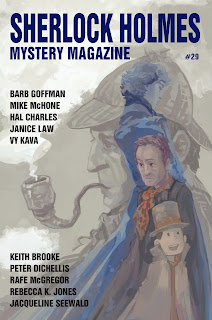
Want to read "Beauty and the Beyotch"? You can buy issue 29 of Sherlock Holmes Mystery Magazine by clicking here. It's available in ebook form and trade paperback.
The magazine is now edited by Carla Kaessinger Coupe, following the death last year of longtime editor Marvin Kaye. This issue also has a story by fellow SleuthSayer Janice Law as well as stories by Keith Brooke, Peter DiChellis, Hal Charles, Rebecca K. Jones, V.P. Kava, Rafe McGregor, Mike McHone, and Jacqueline Seewald; a reprint by Sir Arthur Conan Doyle; and features by Martha Hudson, Kim Newman, and Darrell Schweitzer.
Subscribe to:
Posts (Atom)