Showing posts with label Basil Rathbone. Show all posts

11 May 2026

Sherlock Holmes Actors


Recently I have been thinking about immortality, not the human and aspirational kind, typified by one of our billionaires who apparently wants to sleep his way to eternity, but the curious immortality of certain literary creations. What mysterious secret ingredients has kept folks like Oedipus and Antigone, David and his rival Goliath, Medea, and Orpheus, and the notables of the Hindu epics evergreen and ever present?

New Young Holmes series

Sure, a strong connection to an historic religion is a big help, but not essential, considering the continuing presence of our genre's Sherlock Holmes. Not content with retelling his adventures in every medium except dance and opera, we have retired him, married him, gifted him with a daughter and saddled him with multiple bee hives.

He's been treated for addiction – by Sigmund Freud, no less; brought into the 21st century with Sherlock, and just recently restored to callow youth by Young Sherlock, wherein he works as domestic help in Oxford, crashes parties with a louche undergrad named Moriarty, and gets acquainted with a Chinese princess who is a master of both armed and unarmed combat.

Is anything new possible? Well, yes. In The Final Problem, Arturo Perez-Reverte has come up with an angle that I confess I exploited nearly a decade ago: a mystery employing not the great man himself, but one of his impersonating actors. Together, The Final Problem and my own Holmes Impersonator stories provide two more ways to exploit the great detective.

I did not have ambitions to enlarge Sherlock's already expansive realm when I ventured into Holmes territory. I had hopes of breaking into a lucrative weekly supermarket tabloid, and I had come up with what I thought was a clever plot. In the service of this idea, I needed a detective and for reasons unknown, the Holmes Impersonator arrived.

A journeyman actor, employed by regional theaters and the dinner circuit with occasional voice- over or advertising work, my detective makes some extra cash with a regular gig at The Sherlock Holmes Museum, a small private Connecticut outfit with a slim budget and a constant need for donors. I thought he was ideal; the tabloid editors thought differently.

But the Impersonator was resilient. He found a home at Sherlock Holmes Mystery Magazine where he proved to be a clever guy, a useful narrator for six outings, and surprisingly observant. His flaw is his appearance. As child visitors to The Sherlock Holmes Museum invariably observe, he doesn't look like Sherlock. Indeed, tapped for a PBS revival of Sherlock Holmes, the famous play that made star William Gillette rich enough to build Connecticut's one and only castle, he gets cast as Watson.

The Profile

No such troubles for Perez- Reverte's Basil Osmond, who has the hawk nose and elegant physique of the famous Sidney Paget illustrations. Basil has instant credibility, because he not only looks the part but has played it in over a dozen immensely popular films.

Clearly based on Basil Rathbone, the famous 20th century Sherlock, Perez- Reverte's detective comes with an encyclopedic knowledge of Conan Doyle stories, an almost instant recall of Holmes' famous lines, and the savoir faire of having temporarily been rich and famous and on intimate terms with both London's West End and Hollywood royalty.

Such a character clearly deserves a mystery, and The Final Problem soon sets one for him. Basil has been sailing with a producer who may cast him in an upcoming television series. A storm strands them on a Greek island, one conveniently equipped with a luxury hotel inhabited by other temporarily stranded visitors.

Long time mystery fans will recognize that this setup is far from the atmospheric fogs of Baker Street. We are, in fact, in Agatha Christie territory with nine visitors, the hotel proprietor and three in staff, and very soon we have a corpse, a lot of questions, and no way to get help from the police.

Granted the authority to conduct an investigation, Basil, at first reluctantly and then with considerable flair and enthusiasm, sets to work, assisted by a fawning Spanish mystery writer and fellow Holmes buff.

The plotting, more clever than plausible, gives Basil scope, even if the somewhat awkward epilogue makes clear why Agatha Christie favored dramatic revelations before the assembled suspects.

So, here are our two alternative performers. The low- budget Holmes Impersonator, modest but effective in the compass of short fiction and a small locale, and a famous Sherlock in a luxury setting and the Christie- type plot suitable for a full length novel. Are there room for more such characters? I suspect so.

And what of the secret ingredient, the source of such characters' longevity? I am still far from a solution, but part must be the presence of what the great Scottish philosopher David Hume declared essential to knowledge: a clear and distinct idea.

Sherlock provides that in spades: the pithy phrases, the investigative dictums, and, of course, the instantly identifiable costume. Put a dog or a cat in a deer stalker and an Ulster, hand them a meerschaum pipe and either is instantly recognizable as a detective of this very special type. With a brand like this, no wonder other writers are tempted to enlist him in their literary ventures.

14 May 2013

The Double Dippers


I've always been as big a fan of old movies as I am of detective fiction, as anyone who's read my Scott Elliott series knows. In fact, I first discovered many literary detectives through movies and only later headed to the library to find their books. I was almost always blown away by the source material, but I never lost my fondness for the films.
Somewhere along the line, I spotted the odd fact that is the topic of this column and that I'm offering, free of charge, to anyone stuck for a doctoral dissertation subject. It is that an actor who played one famous detective from popular literature back in Hollywood's golden age often played a second.

Mr. Bogart
The most famous example is Humphrey Bogart, who played both Dashiell Hammett's Sam Spade and Raymond Chandler's Philip Marlowe. The success of Bogart's 1941 The Maltese Falcon certainly inspired his 1946 The Big Sleep. In the trailer for the latter, Bogart enters a bookshop and asks for something similar to the Hammett book. The helpful clerk hands him the Chandler. But Bogart by no means repeated his Spade performance when playing Marlowe. Where he was sardonic and cocky in the first film, he was stalwart and self-deprecating in the second. (Although, you might argue that this was just the way Bogart's screen persona had evolved.)

Mr. Powell
William Powell was a much bigger star than Bogart in the 1930s, though he's not as well- known today. When he is remembered, it is most often as Nick Charles (another Hammett creation) or at least as the man who's always standing next to Nora Charles, as played by Myrna Loy. But Charles was Powell's second detective persona. The first was S.S. Van Dine's Philo Vance. Powell first played Vance in the silent-turned-talkie The Canary Murder Case in 1929 and then in three more films. The best is the last, The Kennel Murder Case, released in 1933, only a year before The Thin Man. Powell's Philo Vance, a well-dressed and serious clubman (often in gloves), would never be mistaken for his brilliantly freewheeling Nick Charles. But the Vance role was probably more important to Powell's career, as it lifted him out of the ranks of silent-screen supporting players and made him a talkie star.
Mr. Rathbone

In the middle of Powell's run as Philo Vance, a rival studio brought out Van Dine's The Bishop Murder Case, starring Basil Rathbone as Vance. Rathbone, as well turned out sartorially as Powell, was much stiffer in the part. He would only find career-changing success as a film detective nine years later, in 1939, when he was given the role he'd been born to play, Sherlock Holmes, in The Hound of the Baskervilles. More on that epic performance at some later time.

Mr. Cortez
Ricardo Cortez is pretty much forgotten outside of film buff circles, but he was the screen's first Sam Spade. His Maltese Falcon was released in 1931, ten years before Bogart's, and, for an early talking picture, it wasn't bad. Cortez was especially good. He was an actor who smiled and laughed a lot, and his Spade was even better-humored than Bogie's. (If you're thinking that Cortez's performance was also a blow for Hispanic actors everywhere, don't let his stage name fool you. He acquired it when he arrived in Hollywood in the 1920s, during the scramble to find another Rudolph Valentino. Up until then, Cortez had been a New Yorker named Jacob Krantz.) Cortez played a second famous detective in 1936's The Case of the Black Cat, taking over the role of Erle Stanley Gardner's Perry Mason, which had previously been played by Warren Williams. Cortez's Mason smiled a lot and acted like he'd actually cracked a law book or two.

Mr. Montgomery
There are further examples, like the aforementioned Warren Williams, who, in addition to playing Perry Mason, was yet a third Philo Vance, and George Sanders, who was both Leslie Charteris' Saint and Michael Arlen's Falcon (and good luck telling them apart), but I'd like to close with Robert Montgomery. When I was growing up, Montgomery was already fading from popular memory, being mostly known as the father of Bewitch's Elizabeth Montgomery. But old film lovers remember him as the star of classics like Here Comes Mr. Jordan and They Were Expendable. Montgomery also played two very famous literary detectives. He was another Philip Marlowe, in 1946's flawed but interesting Lady in the Lake. And earlier, in 1940, Montgomery had starred as Dorothy L. Sayers' Lord Peter Wimsey in Busman's Honeymoon. In both films, Montgomery was more or less miscast, but you have to admire the versatility of an actor who can play both Marlowe and Wimsey with even qualified success.

What does all this double dipping mean? What does it say about the film business or the actors named or the popular fictional detectives of the day? It's your doctoral dissertation; you work it out. And don't forget to send me a copy.

20 December 2012

We're No Angels


"I'll say one thing for prison:  you meet a better class of people." 
               Joseph (Humphrey Bogart) in "We're No Angels", 1955.

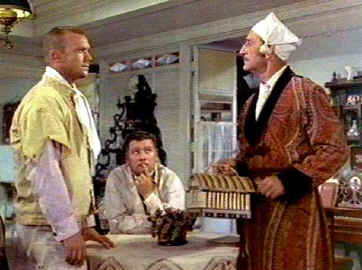
Aldo Ray, Bogart, Peter Ustinov
Okay, so that's only true (with some exceptions) in movies.  But I'd cheerfully spend all day with these guys. I first met them when I was ten years old, back in the 60's, watching the 1955 Christmas Classic, "We're No Angels," a black and white TV set, all by myself.  I laughed until I cried, and I remembered lines from it for years afterwards.  It warped me for life.

"I read someplace that when a lady faints, you should loosen her clothing."  - Albert

Three convicts escape from the prison on Devil's Island on Christmas Eve.  There's Humphrey Bogart as Joseph, a maniac and master forger, Peter Ustinov as Jules, an expert safe-cracker, in prison only because of a "slight difference of opinion with my wife", and Aldo Ray as Albert, "a swine" of a heart breaker who only fell afoul of the law after asking his uncle for money (the illegal part was when said uncle said "no" and Albert beat him to death with a poker - 29 times).  Oh, and their fellow-traveler, Adolphe - or is it Adolf?

                       "We came here to rob them and that's what we're gonna do - beat their heads in, gouge their eyes out, slash their throats. Soon as we wash the dishes." - Joseph

Anyway, these 3 convicts need money, clothing, passports - and they find it all at Ducotel's General Store, the famous Ducotel's, "the one who gives credit".  Along with Felix (Leo G. Carroll), the most inept, innocent, and financially challenged manager in history, his beautiful wife, Amelie (played by Joan Bennett), and their daughter Isobel (Gloria Talbott, in full super virgin mode). 

"You really like us, don't you?"  - Amelie (before Sally Field)

You can see where this is going:  they get hired, they get interested, they get all warm fuzzy, they change their ways, everyone is happy.  Right?  Well, not quite.  Because the big fat plum in this pudding is Basil Rathbone as Andre Trochard, who owns Ducotel's, and has come to Devil's Island - with his sycophantic nephew Paul - to do the books on Christmas Day.  I love a good villain, and Basil Rathbone is as snooty, snotty, sneering, vindictive, scheming, insulting, arrogant, belittling, and generally nasty as they come.  ("Your opinion of me has no cash value."  - Andre Trochard.)  He makes Ebenezer Scrooge look like a warm pussy cat.


Andre Trochard - "Twenty years in solitary - how's that for a Christmas present?"
Jules - "That's a lovely Christmas present.  But how are you going to wrap it up?"

There's no Ghosts of Christmas Past, Present, or Future in this one; no "God bless us, every one"; no Tiny Tim; but there's theft and forgery, fraud and deceit, murder and mayhem, all done with sharp, hilarious dialog.  Go.  Rent it now.  Pour a Chateau Yquem (you'll understand later) or its equivalent, pull out a turkey leg, and enjoy!  Merry Christmas!  Compliments of the Season!

NOTE:  This was Joan Bennett's last role for Paramount for a very long time:  she was in the middle of a huge scandal when her husband, the Paramount film producer Walter Wanger, shot and almost killed her agent, Jennings Lang, in front of her in the MCA parking lot.  "I shot him because I thought he was breaking up my home," Wanger said.  Ms. Bennett said Wanger was wrong, that Wanger was in financial trouble, that Wanger was on the verge of a nervous breakdown, but there would be no divorce. (!)  Wanger got 4 months at the County Honor Farm and went back to producing movies.  (Now that's Hollywood, folks.)  Bennett got blacklisted.  Until, O happy day! Dark Shadows hired her as matriarch Elizabeth Stoddard and she got to play with vampires instead of agents and producers.  As always, life is stranger than fiction.  If only she had had an Adolphe...  or is it Adolf?

SECOND NOTE:  This movie has a ton of great lines, but I have to admit my 2nd favorite Christmas movie has my favorite line of all time - the movie is the 1942 version of "The Man Who Came to Dinner", and it's Beverly Carlton (a thinly veiled Noel Coward) commenting on his former costar Larraine Sheldon (a thinly veiled Gertrude Lawrence):
"They do say she set fire to her mother, but I don't believe it."  
I laugh my head off every time...