Showing posts with label Patricia Highsmith. Show all posts

22 August 2026

The Human Condition


This month, I'm pleased to welcome one of my fellow Mesdames of Mayhem, Hope Thompson, to this blog.  I was particularly intrigued by the topic today, The Human Condition.  You'll see how this post complements my post for next month, How Important is Plot? 

Take it away, Hope!

The Human Condition

by Hope Thompson 

Do you ever read books and immediately forget the plot? As the weeks and months and years pass after reading a crime or mystery novel, I often cannot recall all or even any of the twists and turns of a particular story.  But something that always stays with me are character details - qualities as in British author Ruth Rendell's famous Wexford series set in the fictional Sussex town of Kingsmarkham.  In these books, her protagonist, Detective Reginald Wexford was deeply troubled by one fact: he loved one of his daughters more than the other.  Why did this exquisitely sorrowful detail stick with me?  Through her detective's painful admission, the author reveals a precious detail of the imperfectness of love.  In a story about death, she makes us think about life.

In the fifth book of the American author Patricia Highsmith's wonderful Ripley series, Ripley Under Water, readers find its dubious hero, Tom Ripley, living a luxurious life with his wife, Heloise, in the French countryside.  However, when a peculiar American couple show up and rent a nearby house and appear to be in pursuit of Ripley, he lies to his wife about the threat.  He is a master of the lie.  And his wife seems to know that he's lying but chooses not to question him.  While she seems to suspect something about the strange couple, in particular, and about Tom's dark deeds, in general, she says nothing.  Her stability is worth more to her than the truth.  Like Reginald Wexford, this secondary character stays with me.  In this finely drawn portrait, Highsmith holds up a mirror to all of us.  In how many ways do we turn away and choose not to see and to know, to preserve the peace and stability of our own lives?

In his treatise on suspense writing, the great noir master, Raymond Chandler wrote that, "...the detective story, even in its most conventional form, is difficult to write well.  Good specimens of the art are much rarer than good serious novels.  Second-rate items outlast most of the high-velocity fiction, and a great many that should never have been born simply refuse to die at all.  They are as durable as the statues in public parks and just about as dull." 

I agree with Chandler.  Writing crime fiction is difficult to do well.  For me, the best stories start and end with characters whose thoughts, words and actions pull back the curtain and give readers a glimpse into the frailty and complexity of the human condition.


Hope Thompson’s debut noir short story collection is Dark Thoughts & Other Stories, and is available on AMAZON

https://hopethompson.net/ 

12 February 2015

Write What You Know


"Write what you know!"  That old cliche gets trotted out regularly.  Now usually it's meant as an encouragement, but it's also used to set up (and even justify) limitations. I've had people seriously ask how I could teach World History without having visited every country in the world.  I've talked to writers who seriously said that they couldn't write about a ski bum or a serial killer or a heartbroken mother of a dying child because they'd never experienced that.

My response to the first is, "Does a medieval historian have to go to the Middle Ages?"  [Perennial note to self:  get a Tardis.  NOW.]

And my response to the second is, Emily Bronte, Emily Dickinson, and Flannery O'Connor.

Or Terence:

"I am a human being, I consider nothing that is human alien to me."
                        --Terence, The Self-Tormenter (163 BCE)

Or Walt Whitman:

"I am large; I contain multitudes."
                       --Walt Whitman, Song of Myself (1892 CE)

We are (almost) all born with the same emotional equipment.  Love, jealousy, envy, happiness, sadness, depression, joy, verve, hatred, need, greed, etc.  You want to know how someone else feels?  Pay attention.  To them and yourself.  Look inside and amplify (or de-amplify) as necessary. Everything that happens starts inside the human heart and mind.  If we're lucky, not all of it gets out, except in fiction.
NOTE:  "Just because it leaps into your head doesn't mean you have to DO it," is an observation I keep trying to share with my friends at the pen.  One of the main differences between (most) writers and (most) criminals is that writers have the ability to delay gratification.  (Per word, per piece, perhaps....) 
But seriously, think about writers:  Besides absolute loners like the Brontes and Emily Dickinson, there are many others who wrote amazingly atypical stuff.  In real life, Conan Doyle had far more in common with Dr. Watson than Mr. Holmes.  By all accounts Margaret Mitchell was neither a bitch nor lived during the Civil War.  Elizabeth George is neither a viscount nor a working class frump, and she's never lived in England.  Patricia Highsmith never actually killed anybody, although I understand that some people wanted to kill her.  Ray Bradbury never drove a car.  Rex Stout was happily married (at least the 2nd time), and fairly thin.  Our own Janice Law has never been a male gay artist of extremely unconventional genius with a liking for rough trade.  (That or she has the most fantastic disguise in history.)  It's called imagination.  And observation.  And mulling things over.  And wondering...  That's why we write.

Look, there's nothing new under the sun.  Humans are humans (including Neanderthals).  Everyone on Jerry Springer could be any of us, given the wrong circumstances and a complete lack of self-control in public.  There are really no new plots, which is a godsend to those of us who scramble to figure out not whodunnit but how the heck they did it.  My story "Sophistication" used a 4,000 year old plot device and I'm damned proud of it.  And if the news is quiet, and you just can't think of a reason why someone would commit a violent act, consider Steven Pinker's breakdown of the Five Inner Demons from his book, "The Better Angels of Our Nature":
  • Practical violence (means to an end)
  • Dominance violence (the quest for authority, prestige, power, glory, etc.)
  • Revenge 
  • Sadism 
  • Ideology 
There's a list to haunt your dreams.

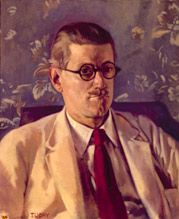
James Joyce,
painted by Patrick Tuohy
in Paris, 1924
So we have all the emotions, we can crib the plots, what do we really need?  Education.  Facts.  And here's where we are the luckiest generation in history.  You can research almost ANYTHING on the internet.  I don't have to be James Joyce, sitting in Paris, writing frantic letters back home to Dublin, trying to nail down details of Dublin, June 16, 1904.  (Although there's worse things to be, that's for sure.  I wouldn't want his failing eyesight, but otherwise...)  I can find out almost anything I want to know about guns, poisons, crime, statistics, spyware, malware, anything-ware online.  I can read old diaries, old letters, old cuneiform, and go to an infinity of historical websites dedicated to Life In ___ (fill in the blank).  It's out there. And I have done it:  I am proud to say that my most recent sale to AHMM (thank you, Linda Landrigan!) is "Miss West's First Case", set in a tuberculosis sanatorium in post-WW2 Vienna, and I did ALL the research either on-line or amongst my books.  

Write what you know?  Honey, we can know anything we want.  We just have to put it together. Excuse me, I have to get writing!


02 April 2013

My Non-series Series


I'm going to follow the recent example of my blogging mentor Robert Lopresti and use the publication of a short story as a jumping-off point for a column. The June 2013 issue of Alfred Hitchcock Mystery Magazine, which, in direct defiance of the calendar, is now available, leads off with my story "The Mayan Rite." It's the latest in my short-story series that isn't a series. That is, it's only a series from my perspective, from the inside looking out.

The Alfred Hitchcock stories, five of which have appeared so far, share no characters or settings. But the stories do have a few things in common besides my credit under the title. Those common features come from the challenge I set myself when I began writing them, which was to try something new.

I'd published short tales before my first Hitchcock appearance, but they were almost all related to my two book series, the Owen Keane metaphysical detective books and the Scott Elliott Hollywood private eye books. It was fun to write about those two characters in a shorter form, but it was also a very comfortable and familiar exercise. For Alfred Hitchcock, I decided to move a baby step or two outside of that comfort zone. So I tried female protagonists and I gave up the first-person point of view. That second change is still such a sacrifice for me that I could use it during Lent. I love first person for the detective story and have ever since discovering Raymond Chandler. There's something about a beaten-up, lone-wolf detective telling me his or her story one-on-one that I find irresistible. Not that the first-person point of view doesn't also have disadvantages, as anyone who has written a first-person whodunit at novel length can tell you. Being limited to one thread of action, the writer has to come up with a pretty convoluted plot to keep the detective and the reader guessing, another Chandler characteristic.

But then, the whodunit structure was another security blanket I opted to set aside for the Hitchcock stories. Instead, I decided to try my hand at suspense, as a nod to the man who had lent his name to the magazine. On the advice of Peter Lovesey, a writer whose advice is well worth taking, I read Patricia Highsmith's Plotting and Writing Suspense Fiction. That book's title suggests that it's a textbook, a how-to-do-it guide, but it's really a how-I-did-it reminiscence, a fascinating glimpse into one writer's writing decisions. Highsmith defined the suspense story as one "in which the possibility of violent action, even death, is close at all times." A "Sword of Damocles" story, in other words, though in a modern take, the sword may only be a paranoid imagining--in the character's head rather than suspended above it. Going with suspense was another potential Lenten sacrifice for me, as it meant giving up one of the compensations of the whodunit: its underlying theme of order restored. So, for example, in "The Mayan Rite," unease and disorder are created but not resolved. The comforting "all questions answered in the end" quality of the traditional mystery is distinctly lacking. In fact, the question of what really happened is one of the unresolved issues of the story.

I said before that my Hitchcock stories don't have a setting in common. But they do have unusual settings in common. Unusual for me, I mean. Owen Keane is a New Jersey guy, like me, and Scott Elliott works in postwar Hollywood, a place I researched and imagined until I felt comfortable there. For this new series that isn't a series, I decided to use a different setting for each story, some spot my wife and I had visited as tourists. So far, I've used Scotland, Wyoming, Cancun, and two islands: St. Simon, in Georgia, and Mackinaw, in Michigan. Setting stories in each of these places was more than a way of putting my vacation photos to work. It was a new (for me) answer to a dreaded but inevitable question: "Where do you get your ideas?"

Brian Thornton posted a great column in this space last week about setting as character. Setting can also function as muse. I decided to let each setting suggest a story to me--or at least suggest the premise of a story. St. Simon Island, where my wife and I stayed in a creaky old carriage house, suggested that I write a ghost story. Scotland prompted me to use Mary, Queen of Scots, who seems to have been a resident or guest at every old pile of stones we visited. Mackinaw Island boasted of its connection to a crazy, not-quite-old movie called Somewhere in Time, and I can never resist a movie tie-in. Jackson Hole, Wyoming, where one of my favorite movies, Shane, was filmed, called for a western--of sorts. I worked in a Colt .45, at least.

I found Cancun, the setting of "The Mayan Rite," to be very evocative, especially our arrival there. Our airliner did a low, leisurely approach over miles and miles of jungle. Then suddenly, right along the water's edge, was a strip of beautiful hotels and their supporting community. It seemed to cry out for a story about how thin the veneer of civilization is, not just in Mexico, of course, but everywhere, and about the danger of straying from a safe, routine life.