Showing posts with label Jean Shepherd. Show all posts

22 December 2025

The Pretty Good Shepherd


 Occasionally one of us SleuthSayers needs a day off and we have to find something to fill the slot.  Today was one of those moments.  I was looking for something to entertain you with and then I noticed today's date.  For reasons that will be clear at the end, it made me remember this piece which I wrote many years ago for Criminal Brief.  I hope you enjoy it.  - Robert Lopresti

I was a kid, see … Christmas Eve, 1964. In a house in suburban New Jersey ten-year-old me, too excited to sleep, lay in my bed, trying to find something interesting on my AM radio. Suddenly, I hit the jackpot.

A wonderful voice I have never heard before is reading a story  about a boy who wants a BB gun for Christmas. Everyone he tells about it — his mother, his teacher — responds the same. As the department store Santa puts it:

“HO HO HO! YOU’LL SHOOT YOUR EYE OUT, KID! HO HO HO! MERRY CHRISTMAS!”

It was hilarious. It was like nothing I had ever heard before.

The next night, Christmas, I went frantically down the dial trying to find the voice again. Nothing. Just Howard Cosell Speaking of Sports, and Cousin Brucie playing the Beatles. Where was the magic storyteller?

I found him a few days later. His name was Jean Shepherd and in those days he was on WOR-AM from 10:15 to 11 PM, five nights a week, talking.

Let me emphasize that: talking. This is not what we mean by talk radio today. He didn’t have guests. He didn’t take phone calls. And he didn’t play music, except as occasional background for what he was saying. The man simple talked for forty-five minutes five nights a week. Sometimes on Saturday he added a live show from a club in Greenwich Village. This went on for decades.

The first show I heard was unusual, because he was reading a printed text — his story “Duel In The Snow, Or Red Ryder Nails The Cleveland Street Kid,” which had recently been published in Playboy. More typically he did his show with a few written notes or nothing at all.

He talked about anything and everything but what people loved best were his stories about growing up in Hohman, Indiana (based on Hammond, Indiana and East Chicago, Illinois), and attempting to get an education at Warren G. Harding School. Many people are astonished to discover that Shep really did attend a school named after that bottom-of-the-barrel president. And by the way, the first five words of this column is the way his stories often began. He also told bizarre stories about his days in the Army Signal Corps during World War II (or Korea … the time period for his stories shifted over the years. He lied about his age as he did about so much else.)
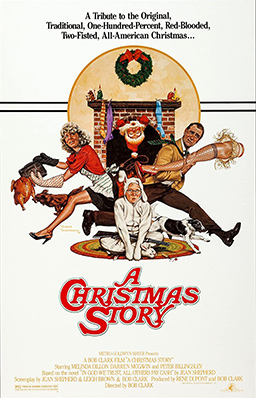

Most of you out there never heard Shep on the radio, but some are saying “that story sounds like the movie A Christmas Story.” It should. That film was based on his work (he narrates it and has a cameo). The studio had so little faith in it that it wasn’t in theaters at Christmas, but the thing is a certified classic today. And because of it, Shepherd died a rich man. Radio, the medium which gave him his best canvas, was not so kind to him, financially.

If you dig around on the web you can find recordings of Shepherd, and clips from his TV work — PBS movies, a series called Jean Shepherd’s America, etc. — but since this blog is mostly about writing, let’s talk a little about the words he put down on paper.

They sparkled. Here are a few examples:

It seems like one minute we’re all playing around back of the garage, kicking tin cans, and yelling at girls, and the next instant you find yourself doomed to exist as an office boy in the Mail Room of Life, while another ex-mewling, puking babe sends down Dicta, says “No comment” to the Press, and lives a real genuine Life on the screen of the world. —“The Endless Streetcar Ride Into The Night, And The Tinfoil Noose.”

It was the Depression, and the natives had been idle so long that they no longer even considered themselves out of work. Work had ceased to exist, so how could you be out of it? —“Duel In The Snow …”

(After the Prom we) arrived at the Red Rooster, already crowded with other candidates for adulthood. A giant neon rooster with a blue neon tail that flicked up and down in the rain set the tone for this glamorous establishment. An aura of undefined sin was always connected with the name Red Rooster. Sly winks, nudgings and adolescent cacklings about what purportedly went on at the Rooster made it the “in” spot for such a momentous revel. Its waiters were rumored really to be secret henchmen of the Mafia. But the only thing we knew for sure about the Rooster was that anybody on the far side of seven years old could procure any known drink without question. —“Wanda Hickey’s Night Of Golden Memories.”

Just as MAD Magazine was for many people of my age, Shep was the voice of sanity that got me through early adolescence. The whisper that said: You’re right! The adults ARE crazy! I owe him a lot for that.

But I owe him a hell of a lot more. One day when I was in high school a friend told me that his sister Terri  and one of her friends wanted to go see Shep perform live in Red Bank, and since the girls didn’t have licenses yet, they were asking him to drive. Would I like to go along?

Sure, I said. And the show was so good I wound up marrying  Terri. Today, December 22, is our 49th anniversary.

Thanks, Shep. You changed my life.

10 December 2015

Fables in Crime


by Robert Lopresti

I wonder if you have ever heard of George Ade?  Probably not, for most of you.

He was a nineteenth century Indiana humorist and Chicago newspaperman from Indiana.  While he wrote all kinds of stuff his longest-lasting material seems to be his Fables in Slang.  He capitalized all the slang words to show that he knew they didn't belong in proper English.

I learned about the man from the radio show of Jean shepherd, another Indiana humorist, the one whose tales led to the classic movie A Christmas Story.  The following Fable seems to have enough criminal element to belong on our blog.  Ade had a dry sense of humor and a rather grim view of "modern" society, as you will see.


THE FABLE OF THE INVETERATE JOKER

WHO REMAINED IN MONTANA


The Subject of this Fable started out in Life as a Town Cut Up. He had a keen Appreciation of Fun, and was always playing Jokes. If he wanted a few Gum-Drops he would go into the Candy Store and get them, and then ask the Man if he was willing to take Stamps. If the Man said he was, then the Boy would stamp a couple of times, which meant that the Laugh was on the Man. It was considered a Great Sell in Those Parts.

Or else he would go into a Grocery with another tricky Tad and get some Article of Value, and they would pretend to Quarrel as to which should Pay for it. One would ask the Proprietor if he cared who paid for it, and if he said he did not, they would up and tell him to Pay for it Himself. This one was so Cute that they had a little piece in the Paper about it.

Or they would go and Purchase a Watermelon to be paid for as soon as a Bet was decided, and afterwords it would Develop that the Bet was whether the Saw-Mill would fall to the East or the West, in case the Wind blew it over.

It was Common Talk that the Boy was Sharp as a Tack and Keen as Brier and a Natural-Born Humorist.

Once he sold a Calf to the Butcher, several Hours after the Calf had been struck by Lightning. As for ordering Goods and having them charged to his Father, that was one of the Slickest Things he ever did.

About the time the Joker was old enough to leave Home, he traveled out through the Country selling Bulgarian Oats to the Farmers. When the Contract for the Seed Oats got around to the Bank, it proved to be an iron-clad and double-riveted Promissory Note. The Farmer always tried to get out of Paying it, but when the Case came to Trial and the Jurors heard how the Agent palavered the Hay-Seed they had to Snicker right out in Court. They always gave Judgment for the Practical Joker, who would take them out and buy Cigars for them, and they would hit him on the Back and tell him he was a Case.

One Day the Joker had an Inspiration, and he had to tell it to a Friend, who also was something of a Wag.

MANUFACTURING SUBURB
They bought a Cat-Tail Swamp remote from Civilization and divided into Building Lots. The Marsh was Advertised as a Manufacturing Suburb, and they had side-splitting Circulars showing the Opera House, the Drill Factory, Public Library, and the Congregational Church. Lots were sold on the Installment Plan to Widows, Cash-Boys, and Shirt-Factory Girls who wanted to get Rich in from fifteen to twenty Minutes.

The Joker had a Lump of Bills in every Pocket. If asked how he made his Roll, he would start to Tell, and then he would Choke Up, he was so full of Laugh. He certainly had a Sunny Disposition.

Finally he went to the State of Montana. He believe he would have a Season of Merriment by depositing some Valuable Ore in a Deserted Mine, and then selling the Mine to Eastern Speculators. While he was Salting the Mine, pausing once in a while to Control his Mirth, a few Natives came along, and were Interested. They were a slow and uncouth Lot, with an atrophied Sense of Humor, and the Prank did not Appeal to them. They asked the Joker to Explain, and before he could make it Clear to them or consult his Attorney they had him Suspended from a Derrick. He did not Hang straight enough to suit, so they brought a Keg of Nails and tied it to his Feet, and then stood off and Shot at the Buttons on the Back of his Coat.

Moral: Don't Carry a Joke too Far, and never Carry it into Montana.