Showing posts with label bias. Show all posts

01 June 2026

A Bias Against Biases


            Given the crazy political environment we’re in, I’ve been giving a lot of thought lately to the evil bias twins: negativity bias and confirmation bias.  As with most of our psychological afflictions, these tendencies are rooted in biological evolution.  We tend to overemphasize the bad in life because it made survival more likely.  Worrying about the saber tooth tiger that almost ate us was more beneficial than spending a lot of energy admiring our cave art. 

            Confirmation bias is trickier, but it did help us stick with smart choices, like keeping our hands out of the fire, while ignoring the advice of the shaman who thought a little fire cleansing was good for general health.  On the other hand, the shaman who agreed you shouldn’t move your settlement to the valley next door as you depleted the available resources confirmed the wrong thing. 
            Of the two, I think negativity bias has hobbled more of my family members and social reference groups.  This penchant is significantly reinforced by the media, for whom negativity is mother’s milk.  A bottomless well of attention and renewed subscriptions, of clicks and likes.  I think being aware of imminent or emerging threats is wise, but wallowing in all the bad news distorts reality and undermines the ability to have a little joi amidst all the ennui.

            Historians will tell you that everyone has nearly always thought that life has degenerated, if not gone to hell in a hand basket, and that we’re all doomed.  That each successive generation has also been wealthier, healthier, less subject to horrific wars and chronic deprivation never enters into it.  That doesn’t mean every little thing has improved, or that some things in the past weren’t arguably better, or that progress doesn’t come with a fair amount of regression.  You just have to look at the declining number of free-range children, or the obesity epidemic, or the decrease in pop tunes that feature key changes, to support that view. 

            As to confirmation bias, I’m more attracted to commentators who agree with me than those who don’t.  I read the educated opposers anyway, because I think that’s good mental hygiene, and sometimes I stumble on an argument that shifts my point of view. But I have a diminishing number of years left on this planet, and I’d rather spend this precious time with convivial associations than a bunch of chuds who just make me want to assert my second amendment rights and reach for the nearest cudgel.   


            To confess my biases, I feel the mystery/thriller genre is as good, or better, than ever.  I think the form has been dramatically improved by all the women and people of various ethnicities who have come on the scene.  It reminds me of the fifties and sixties when the publishing industry (and academia, and advertising, not coincidentally) started admitting Jewish writers, who revolutionized American fiction.  

            The rising tide of diversity in mystery/thriller writing has risen all boats. 

Yet now, when it comes to what we’d generally call literary fiction, I’m just not feeling it.  I’ve tackled some of the leading fiction writers of recent times, and with the exception of Amor Towles, I’m generally disappointed.  To be more specific, it’s as if they’ve forgotten that plots matter more than obsessive introspection.  That beautiful language can transcend the mundane activities of daily living (maybe go back and review James Joyce), that there’s greater meaning to be perceived from simple human interaction than thwarted expectations. 

I’m not alone in this.  David Brooks did a whole column on the matter.  https://tinyurl.com/eypvzzx5   I don’t necessarily agree with his political thesis, but the numbers underlying the argument are availble from Neilsen. 

At the same time, maybe I’m not giving literary fiction enough of a chance; like Brooks, I’ve only been peaking into the current literary world.  Maybe I should just push through and be pleasantly surprised.  Stop letting bias creep into my prehistoric brain.  (Anyone eager to set me straight with recommendations are urged to comment.)

It could be that literary fiction has gone the way of poetry, ballet, symphonic music and opera.  Settling in as a marginal art form, yet enduring with a hard core of devotees who will keep it alive into the foreseeable future.  I hope that's true, because I want all art forms to survive and thrive, even those I'm not very partial to.  Art tends to evolve toward and away from you, in big, barely noticeable cycles.  The important thing is to keep it all alive.  
            

            Unlike Timothy Chalamet, I adore ballet. Since my mother was a ballet dancer, as is a niece I’m particularly close to, perhaps that formed a positivity bias.  I love a handful of operas, though like hip-hop, some of which I really enjoy, I don’t seek it out as a general rule.  Call it ambivalence bias.  

             As I wrote in a prior post, keeping an open mind is really difficult.  You’re constantly warring against biological determinism – not succumbing to negativity or huddling in comfort with your collection of favorites.  I remember as a younger man telling myself that I wouldn’t be like the old curmudgeons I knew at the time.  That I’d fight, fight against the dying of a flexible mind, the elasticity of a healthy consciousness.

23 May 2021

Asian Aversion


Crime writers Eve Fisher and Mary Fernando have written about bigotry and touched upon prejudice against Asians. A farmer in rural Minnesota demonstrated one way to mitigate the problem.

I lived in a state forest near Big Lake, Minnesota, one of many villages near the upper Mississippi River, all grown up now into a city. Not many eateries fed travellers along Hiway 10, and it didn’t help the main diner closed and was sold to an Asian family.

Lake in Big Lake, Minnesota
Big Lake, Minnesota © Wikipedia

In town one day, my neighbor Bud announced several of us must go to lunch at the newly reopened diner. One bigmouth said he wasn’t gonna et no Viet Congo victuals.

Bud said, “They’re Korean and it’s damn good food.”

“Don’t care. Who knows what they put in it?”

At that point I suggested, “Garlic, ginger, onion…”

Bigmouth sneered.

Neighbor Bud wasn’t a fragile flower. He said, “Way I figure it, you got a choice between stupid and hungry, or well-fed and wise. Whizzit gonna be?”

Bigmouth grudgingly came along with a group of us, grumbling the whole way.

“Order steaks,” Bud suggested.

Bigmouth stared at everything suspiciously, mumbling under his breath. When the steaks arrived, he sniffed it. He poked at it with his fork in case it wasn’t dead. To be sure, he stabbed it with a knife.

Then he took a bite. He chewed. And another bite. He stopped grumbling. He ate everything, everything on his plate.

Leaning back, he patted his stomach and said, “God-blessed-durn, that was the best steak I ever et. I wonder what they put in it?”

Bud said, “Garlic, ginger…”

Bigmouth not only became a fan of the diner, he became friends with the family.

Every town needs a Bud. And a great Oriental restaurant.


As mentioned in the opening paragraph, Big Lake is all grown up into a city, one I wouldn’t recognize nor find my way around. But a local web site demonstrates a decided hostility I can’t account for.

Searching for a picture of the town, I came across BigLake.com where, at the bottom of the home page, I found one of the weirdest legal statements ever, complete with a fat, yellow acknowledgement button:

Due to GDPR, residents of the EU are STRICTLY FORBIDDEN from using this site.
18 USC § 1030 (a)(2)(C)

Why should a burg in Minnesota care, let alone disapprove, that Europe values the privacy of its citizens? Clearly the programming muggle has no understanding of Europe’s data protection regulations or United States Criminal Code or United States Uniform Commercial Code regarding fraud. How very, very peculiar.

But if that Asian restaurant is still around, try the Steak Korean.

11 April 2013

History is Mystery


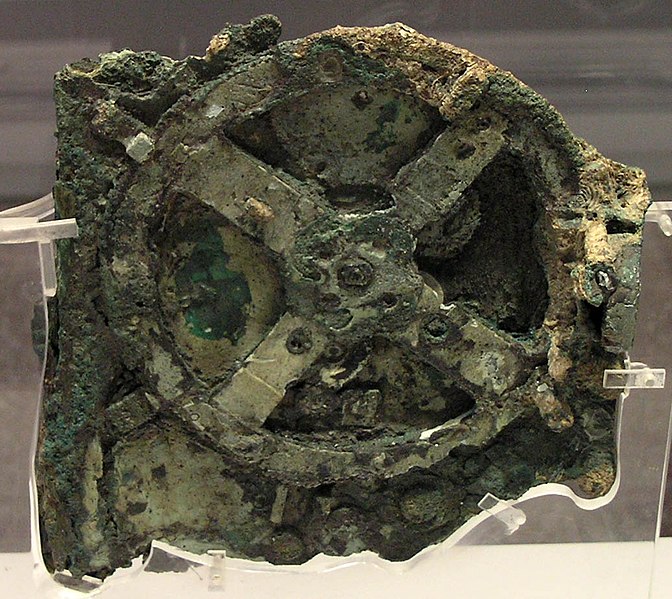
File:NAMA Machine d'Anticythère 1.jpg
Part of the mechanism in the Athens Museum
Some of you might have caught the Nova show a week ago on the Antikythera mechanism, a device from approximately 100 BCE found in 1901 in a Greek shipwreck near the island of Antikythera.  It is the world's oldest (yet found) working analog computer:

File:NAMA Machine d'Anticythère 6.jpg
Reconstruction in Athens Museum

and it generated complete astronomical information and forecasts:  sun, moon, planets, and eclipses, from now until...  whenever.  A very complex machine.  It's assumed the found object was a factory reproduction of an original designed by the great Syracusan mathematician, Archimedes.  In the process of discovering all of this information, the historians used all sorts of mystery-solving techniques - questions, x-rays, research, reconstructions, debates, etc. - to try and figure out what that super-corroded device was, what it was for, and how it was made.  Fascinating.  Catch the reruns, or rent the DVD.

And it explains why so many of us historians are also mystery fans/writers/etc.  Because history is all about solving mysteries, very cold case mysteries, with limited evidence, almost no eye-witnesses, and a whole lot of deduction.  Yes, a lot of people think that history is nothing but names and dates, but I can assure you that's the least of it - the historical equivalent of a GPS system, keeping you afloat in a vast sea of time.  But the real purpose for history is to find out how things got the way they are. History is all about solving the mystery of us. 

Of course, some things never change: human nature (curiosity, greed, anger, pride, love, lust, all the emotions and desires), and what comes of that human nature (the pursuit of power, pleasure, wealth, appetite, and occasionally peace). 


File:EmileFrontispiece.jpeg
Frontisepiece to Rousseau's "Emile"
Some things change dramatically, in a paradigm shift that makes it inconceivable (to us) that things were ever different:  our modern concepts of privacy, romance, childhood, individual rights, and personal comfort are all just that, MODERN concepts. Romantic love used to be considered a form of mental illness (read Chaucer).  What we call privacy used to be proof that you were either had no status or were in prison (who would ever be alone if they didn't have to be?).  Rousseau practically invented modern childhood in "Emile" (ironic, considering that he put each of his four children in an orphanage).  And most societies have always been willing to sacrifice individual rights for societal order, especially if it keeps the barbarians (within and without) at bay.

And some things change all the time, especially fashion and beauty, which are simply exercises in the verb "to change". 

Where does technology fit into this?  Well, I couldn't help noticing that, even on Nova, the scientists were constantly amazed at the complexity of the Antikythera Mechanism, and the ingenuity of the ancients.  And this is a classic example of one of the two great biases that historians face, within themselves and within their students/readers/society:
BIAS # 1.  Time is an arrow, leading to us, and we, right now, are living in the best of all possible worlds at the best of all possible times, and anyone in the past who didn't live the way we do, especially in terms of morality, government, technology, and religion, were stupid, not to mention just plain wrong.  A major subsection of this bias against our ancestors' intelligence is all about technology.  I cannot tell you the number of people who say, well, if the ancients were so smart, how come they didn't come up with the technology of today? The answer is to consider where and how technology was used in the ancient world:
    File:Rome Colosseum interior.jpg
  • WAR:  Greek fire; gunpowder; Archimedes and his war machines (first laser prototype; the Archimedes Claw).
  • TIMEKEEPING and ASTRONOMY:  Chinese paper and compasses, originally used for timekeeping, astronomical observations, divination, and prayers; the Antikythera Mechanism, used for timekeeping and astronomy; water clocks, mechanical clocks, etc. 
  • ENTERTAINMENT:  Look no further than the Roman Colosseum, which used a huge amount of technology of all kinds to present battles on land and sea. 
  • PUBLIC HEALTH:  Flush toilets and sanitary systems of the Indus Valley (Harappa, 26th c. BCE), Knossos (18th c. BCE) and other ancient civilizations; public baths (Indus Valley, Greece, Rome,Ottomans, Japanese).
        Sounds pretty modern to me...
    • NOTE:  I'm well aware that time only moves in one direction (at least in this brane), but it's far more like a tree, with multiple branches and twigs and stems and leaves, than an arrow. There have been societies and civilizations that have vanished completely off of the face of the earth. There are echoes everywhere of things and people that were, but left no trace. And even if they leave a trace, no explanation. Not everything connects. History is full of red herrings. 
The other major bias is the exact opposite:  

    File:Leonidas I of Sparta.jpg
BIAS # 2.  We are a degenerate and weakened species, and things used to be much better, back in... well, the Greeks believed in a Golden Age before their own Age of Iron; the Hindus for millenia have believed we are in Kali Yuga, the age of the demon; and today a surprising number of people like to tell me how much better things were in the 1950's (and I suppose they were, if you weren't a woman, gay, black, or other minority).
    • NOTE:  Just to show how dangerous this bias can be, a classic work of nostalgia history is Plutarch's (ca. 46-120 CE) "On Sparta", in which that violent, anti-education military slave state is presented as the ideal civilization, strong, brave, and free from the corruptions of commerce and money.  Obviously, Plutarch had an axe to grind.  But very few people even think about that.  Because he himself is an "ancient writer" a lot of people swallow everything he wrote as if it were absolute truth, not paying attention to the fact that he wrote almost 500 YEARS AFTER SPARTA'S DEMISE.  That's the kind of thing you have to look out for.  And part of the reason yes, you do have to know your dates... 
My general analysis of bias holders is that the first is primarily held by the young and/or successful; the second is primarily held by older people and/or those who feel throttled by present-day culture (whatever the present day is).  My other great observation is that either bias gives you a perfectly logical reason to ignore the past.  They both imply that we can learn nothing from the past, either because we are absolutely superior or infinitely inferior.  Either way, we are on our own.  Me?  I know that everyone who ever lived were just as human as I, and the basic lesson of the past is that, until human nature changes as completely as fashion or song stylings, history is going to continue to be the same damn thing over and over again.  We'd better start paying attention.