by Eve Fisher
Whenever people wax nostalgic around me - always a big mistake - I bring up premodern dentistry, medicine, plumbing, pest control, and law enforcement. Let's not tackle the horrors of the first four, but stick to law and order. There wasn't a lot of it. For one thing, of course, there weren't any police
per se, before our own Gabriel Nicolas de la Reynie became the first Lieutenant General of Police in Paris in 1667. (The London bobbies were established in 1829.) This didn't mean that there was a whole police force in Paris: there were some "police chiefs", constables, archers, and men of the watch, but the main staff was an intricate web of informers who would cheerfully tell anything they heard for money.
 |
| M. de la Reynie |
God help you if the informers turned you in. As I mentioned in the last blog post, standard investigative practice until at least the 19th century was to question prisoners under torture. (In ancient Rome, a slave's testimony was admissible only if it had been extracted by torture, because it was believed that they wouldn't tell the truth otherwise.) The only exceptions were if you were a member of the nobility or the royal family, in which case... maybe not. The other exception was England, which abolished the use of torture in 1640, except for the use of "peine forte et dure", i.e., pressing, for those who refused to answer guilty or not guilty in an attempt to hang on to their estate for their kids. (They used this during the Salem witch trials.)
Anyway, back in Renaissance and Enlightenment France (say, the 1500 through very late 1700's), most judicial proceedings were presided over by either your seigneur (lord) if you were a peasant, or a judge/panel of judges (if it was a question of a felony), or a chambre ardent (if you were suspected of witchcraft), or the King, if you were sufficiently noble. Punishments varied:
 |
| The Bastille |
- Banishment, exile, monasteries/convents for the wealthy and the nobility. (It helped if you could flee the country - like Olympe de Soissons - before they came after you.)
- Imprisonment in the Bastille or another old castle with damp, insufficiently lit cellars for the wealthy or too offending nobility (just a reminder: a noble family could ask the king for a lettre de cachet, which would imprison the recalcitrant relative for life). Also, the occasional political prisoner - Voltaire was sent to the Bastille three times, twice for his incendiary writings and the last time because he challenged the Chevalier de Rohan to a duel. Voltaire was a peasant, Rohan was a nobleman, a lettre de cachet was given, and I for one am amazed that he ever got out.
- Burning for witches.
- Flogging, branding, more torture and/or hanging for the lower classes.
- The galleys (for all classes).
Numbers 3 and 4 were done publicly, and drew big crowds because they were considered entertainment. A certain Dr. Patin wrote to the father of his pupil that the boy had been doing so well that tomorrow he was taking him - as a treat - to see a man broken on the wheel. (W. H. Lewis,
The Splendid Century, p. 175) And let us never forget Casanova's account of watching two people having sex while they watched the four hour execution by torture of Damiens, would-be assassin of Louis XV.
And then there were the galleys. Today there is a growing issue with privatized prisons (I hope), in which prisons are run for profit and the prisoners are turned into slave labor ($0.25/hour is the norm; $3.25/hour is considered good wages), which could lead to the question: are people being arrested and convicted because they are really guilty, or because the prison needs to be full? (After all, standard private prison contracts require a certain level of occupancy, no matter what the actual crime rate is, so even if crime goes down, people still need to be arrested...) Back in the 16th, 17th and 18th centuries, the question was whether people were condemned to the galleys because they were guilty or because more oarsmen were needed to man the fighting ships of the Mediterranean. Louis XIV ordered the courts to sentence men to the galleys as often as possible, and, instead of the death penalty, send them to the galleys for life. And so it was done.
 |
| The Reale - a galley ship of Louis XIV |
As you can see from above, galleys were open boats, that could use sail or oar for the best maneuverability possible. The reason that they were manned exclusively by convicts was because they'd tried using paid free men in the 14th century, but the paid workers just couldn't get up the speed and endurance. It took constant application of the whip - and other tortures - to get the men rowing for their lives. (By the way the Ottoman Turks and the Barbary pirates both used galley slaves, usually captured Europeans.)
The galley slaves -
galériens - were made up of Turks (who really WERE slaves, bought by the French government from the Barbary pirates and other sources), military deserters, salt smugglers, plain criminals (including nobility - the Chevalier de Margaillet, for example, was sent there for raping his niece, who by the way, must have had connections of her own to get a conviction), and Huguenots (i.e., Protestants, which was illegal in 17th and 18th century France).

Galley slaves had nothing. They were branded GAL for
galérien. Their heads were shaved for lice, and they were given only canvas drawers and a red hat. They lived in the open because there was literally nowhere else for them to go. They lived on biscuit and bean soup - and, being France, when they were at sea were given a cup and a half of wine day. They slept and ate and defecated where they sat (although I suppose if they were the oarsman closest to the side of the boat, they went over the side). They never washed. Five men chained to an 18-foot oar, pulling it with all their might - for life. A Huguenot
galérien said that "One would not think it was possible to keep it up for half an hour, and yet [thanks to the whip] I have rowed full out for twenty-four hours without pausing for a single moment." (Lewis, p. 220) Such appalling labor only happened during a heated battle - and during a battle anyone who died, or even fainted, was cut loose and flung overboard.
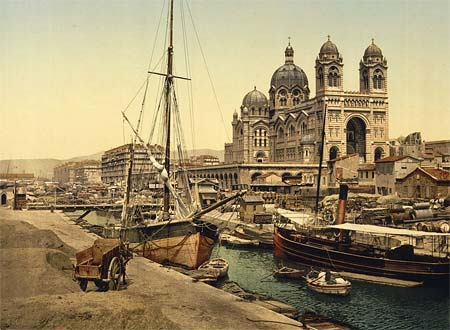 |
| 19th century Marseille |
In between battles, things weren't so bad. In Marseilles or other ports, they got better food, fresh from town. And in the autumn and winter, when there were no battles, while the galley slaves remained on the boat, life was better. The officers were billeted ashore, so the slaves had room to spread out. They were
required to practice a trade during the winter months - anything and everything from music to repairing clocks to (for the absolute incompetents) knitting stockings. (In other words, they had to pay for their own incarceration during the winter.) And each galley was allowed one week ashore in rotation, when they could wander the port town with their skills and goods, selling, and stealing everything in sight. Which they got away with. Because here's the one advantage of being a
galérien: once sentenced, since it was (usually) for life, the French judicial system washed its hands of you. You could do anything, and you would not be tried again. Granted, your captain could flog you, mutilate you, kill you - but the courts could and would do nothing more. No wonder Marseilles had a reputation for being rough: port life during the centuries of
galériens was incredibly dangerous for civilians. The galleys finally came to an end in the mid-1700's, but the term
galérien remained the standard term for a prisoner until well after the French Revolution. (For one thing, after the end of the galleys as a fighting part of the French navy, convicts were still kept in chains on galleys moored in the harbor of Toulon and other port cities.)
The wheel and the stake, beheadings and burnings were all much more public, but the the two secret hells, the fates worse than death, were the lettre de cachet and sentencing to the galleys. Either way, you got to live - for a while - but probably spent that life wondering why. Some great literature has been written around hell, though, and its aftermath: "The Count of Monte Cristo", "Les Miserables", "A Tale of Two Cities", all tales of escape, all tales of new life - but the Count, Jean Valjean, Dr. Manette are all marked, changed forever. But perhaps the book closest to the spirit of the galleys and the dungeons is Alexandr Solzhenitsyn's "One Day in the Life of Ivan Denisovich" - where one sentence only leads to another, and when he counts the days of his sentence, he has to add extras for the leap years...


